

Why should a traditional print shop move into the high-barrier pharmaceutical packaging market?
Commercial print margins have been eaten alive by digitization, so breaking into high-barrier pharmaceutical packaging builds real switching costs, a moat that locks in long-term, high-margin orders
From what I've seen on the line and at the customer end for years, print shops grinding through ordinary books and magazines have had their profit space squeezed to a pulp. France's century-old Aubin watched revenue fall because it moved too slowly, a brutal wake-up call about the structural disease in commercial print. Bulgaria's oldest printer Dunav Press, though, took a completely different path
Founded in 1864, Dunav Press was reshaped in 2010 under general manager Nikolay Alexiev, who swung the entire business into pharmaceutical packaging. Today the company turns out 800 million pharma folding cartons a year, most of them shipped to Europe's medical heavyweights, Germany, Italy, Switzerland, Romania
Pharma folding cartons are precision-engineered boxes designed specifically for drug packaging: tight dimensional stability, exact anti-counterfeit features, braille embossing, and strict adherence to international pharma packaging standards that keep the product sealed and compliant through transit and storage
The secret to walking away from cheap-and-easy is dead simple: stop being a generalist that prints everything, pick one niche with brutal standards and brands that can't live without you. That's it

How should brand packaging buyers evaluate a printer's long-term supply capability?
When brands vet print partners, they should weigh equipment stability, zero-defect quality control, and the long-term trust commitment both sides are willing to make
Dunav Press's experience shows equipment selection isn't just about comparing machine hardware, it's a statement of business strategy. Dunav Press recently brought in high-end Komori presses from Japan, and the core reasoning was low makeready waste and competitive total cost of ownership
Honestly, plenty of brand buyers stare at tiny per-sheet price gaps on a quote sheet and completely miss the material waste and delivery risk caused by a printer's makeready losses. That kind of short-term thinking tends to cost the brand many times over when the production line snaps
When auditing and selecting printers, brand owners can bring in the Mai Strategy Knowledge Academy consulting team to run the "Mai Strategy Three-Gate Print Audit" for a deep evaluation:
・Waste Control Gate: makeready sheet count, can the press cut waste to near-zero and hit ISO 12647 color specs; material scrap rate, can automated color matching shorten time to first approved sample
・Quality Defense Gate: full inline inspection, is the line equipped with full inline inspection across the board; defect interception, can the machine catch 100% of print defects and barcode errors while running
・Total Cost Gate: equipment carrying cost, are machine depreciation and consumables reasonable; delivery stability, is line maintenance solid enough to handle seasonal volume spikes
How Can Commercial Printers Lock in Major European Brand Accounts Through Energy Transition and ESG?
By building their own renewables and cutting the carbon footprint, print shops can directly meet international brands' strict Scope 3 decarbonization demands on the supply chain
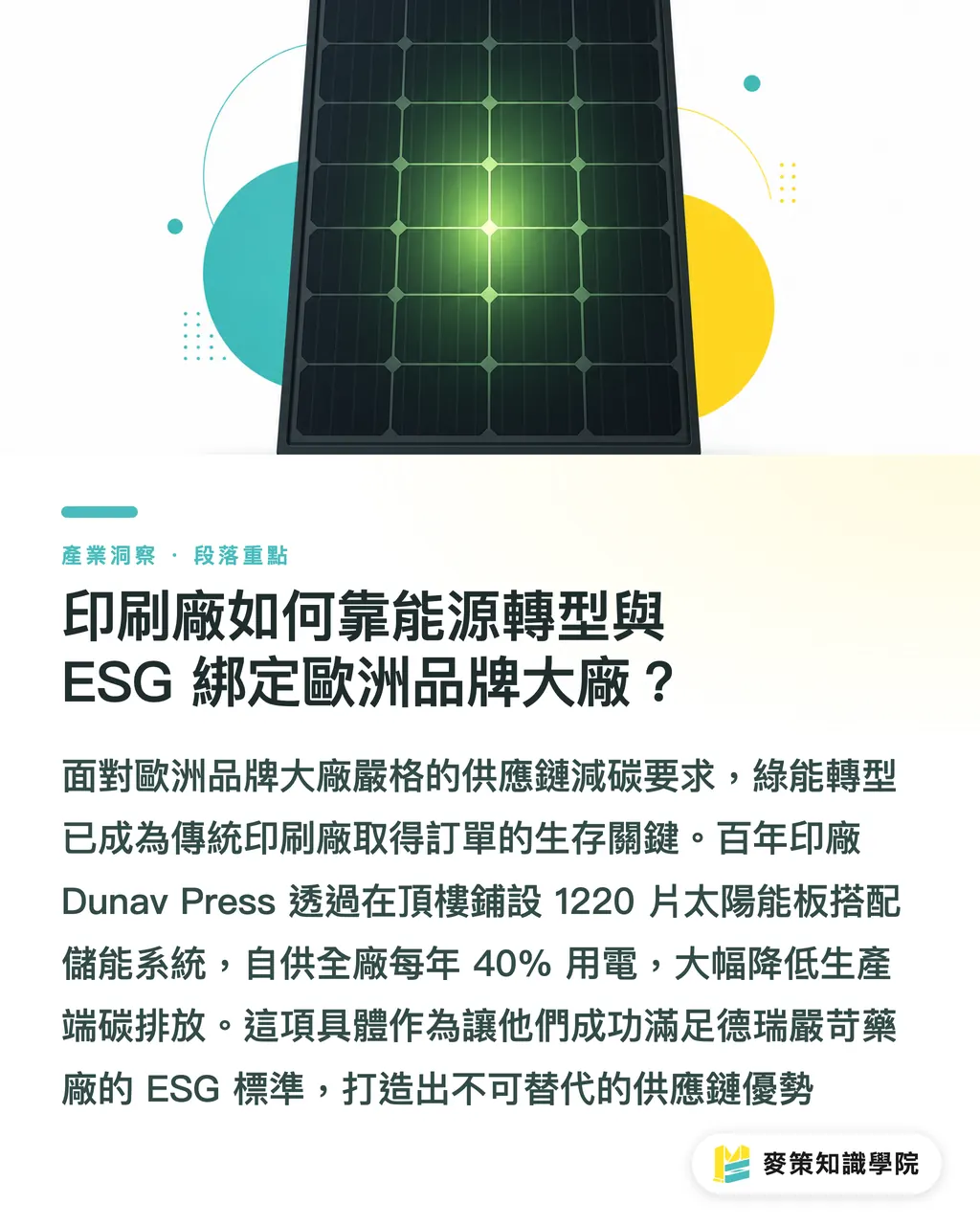
European majors are running a hard-hitting wave of M&A and supply chain reshuffling. Printers that don't meet sustainability standards can get kicked off the vendor list overnight. Dunav Press figured out early that green energy is the entry ticket to brand orders, not a marketing stunt
Dunav Press put 1,220 solar panels across the factory rooftop, paired with a 500 kW battery storage system. The setup covers 40% of the plant's total annual electricity
Combined with the paper savings from Komori's drastically lower makeready waste, the century-old printer has pushed production-side scrap and carbon emissions to record lows. That's what gives them a non-replaceable edge when facing German and Swiss pharma customers who are ruthlessly demanding on ESG compliance
What should Taiwanese brands and mid-sized print shops actually do?
Taiwanese companies should borrow from the European playbook, stop chasing blind expansion, invest for the long haul in high-value packaging, and build genuine buy-in from the team inside
The European print sector's consolidation storm isn't distant news for Taiwan. Whether you're a brand packaging buyer or a print shop owner, you have to rethink what your product mix and customer relationships really mean
At Dunav Press's 162nd-anniversary Open House, they invited nearly 180 brand customers and partners from across Europe, let employees bring their families onto the production floor, and put a 50-plus-year veteran on stage for recognition. GM Alexiev proved with action that the foundation of premium packaging is people and trust
For Taiwanese brands looking to level up product packaging feel and lock in a reliable local supply chain, the right move is to work with a team like MINDS — outfit with real mid-to-high-end custom commercial print experience, to build a dedicated brand packaging strategy from structural R&D through line standardization

Key Takeaways
・Drop the generalist, print-everything model. Locking into a high-switching-cost niche like pharma packaging builds a near-impenetrable competitive moat
・When picking equipment, focus on total cost of ownership and makeready waste. Pair it with full inline inspection if you want true zero-defect quality
・Rooftop solar and battery storage aren't feel-good extras, they're the core lever for pulling European majors into a Scope 3 decarbonization partnership with you
・The real nature of the printer-brand relationship is long-term trust and human values, not low-price bidding
Further Thinking
With commercial print still shrinking and global supply chains being rewritten, the urgent task for Taiwanese mid-sized printers and brand owners is to shift from price-chasing to value reconstruction. Print shop operators should think about how to pool resources into a technically demanding niche packaging line and get ahead on solar and other green energy planning. Brand buyers, on the other hand, need to break the myopia of single-quote comparison and evaluate suppliers across three dimensions, quality control, waste rate, and ESG compliance. Only by building deep trust through tech upgrades and sustainability compliance can Taiwan's print supply chain hold its ground in international markets
Further Reading
FAQ
- What are the high entry barriers for a traditional print shop moving into pharmaceutical packaging?
- Pharma packaging demands extreme dimensional precision, barcode anti-counterfeit specs, and braille embossing standards. Printers must deploy full inline inspection systems and pass strict international quality certifications to meet pharma customers' zero-defect production requirements
- Why is total cost of ownership more important than per-sheet pricing when brands evaluate printers?
- A printer with low per-sheet quotes but heavy makeready waste burns through paper, adds carbon emissions, and is far more likely to cause delivery disruptions through color drift or line delays, hidden costs that end up far higher than the original savings
- What real benefit does a print shop's solar power installation bring in attracting brand customers?
- International brands face strict Scope 3 decarbonization mandates and actively prefer suppliers with low-carbon production. When a printer builds its own solar, it directly cuts manufacturing carbon footprint and helps brands hit their ESG reduction targets
Related articles





The Print × AI weekly
The print and AI know-how designers, brands and enterprises can use before they commit — one email, every week
MINDS Free Tools
AI background removal, a LINE sticker maker, spine & imposition calculators — all free, right in your browser, no upload.
MINDS Group
Need actual printing or gifting services?
From premium printing to online ordering and festive gifts — the MINDS Group sister brands take it from here.