
Overview
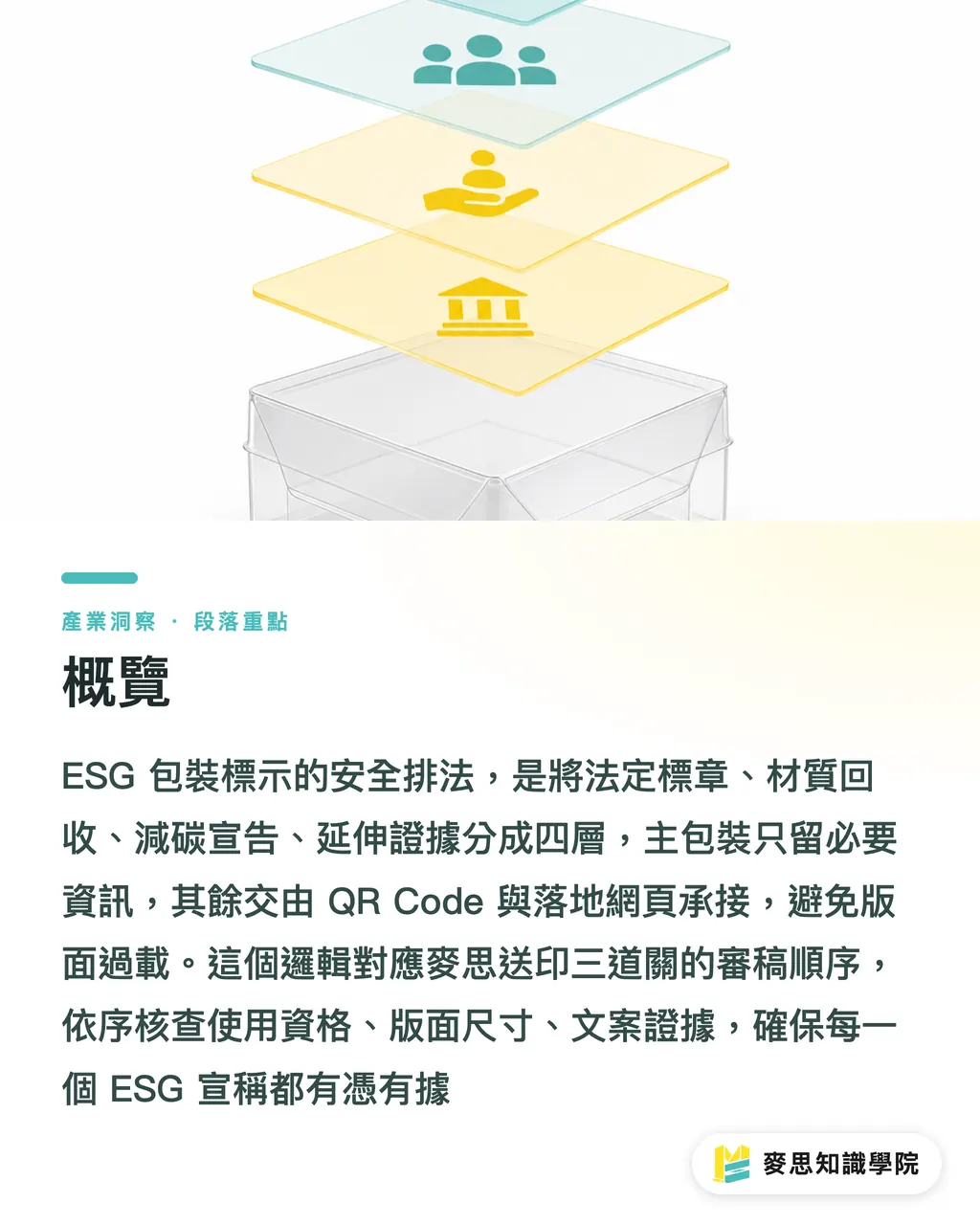
Safe packaging layout for ESG labels breaks down into 4 clear layers: mandatory marks, material recycling, carbon reduction claims, and extended proof. Keep only essential info on the main package, letting QR codes and web pages handle certificates and backing evidence. When reviewing ESG packaging proofs at MINDS, I always run them through the MINDS 3-step prepress check order: 1) Eligibility, 2) Layout dimensions, and 3) Copy proof
Where Should Packaging ESG Labels Go?
Packaging ESG labels include certifications, text, icons, and QR codes that disclose environmental responsibility, material origin, recycling methods, and carbon details. The key is making it easy for consumers to distinguish mandatory markings from optional brand details right away
I divide the packaging layout into 4 distinct layers instead of stuffing all green info onto the front panel. Sustainable messages that cannot be understood within 20 seconds often create doubt on retail shelves
・Layer 1: Mandatory or authorized marks, such as environmental labels, FSC labels, or carbon footprint labels. Place them in a fixed info zone on the bottom or side panel to guarantee clarity and compliance
・Layer 2: Material and recycling guidance, such as container recycling symbols, plastic resin identification codes, or separate box and tray recycling steps. Put them where they stay visible even after unboxing
・Layer 3: Carbon reduction and material claims, like 'Outer box made with FSC-certified paper' or 'Reduced paper usage for outer box.' Keep text grounded with clear scopes and conditions rather than broad slogans
・Layer 4: Extended proof via QR code, linking to certificates, material guides, carbon footprint audit details, and recycling tutorials to let your packaging design breathe
Hold on a moment
Many brands initially ask to put green messages front and center. In practice, I recommend saving the front panel for product identity and organizing ESG details into a clean info band along the side or bottom. On an 80 mm wide color box side panel, setting aside 25 to 35 mm in height for marks and recycling info works far better than cramming 3 symbols in at the last minute
Which Labels Cannot Be Drawn from Scratch?
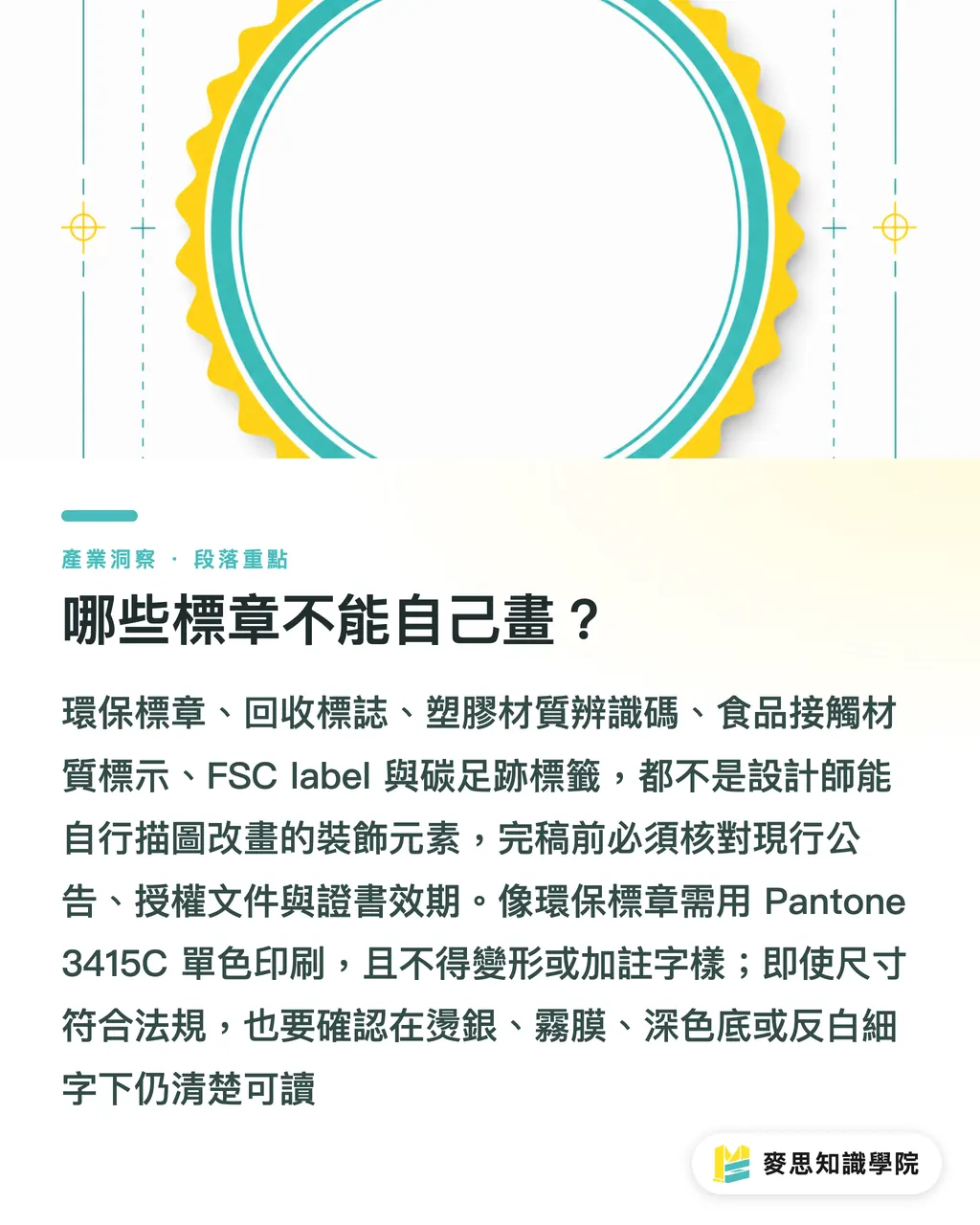
The Green Mark is an environmental protection graphic registered and authorized by the Ministry of Environment under trademark law. Once authorization is granted, you can display the approved artwork on products, packaging, or service locations
Designers cannot simply trace low-res internet images of these marks and recycling codes for print. Before finalizing prepress files, cross-check current official announcements, authorization documents, and certificate validity dates
・Green Mark and Category II Green Mark: The Ministry of Environment updated its guidelines on November 27, 2023. Print the mark in solid Pantone 3415C. Minimum width must be at least 0.5 cm, minimum height at least 0.8 cm, without distortion or added text
・Recycling Symbol and Plastic Resin Identification Code: The Ministry of Environment announcement on July 1, 2025 states that container recycling marks include the general recycling symbol and plastic resin codes. Color can vary but must remain solid single color, positioned prominently on the container, package, or label
・Plastic Resin Identification Code: Standard codes are 1 PET, 2 HDPE, 3 PVC, 4 LDPE, 5 PP, 6 PS, 7 OTHER. Equilateral triangle graphics for bioplastics must have sides of at least 1.5 cm, with the English bioplastic abbreviation clearly marked below
・Food-Contact Plastic Packaging: The TFDA updated labeling rules on December 10, 2019, requiring clear material labeling using Chinese and universal symbols. Multiple materials must be listed separately. Coated paper cannot be labeled simply as 'coated paper' and must specify both PE and paper
・FSC label: FSC-STD-50-001 V3-0 took effect on July 1, 2026. Minimum product label width is 8 mm portrait and 5 mm height landscape. FSC logo minimum height is 4 mm. FSC QR label minimum width is 12 mm portrait and 15 mm height landscape
・Carbon Footprint Label: Ministry of Environment rules from March 19, 2025 require Pantone 368C, 348C, and Pantone Process Blue C. The heart shape must show product carbon footprint values and units. Scale proportionally without distortion or extra text
・Carbon Footprint Approval: Product carbon footprint approvals remain valid for 2 years. Users must retain application and audit records for 3 years, stopping label use immediately if approval expires
During file review, I remind designers of one thing: regulations give minimum sizes, but prepress judges real-world legibility. Silver foil, matte lamination, dark backgrounds, and thin knock-out text can easily turn technically compliant dimensions into unreadable marks
How to Build ESG Hierarchy on Limited Panels?
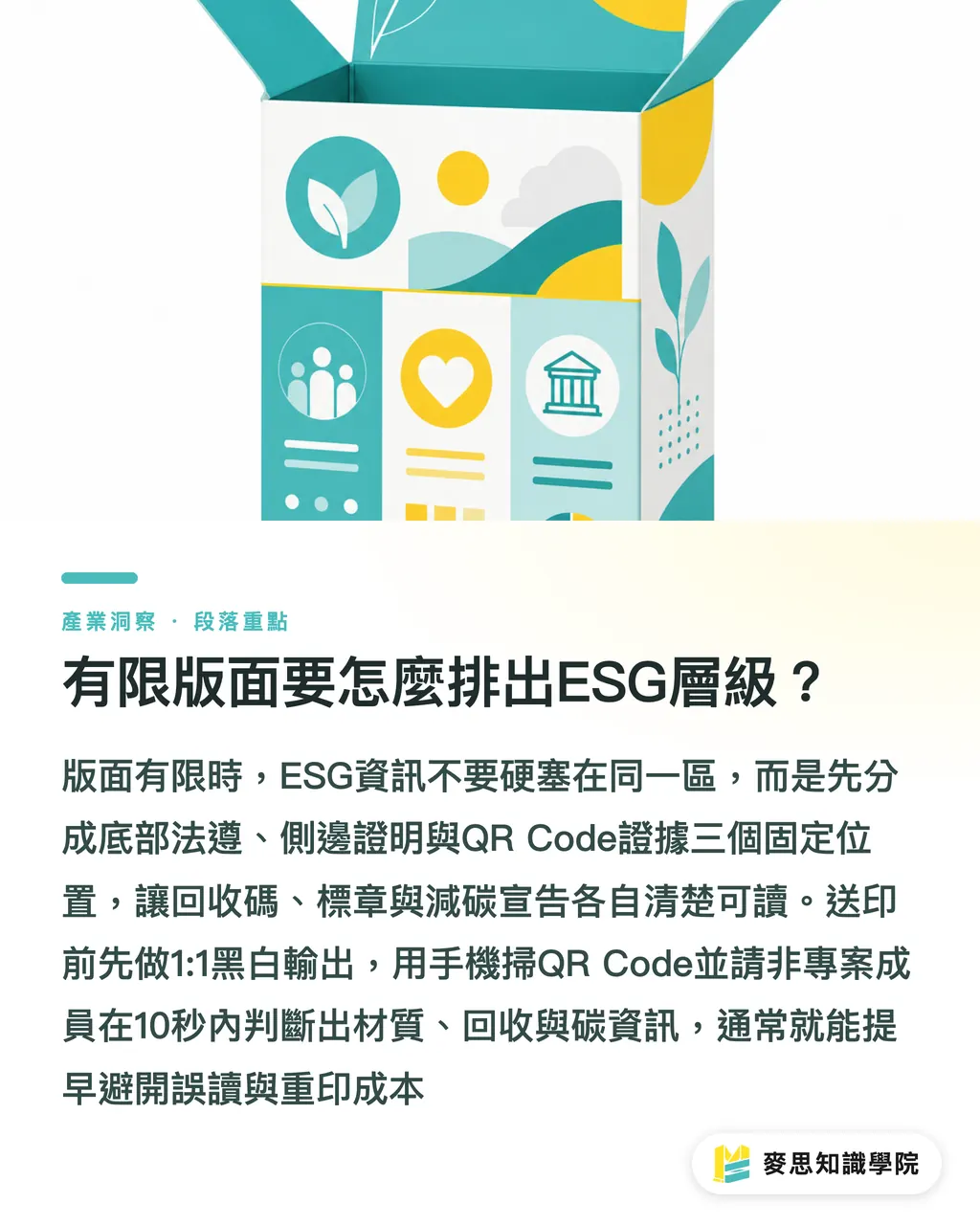
When panel space is tight, I assign ESG info into 3 fixed zones. This gives symbols, recycling codes, and carbon claims dedicated spots, keeping the layout clean while quality control checks every item
・Bottom compliance zone: Place container recycling symbols, plastic resin codes, and mandatory material text here. Keep clear of glue flaps, fold lines, and seal stickers, maintaining at least 3 mm safety distance from die-cut lines
・Side proof zone: Place FSC labels, carbon footprint labels, or Green Marks here. Avoid placing marketing copy too close to labels so consumers do not mistake all claims for being backed by the same logo
・QR code proof zone: Link to certificate queries, sustainability records, material teardowns, and recycling steps. Keep adjacent text short, such as 'Scan to view packaging materials and recycling steps.'
If a single package carries FSC, carbon footprint, recycling codes, and carbon reduction claims, print a 1:1 black-and-white output proof first. Measure marks with a ruler, scan the QR code with a phone, and ask someone outside the project team to check if they can distinguish materials, recycling, and carbon details within 10 seconds
That is enough
For packaging with multiple logos, languages, or SKUs, designers can send label specs and claim copy to the Mai Strategy Knowledge Academy Consulting Team for pre-print checks first. The print shop can then verify colors, die-lines, coatings, and label legibility, which costs far less than a full reprint
How to Write Carbon Reduction Claims Without Greenwashing?
Green claims represent a brand's environmental benefit statements regarding products, packaging, or processes. They must define boundaries, conditions, evidence, and validity periods to prevent consumers from mistaking them for blanket guarantees
Packaging copy stumbles most on broad words like 'eco-friendly,' 'earth-friendly,' 'low-carbon,' or 'recyclable' because big words demand big proof. A safer approach for small and medium businesses breaks a catchy slogan into 4 verifiable fields
・Specify target: Clarify whether it applies to the outer box, inner bag, bottle body, label paper, ink, or the whole product
・Specify scope: State clearly if it covers material source, paper volume, production energy, shipping materials, or product lifecycle
・Specify baseline: If claiming a 30% reduction, specify the comparison year, packaging version, process, or weight
・Specify evidence: Provide proof such as FSC license labels, Ministry of Environment carbon footprint approvals, third-party verification statements, or supplier material certificates
Here are a few sentences I often rewrite for brands, saving real headaches before hitting the press
・Original: 'This product uses eco-friendly packaging.'
・Revision: 'Outer box made with FSC-certified paper. See box bottom for FSC label and license code. Certification covers outer box paper only.'
・Original: 'All-new low-carbon packaging.'
・Revision: 'Outer box paper usage reduced by 30% compared to the 2024 version. Claim applies to outer box only and does not reflect a 30% reduction in total product carbon footprint.'
・Original: '100% Recyclable.'
・Revision: 'Paper box body is recyclable. Inner tray is PP #5. Please separate components and follow local recycling rules.'
Industry insiders know the biggest trap is packaging that looks completely right on the surface while certificates cover only the paper box and skip the plastic tray inside. Catching this during proofing takes minutes. Fixing it after hitting store shelves hurts
Prepress Checks to Prevent Reprints
The MINDS 3-step prepress check fits ESG packaging prepress perfectly: 1) Eligibility check to verify usage rights, 2) Layout check to confirm legibility on press, and 3) Evidence check to ensure copy matches supporting documents
・Step 1 Eligibility check: Confirm Green Marks, FSC labels, and carbon footprint labels have valid authorization, certificates are active, and scope covers this exact SKU and packaging component
・Step 2 Layout check: Measure label sizes on 1:1 proofs. Confirm single-color, knockout text, transparent bases, coatings, and foil stamping do not hurt legibility. Keep promotional phrases and carbon slogans away from label boundaries
・Step 3 Evidence check: Ensure green claims align with certificates, purchase orders, material proof, FSC Chain of Custody records, carbon footprint approvals, or QR code landing pages
・Step 4 Proofing check: Inspect physical proofs for color boxes, stickers, shrink sleeves, and flexible pouches. Fold lines, heat seals, and curved bottle surfaces swallow up layout space that looked plenty spacious on flat screens
・Step 5 Archiving check: Store original vector logos, approved proofs, certificates, approval numbers, and final PDFs together in a single job folder so future revisions do not start from scratch
The most common mistake on proofing day happens when prepress files are perfect, but scaling down shrinks a logo by 0.5 mm or places a QR code right across a seal fold. ESG packaging should look great, but beauty must never come at the expense of legibility
Key Takeaways
・Verify label eligibility before tweaking aesthetics
・Keep recycling codes readable for consumers and recyclers. Single colors are safer than busy patterns
・Numbers and codes on FSC and carbon footprint labels represent legal responsibility, not decoration
・Skip vague hype in carbon reduction claims; state the scope, baseline, and evidence clearly
・Use QR codes to provide backing proof, not as a replacement for mandatory labels
Further Considerations
Print manufacturers can build Green Marks, FSC, carbon footprint, and recycling codes into preflight checklists. Designers can standardize an ESG info band within their layout grid. Brands should link certificates, materials, approval numbers, and claim text directly to each SKU. Where AI applications and SaaS tools genuinely help is organizing rules, certificate fields, prepress dimensions, and QR code test logs into a traceable workflow, taking guesswork out of every revision
Further Reading
FAQ
- Can FSC, carbon footprint labels, and recycling codes be placed in the same area on packaging?
- Yes, but maintain clear visual hierarchy. FSC labels, carbon footprint labels, and recycling codes represent different certification systems. Leave enough whitespace around them so carbon claims do not look endorsed by FSC or the Ministry of Environment
- Do I have to list all plastic recycling numbers from 1 to 7 on the package?
- No. Mark only the actual material used for that specific container or packaging component, such as PET #1 or PP #5. For multi-part packaging, make it clear which code belongs to which component
- Can packaging state 'Eco-Friendly Packaging' directly?
- Writing just 'Eco-Friendly Packaging' is risky. A safer approach specifies exact boundaries, such as 'Outer box uses FSC-certified paper, inner tray is PP #5, paper box body is recyclable,' while keeping proof documents on file
- Can a QR Code replace the Green Mark or recycling codes on packaging?
- QR codes work well for certificates, material origins, and recycling guides, but they cannot replace mandatory labels or material disclosures required by law. Always check current regulations before printing
- What should I do if label regulations change after packaging is already printed?
- First check whether the change affects existing inventory, label grace periods, or the next print run. For instance, FSC V3-0 provides a transition window from July 1, 2026, to January 1, 2029. In practice, freeze old print plates and incorporate updated specs into the next revision
Related articles



The Print × AI weekly
The print and AI know-how designers, brands and enterprises can use before they commit — one email, every week
MINDS Free Tools
AI background removal, a LINE sticker maker, spine & imposition calculators — all free, right in your browser, no upload.
MINDS Group
Need actual printing or gifting services?
From premium printing to online ordering and festive gifts — the MINDS Group sister brands take it from here.