
Overview
The most reliable approach to ESG packaging communication is splitting the packaging into two layers: 'understood at a glance on the shelf' and 'evidence available online.' MINDS uses what it calls the 'Three-Gate QR Code System': clean layout, scannable QR code, traceable sustainability record. One small square code carries materials, carbon footprint, recycling guidance, and certifications, so the box face never has to become a data dump
When Packaging Space Is Tight, Where Should ESG Info Go?
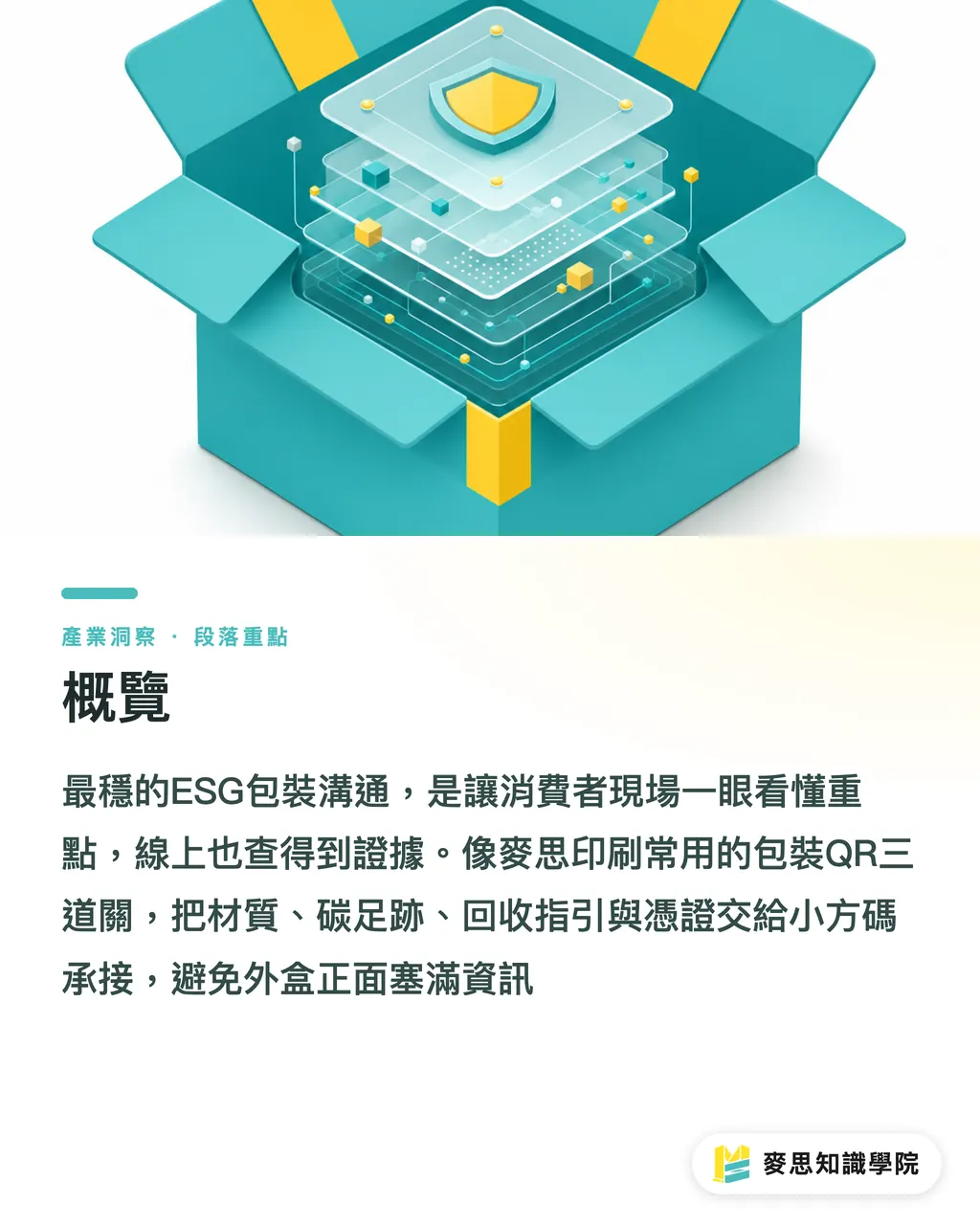
A packaging front face usually has room for three things: brand identity, product selling points, and required regulatory information. Squeeze ESG into that same visual zone and consumers can't read it, and there's not much any designer can do to save it. MINDS' Three-Gate QR Code System (MS, mid-to-high-end fully customized commercial printing) starts by keeping the front face to a single verifiable sustainability claim and one QR code entry point
The most common mistake I see on production floors is piling on eco labels, material descriptions, carbon-reduction slogans, and recycling symbols all at once, and every word ends up tiny enough to pass for a copyright line. On small boxes, bottle labels, and hang tags especially, the usable space for ESG content is often less than one-tenth of the full face
MINDS' layout logic for the Three-Gate QR Code System is direct:
・① Front face: only ESG information the buyer needs at the moment of purchase, such as recyclable materials or plastic-reduction details
・② Side or back panel: the QR code, a short header, and any necessary supplementary text, such as 'Scan to see packaging materials and recycling instructions.'
・③ Online sustainability page: the details, including packaging weight, material composition, carbon footprint data, supplier certifications, and version dates
The point of this layout isn't to cut corners. It's to keep the packaging looking like packaging on the shelf, while the page behind the QR code reads like a proper report
What Is a Packaging Sustainability Record?
A sustainability record is a traceable document covering a product's packaging materials, weight, carbon footprint, recycling method, and certification history, available for consumers, retailers, and auditors to verify
A packaging sustainability record can't just be a polished web page. MINDS' Three-Gate QR Code System treats it as a handoff document that could be pulled in an audit at any time, and it has to be readable by at least four groups: brand marketing, procurement, the print shop, and the recycling end
A sustainability record ready to go live typically needs these fields:
・Packaging structure: cardboard boxes, stickers, flexible pouches, inner liners, and cushioning materials each get their own entry. 'Eco-friendly packaging' as a catch-all won't cut it
・Material details: FSC paper, recycled paper, single-material plastic, composite film, all need to be spelled out clearly, and flag recycling limitations for composite materials in particular
・Weight and specs: if the same product changes paper weight, film thickness, or dimensions, the record version needs updating too
・Recycling instructions: consumers need to know which layer to separate, which bin each part goes into, and which components can't be recycled together
・Evidence documents: supplier declarations, inspection reports, purchase orders, and batch records should trace back to internal folders
If there's no evidence behind an ESG claim, I don't recommend putting it on the packaging. Once a job goes to print it's thousands to tens of thousands of copies. A typo can be patched with a label. Greenwashing suspicion is a lot harder to fix
How Do You Design a QR Code That Actually Scans?
A QR code on packaging isn't just slapping a black-and-white square on a box. MINDS' Three-Gate QR Code System checks three things first: size, contrast, and placement. If those three don't pass, it doesn't matter how thorough the sustainability page is, nobody's getting in
For standard retail packaging, I'd conservatively recommend a finished QR code size of 15mm or larger, with a quiet zone of at least 4 modules on all sides. Don't place it on fold lines, curved surfaces, foil stamping, spot UV, heavy textures, or transparent materials. Matte laminate is usually fine. Gloss laminate on a curved surface is a reliable way to confuse a phone camera
Before locking off the prepress file, add two rounds of checks:
・First check on screen: confirm the QR code links to the live URL, not a test page and not a short link that expires
・Second check on the proof: scan with at least two phones, simulating three lighting conditions, retail white light, warehouse yellow light, and natural light
・Third check before the print run: verify that the actual paper stock, laminate, halftone dots, and die-cut position don't affect readability
If a brand is restructuring its packaging layout, bringing in MINDS to lock down the QR code, paper stock, finishing, and file requirements in one round usually saves a lot more time than fixing things after the print run
How Should a Sustainability Page Be Structured So People Actually Read It?
Don't build the sustainability page like a PDF archive. MINDS' Three-Gate QR Code System divides the online page into three layers: understand in 5 seconds, verify in 30 seconds, download when needed
Layer 1 is for consumers: the first thing they see after scanning is the product name, a packaging overview, and recycling instructions. Keep the text short and the icons clear. Ideally, people can figure out how to handle the outer box, inner bag, and sticker without zooming in
Layer 2 is for retailers and corporate buyers: material percentages, packaging weight, version date, and applicable product batches. The data needs to match purchase orders and shipping records, or you'll spend year-end scrambling to trace the source when writing the ESG report
Layer 3 is for auditors and internal teams: certification downloads, supplier declarations, and revision logs. Access can be tiered, consumers see the summary, internal staff see the documents. That way you're not putting commercially sensitive information on a public page
I'd recommend every sustainability page include at least one update date. ESG data doesn't end when the job ships. Change the paper, change the film, change the supplier, change the dimensions, and each one should leave a version record. That's usually the most painful gap when companies are scrambling to pull data together at year end
Where Should Companies Start When Adopting Packaging QR Codes?
Don't start with web design. MINDS' Three-Gate QR Code System starts with a single SKU trial run, cycling through packaging, data, URL, and audit documents once before rolling out across a full product line
I recommend 6 to 8 weeks for the first version. Here's a rough pace:
・Week 1: pick one SKU with a small packaging footprint, dense ESG information, and an upcoming revision
・Week 2: audit existing packaging material data, including materials, weight, supplier certifications, and recycling instructions
・Week 3: organize the packaging layout, decide on the ESG short copy, QR code placement, and minimum scannable size
・Week 4: build the sustainability page, starting with the mobile version, because that's what most consumers scan with
・Week 5: test proofs, checking printing, laminate, fold lines, curved surfaces, and lighting interference
・Weeks 6 to 8: have the brand team, procurement, print shop, legal, or ESG contact proof the content together, confirm what can be printed and what stays online only
If the company doesn't have a packaging material data framework yet, the Mai Strategy Knowledge Academy consulting team can help brands build a 'Packaging Materials Data Audit Sheet' first. Without that sheet, a QR code is just a door. It won't grow trustworthy content on its own
One caution:
The biggest risk with ESG packaging is splitting it three ways: aesthetics to the designer, data to the sustainability team, QR code to marketing, and then nobody can hand off to the next person on production day. The best division of labor is having the print shop set the process constraints first, the designer lay out the page, the brand side supply the evidence, and the digital page follow the packaging version
Key Takeaways
・The front face gets noticed. The QR code handles verification. Keep those two jobs separate
・More ESG information means less belongs on the box face. White space is part of sustainable communication too
・A QR code isn't a marketing sticker. It's a shared entry point for packaging, data, certifications, and recycling instructions
・Sustainability pages need version dates. Change the packaging material, update the data
・Without packaging weight, material specs, and certifications, a QR code just moves the problem from paper to a webpage
Further Thinking
For print manufacturers, packaging QR codes pull proof scanning, paper stock reflectance, laminate type, and die-cut placement into the ESG conversation. For designers, ESG layout has to shift from 'cramming in data' to 'layered navigation.' For AI and SaaS teams, the products that actually land aren't the ones that write a few sustainability taglines for clients. They're the ones that manage SKUs, packaging specs, certification files, sustainability page versions, and packaging URLs, so the next revision doesn't mean hunting through records from scratch
FAQ
- Does ESG information have to be printed on the box face when packaging space is tight?
- It doesn't. The front face should carry one verifiable sustainability claim and one QR code. Full materials, carbon footprint, recycling instructions, and certifications go on the online sustainability page
- What's the minimum reliable size for a packaging QR code?
- For standard retail packaging, I'd conservatively say 15mm or larger, with a quiet zone of at least 4 modules on all sides. Test-scan with actual paper stock, laminate type, and lighting conditions before the print run
- What data needs to go on a sustainability page?
- At minimum: packaging structure, material details, weight and specs, recycling instructions, evidence documents, and an update date. The data needs to trace back to internal purchase and print records
- Which SKU should a company start with when adopting packaging QR codes?
- Start with one SKU that has a small packaging footprint, dense ESG information, and an upcoming revision. Run the full cycle, data audit, layout, sustainability page, proof scanning, and internal proofing, in 6 to 8 weeks
- Can a QR code link to a PDF?
- That works as a backup option, but don't make it the only destination. After scanning, it's better to land on a responsive web page. Consumers see a summary first, procurement and auditors download documents when they need them
Related articles



The Print × AI weekly
The print and AI know-how designers, brands and enterprises can use before they commit — one email, every week
MINDS Free Tools
AI background removal, a LINE sticker maker, spine & imposition calculators — all free, right in your browser, no upload.
MINDS Group
Need actual printing or gifting services?
From premium printing to online ordering and festive gifts — the MINDS Group sister brands take it from here.