
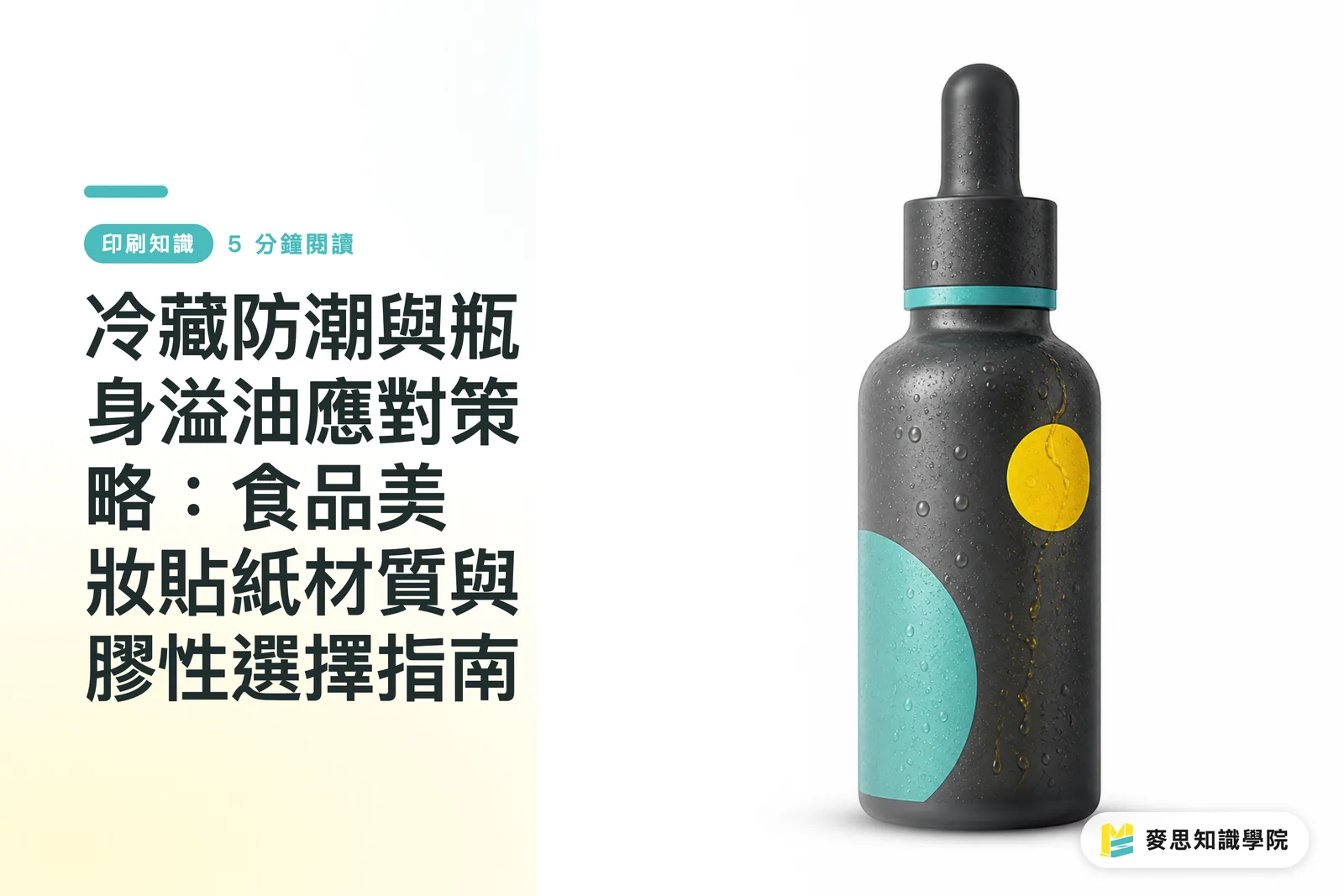
Why do cold temperatures and oils keep causing labels to fall off?
The most common label failures on chilled foods and cosmetic essential-oil products come down to condensation rebound and oil penetration
When a label goes onto a container, the adhesive needs time to build a physical bond with the surface molecules of the bottle
The moment a product moves out of a minus-eighteen-degree freezer or a five-degree chill display, the container beads up with fine condensation within thirty seconds
That moisture gets sandwiched right between the adhesive layer and the container surface, and the bond drops off a cliff
Oil penetration is a different kind of killer. Makeup removers, essential oils, or food glazing oils that drip onto the bottle wick inward along the label's edge capillaries and gradually break down the molecular structure of ordinary water-based adhesives
When you're picking label materials for chilled or oily settings, the whole game is balancing adhesive tolerance against face-stock tension
At MINDS, when we help brands plan their packaging, we lean on a framework we call the 'MINDS (MS, mid-to-high-end fully custom commercial printing) Three-Gate Proofing Workflow': ① nail down the storage and post-cooler temperature and humidity, ② match the bottle substrate against the adhesive chemistry, ③ test the cylindrical-arc die-cut and overlap geometry. Run through them in order and you can head off moisture rebound at the pass
Freezer-grade adhesive is a modified acrylic or hot-melt formulation tuned for minus-eighteen to five-degree environments. It builds initial tack fast under high humidity and cold, and keeps condensation from seeping in
Don't rush to plate yet. Get straight on how liquids and temperature swings attack the adhesive layer, and you avoid the trap from the start
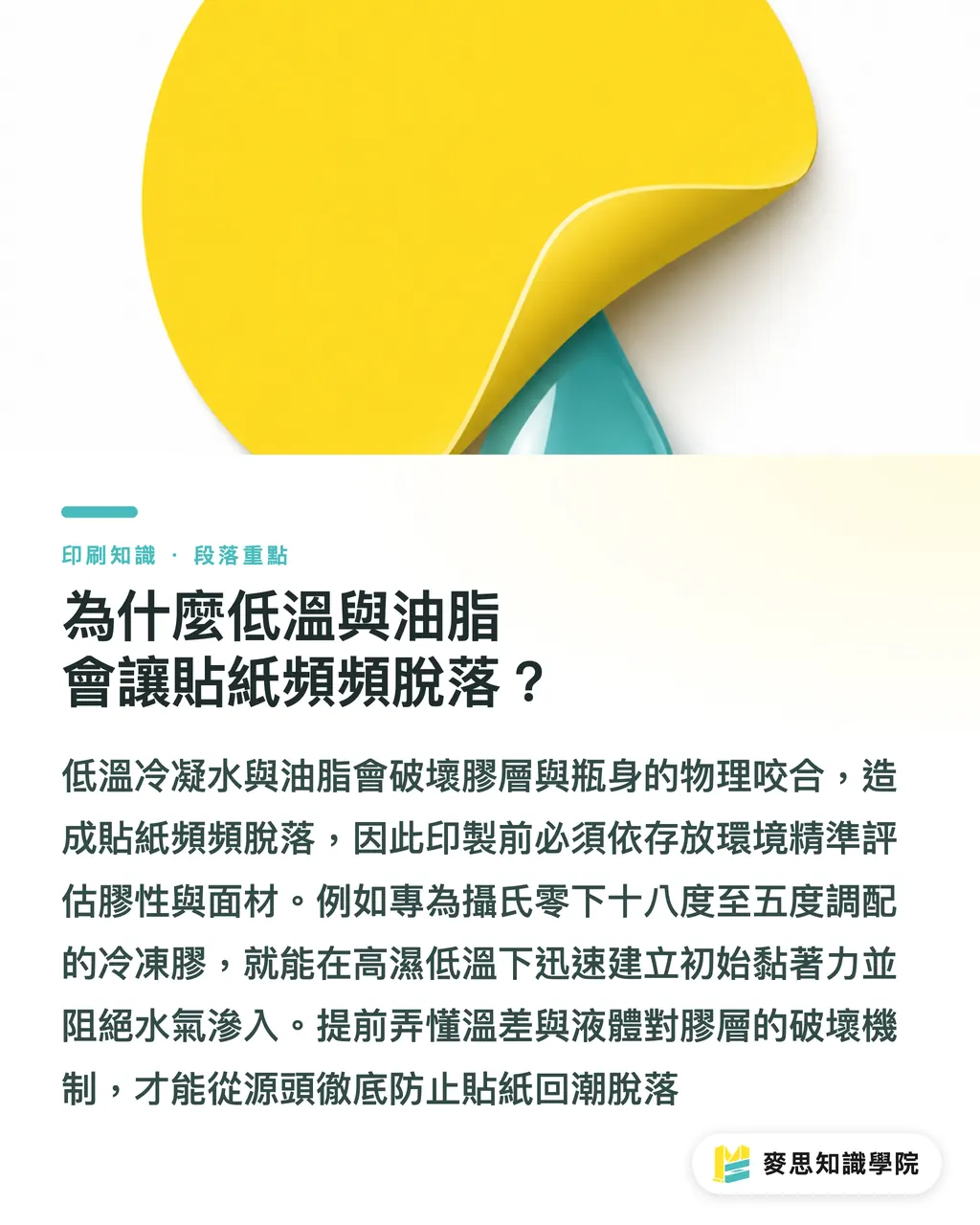
How do you match label materials for cold storage, freezers, and oily bottle surfaces?
Pick the right material and you're already halfway there
Paper and film stocks behave completely differently against moisture and oil. Traditional coated or woodfree paper soaks up water, swells its fibers, and ends up with a bubbled laminate, or tears apart and goes pulpy
On the production floor and in prepress, here are the four workhorse face stocks and what they actually do:
・Synthetic paper: made from polypropylene resin. Waterproof and tear-resistant, with an eighty-micron thickness that's the sweet spot for chilled-food labels
・Pearl paper: fine pearlescent sheen on the surface, moisture-tolerant and able to shrug off light oil splashes. Common on mid-to-high-end skincare bottles
・PET labels: top-tier dimensional stability and a wide temperature range, handling everything from fifty degrees down to minus forty. The strongest defense against chemical solvents and oil penetration
・Clear labels: polyester or polyethylene film for a borderless, see-through look, but watch out for the container color bleeding back through and messing with the printed artwork
For cosmetic bottles prone to oil bleed or acidic/alkaline skincare, ask the Mai Strategy Knowledge Academy consulting team for samples and run a real oil-immersion test
A stock that doesn't absorb water is only half the job. Surface finishes, gloss or matte lamination, are the first line of defense against oil creeping in from the edges
Where do water-based, solvent-based, and freezer adhesives hit their limits?
Adhesive choice decides whether your label lives or dies in extreme conditions
Plenty of brands figure waterproof synthetic paper is enough, slap a generic water-based adhesive on it, and watch the whole label slide off the bottle three days into the fridge
Here's what those adhesives actually handle on a real production line:
・Standard water-based adhesive: waterborne acrylic emulsion. Cheapest option. Works in dry room temperatures between fifteen and forty degrees. Absolutely hates water and oil
・Solvent-based adhesive: solvent-borne acrylic. Tight molecular structure once cured, with strong resistance to water, oil, and acid/alkali. The first pick for cosmetic bottles that sweat oil
・Freezer-grade adhesive: a specialty pressure-sensitive formula for cold. Bonds directly to surfaces below minus five degrees and holds up long-term at minus eighteen
・Easy-peel adhesive: leaves almost no residue. Great for promotional labels, but doesn't last long in humid environments
That's the rundown
When you're picking an adhesive, look past the long-term service temperature and pay attention to the actual temperature on the line when the label goes on
If you're labeling in a five-degree cold room, you need a freezer-grade adhesive with very high initial tack, anything else and the glue won't flow and wet out at that temperature
How do you stop cylindrical containers from springing back and flagging at the edges?
Small-diameter cylinders are the final boss fight of label printing
Stick a label on a bottle, lip balm tube, or test tube under three centimeters in diameter, and the face stock's material memory fights back, trying to peel outward. That's the flagging everyone complains about
Solving cylindrical flagging takes three things firing together: face-stock thickness, die-cut design, and overlap application
・Thinner face stock: go for PET or soft PE films under fifty microns. The softer the material, the less it wants to spring back
・Overlap application: when the label wraps the bottle, leave a three-to-five-millimeter overlap. The adhesive sticks to the label's own face stock instead of to the bottle
・Rounded die-cut corners: round off all four corners instead of leaving sharp ninety-degree angles that concentrate stress and lift
・High-tack solvent adhesive at heavier coat weight: lay it on thick so it grabs hard enough to fight the rigid face stock's memory
The complaint we hear most often: flat-applied proofs look perfect, but the day after production runs go onto round bottles, every single edge has lifted
Run a cylindrical wrap test before you go to plate. It can save you from a whole-batch return
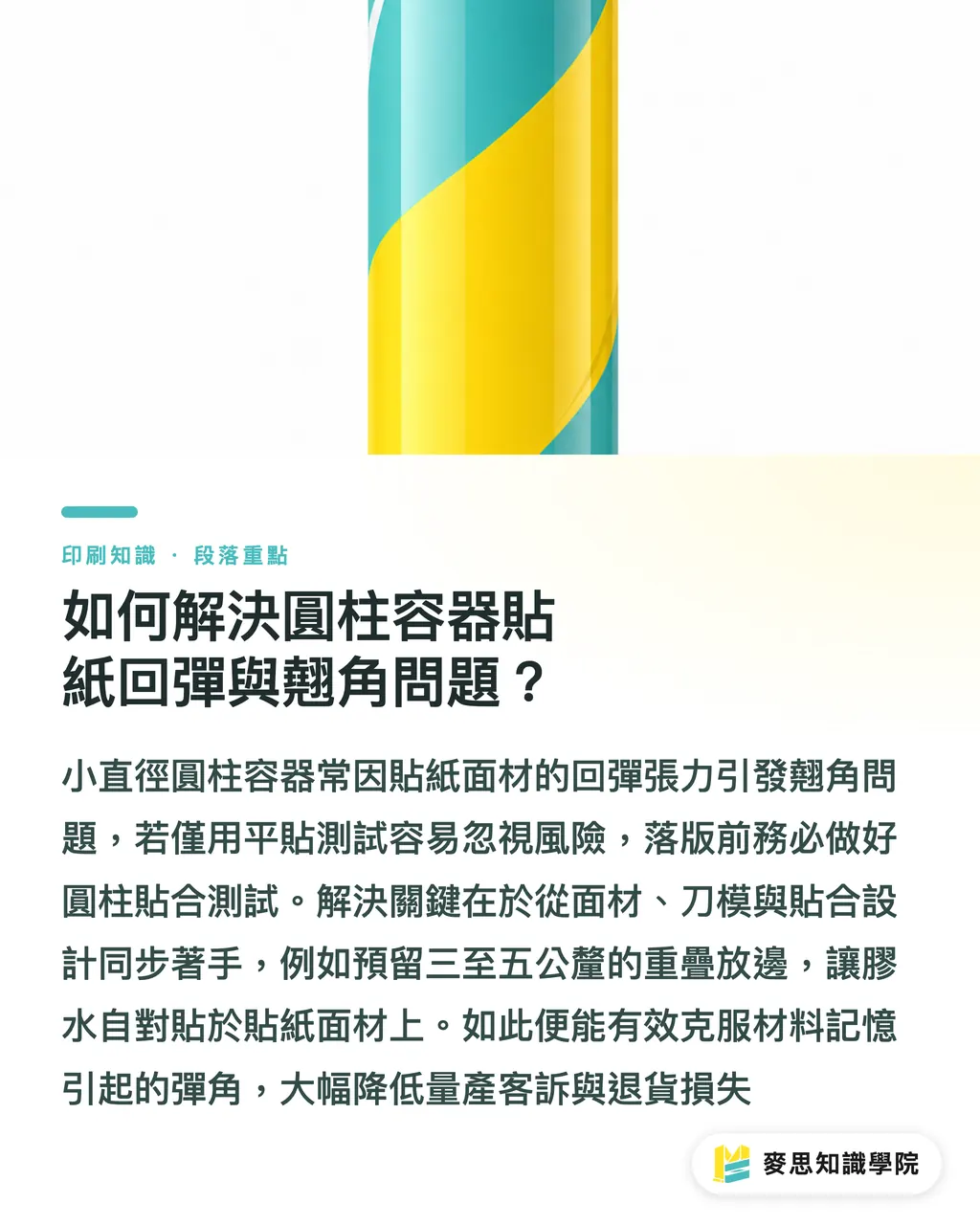
Key Takeaways
・Cold condensation and bottle-surface oil are the main reasons labels fail. Your material choice has to weigh face-stock tension against adhesive chemistry at the same time
・For chill and freezer environments, eighty-micron synthetic paper with freezer-grade adhesive keeps post-cooler moisture out of the bond
・Essential-oil and acidic/alkaline skincare bottles need solvent-based adhesive with a laminate finish to cut off the oil penetration path
・Small-diameter cylinders need a three-to-five-millimeter overlap and a sub-fifty-micron soft film to prevent edge lift
Further Thinking
Designers and buyers can't leave label-material selection until after the artwork is finished
Traditional workflows treat labels as pure visual surfaces and ignore the physical reality of what happens during shipping and use
Modern print manufacturing is starting to fold in smart production and proofing databases that can simulate high-humidity and oily conditions at the proof stage
Brands should put 'environmental extremes' into their design specs up front. When a designer locks down dimensions, they should already be calculating the cylindrical overlap
For teams running SaaS and automated print-submission systems, modularizing adhesive temperature/humidity limits and container-diameter flagging warnings can slash the trial-and-error cost of cross-functional communication
Further Reading
FAQ
- Why do my chilled-food labels peel off completely after time in the fridge?
- The main culprit is condensation forming on the bottle within thirty seconds of leaving the cooler. With a standard water-based adhesive, that moisture works its way between the glue and the bottle and kills the bond. Switch to a polypropylene synthetic paper paired with a freezer-grade low-temperature adhesive
- For cosmetic essential-oil and skincare bottles that bleed oil, which adhesive keeps labels from bubbling?
- Essential oils and oily ingredients dissolve standard water-based adhesives. Use a solvent-based adhesive with PET or pearl-paper face stock, and add a gloss or matte laminate to the printed surface to block oil from seeping in at the edges
- The edges on my small essential-oil bottles always lift. How should the die-cut be designed?
- Small-diameter cylinders are prone to material memory flagging. Round off all four corners on the die-cut, and leave a three-to-five-millimeter overlap so the tail of the label sticks to the label itself rather than directly to the bottle
- Can freezer-grade adhesive be applied in a normal room-temperature packaging room?
- Yes. Freezer-grade adhesive has very high initial tack at room temperature too. The real point is the other direction: if the labeling environment is below five degrees, you must use freezer-grade adhesive to let the glue flow and wet out properly
Related articles
The Print × AI weekly
The print and AI know-how designers, brands and enterprises can use before they commit — one email, every week
MINDS Free Tools
Spine width and imposition calculators — skip the manual math, free in your browser.
MINDS Group
Need actual printing or gifting services?
From premium printing to online ordering and festive gifts — the MINDS Group sister brands take it from here.