
Can AI and Digital Printing Really Work Together?
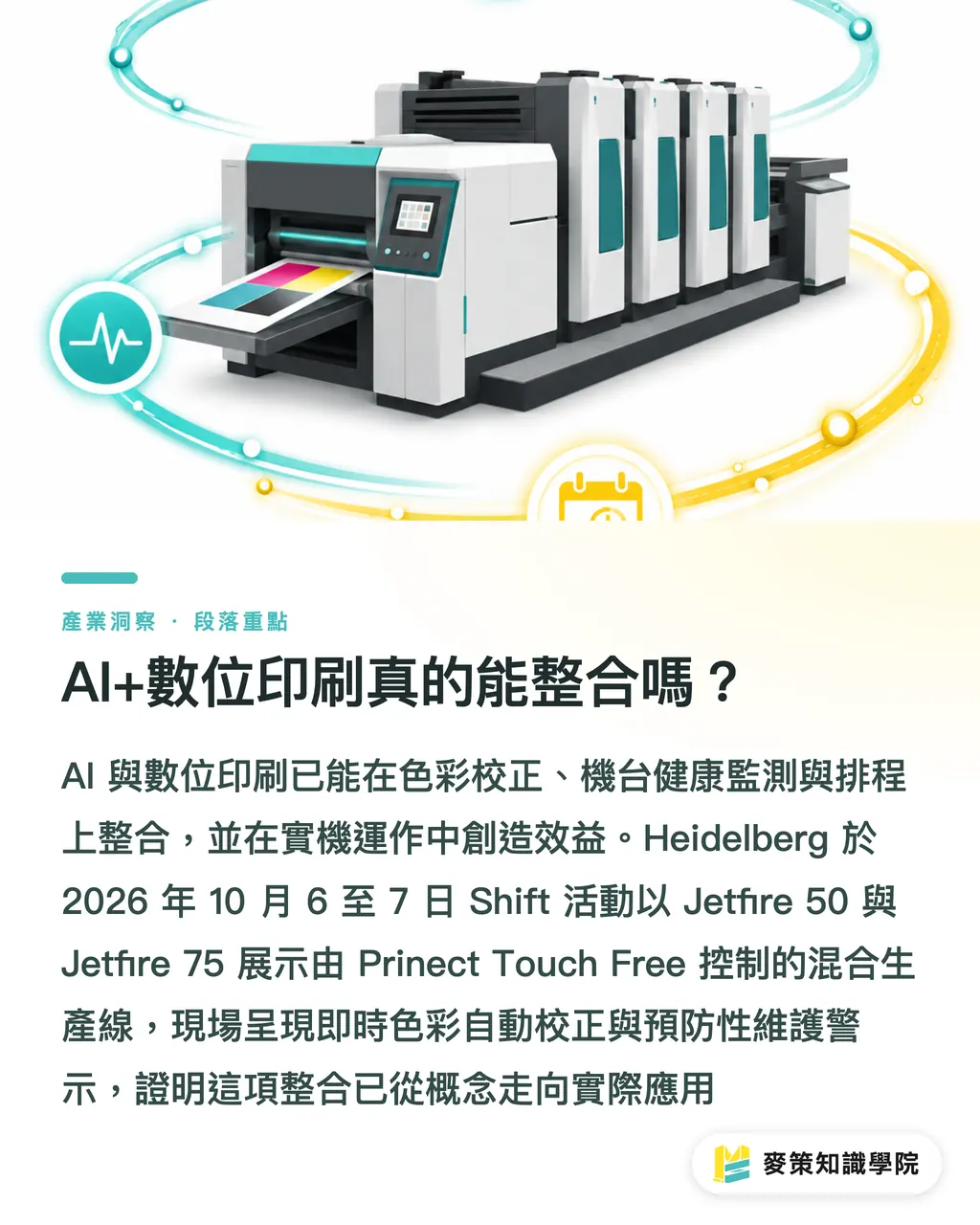
The short answer is yes. Combining AI and digital inkjet across color calibration, machine health monitoring, and scheduling already delivers measurable gains on the press floor. At Heidelberg's Shift event on October 6-7, 2026, live demonstrations of the Jetfire 50 and Jetfire 75 running hybrid lines under Prinect Touch Free showed automated real-time color correction and predictive maintenance alerts. It proved the setup works in practice, not just on paper
Which AI Modules Are Worth Investing in First?
Start with the three features that show clear ROI
・Automated color calibration: AI reads spectral sensors to adjust print curves in real time, cutting down manual setup time. This matters especially for packaging clients with strict color-tolerance standards
・Predictive maintenance: AI analyzes operating data to flag bearing wear or clogged nozzles before they cause unexpected downtime. Meinders & Elstermann boosted machine uptime by about 5 % this way
・Production schedule optimization: By combining order priorities with machine load models, the system automatically builds schedules for the shortest turnaround times, cutting down on manual scheduling mistakes and idle press time
How Do You Roll Out Digital and AI on an Existing Offset Line?
Add the hybrid model to your current workflow step by step
1. Fit key presses with color sensors and vibration detectors, making sure the data feeds directly into platforms compatible with Prinect Touch Free
2. Bring in a Jetfire 50 on a short-run trial line as a test machine, and run side-by-side tests using the built-in AI color calibration in Prinect
3. Connect AI early-warning and scheduling modules to your existing ERP system through APIs to set up automated quoting and scheduling feedback loops
4. Move high-value accounts (like brand packaging) over to the hybrid model first while keeping other jobs on traditional offset, securing both capital payback and client buy-in
5. Once set up, bring in the Mai Strategy Knowledge Academy consulting team for workflow audits and performance validation to make sure every step has measurable benchmarks
How Do You Measure Results After Rollout?
Track three core metrics to quickly test your return on investment
・Higher uptime: Compare actual running hours on the same press before and after rollout, aiming for a 3-5 % lift
・Better yield: Color deviation drops from 2-3 % to under 0.5 %
・Shorter lead times: Average delivery window drops from 7 days to 5 days, with the biggest speed gains showing up on gang-run, multi-plate jobs
If you want quick proof, test it first on limited-edition print runs for a single client. Once you have a win, roll it out across the entire shop floor to keep overall risk low

Key Takeaways
・The three AI plus digital inkjet modules offer the quickest route to upgrading an offset plant
・Testing first on a short-run digital line before expanding to plant-wide hybrid production protects capital
・Uptime, yield, and turnaround time are the three yardsticks for measuring rollout success
Looking Ahead
Long term, pairing AI with digital printing is more than an equipment upgrade. It redefines design delivery and floor flexibility. Designers can adjust color settings right at the CTP stage to shorten proofing cycles, while print shops can track equipment health with AI to bring down repair costs. If SaaS platforms package these modules into plug-and-play APIs, entry barriers for small and medium shops will drop even further, accelerating the entire industry toward hybrid production
Further Reading
FAQ
- Do I need to replace all my offset presses to adopt AI?
- No. You only need to add sensors to key presses and connect them with Prinect Touch Free to upgrade gradually
- Can a small print shop's budget support a Jetfire digital press?
- Yes. You can access a Jetfire 50 through leasing or OEM partnerships, running it alongside your existing presses in a hybrid setup to avoid massive upfront capital spending
- Will AI replace a designer's color judgment?
- AI only provides real-time adjustment suggestions. The final call stays in the designer's hands, shortening proofing rounds without replacing creative decisions
Related articles


The Print × AI weekly
The print and AI know-how designers, brands and enterprises can use before they commit — one email, every week
MINDS Free Tools
AI background removal, brand stamping, and a LINE sticker maker — free design tools, right in your browser, no upload.
MINDS Group
Need actual printing or gifting services?
From premium printing to online ordering and festive gifts — the MINDS Group sister brands take it from here.