
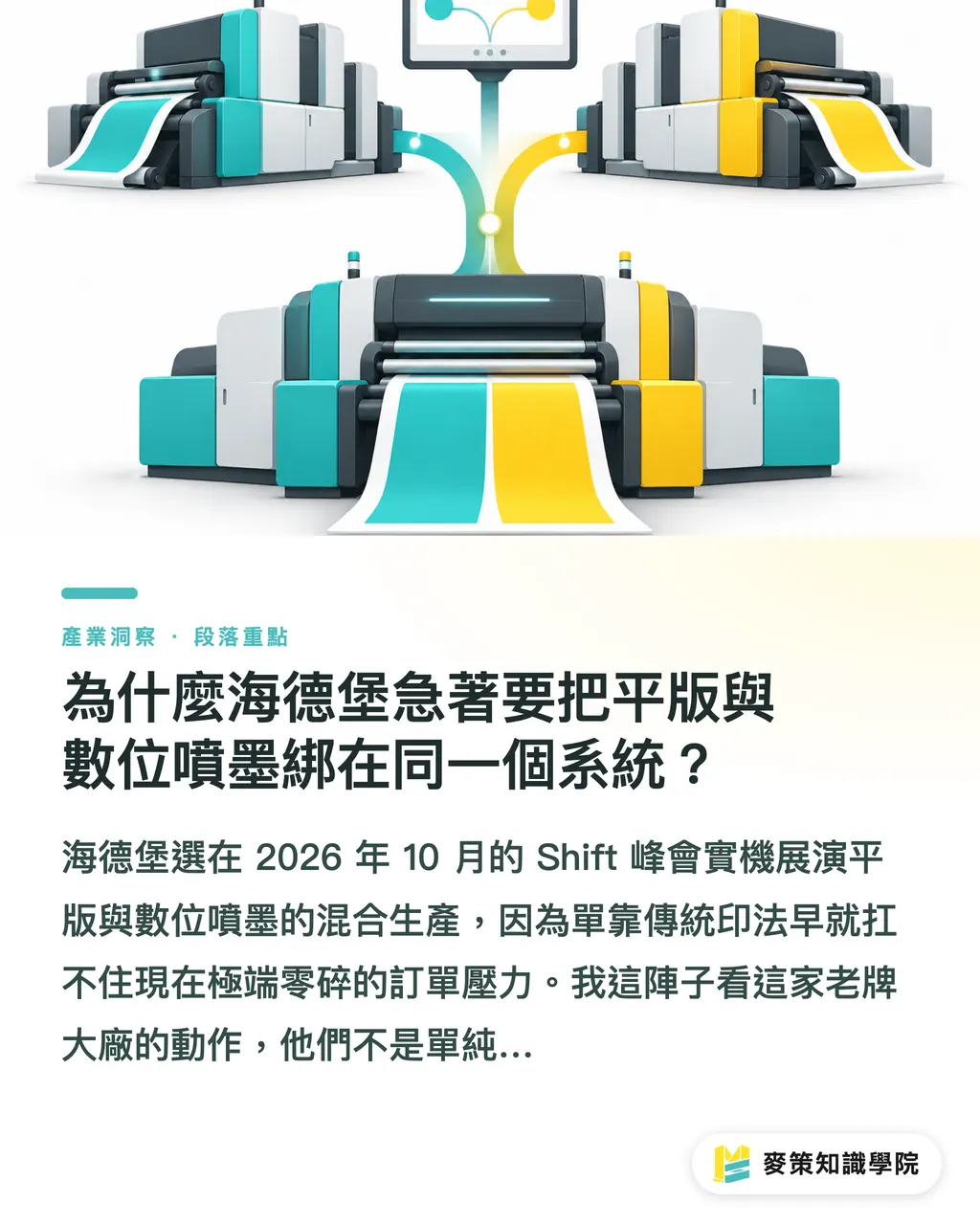
Why Is Heidelberg Rushing to Tie Offset and Digital Inkjet into a Single System?
Heidelberg chose its Shift summit in October 2026 to run live demos of hybrid offset and digital inkjet production. Traditional printing alone can no longer handle the pressure of increasingly fragmented, small-batch orders. Looking at what this veteran manufacturer has been doing lately, they are not simply selling industrial digital presses like the Jetfire 50 or Jetfire 75. They are pushing a data-driven production model run entirely by software. That says it all
The core piece is Prinect Touch Free, Heidelberg's automated prepress and scheduling workflow that decides whether a job goes to offset or digital presses. This system completely upends the old model where plant managers scheduled runs based on gut feeling. Instead, AI looks at current deadlines, paper costs, and press loads in real time to split or batch parts of a single order. German commercial printer Meinders & Elstermann is an early adopter of this hybrid setup. They linked the Jetfire 50 with their existing offset lines, giving both digital and offset a single automated intake point. Heidelberg sales chief David Schmedding put it bluntly: without digitization, automation, and AI, surviving commercially in print will soon be almost impossible. That statement sounds the countdown for purely manual shops
When Evaluating an AI Upgrade, Should Print Shops Buy Hardware or Clean Up Their Data First?
Automate your quoting and connect your scheduling data first, without question. Only then should you look at hardware. I have seen plenty of small and mid-sized shops rush into AI and make the same mistake. They buy expensive high-end presses, yet sales reps still calculate quotes by hand and call designers to verify layout specs
When your PDF specifications, dielines, and production data cannot move freely across workstations, multi-million-dollar smart machines are just faster office printers. Design circles abroad often talk about AI agents ordering print jobs directly for clients. That is a concrete test for print shops: are your website and quoting system ready for machines to read? Do not rush. I usually advise shops planning a transformation to start with Mai Strategy's Three Checkpoints for Print Submission. Set firm handoff standards across every workstation, covering file normalization, color data alignment, and machine feedback metrics. Turn your quoting rules into machine-readable APIs and link press availability to shop scheduling. Once the foundation is clean, connecting high-end digital presses will actually save time
How Can Corporate Buyers Tell How Automated a Print Shop Really Is?
Look at how fast they handle rush revisions and verify color consistency across different substrates. As a corporate print buyer, comparing bottom-dollar prices on single items is no longer enough. What matters is whether the vendor can take on complex projects and deliver reliably. If a shop still relies on staff passing notes back and forth, error rates will spike the moment a deadline tightens
From a practical procurement standpoint, here is how I compare them:
・Traditional manual routing: Getting a quote means waiting for sales to ask the plant manager, offset and digital jobs must be sent to different contacts, and color matching requires designers on-site to inspect press sheets. Communication costs are high, and assigning blame when things go wrong is messy
・Hybrid automated workflow: The system reads the PDF and immediately extracts finishing specs and turnarounds. Software like Prinect automatically routes long runs to offset and short-run variable data to Jetfire, while color across machines is locked down with standardized ICC profiles
・Key acceptance metric: Ask the printer for proofing data reports across machines (such as Delta E color difference values) to verify that they control final quality with data rather than the naked eye
When a shop has hybrid production and AI automated scheduling, every file you submit is treated as pure data. For corporate buyers choosing long-term suppliers, that is the most practical and reliable risk management you can get

How Is AI Transformation Redefining Print Talent Amid Labor Shortages?
Print apprentices today need to treat data literacy and cross-station troubleshooting as basic skills, just like mixing ink. Machines are getting smarter, but if operators cannot spot anomalies on their monitors, the entire automated line will still grind to a halt
When recruiting trainees for the 2026 academic year, Heidelberg added a dedicated data science and AI program alongside traditional hands-on training. The subtext is clear: the industry's biggest equipment maker is redefining the standard profile of a print professional. Future press operators will not spend all day listening to mechanical clatter to diagnose issues. Instead, they will sit in front of dashboards, evaluating whether automated scheduling suggestions make sense and knowing which workstation needs color curve adjustments when an AI alarm triggers. Experience on the floor at mid-to-high-end custom printers like MINDS shows that the people who make complex projects succeed are those who can read data across different production stages. When planning staff training, small and mid-sized shops really need to shift resources away from repetitive manual tasks and toward logical reasoning and software integration
Key Takeaways
・Heidelberg Shift 2026 established that offset and digital are no longer mutually exclusive, but part of an automated hybrid production network managed by AI
・Get the investment sequence right: set up machine-readable quoting and scheduling data before buying high-end smart printing equipment
・When corporate buyers choose suppliers, do not just look at equipment lists. Test how smoothly they transfer files across machines and control color data
・Training in print shops must shift completely toward building controllers who can interpret system data and troubleshoot across processes to solve staffing shortages
Food for Thought
For print professionals, the biggest impact of bringing AI into production is turning practical experience stored in workers' heads into clearly defined operational rules. Whether you sell equipment, build SaaS, or buy print jobs, your next step is to examine how many parts of your workflow still rely on verbal handoffs for job specs. Replacing those gray areas with standardized data formats is your best defense as the next wave of automation arrives
Further Reading
FAQ
- If a shop only runs traditional offset presses, is digitizing for AI still necessary?
- Yes, without question. Simply recording machine uptime and production run times digitally, while building automated quoting and scheduling logic, cuts out endless back-and-forth between sales and the plant manager. It is also an essential prerequisite before adding digital presses down the road
- When placing print orders, how can buyers verify that a shop actually has hybrid production capabilities?
- The most direct way is to submit a project that combines a high-volume catalog (suited for offset) with short-run variable name badges (suited for digital). See if they can quote it in a single system, maintain color consistency, and provide digital data reports for your sign-off
- Will veteran press operators lose their jobs after AI scheduling and automation are introduced?
- No, but their roles will shift from labor-intensive machine operators to data supervisors. Their years of hands-on experience will be used to judge whether the system's scheduling and color recommendations make sense. For an industry facing serious labor shortages, that is actually a welcome solution
Related articles



The Print × AI weekly
The print and AI know-how designers, brands and enterprises can use before they commit — one email, every week
MINDS Free Tools
AI background removal, brand stamping, and a LINE sticker maker — free design tools, right in your browser, no upload.
MINDS Group
Need actual printing or gifting services?
From premium printing to online ordering and festive gifts — the MINDS Group sister brands take it from here.