
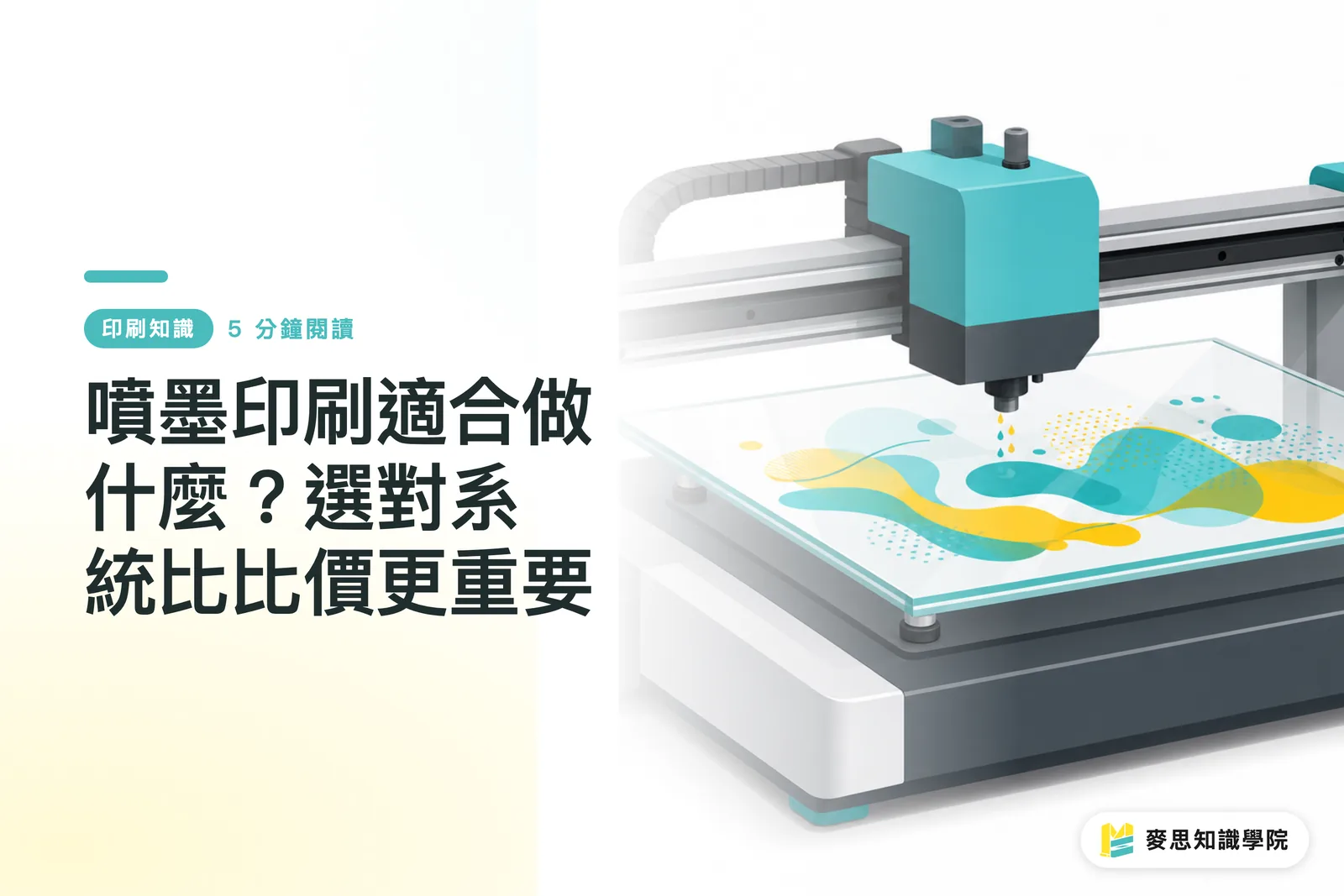
Is Industrial Inkjet Printing Really Just a Scaled-up Home Printer?
No. In fact, this is the most common misconception I have to clear up for clients first
The only thing a cheap home printer has in common with an industrial inkjet printer on a production line is the act of "spraying ink droplets onto a surface." Beyond that, they are completely different beasts. The differences lie in ink chemistry, printhead lifespan, substrate feeding systems, and post-printing drying processes. These four factors determine whether your prints are usable and durable
Industrial inkjet printers are generally classified into four categories based on their ink systems, each with vastly different characteristics:
・Aqueous: Water-based ink that delivers clean colors at a relatively low cost, but is vulnerable to water and scratching. It is primarily used for indoor, paper-based prints
・UV: The ink cures instantly under UV light, allowing it to print on almost any rigid material (acrylic, glass, metal, wood boards). It features a textured ink layer and strong adhesion, making it the fastest-growing sector for custom products in recent years
・Latex: A water-based formula that relies on heat to cure resin into a film. It has no harsh solvent smell, is suitable for indoor installation, and is more weather-resistant than pure Aqueous inks. Commonly used for wall stickers and large indoor prints
・Solvent (Solvent / Eco-solvent): The ink slightly bites into the surface of plastics like PVC. Excellent outdoor weatherability is its main strength, making it the go-to for vehicle wraps and outdoor banners
Quick rule of thumb: If it needs to be waterproof, go with Latex or Solvent; if you are printing on rigid substrates, choose UV; for pure indoor paper prints, Aqueous is the most cost-effective
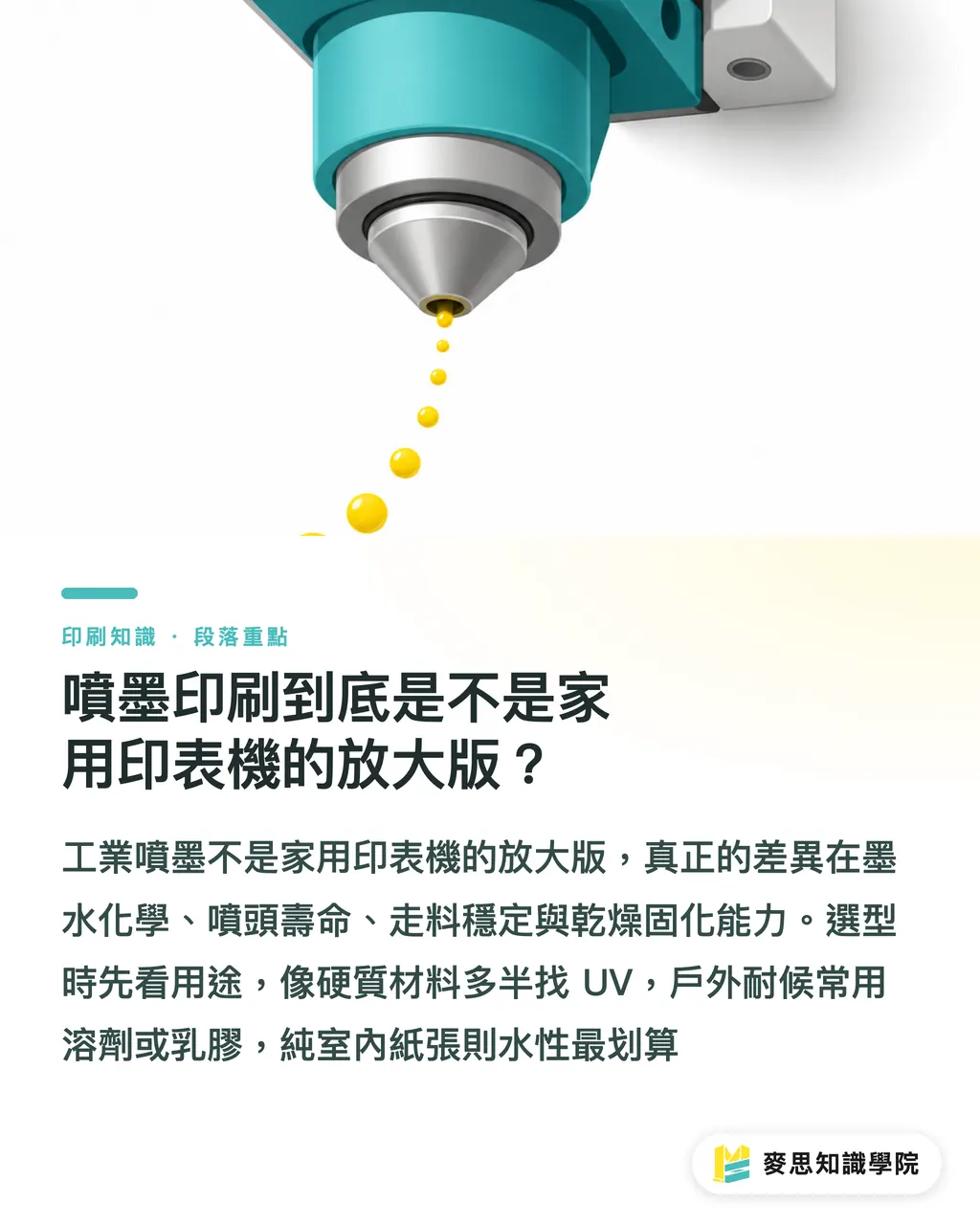
Why You Shouldn't Judge Quality Solely by the Price Per Sheet
Because price reflects the ink system and post-processing, not just "how good the print looks."
I've seen too many clients place three quotes side-by-side and choose the cheapest option, only to have their outdoor sign fade into a blank sheet of white in three months. The issue wasn't that the vendor cut corners; it was that they used indoor water-based ink for an outdoor job, which naturally couldn't withstand UV exposure
Before judging quality, clarify these three things first:
・Where will this product be placed? Indoors, semi-outdoors (such as arcades or illuminated store signs), or fully outdoors under the sun and rain?
・How long does it need to last? The specifications for a two-week exhibition are completely different from a store sign meant to hang for two to three years
・Will it be touched, scratched, or wiped with cleaning agents? Counter displays and customized phone cases have vastly different requirements for wear resistance
By clearly explaining the application, the vendor can match it with the correct ink and protective lamination. For the same A1 size print, the cost of outdoor solvent ink with lamination is naturally two to three times that of indoor water-based ink. This isn't expensive, they are simply two different products
Outdoor Signage, Packaging Mockups, and Low-Volume Customization: What Are the Key Differences in Specs?
The differences lie in the priority of three dimensions: weather resistance, color accuracy, and the feel of the ink layer
Although they are all under the umbrella of inkjet, these three requirements demand almost opposite things:
・Outdoor Signage: Weather resistance is the top priority. To resist UV fading and rain, solvent or latex inks combined with outdoor-grade lamination are essential. Color accuracy can be slightly compromised; durability is what matters
・Packaging Mockups: Color accuracy is the top priority. The client wants to see if "the mass-produced version will look like this." Thus, it must accurately simulate production colors, ideally on specialty paper or mockup packaging substrates. Here, the wide color gamut of UV or high-end Aqueous systems has the advantage
・Low-Volume Custom Products (phone cases, mugs, acrylic stands): Material adaptability is the top priority. Whether the surface is curved, rigid, or transparent acrylic, a UV flatbed printer is almost the only solution because it cures directly onto hard surfaces and supports white ink under-printing
Also, do not be misled by resolution figures. The visual quality of inkjet is not determined by DPI alone; you must look at ink droplet size, variable droplet technology, and printhead carriage speed together to get an accurate picture. For the same machine, the speed can vary by three to four times between the highest quality mode and the fastest draft mode, with a corresponding drop in detail. Urgent banners and mockups meant for close inspection should naturally be set to different print modes
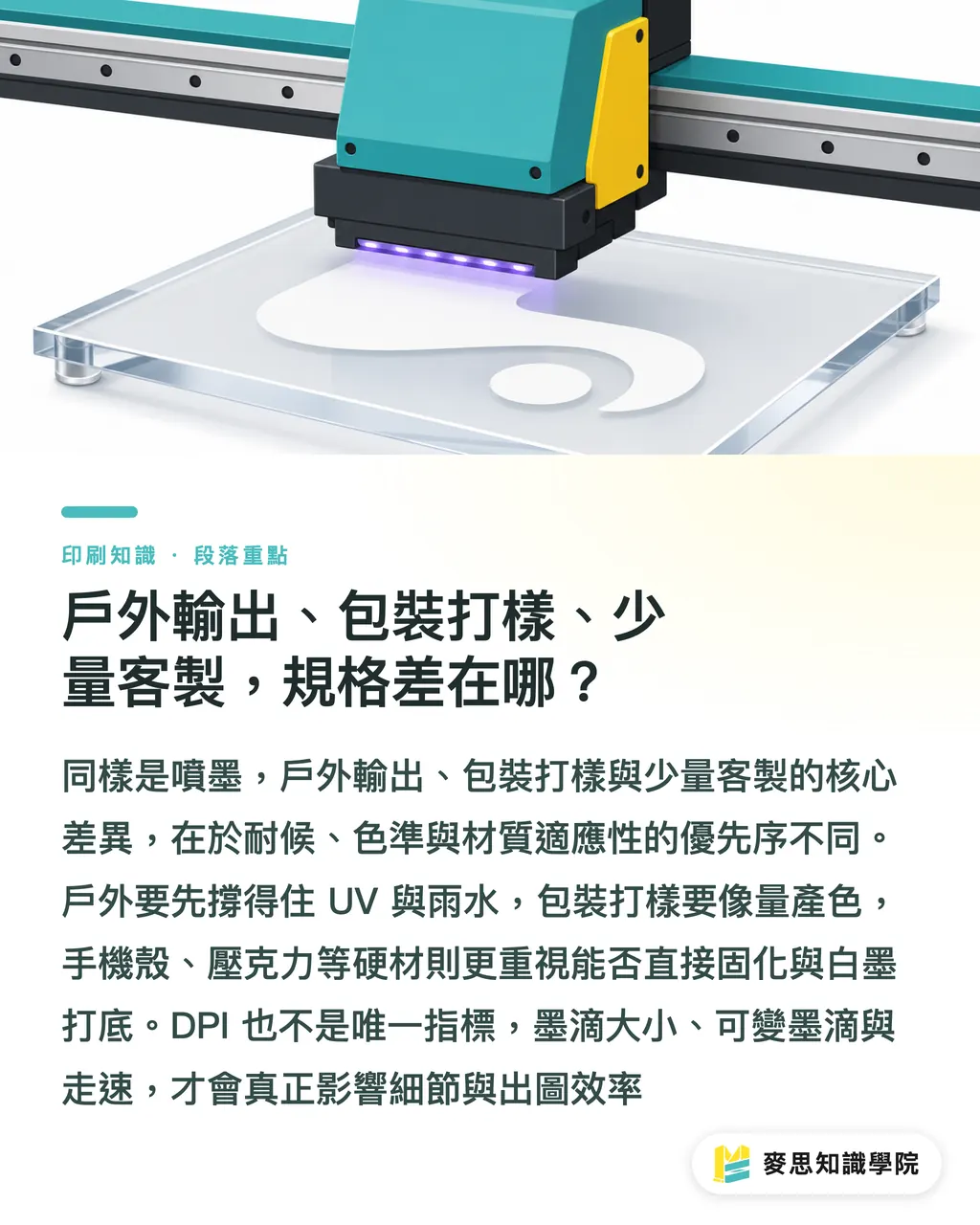
Why Do Drying Methods and Ink Layer Thickness Affect the Final Product's Quality?
Because drying determines adhesion and production efficiency, while ink layer thickness determines the tactile feel and level of texture
The drying mechanism of the four systems is completely different, which directly impacts what materials you can print on:
・Aqueous relies on evaporation or hot air. It dries slowly, and ink can easily pool or smudge on non-absorbent substrates
・Latex relies on heating to form a resin film. Therefore, the substrate must be able to withstand that temperature; thin film materials may wrinkle
・Solvent relies on solvent evaporation. It requires some "degassing" time for the smell to dissipate and for adhesion to stabilize. Laminating too quickly can cause issues
・UV cures instantly under a lamp. This immediate drying is why it can build up a thick, tactile ink layer to create spot UV, braille, or 3D textures
The "tactile thickness" of UV is its most underestimated value. Adding spot UV thick-ink effects to a business card instantly elevates both its look and feel. Traditionally, offset printing would require a separate spot UV coating process to achieve this effect, but UV inkjet does it in a single pass. On the flip side, a thicker ink layer means higher ink costs and greater curing energy, so thick ink shouldn't be applied to everything
How Should SMEs and Designers Choose an Inkjet Solution?
Choose by "working backward from the application to the system," rather than starting with "whoever is cheapest."
Here are a few practical rules of thumb I often share with clients:
・For indoor posters, exhibition boards, and large paper prints: Aqueous or Latex is sufficient. Don't pay extra for weather resistance you don't need
・For outdoor signs, vehicle wraps, and banners: Make sure to use Solvent or Latex inks, and always ask if outdoor lamination is included. Outdoor inkjet printing without lamination is a gamble
・For rigid custom products, acrylic, metal, wood, or 3D mockups: Target UV flatbed printers and check if they can print white ink (transparent and dark substrates won't produce accurate colors without a white base)
・For packaging mockups and color proofing: Focus on color management and matching. Ask the vendor if they have ICC profiles and if they can print on your specified paper
The most practical first step is to write down three answers for your product: "Where will it go? How long must it last? Will it be touched?" Use this list to query vendors. Those who ask about your application first, rather than instantly quoting the lowest price, are usually more reliable. This is also what MINDS Printing is accustomed to clarifying first when taking on projects, because if you choose the wrong system, even the most beautiful design files won't save the final result
Key Takeaways
・Industrial inkjet is divided into four systems: Aqueous, UV, Latex, and Solvent. Their properties are worlds apart, select the system before discussing the price
・Go with Latex or Solvent if waterproofness is needed; choose UV for printing on rigid substrates; and Aqueous is the most cost-effective option for pure indoor paper prints
・Outdoor printing without lamination is a gamble. Signs that fade in three months are usually the result of using the wrong ink
・UV inkjet can build up tactile, dimensional ink layers, delivering spot UV and rigid customization in one go
・Select a solution by working backward from "where it goes, how long it lasts, and whether it will be touched," rather than starting with the cheapest price
Further Thoughts
The step where things actually go wrong is rarely in the design files themselves, but rather because "no one asked where the final product is going." The next step is simple: whether you are a designer outsourcing production or a corporate buyer, summarize the application, lifespan, and physical contact context into a single requirement sheet before asking for quotes. You will find that the discrepancies in quotes suddenly make sense because everyone is finally bidding on the same thing. For print shops adopting digital tools, turning this "application check-up" into a standard form or an online configuration workflow will retain clients far better than competing on price-per-sheet. After all, you are selling peace of mind that nothing will go wrong, not just the cheapest sheet of paper
FAQ
- Can inkjet printing be used for outdoor signs?
- Yes, but you must use solvent or latex inks, combined with outdoor-grade lamination or protective coating, to withstand UV rays and rain. Using indoor water-based ink outdoors commonly results in noticeable fading within a few months
- What is the difference between UV inkjet and standard inkjet printing?
- UV inkjet ink is cured instantly by UV lamps and dries almost immediately. It can print directly on rigid materials like acrylic, glass, metal, and wood, and it can build up a tactile, dimensional ink layer, making it ideal for rigid custom items and spot varnishing
- Why is there such a huge price difference for inkjet prints of the same size?
- The price difference stems primarily from the ink system and post-processing. Indoor water-based printing is the cheapest, while outdoor solvent with lamination can cost two to three times as much due to different weather resistance grades. They are simply not the same product
- Is inkjet printing suitable for packaging mockups?
- Yes, but the key is color management rather than resolution alone. To simulate production colors on specified substrates, the wide color gamut of UV or high-end Aqueous printing is preferred. Be sure to confirm that the vendor has color management capabilities using ICC profiles
- Is a higher inkjet resolution number always better?
- Not necessarily. Visual quality must be evaluated by looking at droplet size, variable droplet technology, and print carriage speed together. Running the same machine at its highest quality mode versus its fastest speed can vary output times by three to four fold, with a corresponding change in detail. Urgent prints and mockups meant for close inspection should be set to different modes
Related articles
The Print × AI weekly
The print and AI know-how designers, brands and enterprises can use before they commit — one email, every week
MINDS Free Tools
Spine width and imposition calculators — skip the manual math, free in your browser.
MINDS Group
Need actual printing or gifting services?
From premium printing to online ordering and festive gifts — the MINDS Group sister brands take it from here.