

Overview
Before asking for a quote, first confirm how many pieces fit on one sheet, how many cuts are needed, how much trim waste remains, and whether multi-color registration is involved. Then use those specs to discuss pricing. The "MINDS (MS) three print-ready checks" used by MINDS (MS, mid-to-high-end fully custom commercial printing) usually blocks on ① finished size ② layout yield ③ cutting path. If these 3 things are not confirmed, the low price on a quotation often just hides the waste until later
What Should You Ask Before Quoting So Price Comparisons Are Not Wasted?
Imposition efficiency: the yield rate showing how many finished pieces can fit on a parent sheet or press layout while keeping bleed, gripper margin, and cutting safety margins. It is usually estimated by dividing finished product area by usable layout area
Do not ask only "how much is one box of business cards." That usually gets you an item price, not a process price. The MINDS (MS) three print-ready checks break the issue into the negotiable details below
・Finished size: 90×54 mm or a non-standard size, and how much bleed and safety margin are needed on all four sides
・Imposition method: business cards of the same size may be imposed as 1× 10, 2× 5, 4×3, or gang-run with other items
・Cutting path: whether the long edge or short edge is cut first, and whether rotation, re-stacking, or trimming is needed
・Trim waste handling: whether the waste ratio is estimated by area only, or together with cut count, make-ready sheets, and spoilage
・Multi-color registration: beyond CMYK 4-color, whether spot colors, white ink, foil stamping, or local finishing need to align
If the specs are fixed, the quantity is small, and price sensitivity is high, I would suggest starting with the online order items at Mai Printing. If size, paper, finishing, or brand color control matters more, hand it directly to MINDS for layout and process confirmation. Asking 10 more minutes of questions upfront is usually easier than fixing files later
Why Do 1×10, 2×5, and 4×3 Cost Differently for the Same Business Card?
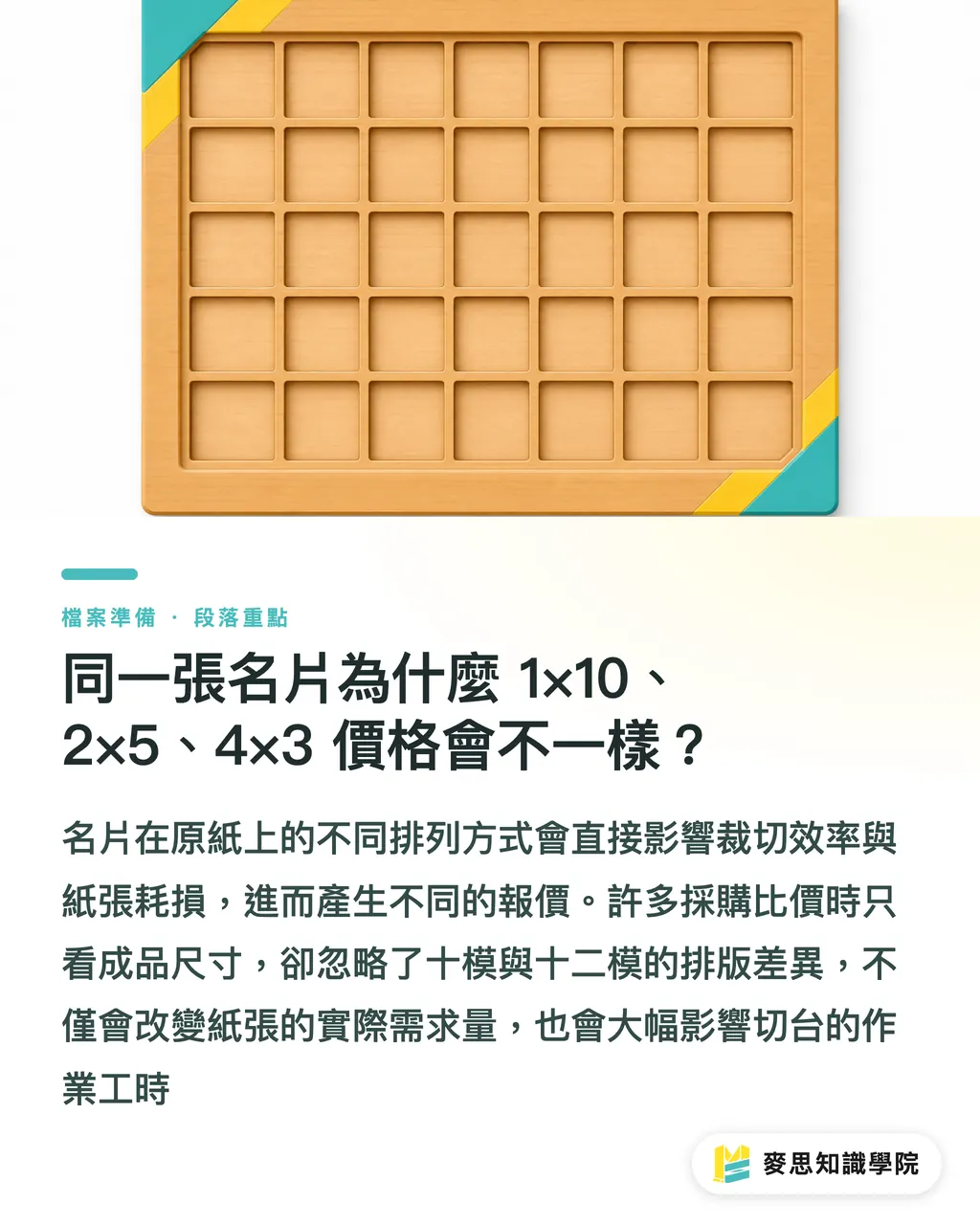
The same business card size can be imposed as 1×10, 2×5, or 4×3. On the surface, that looks like simple rearrangement. On the production floor, the question is how many deliverable pieces each parent sheet gives back, and whether the cutter must keep changing direction
Cutting efficiency: the degree to which cutting lines can be shared in batches when large printed sheets are cut down to final size. It is affected by cut count, number of rotations, number of re-stacks, and trim waste area
・1×10: very long horizontally. If the leftover edge is too narrow, the cutter has to handle long strips of paper waste, increasing stacking and alignment time
・2×5: 10 pieces per set. Usually easier to stack, with cleaner cut lines, so quotes tend to be more stable
・4×3: 12 pieces per set on paper, but only if the parent sheet width and height can still fit the bleed and gripper margin. Forcing it in often turns trim waste into scrap risk
I have seen too many purchasing teams compare only by finished size without asking how many-up the vendor will actually impose. For the same 1000 business cards, 10-up and 12-up require different amounts of paper and different cutter time
How Do You Convert Finished Size into Parent Sheet Cost?
Do not rush
Take a 90×54 mm business card as an example. What actually enters the quote is not the 90×54 mm size itself, but the imposed area after bleed, cutting gaps, and gripper margin are added. If the designer only provides the finished outline, prepress still has to calculate it again
・Single-up width including bleed = finished width + left and right bleed + allocated cutting gap
・Single-up height including bleed = finished height + top and bottom bleed + allocated cutting gap
・Number of columns that fit = floor (usable parent sheet width ÷ single-up width including bleed)
・Number of rows that fit = floor (usable parent sheet height ÷ single-up height including bleed)
・Finished pieces per parent sheet = number of columns × number of rows
・Imposition efficiency = finished product area × finished pieces per parent sheet ÷ usable parent sheet area
Trim waste can be estimated first with "1 - imposition efficiency." If imposition efficiency is 80%, at least about 20% of the area goes into trim waste, before counting test prints, color adjustment, trimming, and rejected pieces
How Do Standard Cutting Sizes Eat Into Your Budget?
A standard cutting size is the range that production can handle consistently after paper specs, pressable layout area, gripper margin, bleed, and cutting safety distance are all taken into account
I usually split cutting questions into 3 production-floor questions. These 3 questions are much closer to quoting reality than "paper should be cheap, right?"
・Can this finished size be cut along an existing cutting path, without adding another cutting round just for 2 mm
・After the parent sheet is cut, is the leftover material a reusable long strip, or can it only go into waste paper
・Does the finished edge length let the operator align sheets consistently, without shifting once the stack gets thick
Designers often change 90×54 mm to 92×55 mm and think it is only a little bigger. What prepress sees is that a layout that used to fit 10-up may lose 1 position, and the cutter may need 1 extra rotation. That cost does not disappear. It goes into the quote
Why Do Multi-Color Printing and Registration Change Imposition Decisions?
Registration: in multi-color printing, the control process that realigns separated CMYK or spot-color plates back onto the same finished product position. Any error becomes more visible on borders, text, and fine lines
CMYK 4-color is only the baseline. In multi-color registration, you cannot chase the highest number of pieces per sheet only, because gripper margin, paper pull direction, color sequence stability, and paper expansion or shrinkage all affect alignment
・Bordered business cards: if the visual border is only 1 mm around the edges, even a small cutting or registration shift makes the uneven thickness visible
・Full-bleed background color: trim waste and bleed must be enough. If cutting exposes a white edge, the whole stack needs rework
・Spot color or foil stamping: the position must align with the main artwork. Imposition has to keep the registration reference clear, not just cram in as many pieces as possible
My judgment is firm: when brand colors, thin borders, two-sided alignment, and multiple finishing steps appear in 2 or more items, do not make the lowest unit price the main target. Settle cuttability and registration allowance first

Key Takeaways
・A quote does not start with print quantity. First check whether one sheet can be filled well and cut steadily
・The differences between 1× 10, 2× 5, and 4×3 are often hidden in cutting paths and trim waste
・If imposition efficiency drops by 10%, you lose more than paper. You also lose cutter time and room for rework
・For multi-color registration jobs, it is better to impose one fewer position than to use up all alignment allowance
・When purchasing can ask how many-up the layout is, the quote finally has something concrete to negotiate
Further Thinking
The practical method does not need to be complicated. Start with 3 fields: finished size, usable parent sheet size, and cutting path limits, then write them into the quotation process. Before final artwork, the design side can back-calculate bleed and safety margins from finished sizes such as 90×54 mm. The AI and SaaS side can first compare imposition options, estimate trim waste ratio, and provide preflight reminders, while keeping final human confirmation for cutting paths and registration allowance. If this workflow needs to become an internal checklist or customer inquiry form, the Mai Strategy Knowledge Academy consulting team can help translate production-floor rules into specification language designers can understand
Further Reading
・Source topic: Layout Imposition and Cutting Efficiency: Cost Factors You Must Know Before Quoting
FAQ
- Does layout imposition directly affect a print quote?
- Yes. When the same business card size is imposed as 1×10, 2×5, or 4×3, finished pieces per parent sheet, trim waste ratio, and cutting path all change, so the quote changes too
- How can I estimate imposition efficiency myself?
- Use the finished size including bleed to divide the usable parent sheet dimensions, calculate the number of columns and rows that fit, then estimate imposition efficiency with "finished product area × finished piece count ÷ usable parent sheet area"
- How is trim waste ratio calculated?
- Start with "1 - imposition efficiency" to estimate area waste. For example, if imposition efficiency is 80%, trim waste area is at least about 20%, before counting make-ready and trimming losses
- Why can't multi-color printing just fit the most pieces possible?
- CMYK 4-color or spot colors need registration alignment. Packing too tightly compresses the allowance for gripper margin, bleed, and cutting lines, making thin borders, full-bleed background colors, and two-sided alignment more likely to fail
- What should small and mid-sized businesses prepare before asking for a quote?
- Prepare the finished size, quantity, paper stock, finishing, two-sided orientation, and color requirements, then ask the vendor to explain how many-up the layout will be, how trim waste is calculated, and whether extra cutter rotation is needed
Related articles





The Print × AI weekly
The print and AI know-how designers, brands and enterprises can use before they commit — one email, every week
MINDS Free Tools
Spine width and imposition calculators — skip the manual math, free in your browser.
MINDS Group
Need actual printing or gifting services?
From premium printing to online ordering and festive gifts — the MINDS Group sister brands take it from here.