
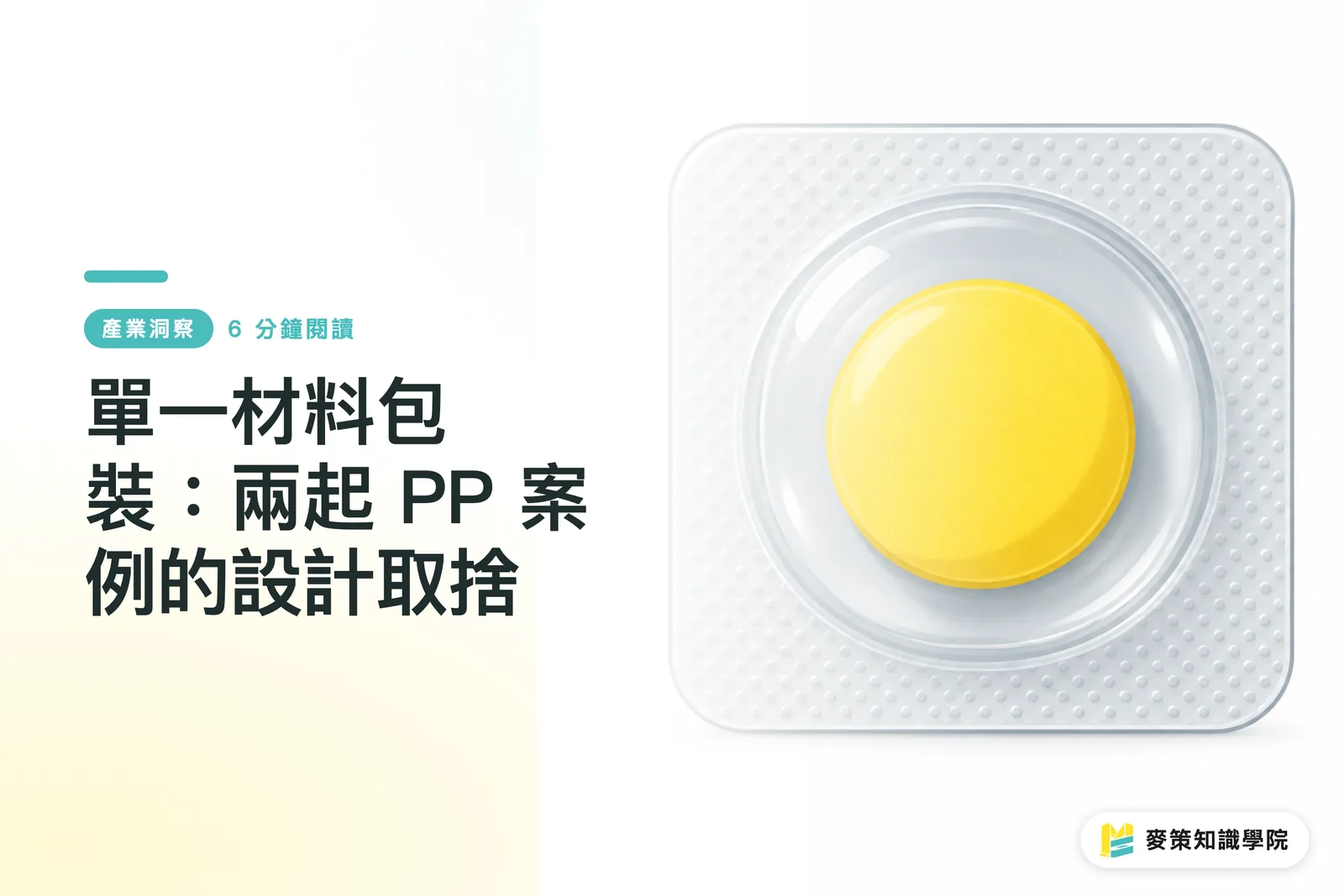
What problem does monomaterial packaging actually solve?
Monomaterial packaging addresses the friction between packaging structures and recycling sorting. It first keeps the main structure within one material family, then puts design, manufacturing, and recycling on the same specification sheet
Monomaterial packaging means that a package’s main structure uses one family of recyclable materials, reducing the obstacles that separating different materials creates for recycling. It still has to meet product-protection, processing, and use requirements
The two PP (polypropylene) case studies involve different settings: Bayer launched a monomaterial PP blister for Talcid in Germany, while Klöckner Pentaplast introduced recyclable PP pizza packaging designed to retain heat. See the full case study at Packaging Insights: Bayer launches a monomaterial PP blister for Talcid
I’m putting the two cases side by side because material changes have already entered design discussions for pharmaceutical and food-service packaging. Brands cannot simply write sustainability into a slide deck. They also need to answer what happens to the package after use
What should the design team validate first in Bayer’s Talcid PP blister redesign?
Bayer’s Talcid PP blister case reminds the design team to validate the package’s protection, sealing, and dispensing requirements first, then plan the graphics, color, and recycling communication
A blister is not a flat print job that can be completed just by swapping in a new layout. The material, forming, sealing, and opening experience all affect one another
The German Talcid case shows that monomaterial PP has entered pharmaceutical packaging. The brand still needs its packaging-material, printing, and quality-control teams to confirm product protection, regulatory requirements, and how the package will be used
Don’t rush
Before sampling, I ask the team to put the following items into the acceptance record
・Confirm first that the material change does not affect product protection
・Include forming, sealing, and opening feel in the sample inspection
・Then check the print performance and recycling labeling of the PP substrate
These tasks do not automatically disappear just because the structure becomes monomaterial. The value of the Talcid case is that it brings material selection into the actual packaging task. A good-looking design proof is only one item on the checklist
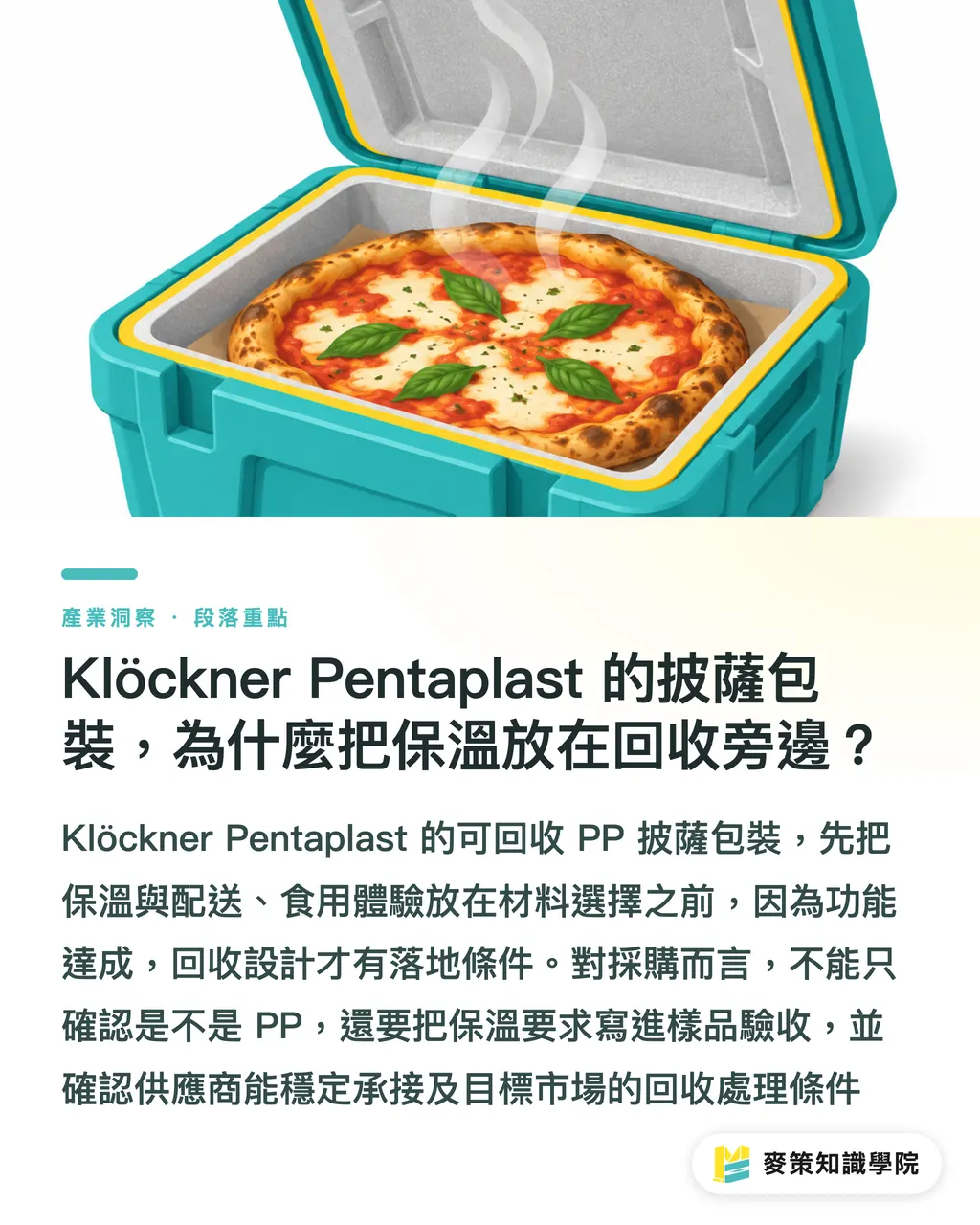
Why does Klöckner Pentaplast put heat retention alongside recyclability in its pizza packaging?
Klöckner Pentaplast’s recyclable PP pizza packaging puts heat retention alongside material choice because hot-food packaging must first preserve the delivery and eating experience. Recycling design only has a chance to work once that is in place
This case builds heat retention directly into PP pizza packaging, which is highly practical for procurement. Before asking, “Is it PP?”, brands should spell out what the structure must do before the product reaches the consumer
Start with one question
A specification meeting can check these items one by one
・1. Write the heat-retention requirement into sample acceptance. It cannot be left only in the slide deck
・2. Confirm whether the existing printing, forming, and processing suppliers can handle the work consistently
・3. Break “recyclable PP” down into the material structure and the target market’s recycling conditions
The two cases involve very different settings, a Talcid blister and pizza packaging, yet both require brands to bring material decisions back to product function. These are the specification fields that small and midsize businesses can use when questioning suppliers
How can a brand make the “recyclable PP” claim hold up?
For “recyclable PP” to hold up, the brand must check its material claim, packaging structure, and the recycling conditions in the target market in the same specification
The word “recyclable” cannot fulfill a brand’s recycling promise by itself. The brand needs to verify each point:
・Whether the packaging structure stays aligned with a monomaterial approach
・Whether the target market’s collection, transport, and sorting conditions can support it
・Whether consumers can understand how to handle it
The German Talcid blister and Klöckner Pentaplast’s pizza packaging are both European cases. When Taiwanese brands cite them, they should spell out the region, material, and recycling conditions instead of treating an overseas case as a guarantee for the Taiwan market
ESG (environmental, social, and governance) communication should use the same wording as procurement specifications. The reminder I give clients most often is simple: leave one vague adjective off the package, and the verification and communication that follow have one less layer of dispute
What should Taiwanese brands and small and midsize printing companies do now?
Taiwanese brands and small and midsize printing companies should treat monomaterial PP as a joint sampling exercise: align on function first, confirm whether the supply chain can deliver it, and only then decide what to say publicly
From the packaging-material projects I’ve handled recently, I can tell that when a brand waits until just before placing an order to ask about materials, the schedule is already tight. I use Mai Strategy’s “three gates before sending a job to print” to structure the first meeting
・1. Turn the Talcid blister’s protection and dispensing requirements, or the pizza package’s heat-retention requirement, into sample acceptance criteria
・2. Then confirm the responsibility boundaries for the PP substrate, printing, forming, sealing, and post-processing
・3. Finally, check the recycling language for the target market and the instructions for consumers
When a client asks, “Can you make it in PP?”, a printer’s answer cannot stop at whether the equipment can feed the material. It also needs to clarify the product requirements and delivery responsibilities
For a mid- to high-end, fully customized commercial printing assessment, brands can ask MINDS to review the samples and specifications together. If the internal material and communication specifications are not in place yet, they can contact the Mai Strategy Knowledge Academy consulting team to first turn the questions into procurement language
Key takeaways
・The value of monomaterial PP must be validated against both product function and the recycling route
・Bayer’s Talcid blister reminds brands that a material change in pharmaceutical packaging cannot skip protection and dispensing tests
・Klöckner Pentaplast’s pizza case shows that heat-retention requirements must be written into the recyclable-packaging specification
・Taiwanese brands should put the function, structure, and recycling checks into the sampling process before talking about sustainability copy
Further thoughts
Looking at print manufacturing, monomaterial PP will draw clearer lines of responsibility across prepress, printing, forming, and sealing. Designers cannot simply hand over a layout file, and printers cannot simply quote one material price. AI can compare material specifications across versions, organize sampling records, and check whether claims go beyond the conditions already confirmed. But product protection, sealing, and recycling suitability still require physical samples and confirmation from the supply chain. If SaaS (Software as a Service) can place material versions, supplier responses, sample results, and market wording in one traceable record, a brand will not have to start over from verbal memory the next time it changes materials. The first step is to turn the two PP cases into a one-page specification sheet
Further reading
FAQ
- Is monomaterial packaging just one kind of plastic?
- Monomaterial packaging means using the same type of recyclable material for the main packaging structure. The key is whether the structure connects with the recycling route, not just what the material is called
- What can brands learn from Bayer’s Talcid PP blister case?
- The German Talcid case reminds brands that a PP material change must validate pharmaceutical packaging’s protection, sealing, dispensing, printing, and recycling communication at the same time. It is not enough to confirm that the material can be purchased
- Why does Klöckner Pentaplast’s pizza packaging emphasize heat retention?
- Pizza packaging must first maintain the conditions needed for hot-food delivery and eating. If heat retention is not written into sample acceptance, the recyclable claim lacks support from product function
- How should Taiwanese brands start adopting monomaterial PP?
- Start by organizing the specifications around three checks: function, structure, and recycling. Then have the designer, printer, and packaging-material supplier develop samples together, and confirm the recyclable wording for the target market
Related articles
The Print × AI weekly
The print and AI know-how designers, brands and enterprises can use before they commit — one email, every week
MINDS Free Tools
AI background removal, a LINE sticker maker, spine & imposition calculators — all free, right in your browser, no upload.
MINDS Group
Need actual printing or gifting services?
From premium printing to online ordering and festive gifts — the MINDS Group sister brands take it from here.