
Why Is Plastic Packaging Under Pressure From Two Sides at Once?
Plastic packaging is under pressure because its environmental cost and the functions plastics provide in medical settings are now both part of decisions about policy, procurement, and brand reputation
Flexible Packaging Association (FPA, the U.S. association for flexible packaging and a source of information about the flexible packaging industry) published Plastic Packaging Under Double Pressure: How the Industry Can Find a New Balance Between Environmental and Health Concerns on August 25, 2026. Read alongside an industry review for World Cleanup Day (a global initiative focused on environmental cleanup), the article moves the debate from a preference for one material to plastic's production, use, and disposal
The article also breaks healthcare plastics down by use: syringes, IV bags, catheters, diagnostic kits, gloves, and PPE each serve different roles in patient care, infection prevention, and clinical efficiency
Health concerns cannot be treated as proof that all plastics carry the same risks, and plastic-reduction slogans cannot skip over product use
On packaging projects, I draw this line first. When a brand lumps medical plastics, everyday consumer packaging, and high-barrier flexible packaging into one category, procurement specifications quickly lose focus. That is why I do not support handling every plastics project with one slogan
Can a Single Material Really Solve the Recycling Problem?
A single material can simplify the packaging structure, but it cannot automatically restore the barrier performance that multilayer films originally provided
Single-material packaging is made mainly from one type of polymer, which makes sorting and processing after use easier. It still has to meet barrier, sealing, and preservation requirements. The material name alone is not enough
mono-PE (single-material polyethylene) and mono-PP (single-material polypropylene) are common routes discussed when flexible packaging is redesigned. High-barrier multilayer films combine the functions of different materials. They often offer better protection, but are harder to separate for recycling
Start with the use case
・mono-PE / mono-PP: The structure is simpler, and the recycling design is easier to explain, but barrier performance, sealing, and shelf-life requirements still need to be revalidated
・High-barrier multilayer film: It offers more complete protection for the contents, but makes separation and recycling more difficult. The brand needs to explain what each material layer does
If shelf life, seal reliability, and content protection have not been validated, a material switch can easily circle back to the original solution. The brand may also end up paying for scrap and reprinting
Even the prettiest design proof cannot replace material testing
How Can Brands Turn the Debate into Procurement Decisions?
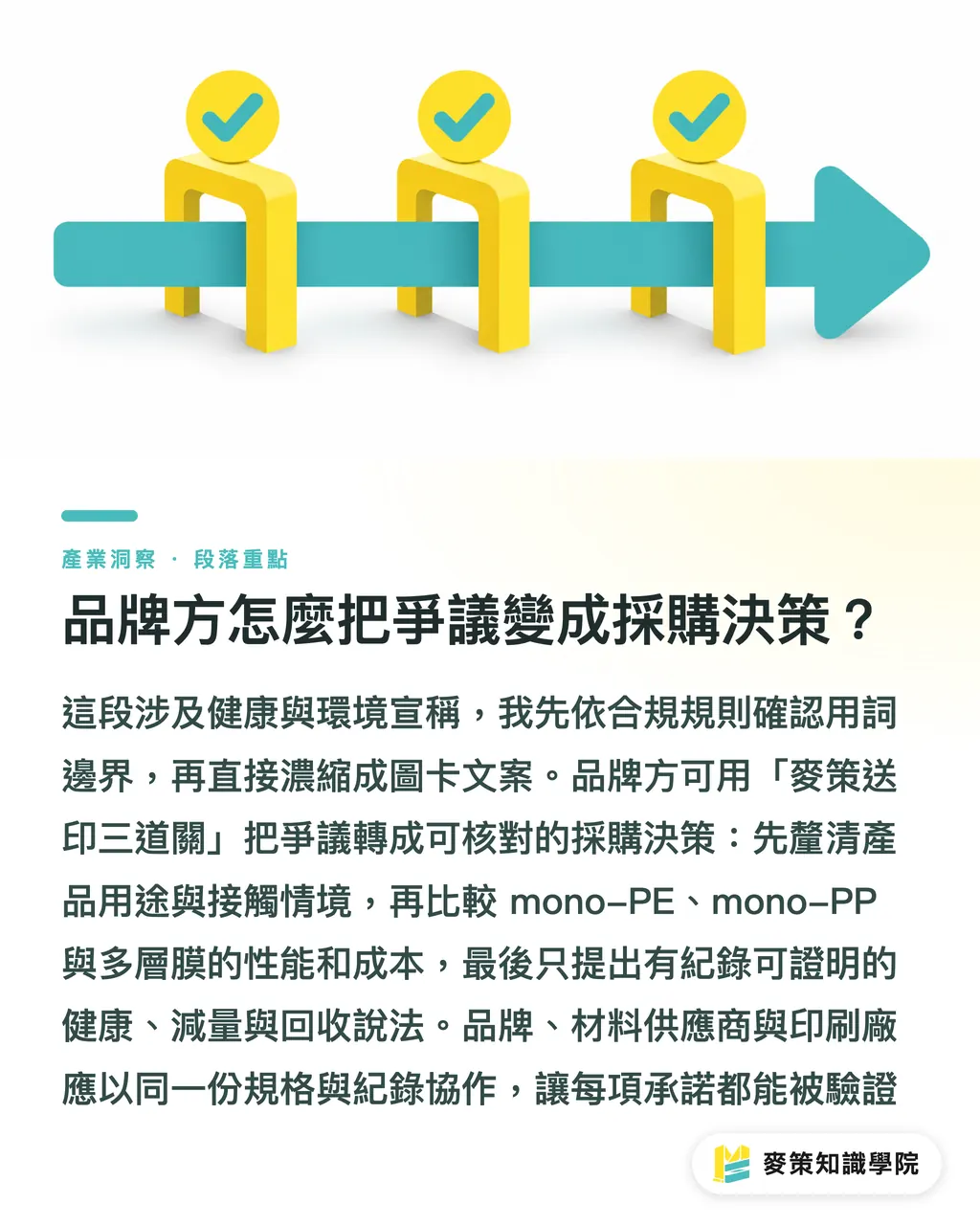
Brands need to break the debate into three procurement questions: What must the product protect? Where does the packaging go after use? Which health and environmental claims can be proven?
When I review specifications with a brand and printer, I use the "Mai Strategy Three-Gate Send-to-Print Check" to bring the discussion back to documents that can be checked
・1. Use-case gate: Spell out the product, preservation, and contact conditions. Assess medical plastics separately from general consumer packaging
・2. Materials gate: Compare the barrier performance, sealing, printing, and replacement costs of mono-PE / mono-PP and multilayer films
・3. Communication gate: Promise only reduction, recycling, and safety information that can be supported by records
FPA's page also lists "A Value Chain Road Map for Film and Flexible Packaging". The title puts responsibility on the entire flexible packaging value chain. Brands, material suppliers, and printers all need to work from the same specification
If the brand lacks a shared internal vocabulary, it can work with the Mai Strategy Knowledge Academy consulting team to put specification sheets, proofing records, and external wording into one document
How Should Small and Mid-Sized Printers Respond Early?
The first thing small and mid-sized printers should do is bring material substitution into quoting, proofing, and client approval, so the specifications are settled before the job reaches the press
Both the World Cleanup Day industry review and FPA's August 25, 2026 article place recycling, plastic reduction, and health concerns on the same map. Printers cannot wait for the client to specify the material at the very end
・Quoting: List the structure, function, alternatives, and validation status. Do not use "eco-friendly material" as a product name
・Proofing: Confirm print appearance, sealing, and use conditions at the same time, so the artwork does not need reworking at the end
・Delivery: Spell out the applicable recycling regions and post-use handling, so the brand has an answer when asked
On the production line, the most maddening moment is when a client holds up the word "recyclable" and asks: Where exactly is it recycled? Who takes it? What happens after it is collected?
If a packaging project also involves layout, proofing, and print production management, work with MINDS to lay out the trade-offs and confirm them. That way, the brand knows what it is paying for before placing the order
Key Takeaways
・Environmental pressure and health concerns around plastic packaging need to be assessed by use case
・Single-material packaging reduces structural complexity, but it does not guarantee that barrier performance and recyclability will both be acceptable
・Brand procurement should start by documenting product function, post-use destination, and external claims that can be proven
・Small and mid-sized printers should bring material substitution forward, creating room to negotiate at the quoting and proofing stages
Further Thoughts
At the manufacturing end, turn materials, proofing, and client approval into traceable fields. On the design side, mark material and finishing constraints at the layout stage. AI can help compare specifications, organize meeting notes, and generate question lists, but it cannot decide a brand's health and safety or recycling commitments. SaaS should keep material structures, test results, recycling regions, and versions in one record, so the next material change does not depend on verbal memory
Further Reading
FAQ
- Does using less plastic packaging automatically make it more environmentally friendly?
- Not necessarily. Brands need to look first at product use, shelf-life requirements, and where the package goes after use. If material substitution causes product loss or removes necessary protection, the plastic-reduction goal has not fully counted the cost
- Is single-material packaging always better than multilayer film?
- Not necessarily. mono-PE or mono-PP can make the structure simpler, but high-barrier multilayer film may protect the contents better. The choice has to come back to barrier performance, sealing, shelf life, and recycling conditions
- Can medical plastics and general packaging use the same plastic-reduction standard?
- Not directly. Syringes, IV bags, catheters, diagnostic kits, gloves, and PPE serve different roles in patient care, infection prevention, and clinical efficiency. Health concerns must also be assessed by category
- What should small and mid-sized printers in Taiwan do first?
- Put the material structure, alternatives, validation status, and recycling notes into quotation and proofing documents. Before client approval, confirm which claims are backed by records, so the job does not have to be reworked after it reaches the press
Related articles


The Print × AI weekly
The print and AI know-how designers, brands and enterprises can use before they commit — one email, every week
MINDS Free Tools
AI background removal, a LINE sticker maker, spine & imposition calculators — all free, right in your browser, no upload.
MINDS Group
Need actual printing or gifting services?
From premium printing to online ordering and festive gifts — the MINDS Group sister brands take it from here.