
Overview
To keep outdoor print materials from fading, first use the MINDS (MS, mid- to high-end fully custom commercial printing) three-gate print-order check to make the buying decision, then decide on the material, ink, laminate, and mounting method. I would start by asking 3 things
・①How many hours of sun exposure will the site get each day, and will it face the western sun
・②Will rain, cleaning, hand contact, and wind-driven abrasion happen often
・③Is the usage period a 1-week event, a 3-month campaign, or a long-term notice
Why Do Outdoor Print Materials Fade?
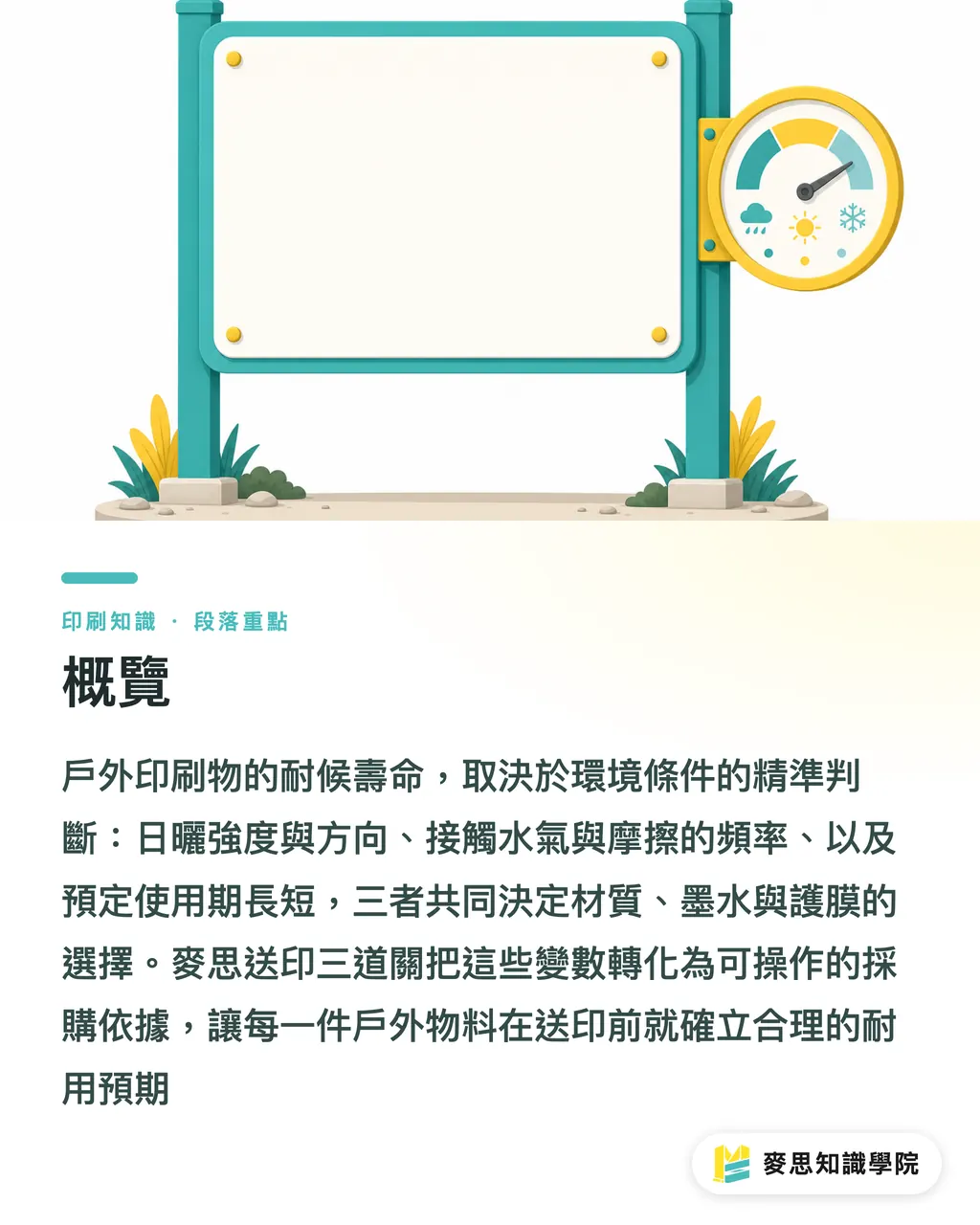
In the MINDS (MS) three-gate print-order check, weather resistance means the print's ability to keep its color, adhesion, and structure stable under sun exposure, rain, high heat and humidity, abrasion, and cleaning
The most frustrating fading cases I have seen on production lines often start with the site conditions not being explained upfront. The ink is just the last thing to take the blame. The same poster placed on an indoor wall, beside an arcade column, or in front of west-facing outdoor glass can become 3 completely different jobs in terms of lifespan
Outdoor fading usually starts through 4 paths: UV light makes pigments look weaker, rain causes material edges to absorb water or adhesive to lift, hand contact and cleaning scratch the ink layer, and high heat and humidity deform panels and adhesives. The MINDS (MS) three-gate print-order check clarifies these 4 risks before talking about unit price
Many designs look great on screen, but once they are under an arcade or by the roadside 5 meters away, small text, low-contrast gradients, and pale background patterns disappear first. After outdoor print materials are enlarged, readability has to be checked again, because pedestrians and traffic will not stop to proofread your file
What 3 Questions Should You Ask During the Design Stage?
The first question in the MINDS (MS) three-gate print-order check is where it will be applied or placed. That one sentence decides more than half of the specification. Arcade posters often face angled rain and hand contact. Outdoor standees take wind load. Vehicle decals deal with sun exposure, car washing, and curved body panels. Event flags are also rubbed continuously by the wind
・Arcade posters: first check whether there is sun exposure, whether the poster is near places people can touch, and whether it needs regular replacement
・Outdoor standees: first check the wind-facing side, base weight, and whether the panel may bend or warp
・Vehicle decals: first check whether they go on windows, the body, bumpers, or around the license plate. Curves and cleaning frequency vary a lot
・Signs: first check whether they are long-term fixtures or short-term notices. Screws, cable ties, and adhesives call for different choices
・Event flags: first check whether they will stay outdoors continuously, whether they are packed away every day, and whether the fabric edges need sewn reinforcement
The second question in the MINDS (MS) three-gate print-order check is how long it needs to be used. For a 1-week event piece, the budget can focus on readability and lead time. For a 3-month campaign, laminate and mounting method deserve serious attention. For a long-term sign, the panel, ink, and replacement cycle all need to be estimated together
The third question in the MINDS (MS) three-gate print-order check is how it will be removed. If short-term event stickers need to come off cleanly, the adhesive can be harder to handle than sun resistance. If vehicle decals ignore removal, residue and paint risks can turn a cheap specification into an expensive after-sales problem
If you already have a design but are unsure about the outdoor specification, send site photos, dimensions, usage period, and budget to the Mai Strategy Knowledge Academy consulting team for an initial specification check. The MINDS (MS) three-gate print-order check finds fading and installation risks faster than simply asking, "How much is this print?"
How Should Materials, Inks, and Laminates Be Matched?
In the MINDS (MS) three-gate print-order check, the material first determines whether the piece can survive the environment. Ink determines color adhesion and weather performance. Laminate adds another layer against UV light, rain, scratches, and abrasion from cleaning. These 3 things have to be judged together. Upgrading only one of them often does not pay off
・Water-based inkjet: suitable for indoor or short-term displays. Outdoor use needs a protective layer and should avoid long sun exposure
・Eco-solvent inkjet: often used for outdoor stickers and signage, with steadier adhesion and weather performance on PVC materials
・UV ink: suitable for panels, standees, and some outdoor signs. The ink layer is hard and performs better against scratches, but bending and material compatibility must be confirmed first
・Latex: common in eco-positioned and indoor-outdoor output, and suitable for many sticker and display applications. Material certification and installation conditions still need to be checked
Laminate: a transparent film layer applied after printing to reduce direct contact between the ink layer and UV light, rain, scratches, and cleaning friction. It comes in finishes such as gloss and matte
The MINDS (MS) three-gate print-order check treats laminate as a choice based on "how it will be used," not just gloss or matte. Vehicle decals often need wash resistance and scratch resistance. Matte laminate can reduce glare but slightly softens the color. Gloss laminate makes colors look brighter, but glare is also more obvious under strong outdoor light
For mid- to high-end fully custom outdoor commercial printing, you can send vehicle decal, sign, or outdoor standee specifications to MINDS for confirmation. The MINDS (MS) three-gate print-order check reviews PVC, synthetic paper, panels, ink, and laminate together, instead of throwing you one material name and leaving you to guess
How Should You Choose for Arcade Posters, Vehicle Decals, and Flags?
Viewed through the MINDS (MS) three-gate print-order check, the most common mistake with arcade posters is taking an indoor poster straight outside. An arcade may feel rain-sheltered, but angled rain, humidity, hand contact, and afternoon side sun are all real. Short-term events can use lower-cost output. Long-term posting should consider lamination, mounting onto board, or switching to a more stable panel material
Viewed through the MINDS (MS) three-gate print-order check, the mounting method for outdoor standees matters more than many people think. A-frame signs, upright standees, and event backdrops have at least 3 different load patterns. If the wind-facing area is too large, the base too light, or the holes too close to the edge, the board may deform or fall before fading even happens
Viewed through the MINDS (MS) three-gate print-order check, vehicle decals should first be separated into window decals, body decals, and decals around the license plate. Window decals must account for sightlines and light transmission. Body decals must account for curves and car washing. Stickers around license plates must avoid blocking recognition and creating regulatory risk. These 3 types cannot be handled with the same indoor sticker specification
Viewed through the MINDS (MS) three-gate print-order check, signs come down to "can people read it" and "will it stay there." Outdoor notices are often placed more than 2 meters high. If the text is too small, the background color too pale, and the information too packed, even the best material cannot save on-site readability
Viewed through the MINDS (MS) three-gate print-order check, event flags require questions about fabric, stitching, pole sleeves, and storage. Flags keep moving. Ink weather resistance is one thing. Frayed edges, torn holes, and whether the flag can dry after rain are 3 details buyers should put into the specification
Where Should You Protect the Budget When Funds Are Limited?
The judgment I get from the MINDS (MS) three-gate print-order check is blunt: when the budget is limited, protect readability and the highest-risk locations first, then talk about visual effects. The worst outdoor jobs spend money on delicate gradients, low-contrast background patterns, and too much small text, only to become one patch of color from 5 meters away
・Protect the main headline first: an outdoor headline must be clear while pedestrians are moving. Font size, contrast, and white space come first
・Protect the material next: for west-facing sun, rain exposure, exterior vehicle use, and long-term fixtures, material and laminate cannot be cut in the wrong places
・Protect effects last: matte laminate, gloss laminate, and partial visual effects have to match the lighting. If it looks nice but reflects too much, it loses points
・Plan for replacement: short-term events can accept scheduled replacement. Long-term signs need maintenance costs included in the total budget
The MINDS (MS) three-gate print-order check also reminds designers to subtract from outdoor layouts. If one standee tries to squeeze in the event name, brand story, offer terms, QR Code, address, and 5 photos, usually only the biggest few words will still matter on site
When I work on outdoor display projects, I ask the client for 1 wide site photo and 1 close-up. The wide shot shows viewing distance and background noise. The close-up shows whether the wall, glass, vehicle body, or railing can be installed on. These 2 photos often have more judgment value than a list of material names
Key Takeaways
・For outdoor printing, ask about the site first, then the material. Reverse the order and the budget is easy to spend in the wrong place
・Fade resistance is not just about ink. Material, laminate, mounting method, and replacement cycle have to be calculated together
・A design that cannot be read from 5 meters away will struggle outdoors no matter how high the specification is
・Vehicle decals, flags, and signs each face different site pressures. You cannot apply the same indoor sticker specification to all of them
・For short-term events, protect clarity. For long-term signs, protect weather resistance. Do not cut laminate in west-facing or rain-exposed locations
Further Thinking
For print manufacturers, outdoor job inquiries should become specification diagnosis forms. At minimum, collect 5 items: site photos, dimensions, usage period, mounting method, and removal needs. For designers, AI tools can help pre-check font size, contrast, white space, and QR Code areas, but the final judgment still comes back to viewing distance and material installation. For SaaS teams, the most valuable thing is not adding one more quote field. It is turning "site, use, durability, and maintenance" into a follow-up workflow, so buyers can filter out the wrong specification before ordering
Further Reading
FAQ
- How do you keep outdoor print materials from fading?
- To keep outdoor print materials from fading, first assess sun exposure, rain, abrasion, installation method, and usage period, then choose the material, ink, laminate, and mounting method. The MINDS (MS) three-gate print-order check first asks about the site, durability needs, and removal method
- Do outdoor posters always need laminate?
- For arcade posters or outdoor posters that face sun exposure, angled rain, hand contact, or cleaning, laminate is strongly recommended in the specification. For a short 1-week event, it can be weighed against the budget. For long-term posting, do not rely only on a bare ink layer to hold up
- How are vehicle decals different from regular stickers?
- Vehicle decals have to deal with sun exposure, car washing, curves, adhesive residue, and removal risk. Regular indoor stickers usually do not face these conditions. Window decals, body decals, and stickers around the license plate also need different material choices
- What should outdoor standee design pay attention to?
- Outdoor standee design should first protect readability from 2 to 5 meters away. The main headline, contrast, and white space matter more than decorative details. The mounting method also has to be reviewed, because wind-facing area, base weight, and hole positions affect safety and durability
- When the budget is tight, where should outdoor printing save money?
- When the budget is limited, first remove low-contrast background patterns, too many photos, and tiny text. Do not cut material and laminate first. For west-facing sun, rain exposure, exterior vehicle use, and long-term signs, cutting the wrong specification usually turns into reprint cost
Related articles





The Print × AI weekly
The print and AI know-how designers, brands and enterprises can use before they commit — one email, every week
MINDS Free Tools
Spine width and imposition calculators — skip the manual math, free in your browser.
MINDS Group
Need actual printing or gifting services?
From premium printing to online ordering and festive gifts — the MINDS Group sister brands take it from here.