
Overview
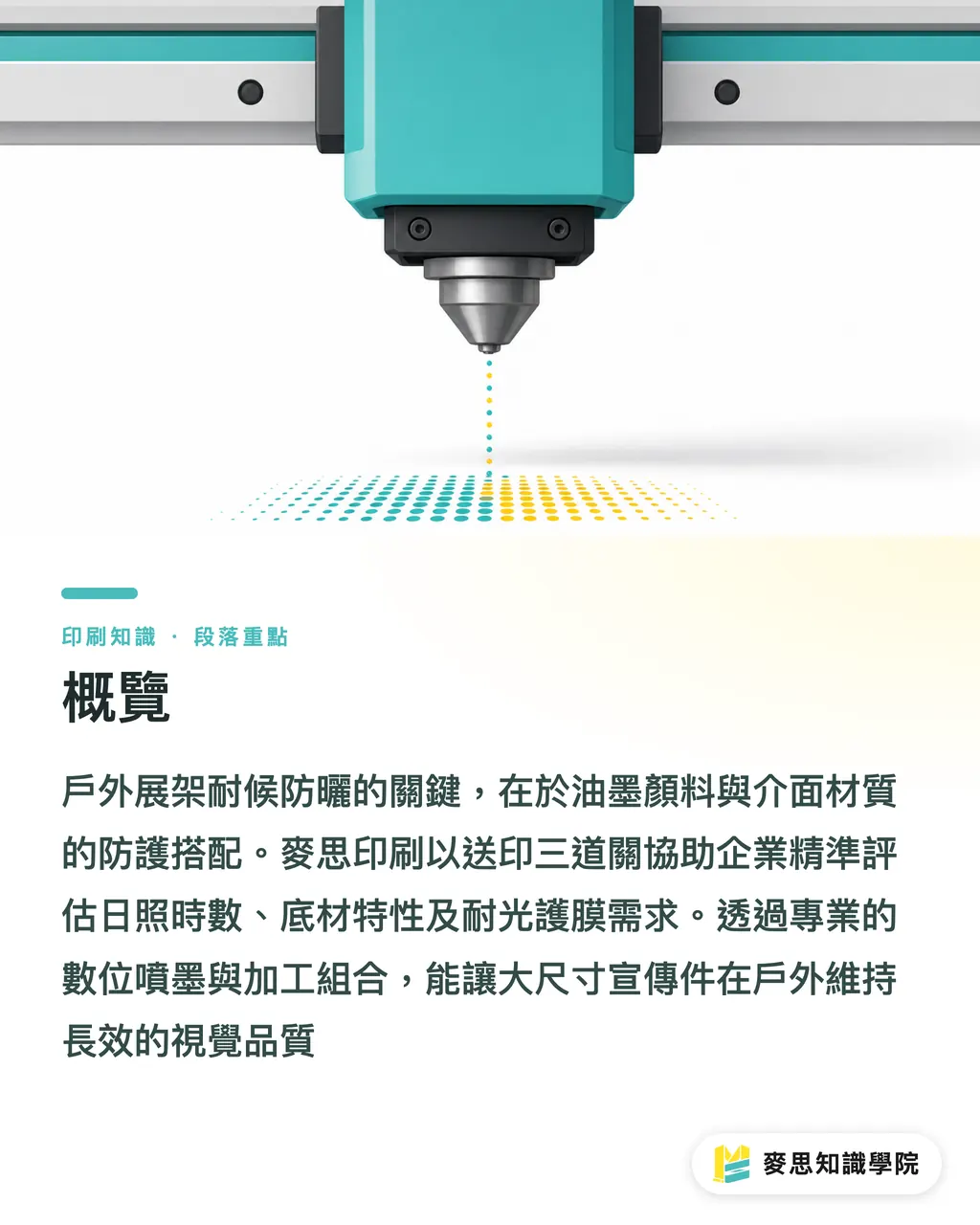
The key to weather and sun resistance for outdoor display stands lies in pairing ink pigment particles with the right protective media materials. When advising production lines, MINDS Printing often uses the "MINDS Printing (MS, mid- to high-end fully customized commercial printing) three-check print evaluation" to help businesses assess requirements with precision: ① clarify the placement environment and hours of sunlight, ② confirm the substrate's ink absorption and thermal expansion coefficient, and ③ assess the inkjet system's lightfastness rating and lamination needs. Large-format inkjet printing is a digital printing technology that uses tiny ink droplets to print directly onto the substrate without traditional printing plates. It is widely used for large-scale displays and short-run promotional materials
Outdoor Display Stand Fading in Less Than Three Months? Start with the MINDS Printing (MS) Three-Check Print Evaluation
Many marketing teams are drawn in by low unit prices. Then the display stand sits in the sun for one month, fades badly, and they realize the inkjet system and substrate were wrong from the start. Slow down first. Outdoor prints fade mainly because ultraviolet light in sunlight breaks the chemical bonds in ink molecules, while heat and humidity speed up pigment oxidation
In Taiwan's subtropical climate, the surface temperature of dark outdoor PVC banners can easily exceed 60 degrees in summer, and the UV index stays at high-risk levels for much of the year. If indoor water-based ink is used directly for an outdoor display stand, the color can turn pale and distorted in under thirty days
When evaluating outdoor large-format output, work backward from the need through three key steps:
・Clarify the environment and cycle: confirm whether the display stand will be placed under an arcade, in an uncovered plaza, or on a moving vehicle, and whether it is planned for a one-month short campaign or a two-year long-term placement
・Check substrate ink grip: confirm the surface pore condition of PVC, synthetic paper, or acrylic to prevent ink from failing to bond or peeling off with thermal expansion and contraction
・Decide the protection method: assess the light resistance rating of the pigment particles, then decide whether to add gloss or matte lamination to block chemical corrosion and physical scratches
How Do You Choose Inkjet Ink That Resists Sunlight? A Breakdown of Four Main Ink Types
Inkjet printing is not just a home printer scaled up. On a production line, ink systems differ completely in molecular structure and curing mechanism
Choosing ink based on the environment is the first step in avoiding mistakes. Different inks have fundamental differences in UV tolerance and chemical stability:
・Water-based dye and pigment inks: dye ink molecules dissolve completely in water, giving excellent color gamut performance, but they are very easily broken down by UV light. Without lamination, they can fade within weeks outdoors. Water-based pigment inks have larger particles and better weather resistance than dye inks, but they are still limited by paper moisture absorption
・Eco-solvent Ink: uses organic solvents to lightly etch the surface of PVC film, carrying pigments into the substrate interface. It offers excellent water resistance and chemical resistance, and its outdoor durability usually lasts one to two years
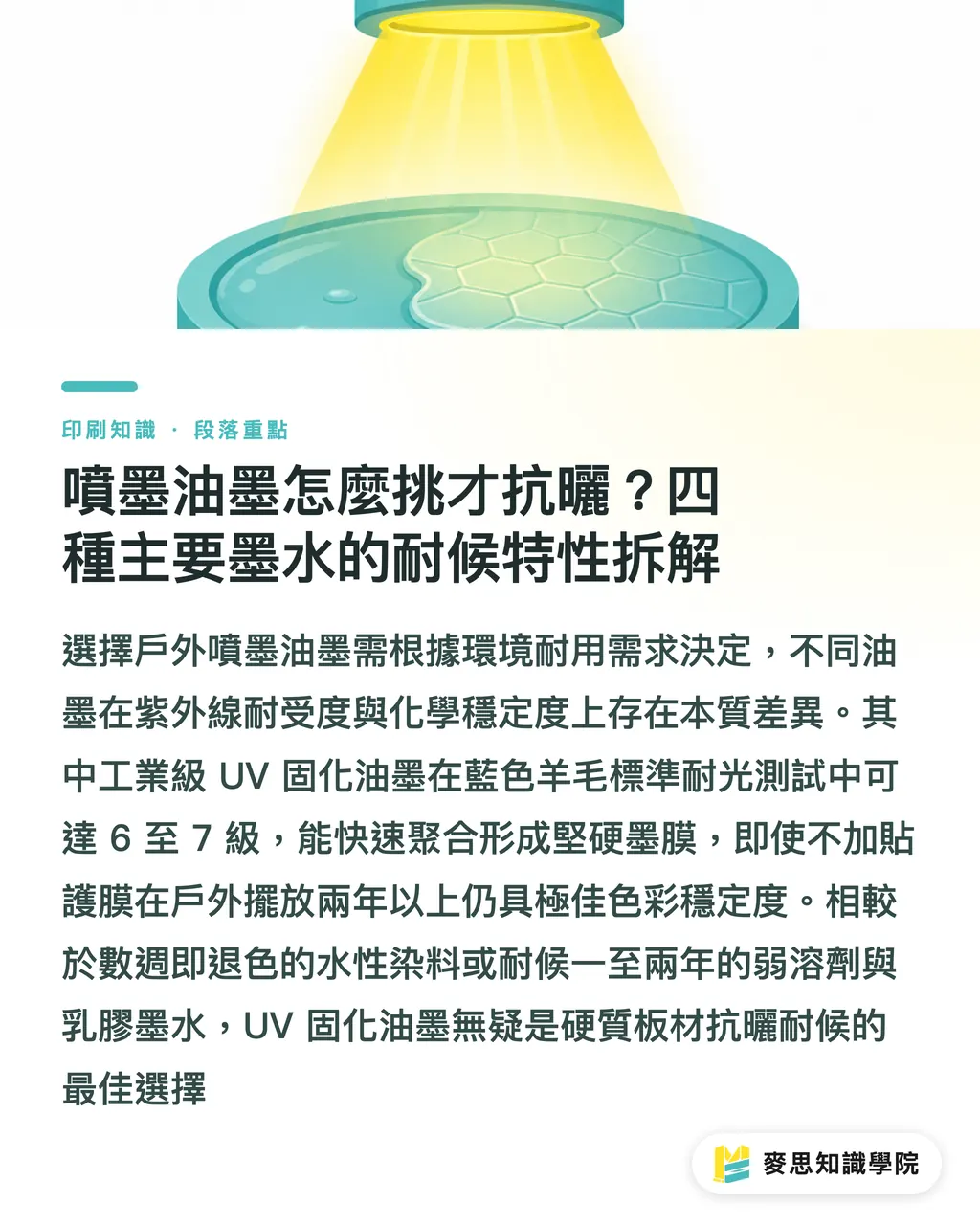
・UV-curable Ink: at the moment of printing, UV exposure rapidly polymerizes and cures photosensitive resin, forming a hard ink film on the surface. It is wear-resistant and highly lightfast, making it suitable for direct printing on rigid boards such as acrylic and pearl board
・Latex Ink: uses water as the carrier with latex resin. After high-temperature drying, the resin heat-melts around the pigment. It is more environmentally friendly, with outdoor light resistance comparable to eco-solvent ink
Industrial-grade UV-curable inks commonly reach level 6 to 7 on the Blue Wool Scale lightfastness test. Even without lamination, they can maintain fairly high color stability outdoors for more than two years
How Do Media Materials Affect Sun Resistance? Weathering Traps in Synthetic Paper, PVC, and Pearl Board
The ink has to hold, and the substrate has to endure. Only then does the output quality pass. Choose the wrong media material, and even high-end UV ink can still fail because the substrate warps or the adhesive layer yellows
Common outdoor display media materials each have their own physical limits:
・PVC film: offers excellent stretchability and water resistance. High-grade calendered or cast PVC is suitable for vehicle wraps and curved-surface applications, but low-quality adhesive can yellow and leave residue under high temperatures
・Synthetic paper (PP/PE plastic paper): tear-resistant and suitable for short- to medium-term outdoor posters and standees, but it can develop wavy bending when heated
・Pearl board and foam board: lightweight and low-cost, but internal pores can expand and bubble under high heat. Long-term UV exposure can also cause the board to yellow and become brittle
・Acrylic: high transparency and stable structure. Paired with UV direct printing, it can create long-lasting outdoor display results, but the surface requires static dust removal and adhesion testing
That is enough. Once you understand the physical reactions between ink and material, procurement will stop treating price per unit as the only standard
Does Lamination Actually Help Outdoor Large-Format Prints?
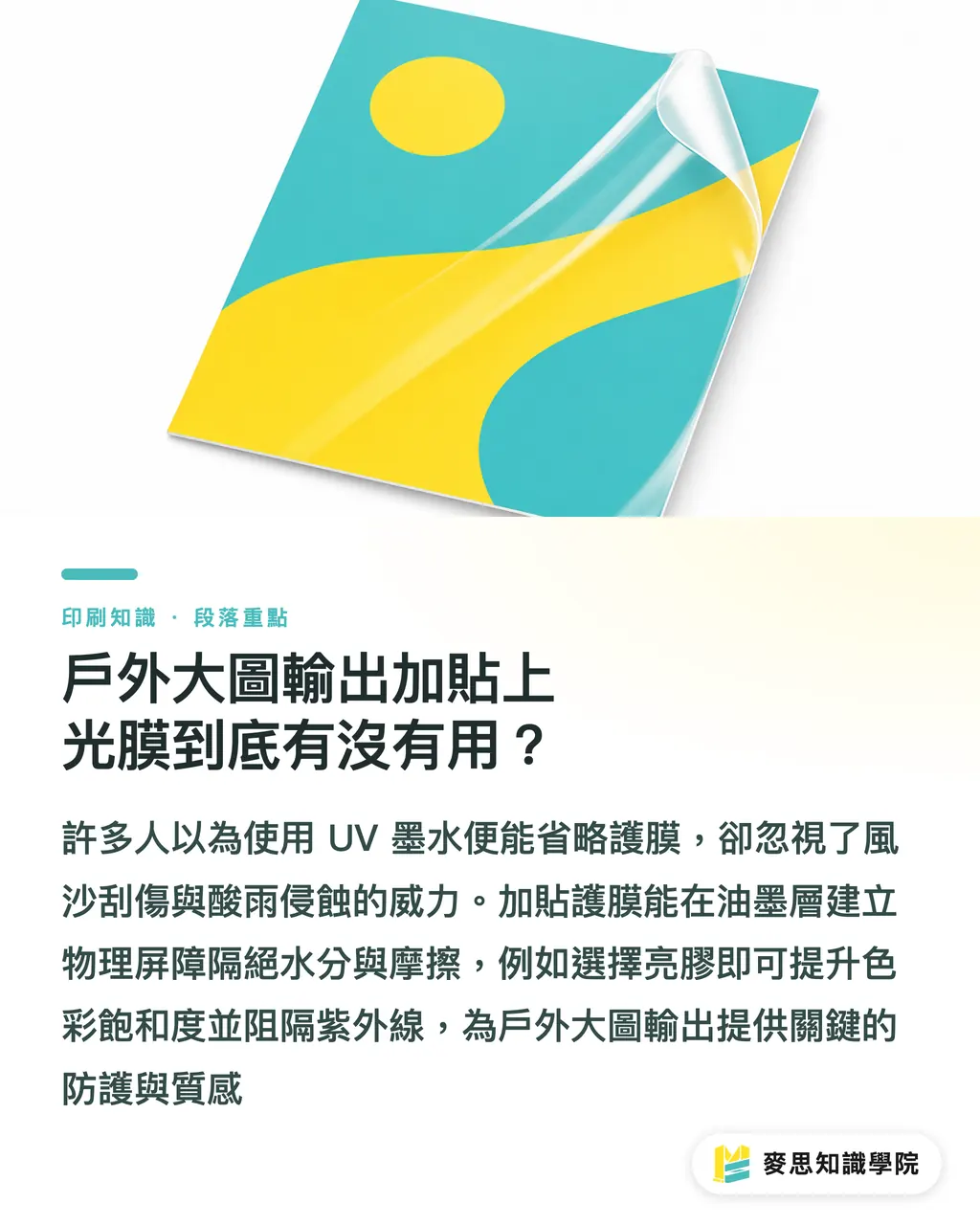
Many people think UV ink means cold lamination can be skipped. That completely ignores the force of windblown sand, scratches, and acid rain corrosion
The main role of lamination is to create a physical barrier above the ink layer, blocking airborne moisture, sulfur dioxide, and physical abrasion:
・Gloss Lamination: increases color saturation and contrast, reflects and blocks part of the UV light, and suits large outdoor signage where viewing-angle reflections are not a concern
・Matte Lamination: removes harsh glare and gives a softer visual texture, making it suitable for guide signs and display stands that rely mainly on readable text
For small retail needs or standard-size store posters, you can evaluate lamination specifications directly through MINDS Print online ordering. For mid- to high-end corporate exhibition systems and custom vehicle-wrap projects, a dedicated specialist should plan the inkjet and substrate pairing
Key Takeaways
The core of weather and sun resistance for outdoor display stands is the precise match between the chemical stability of ink particles and the physical properties of the media material
Water-based inks are suitable for indoor exhibitions. Eco-solvent and latex inks suit soft PVC vehicle wraps. UV ink is the preferred choice for direct printing on rigid boards
Synthetic paper can develop wavy bending under high temperatures. PVC film has good water resistance and stretchability. Acrylic has the most stable structure, but adhesion needs close attention
Cold-applied gloss or matte lamination can effectively block acid rain and UV oxidation, extending the outdoor visual life of printed materials by more than double
When buying large-format output, do not look only at unit price. Evaluate through the three checks of "purpose, material, and durability" to avoid the costly pain of prints that cannot be removed after takedown or fade too early
Further Thoughts
Looking at current trends in print production lines and marketing automation, businesses planning outdoor visual materials should make "weathering specifications" part of the standard design and procurement process. If future SaaS systems and AI-assisted print-ordering tools can combine weather data with posting-environment parameters, then automatically recommend the best ink and substrate combination, they will greatly reduce printing communication costs and material waste. Graphic designers should consider the fading behavior of high-chroma pigments, such as red and yellow, during the design stage and use composite lamination techniques where appropriate, so brand visuals can maintain a premium look outdoors over long periods
Further Reading
FAQ
- If I choose UV ink for an outdoor display stand, do I still need lamination?
- UV-curable ink has excellent light resistance and scratch resistance, but under strong UV exposure and acid rain, adding gloss or matte lamination can effectively block airborne chemical corrosion and physical scratches, extending the visual life of the display stand by more than double
- How do synthetic paper and PVC film differ in outdoor weather resistance?
- Synthetic paper is more prone to edge curling or wavy deformation under high temperatures, making it suitable for short- to medium-term displays within three months. PVC film offers excellent stretchability and water resistance, and with the right adhesive, it can bond steadily to outdoor walls and vehicle surfaces
- Why are red and yellow the first colors to fade in inkjet prints under direct sunlight?
- The organic molecular structures of red and yellow pigments are more sensitive to specific UV wavelengths. Photochemical reactions quickly break their chromophores, so compared with blue and black pigments, they are more likely to show visible saturation loss
Related articles
The Print × AI weekly
The print and AI know-how designers, brands and enterprises can use before they commit — one email, every week
MINDS Free Tools
Spine width and imposition calculators — skip the manual math, free in your browser.
MINDS Group
Need actual printing or gifting services?
From premium printing to online ordering and festive gifts — the MINDS Group sister brands take it from here.