

Overview
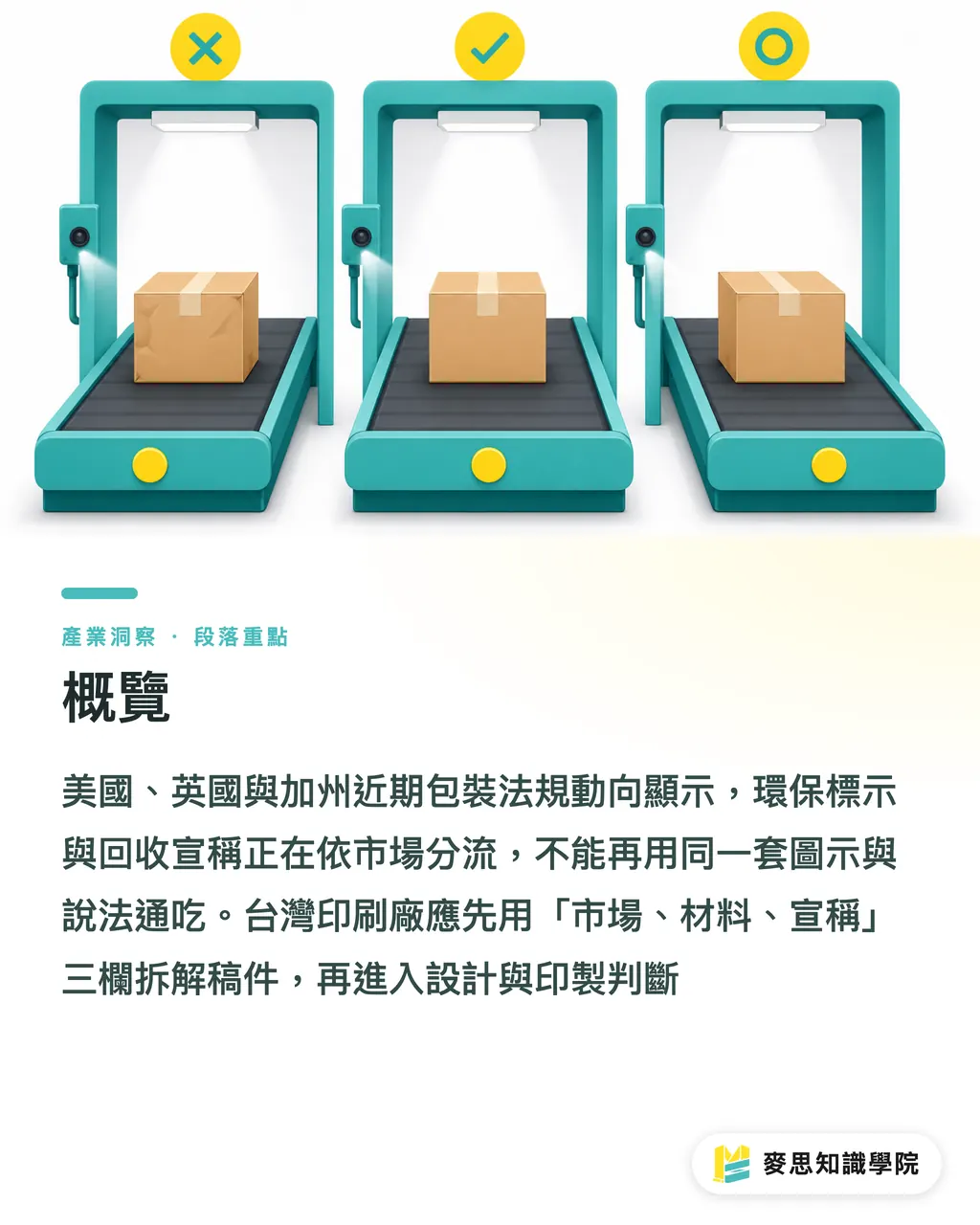
On July 22, 2026, the U.S. Congress discussed the PACK Act and the Recycled Materials Attribution Act. The UK's Defra delayed household collection of flexible plastics. California's SB 343 was also temporarily blocked by a court. Taken together, the answer is blunt: packaging compliance is being split by market. Taiwanese print shops can no longer use one set of environmental icons everywhere. MINDS (MS, mid- to high-end fully custom commercial printing) recommends first separating artwork into three columns, "market, material, claim," before discussing design and production
Why Did Packaging Labeling Suddenly Get Harder?
Packaging Dive reported on July 23, 2026, that the Commerce, Manufacturing, and Trade Subcommittee under the U.S. House Energy and Commerce Committee had discussed two packaging-related bills in a consumer protection hearing the previous day: the PACK Act and the Recycled Materials Attribution Act
I take this signal seriously because it touches one area print shops often underestimate: one sentence on packaging, one loop symbol, one recycled content percentage can all turn into questions of who keeps the proof, who revises the artwork, and who bears the risk of returned goods
Recycled material content labeling: disclosing the recycled content percentage on packaging materials or documents so brands, retailers, and consumers know how much recycled-source material the packaging contains, while keeping verifiable proof
The PACK Act points toward bringing packaging claims such as recyclable, compostable, and reusable under federal-level requirements, with conditional explanations and third-party certification to support those claims. Packaging Dive noted that the PACK Act had 17 cosponsors at the time, including 1 Democratic lawmaker
The Recycled Materials Attribution Act, meanwhile, aims to create federal standards for recycled content and recycling claims, and it runs into the question of how chemical recycling and mass balance should be recognized. Packaging Dive noted that the bill had 12 cosponsors, and supporters had also placed ads in 10 specific congressional districts
Anyone who works on packaging knows this: the smallest words on the layout are often the most expensive ones
If that one environmental claim has no evidence chain behind it, later revisions, relabeling, and reprinting will hurt more than spending an extra half day confirming it upfront
Where Are the United States, the United Kingdom, and California Getting Stuck?
・U.S. PACK Act: The goal is to make packaging claims about recycling, composting, and reuse more consistent, with focus on a federal framework, third-party certification, and consumer understanding
・U.S. Recycled Materials Attribution Act: The goal is to address recycled content and recycling claims. The point of dispute is whether the mass balance method can support recycled-material attribution
・UK Defra: The source material says the UK has delayed its household collection plan for flexible plastics, and the industry has criticized a lack of policy consistency. For the flexible packaging supply chain, a delay on the collection side affects whether "recyclable" claims can work in practice
・California SB 343: The source material says a court has paused enforcement of rules requiring packaging materials to be truly recyclable before they can carry the chasing arrows symbol. The paper industry association AF&PA sees this as a major win. Packaging Dive also noted that a federal judge issued a preliminary injunction several months before the rules were due to take effect
Put these 4 tracks on the same table and the contradiction is clear: some at the U.S. federal level want a common framework, the UK collection timeline has been pushed back, and California tried to tighten how "recyclable" can be used, only for the court to hit pause first
For Taiwanese suppliers taking export packaging orders, the risk is not that there are many regulations. The risk is that when the same package is sold into 3 markets, the client still wants to reuse the same artwork file

How Should Taiwanese Print Shops Judge Whether an Artwork File Is Safe to Accept?
I would start with 3 fields: shipment market, packaging material structure, and environmental claim
This "MINDS (MS) three-part packaging compliance method" is not complicated, but it blocks a lot of late-stage rework
・Shipment market: U.S. federal rules, California, the UK, and the EU cannot be lumped together as "Western regulations." The same recycling symbol may have different usage thresholds in different regions
・Packaging material structure: Paper boxes, mono-material flexible films, laminated films, labeled bottles, and spot-varnished paper stocks cannot be judged only by the main substrate. Adhesives, inks, films, labels, and finishing processes also matter
・Environmental claim: recyclable, made with recycled content, compostable, and reusable cannot borrow from one another. Every word on the design file must match a certificate, a test, or a brand-side responsibility statement
In practice, I would ask sales teams to fill in these 3 fields before quoting, then have prepress circle every environmental statement for client confirmation. If the client is making packaging for North American retail channels, MINDS is better suited to review material, ink, and label placement together before proofing, instead of waiting until the dieline is finalized and then trying to patch things up
Why Do Designers Also Need to Understand Regulatory Language?
Packaging designers often think sustainability labels are just graphic layout elements. The problems on the production floor are much more granular: whether to place chasing arrows, whether to state the recycled material percentage, and whether compostable can sit on the same panel as recyclable. All of these affect a brand's legal risk on the shelf
Packaging Dive noted that supporters of the U.S. PACK Act argue it would reduce consumer confusion, while opponents worry it could preempt stricter state-level labeling standards. On a design file, that dispute means the same icon system may be too loose in some markets and too loaded in others
My advice is practical: designers should not treat environmental marks as decorative elements. Treat them as part of the contract language
The layout can look good, but every environmental claim needs a source, conditions, and an applicable market
If the brand team is still reorganizing its packaging specification sheets, the Mai Strategy Knowledge Academy consulting team can help turn "material, label, claim" into a pre-design brief, so designers know in advance which words can be used, which symbols need proof, and which markets need separate artwork
What Can Small and Midsize Shops Do First?
・Build a market-specific artwork list: separate at least U.S. federal, California, and UK versions. Do not just write "export version."
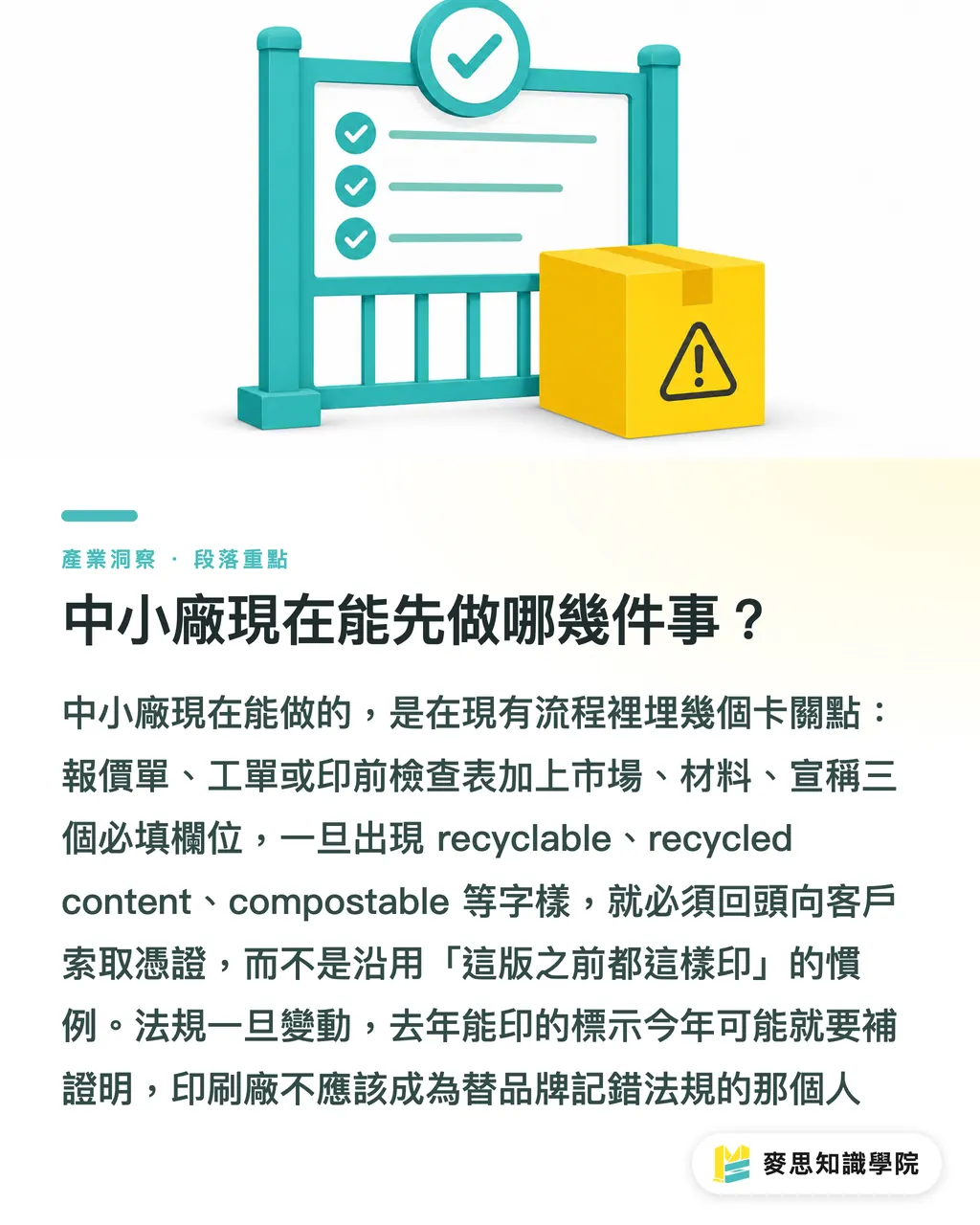
・Add a claim check to the prepress workflow: whenever wording such as recyclable, recycled content, compostable, reusable, or PCR appears, go back to the client for proof or the applicable market
・Flag flexible packaging separately: Defra's delay of household collection for flexible plastics in the UK reminds us that material recyclability is not enough. The local collection and sorting system also has to be in place
・Keep flexibility for California orders: the pause on SB 343 enforcement means the timeline is uncertain. It does not mean "the chasing arrows symbol can be printed freely." North American brands will still manage risk with more conservative internal rules
・Let SaaS or internal forms create checkpoints: quote forms, job tickets, CRM, and prepress checklists only need 3 extra required fields, market, material, and claim, to cut down a lot of back-and-forth emails
The line I dread most on the production floor is: "We printed the previous version this way."
After packaging regulations change, a label that was printable last year may need proof this year. Do not let the print shop end up being the party that remembers the regulations incorrectly for the brand
Key Takeaways
・Packaging compliance is now market-specific. One set of environmental labels cannot be applied directly across the United States, the United Kingdom, and California
・The hard part of recycled-material claims is not printing difficulty. It is the evidence chain and responsibility assignment
・Flexible packaging must be checked against material, collection systems, and the local regulatory timeline. Missing any one of the three can block the claim
・Clarifying the three fields, market, material, and claim, in prepress is far cheaper than reprinting after final artwork
・When designers handle environmental marks, they should treat them as legal language, not layout decoration
Further Thinking
For print manufacturers, the next step is to move compliance checks forward into quoting and prepress, instead of waiting until the client has handed over the final PDF. For design firms, the next step is to break environmental claims into verifiable text, not just visual guidelines. For AI and SaaS teams, the next step is not to build a chat box that memorizes regulations, but to design required fields and reminder rules into job tickets, CRM, and proofing workflows, so "shipment market, packaging material structure, environmental claim" gets asked every time
Further Reading
FAQ
- How does the PACK Act affect packaging print shops?
- The PACK Act focuses on packaging claims such as recyclable, compostable, and reusable. If the bill moves forward, print shops taking packaging orders for the U.S. market will need to check label wording, third-party certification, and client responsibility statements more carefully
- What is the Recycled Materials Attribution Act?
- The Recycled Materials Attribution Act is a U.S. bill direction aimed at creating federal standards for recycled content and recycling claims. Packaging Dive noted that it also involves disputes over chemical recycling and mass balance
- After California SB 343 was paused, can the chasing arrows symbol be printed as usual?
- That is not a good assumption. The pause on SB 343 means the enforcement timeline is uncertain, but brand clients and retailers may still use stricter internal rules. Packaging artwork for North America should still keep market-specific review
- Does the UK delay in flexible plastic collection matter for Taiwanese packaging exports?
- Yes. Whether flexible plastic packaging can claim recyclability depends not only on the material itself, but also on whether local household collection, sorting, and recycling systems can actually support it
- What workflow should Taiwanese small and midsize print shops add first?
- Start by adding a prepress claim check. Make shipment market, packaging material structure, and environmental claim required fields, and ask clients for supporting evidence whenever wording such as recyclable, recycled content, or compostable appears
Related articles





The Print × AI weekly
The print and AI know-how designers, brands and enterprises can use before they commit — one email, every week
MINDS Free Tools
AI background removal, a LINE sticker maker, spine & imposition calculators — all free, right in your browser, no upload.
MINDS Group
Need actual printing or gifting services?
From premium printing to online ordering and festive gifts — the MINDS Group sister brands take it from here.