

Why California's SB 343 Hit a Wall? U.S. Packaging Rules in a Regulatory Void
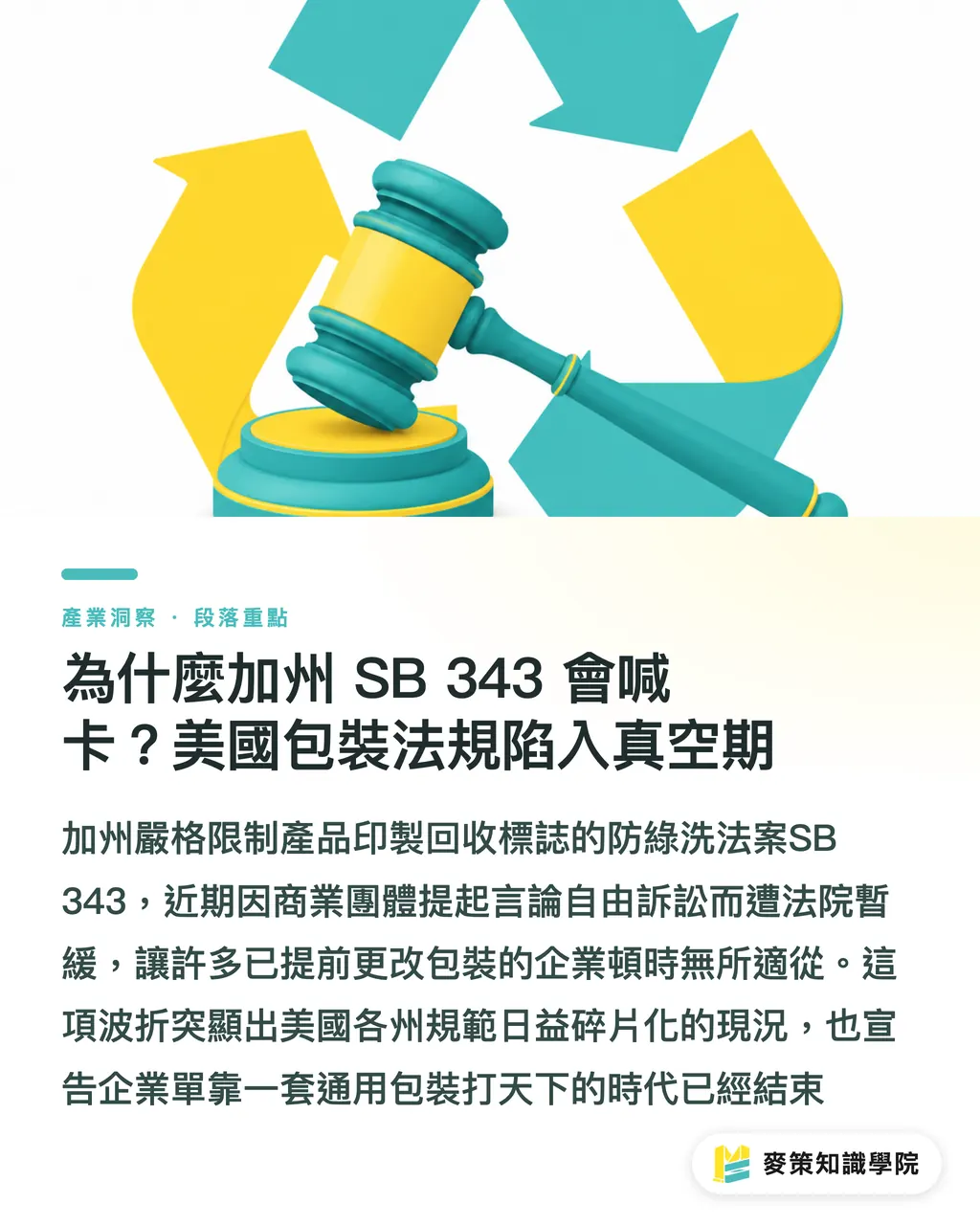
California had slated SB 343, which tightly restricts recycling symbols on packaging, to take effect in October, but a preliminary injunction from a federal court blocked it
According to Packaging Dive, trade groups including the Flexible Packaging Association (FPA), which represents flexible‑pack manufacturers, sued on First‑Amendment grounds, halting what many call the nation's toughest "packaging label honesty" bill. The law aims to curb green‑washing by forbidding the familiar chase‑arrow recycling symbol unless adequate local recycling infrastructure exists
Lately I've talked with many clients serving the North‑American market. They already reworked packaging to meet California's standards, changing the green arrow and sustainability claims, only to be left in limbo when the bill stalled. That confirms what I've warned: regulatory fragmentation is now the norm, from Oregon's EPR lawsuits to California's label setback, and the era of a single "global‑standard" package is over
Why the Industry Is Pushing the Pack Act? What Federal Intervention Can Fix
State‑by‑state standards drive compliance costs sky‑high, so the packaging sector is rallying behind a federal Pack Act to break the impasse
Sponsored by Rep. Randy Weber, the bill seeks to amend the FTC Act, setting a nationwide standard for "recyclable," "compostable," and "reusable" claims, backed by third‑party certification. Crucially, it includes a state‑preemption clause that would let federal law override divergent state rules
In short, groups like Ameripen want a single federal law to curb the patchwork. Without it, a brand may need three different box versions to sell the same SKU in California, New York and Texas, a nightmare for printers' run sizes and inventory. Industry insiders warn that even with California on pause, the future remains unclear. A competing Democratic‑led Truth in Labeling Act also circulates, but the manufacturing side universally calls for a "single standard."
How Export Brands and Printers Should Navigate This Regulatory Transition
Until the federal bill clears, export brands and contract printers must build the widest possible adjustment margin into packaging design and production
When regulations are in limbo, cementing "earth‑friendly" messages into the primary graphics is risky, California's AB 2253 penalties for false eco‑claims are a cautionary tale. I advise clients to adopt the "Mai Strategy's Three‑Step Overseas Packaging Compliance" checklist now. Practically, they can focus on the following:
・Separate sensitive symbols: move recycling logos and material claims off the main print (e.g., cartons, cans) and use later‑stage stickers or hanging tags
・Regional inventory control: keep a master package that only prints brand and ingredient info common to all states; add state‑specific labels or stickers just before shipment
・Watch third‑party certifications: regardless of the Pack Act outcome, U.S. buyers will demand real third‑party backing for sustainability claims (e.g., BPI compostable certification). Empty green buzzwords invite lawsuits
If your brand is planning next year's North‑American packaging, I strongly recommend engaging MINDS early to evaluate modular printing options, or enlist the Mai Strategy Knowledge Academy Consulting Team (https://mindsprt.dev) to clarify state‑specific label red lines, minimizing potential re‑ship and re‑print costs

Key Takeaways
・California's SB 343 blocked by lawsuit, leaving U.S. packaging environmental label rules in a state‑by‑state melee
・The industry is pushing a federal Pack Act, aiming to replace the chaotic patchwork with a nationwide standard and a state‑preemption clause
・Taiwanese export brands should decouple sustainability symbols from the primary package, using stickers or modular printing to retain flexibility
・Future U.S. green claims will likely become a hard rule: no print without concrete third‑party certification
Further Reflection
While the label‑law battle looks like a domestic U.S. legal fight, it mirrors a global reshuffle of the packaging supply chain. For Taiwan's SMEs, regulatory churn can be a chance to rebuild competitive barriers. Instead of viewing rules solely as obstacles, use this moment to audit your material supply chain and turn "compliance flexibility" into a bargaining chip with foreign buyers. Factories and designers that can steer clients clear of state‑level landmines will be far more competitive than those that merely follow artwork
Further Reading
FAQ
- California's SB 343 is on hold – do I still need to manage recycling symbols on my packaging?
- Yes, you must. Even though California has paused, other states continue to push eco‑regulations, and California's AB 2253 still carries strong penalties for false green claims. Mislabeling remains a high litigation risk
- If the Pack Act passes, what concrete benefits does it give export brands?
- The biggest gain is regaining a "single standard." The Pack Act's state‑preemption clause means that once your packaging meets the federal criteria, it can be sold legally in all 50 states, eliminating the need for state‑specific redesigns and reprints
- During this regulatory transition, what's the safest way to commission printing?
- Separate generic information from sensitive eco‑claims. Keep the core package free of recycling symbols, and apply state‑ or channel‑specific labels or stickers in a post‑print step, possibly via small‑batch custom runs
Related articles





The Print × AI weekly
The print and AI know-how designers, brands and enterprises can use before they commit — one email, every week
MINDS Free Tools
AI background removal, a LINE sticker maker, spine & imposition calculators — all free, right in your browser, no upload.
MINDS Group
Need actual printing or gifting services?
From premium printing to online ordering and festive gifts — the MINDS Group sister brands take it from here.