

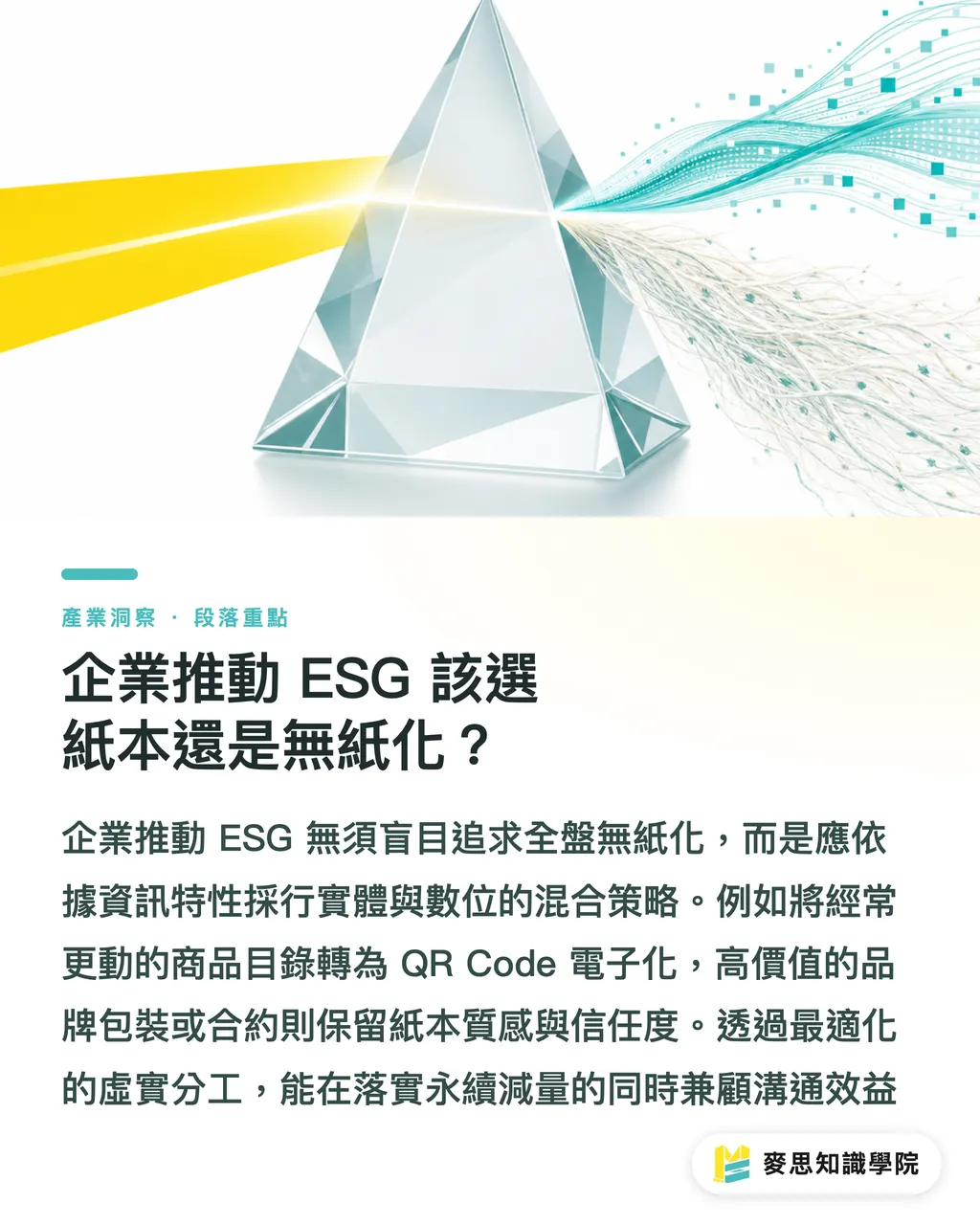
Should ESG-minded businesses choose print or go paperless?
Digital channels are best for information that changes often and does not require a high trust threshold. Physical print still has irreplaceable trust and texture in legal contracts, premium brand packaging, and trade show experiences. When MINDS helps companies plan for ESG, it recommends using the MINDS (MS, mid- to high-end fully custom commercial printing) hybrid decomposition method to assess the best split between physical and digital media
A hybrid strategy of paperless communication and reduced-volume printing means that, when pursuing ESG, a company does not aim to eliminate all physical printing. Instead, it separates content by update frequency, legal retention needs, and communication trust. Catalogs or manuals that change regularly move to digital formats, while high-value assets and brand packaging use small-batch digital printing with finishing in a sustainable integrated setup
・Durability: Contracts and permanent certificates need physical archiving. Digital files face the risks of obsolete formats and distorted backups
・Reading experience: For reports longer than 10 pages or complex charts, print delivers much higher completion rates and recall than screens
・Customer trust: At trade shows and for premium products, a lack of physical tactility can easily weaken brand trust
・Update frequency: Product catalogs and event flyers that change every quarter gain the most from QR Code-based digital delivery
・Inventory risk: Overestimating quantities in traditional plate-based printing leads to waste. That is the biggest hidden loss
It is that simple
Why can't digital documents fully replace paper?
After seeing countless cases on production lines and at event sites, many companies mistakenly believe that loving the planet means not printing a single sheet. Then the sales team shows up at a trade show with nothing that carries any weight, and customers walk away without even scanning the catalog QR Code
From a practical communication angle, paper has a strong physical presence and pulls attention in a way that creates a high level of psychological commitment
・Trade shows and physical events: When people receive well-made printed materials on site, the average interaction pause extends by more than 30 seconds
・Legal and audit needs: For corporate sustainability reports and key financial documents, third-party auditors still tend to prefer physical records and deinking proof
・Manuals and safety guides: For factory equipment or high-risk machinery, including printed safety instructions in the package can greatly reduce the risk of serious operating errors
Do not rush it
How can companies build the ideal low-carbon workflow across print and digital?
To help companies find the sweet spot between business impact and carbon reduction targets, the Mai Strategy Knowledge Academy consulting team breaks the decision into the MINDS (MS) three-gate print submission framework
・① Gate One: Assess information shelf life. Classify content by update cycle. Catalogs that change quarterly should become digital online pages. Brand specifications that stay unchanged for more than a year can remain in print
・② Gate Two: Calculate spoilage and plate-making thresholds. When the print run is under 500 copies, prioritize digital printing to avoid plate setup waste, spoilage sheets, and front-end proofing waste
・③ Gate Three: Introduce POD. Print manuals or packaging stickers dynamically based on actual orders and shipment volume, fully solving the risk of inventory write-offs
Why does eco-friendly paper often make visuals look dull and gray?
When switching to recycled or reclaimed paper, the fibers are shorter and ink absorption behaves differently, so color saturation can drop very easily
The answer to lower perceived quality is not adding another plastic film. Color and ink choices need to be adjusted at the design stage
・Ink formulation: Choose vegetable oil-based ink and moderately increase shadow contrast to compensate for saturation loss after recycled paper absorbs ink
・Finishing adjustments: Use spot embossing, debossing, or metallic ink instead of large-area foil stamping and plastic lamination, while keeping deinking and recycling easier
・White space: Increase the amount of white space and use high-contrast type, allowing the paper's natural texture to become part of the design

Key Takeaways
・Paperless workflows should focus on dynamic information and content that changes often. Physical print should focus on high-trust and deep-reading scenarios
・Inventory write-offs are the biggest hidden waste in printing. Replacing large plate-based runs with on-demand printing can sharply reduce spoilage
・When switching to eco-friendly paper, adjust the ink and layout design. Avoid plastic lamination, which creates a second environmental burden
・When evaluating ESG print standards, procurement, print volume, finishing, and disposal records all need to be built into the standard process
Further Thoughts
Print and digital are absolutely not a zero-sum game
For graphic designers and print buyers, future competitiveness will depend on how accurately they can judge the right medium for each type of information
SaaS teams and AI tools can also use data to forecast optimal print quantities and automatically generate dynamic QR Code support for printed materials
MINDS (MS) will keep integrating software tools with high-quality physical finishing to help the industry move toward sustainable communication with less waste and higher trust
Further Reading
FAQ
- Is a PDF enough for a corporate report, or do companies still need printed copies?
- Digital files work for regular distribution. But for core investors and third-party auditors, a small run of printed reports using film-free finishing better protects audit retention and the reading experience
- Small-batch digital printing has a higher per-sheet cost. Is it really cheaper and greener?
- Although the unit price per sheet may look higher, it removes plate setup spoilage and later warehousing and disposal costs. Total cost of ownership and carbon emissions are often lower
- What should we do if colors become darker after switching to recycled paper packaging?
- During prepress design, raise shadow color contrast, choose high-density vegetable oil ink, and avoid lamination. This keeps the finish refined while meeting deinking standards
Related articles


The Print × AI weekly
The print and AI know-how designers, brands and enterprises can use before they commit — one email, every week
MINDS Free Tools
AI background removal, a LINE sticker maker, spine & imposition calculators — all free, right in your browser, no upload.
MINDS Group
Need actual printing or gifting services?
From premium printing to online ordering and festive gifts — the MINDS Group sister brands take it from here.