
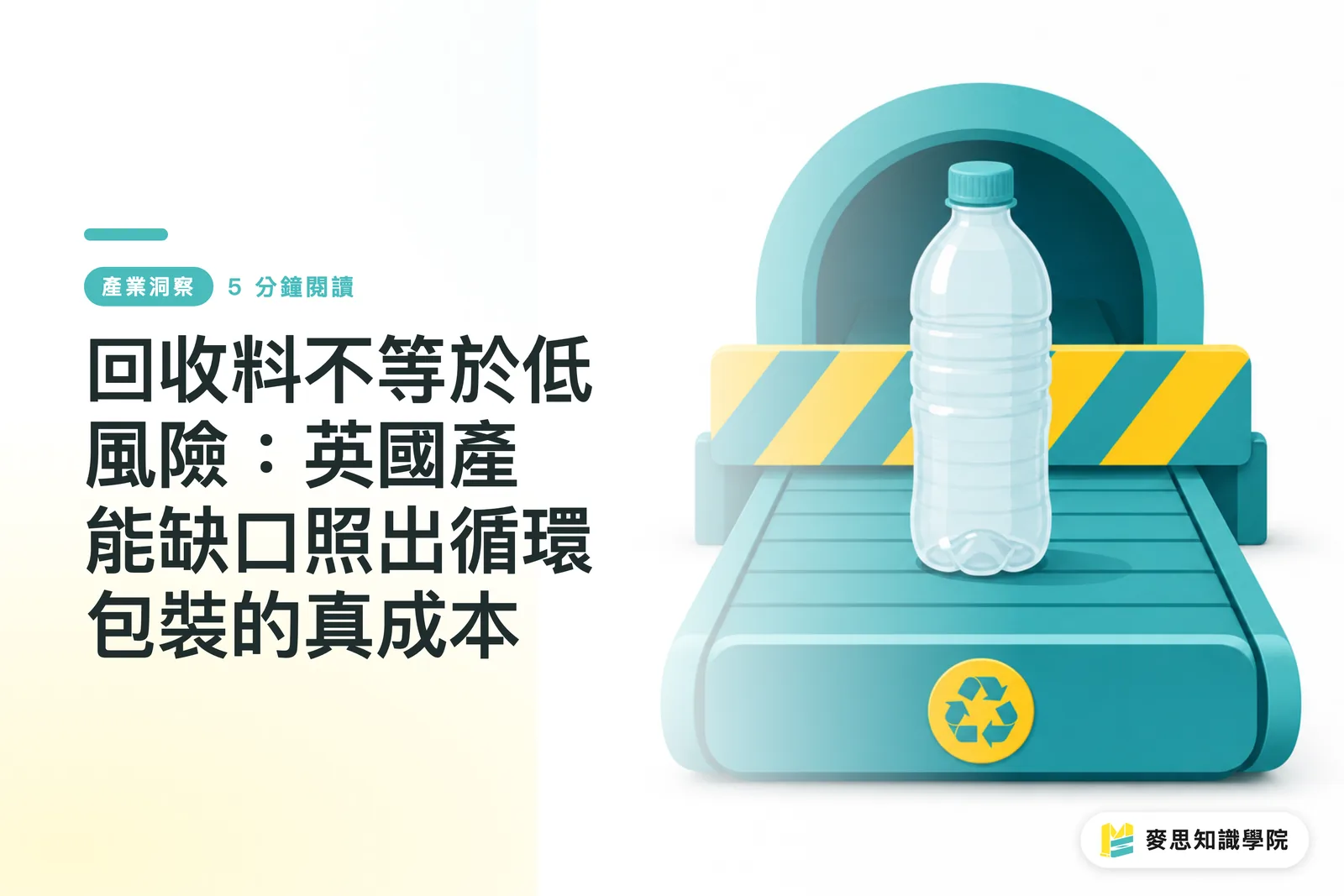
UK recycling capacity is shrinking, and why we can't just treat this as a UK issue
A study commissioned by Viridor, a major UK waste management firm, has been making the rounds in the industry. The report puts it bluntly: even if the UK can sort plastics in the future, it won't be able to process them. The numbers show a clear gap:
・By 2060, the UK is estimated to sort 4.2 million to 4.9 million metric tons of plastic into the recycling system annually
・But domestic recycling capacity will fall short by 3.6 million to 4.4 million metric tons
・In recent years, the UK's plastic recycling capacity has shown a clear contraction
This isn't a temporary market dip. It is a structural contraction of capacity. At first glance, designers and brands in Taiwan might think 'that's a UK problem.' But in reality, the design logic for Taiwan's export packaging mostly follows the sustainability rules of Western brands. The bottlenecks in the UK are often a preview of what Taiwanese manufacturers will face in three to five years
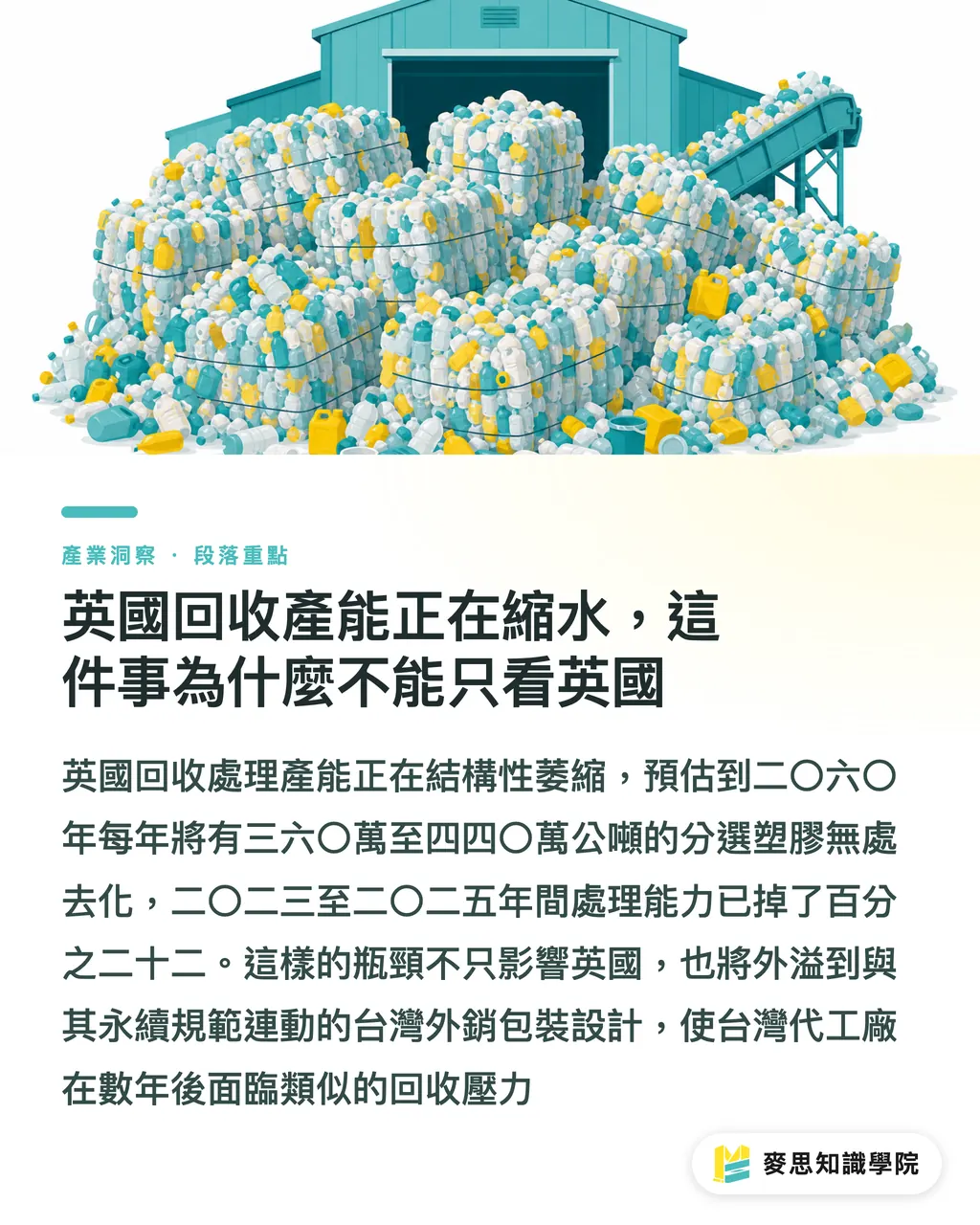
Why is capacity shrinking? Several levers are being pulled at once
The report breaks the causes down into four main areas. I have translated them into terms that hit closer to home for Taiwanese printers and packaging factories:
・Cheap virgin plastics suppress recycled material prices: when raw materials are cheap, the business incentive to buy recycled content is weak. Recycling plants face unstable orders and naturally hesitate to expand capacity
・Imported recycled materials flood the market but quality varies: they can fill the volume gap but cannot build trust. When the traceability of recycled materials is questioned, downstream brands would rather go back to virgin materials
・Spiraling energy, labor, and compliance costs: recycling is a capital-intensive business. Once operating expenses rise, profit margins are eaten away
・Policy and infrastructure delays: expanding capacity and buying new equipment are often held up by slow approvals and funding timelines
None of these four factors are fatal on their own, but together, they cause structural contraction. Looking at Taiwan, we don't have a capacity base as large as the UK, but the same scenario of 'cheap virgin materials, expensive recycled content, and paper-thin margins for processors' has already played out here over the last few years, especially in flexible films and composite materials
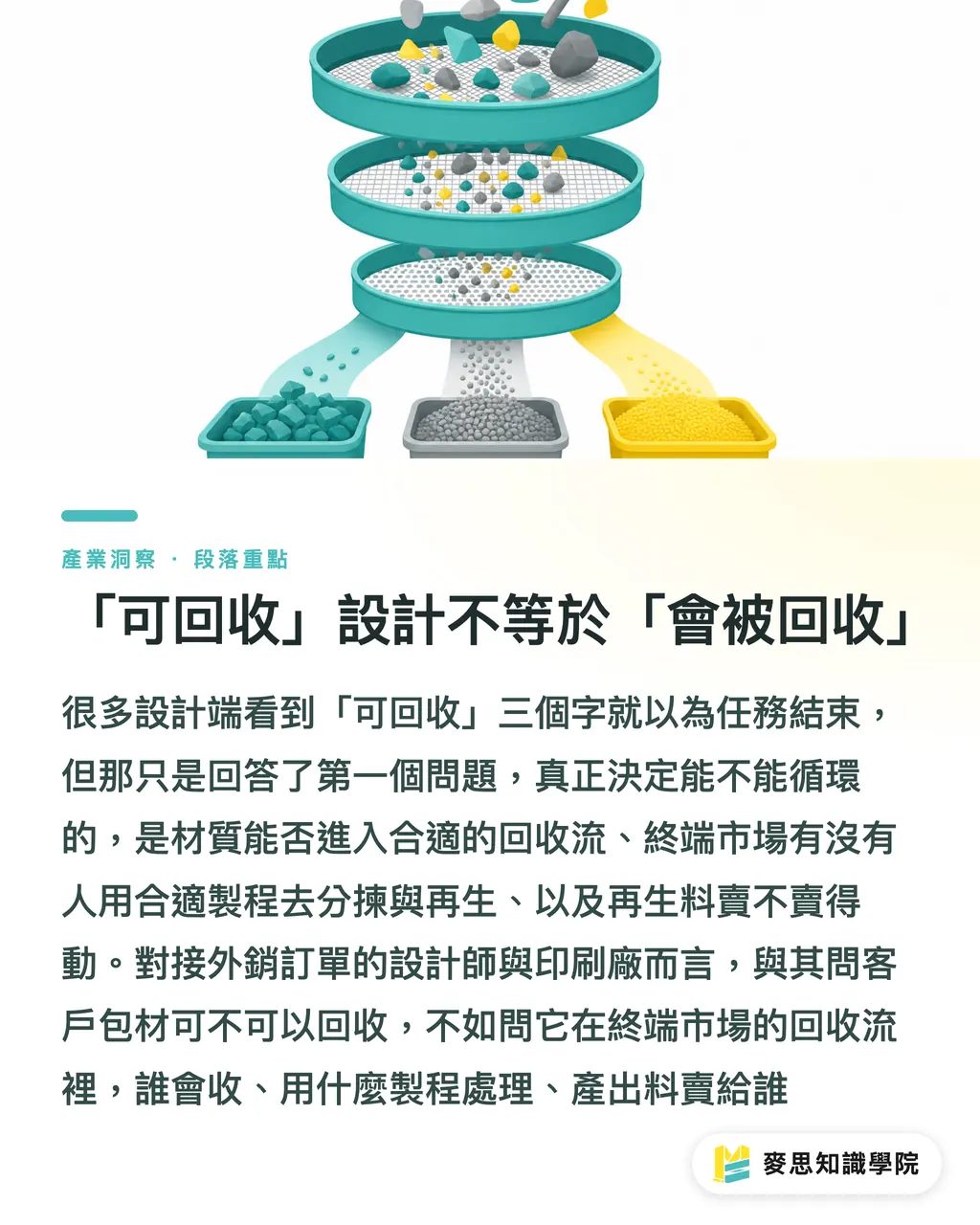
'Recyclable' design does not equal 'will be recycled'
This is the most overlooked part when I help export brand clients make packaging decisions. The design team gets a piece of paper that says 'recyclable' and thinks their job is done. In reality, that paper only answers the first question. The second question, 'who, where, and with what equipment will it be recycled,' has not even been asked
・Materials only determine 'which recycling stream it can enter,' such as the PET bottle stream, the PE film stream, or the paper stream
・Processing determines 'whether it can actually be sorted, washed, and reprocessed into usable materials'
・The market determines 'whether the recycled material sells, and whether buyers are willing to pay a green premium'
A complete loop requires all three layers to work together. The UK report is a reality check for the optimists who only look at the first layer. For Taiwanese designers and printers, especially those taking export orders, the question to ask clients is not 'can this packaging be recycled?' instead, it is 'in the target market's recycling stream, who will collect it, what process will they use, and who will buy the recycled output?'
What small and medium printers and brands can do right now
Even if resources are limited, you can start with these high-impact checkpoints:
・Upgrade your design review from a material list to a supply chain map: map out where the packaging goes after shipping from Taiwan, which country's recycling stream it enters, where the processing plants for that stream are concentrated, and if there is public capacity data available
・Demand traceability and flow data from recycled material suppliers: don't settle for a spec sheet that simply says '50% rPET.' You need to see the source market, processing plants, and actual buyers. If it cannot be traced, it is better to label it conservatively
・Stay disciplined with monomaterial structures: composite materials, double shrink sleeves, and foil-lined paper are headaches for recyclers. Separate them if you can, and stick to monomaterials whenever possible
・Keep the batch and material data ready for EPR reporting: following California's SB 54, the EU's PPWR and various national EPR regulations are taking a similar path. The material ratios, weights, and recycled content percentages of every packaging batch on the production line will likely be required reporting fields in the future
・Shift the language from 'sustainability' to 'circularity' with your clients: instead of claiming '100% recyclable,' be honest and state 'sortable in country A's recycling stream, with an estimated recovery rate of X%.' This is the kind of data that survives audits
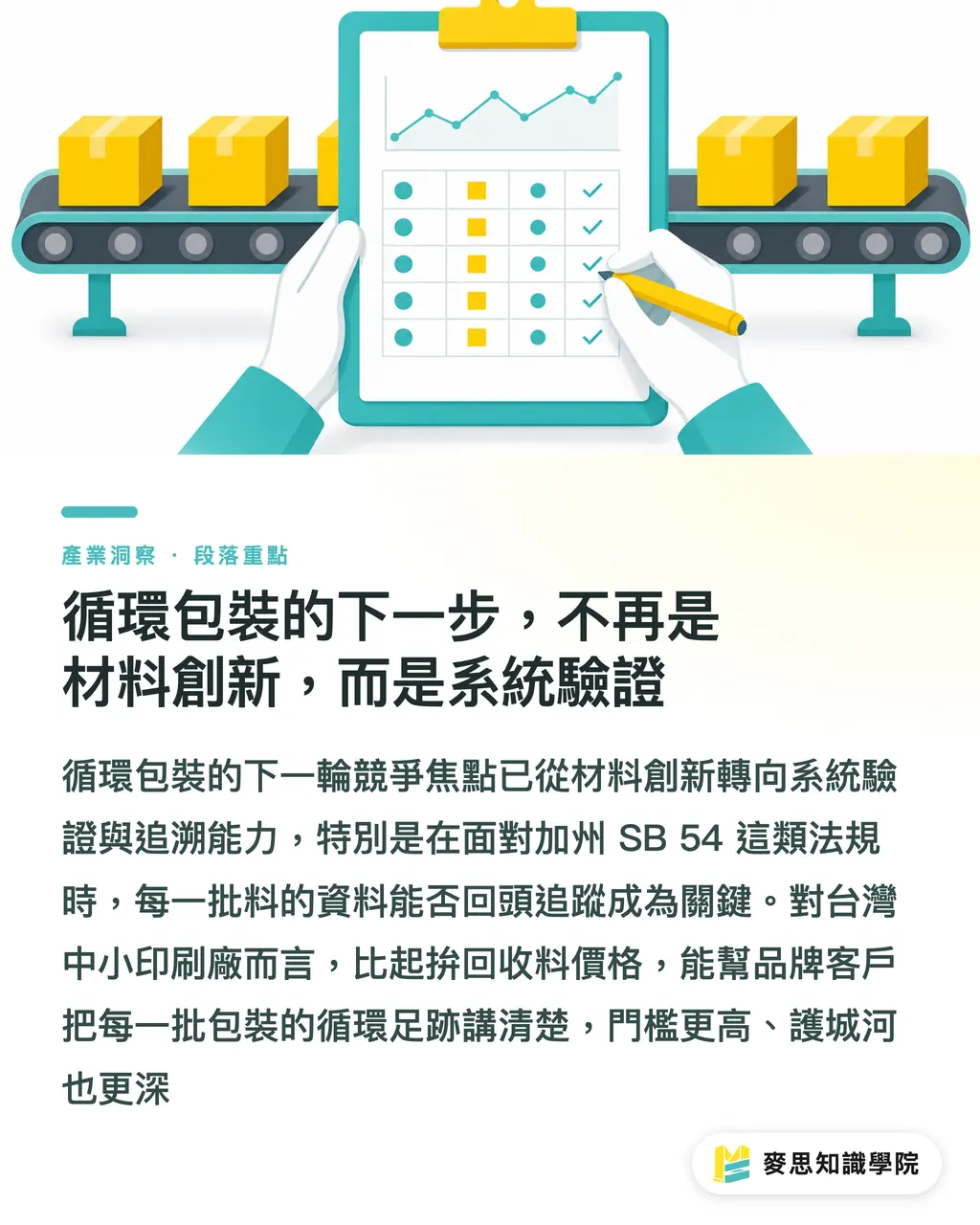
The next step for circular packaging is no longer material innovation, but system verification
Over the past few months, I have been talking to several manufacturers who are scrambling to comply with California's SB 54. Their anxiety has shifted from 'which material to choose' to 'can we trace the data of every batch on the production line.' This is a healthy shift. The easy wins from new materials were exhausted in the last decade. The next wave of value lies in verification and traceability
For small and medium printers in Taiwan, this is actually an opportunity. Instead of competing on the price of recycled materials, competing on 'helping brand clients trace the circular footprint of every packaging batch' has a much lower entry barrier but creates a much deeper competitive moat. This is also where MINDS (a mid-to-high-end fully customized commercial printer) has focused its integrated services in recent years: linking material selection, printing, and compliance data collection into a single line, so brands do not have to piece the puzzle together from scratch when facing Western regulations
The true cost of recycled content is not the price tag, but whether the loop can actually be closed. The UK capacity gap is a wake-up call, and it gives Taiwan a valuable buffer window
Key Takeaways
・Designing for recyclability only solves the first layer of a complete loop. If the other two layers (processing and market) are not connected, the system is just spinning its wheels
・UK recycling capacity has shrunk significantly in recent years, and this is a structural issue, not a short-term market dip
・Recycled materials are only as valuable as the trust behind them. Traceability and flow data will be the next wave of value for brands and printers
・Composite materials and multi-layer structures are the biggest headaches for recyclers. Discipline is more important than innovation
・The material and batch data needed for EPR reporting must be tracked on the production line starting now
Further Reflections
The takeaways from this report for Taiwan's printing industry boil down to three concrete actions:
・First, drop the word 'recyclable' from your design drafts and start asking: 'Where will this be recycled, what process will be used, and who is the buyer?'
・Second, build a database of material compositions and recycled content percentages for each packaging batch. This is not about checking a box today, but preparing for EPR and PPWR reporting in two years
・Third, shift your selling point from materials to path validation. Being able to map the actual path of packaging once it enters the recycling stream and provide traceable data creates a much deeper competitive moat than simply quoting prices. For MINDS, the value of our integrated services lies in connecting these dots, saving clients from having to piece the puzzle together from scratch when dealing with international regulations
Further Reading
FAQ
- How does the shrinking UK recycling capacity affect printers in Taiwan?
- Most export packaging from Taiwan follows the rules of Western brands. The bottlenecks in the UK are a preview of what Taiwanese manufacturers will face in three to five years, especially since supply chain and regulatory pressures spread in very similar ways
- What is the difference between 'designed for recyclability' and 'will be recycled'?
- Designing for recyclability only covers the materials. Whether it actually gets recycled depends on processing (who is handling it and with what equipment) and the market (whether buyers want the recycled output). All three layers must align for a complete loop
- With rPET usage growing, why is the adoption rate actually falling?
- Because cheap virgin plastic suppresses recycled material prices, leading to unstable orders for recycling plants. Combined with traceability doubts, many brands choose to go back to virgin materials. This is a market-driven issue rather than an environmental one
- How should small and medium printers with limited resources start with circular design?
- First, keep strict material discipline: avoid composite materials and choose mono-materials. Second, ask recycled material suppliers for traceability and flow data. Finally, keep track of the materials and weights of every packaging batch to prepare for future EPR reporting
- What should manufacturers prepare now for California's SB 54 and the EU's PPWR?
- Prepare two things: first, batch records showing the material ratios, weights, and recycled content percentages of every packaging run; second, the ability to trace the actual path of packaging into target market recycling streams. These are the core fields for compliance reporting and client audits
Related articles



The Print × AI weekly
The print and AI know-how designers, brands and enterprises can use before they commit — one email, every week
MINDS Free Tools
AI background removal, a LINE sticker maker, spine & imposition calculators — all free, right in your browser, no upload.
MINDS Group
Need actual printing or gifting services?
From premium printing to online ordering and festive gifts — the MINDS Group sister brands take it from here.