
So What Actually Separates Digital Proofing from Traditional Proofing?
One sentence: digital proofing is a simulation, traditional proofing is a dress rehearsal
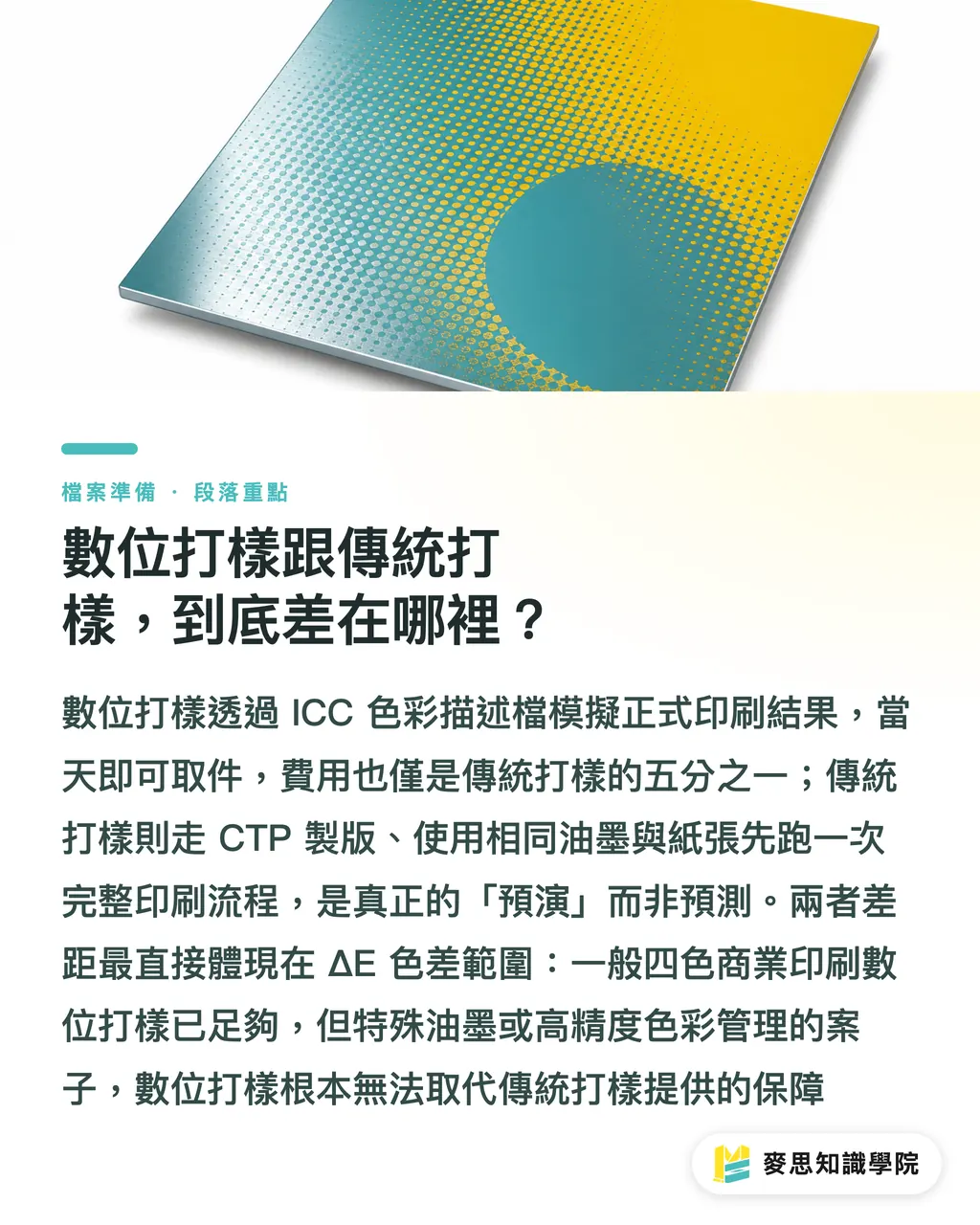
Digital proofing uses an inkjet or laser output device with an ICC profile to push output color as close as possible to the final press result. The technology is mature. For everyday CMYK four-color commercial printing, a calibrated digital proof can hold color deviation to within ΔE 3 of the finished piece, which is more than enough for most jobs
Traditional proofing takes a completely different path. It goes through CTP (Computer-to-Plate) platemaking, uses press plates spec'd to match production, and aligns ink, dot structure, and substrate as closely as possible to actual press conditions. This isn't predicting what the finished piece will look like. It's running through the same materials and process once before you commit
The turnaround difference is stark: digital proofing is typically same-day; traditional proofing takes two to three business days, and with platemaking and press time factored in, it runs three to five times the cost. That gap pushes most buyers to default to digital. But some print conditions are simply outside what digital proofing can cover
Three Scenarios Where Digital Proofing Trips People Up
First: spot colors, especially fluorescents and metallics. Pantone fluorescent orange, fluorescent yellow, silver, and gold inks get their visual character from special pigment particles. An inkjet machine doesn't carry those inks; it can only approximate them with CMYK mixes. The gap can be shocking. I've been in the room when a client sees a color proof and goes tense the moment it hits the table because the orange came back looking like brick red
Second: heavy coverage solids and high ink density. Rich black (C100 M100 Y100 K100) on a digital proof behaves very differently from how a press lays ink into paper. On press, ink drying time and total ink limits mean density doesn't stack indefinitely. But a digital proof might make a client feel the color is plenty saturated, only for the actual sheets to read as flat or color-shifted
Third: four-color overprint prediction. How four colors interact on press is shaped by press speed, ink-water balance, and ink laydown sequence. Digital proofing can't model these variables. Two colors that mix perfectly in the design file and look accurate on a digital proof may shift in gray balance and tone on press. Technically demanding brand color work is especially vulnerable here
When Is Traditional Proofing Non-Negotiable?
The call is straightforward: if the print process goes beyond standard CMYK four-color, or if the substrate differs enough from the digital proof stock to affect a visual decision, you need a traditional proof. These are the situations I've seen cause the most problems:
・Pantone spot colors, fluorescents, or metallic inks: inkjet proofing cannot reproduce the optical properties of these inks. Only a traditional proof gives the client color that approximates the finished piece
・Specialty substrates (cotton stock, laid paper, linen, foil board): these materials absorb ink very differently from standard coated stock. The same color value can look roughly 20% different from one substrate to another
・Solid coverage exceeding 60% of the sheet area: this increases the risk of show-through, uneven drying, and inconsistent color across the run
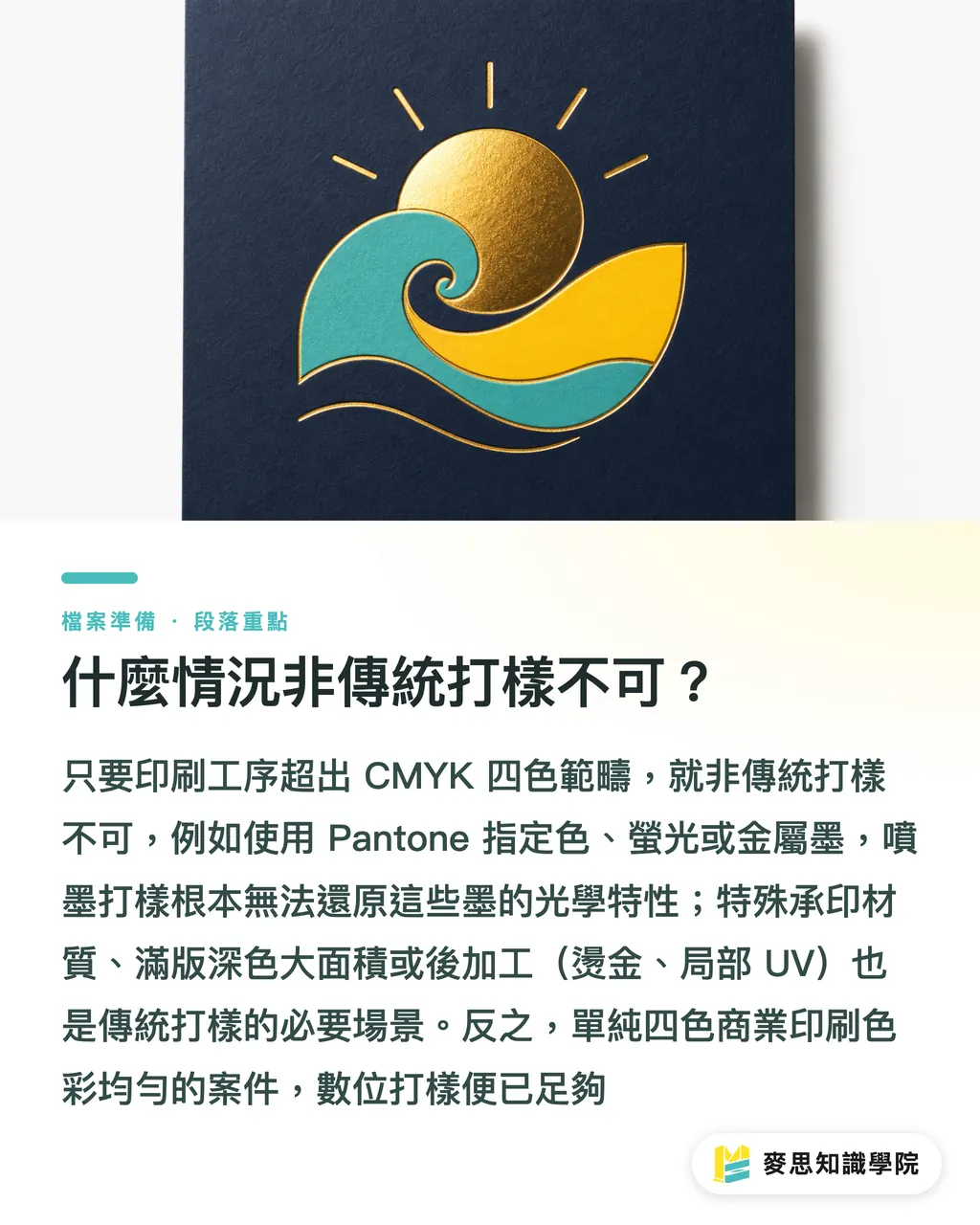
・Post-press finishing including varnish, foil stamping, embossing, or spot UV: finishing changes how the underlying colors read. A traditional proof lets you sign off on the base color before finishing is applied, so you're not discovering a mismatch after the foil is already down
・Brand color tolerance of ΔE ≤ 2: a traditional proof provides a documented reference sample, giving you a clear standard to check against during press inspection
On the other side of the ledger: straightforward CMYK four-color commercial printing with balanced color distribution and mid-range quantities, digital proofing is sufficient. MINDS Printing's online ordering flow handles digital soft-proof confirmation directly, with no wait for press scheduling, making it a natural fit for everyday jobs
A Decision Framework for Buyers and Designers
I usually tell designers to ask themselves three questions before sending files to print:
・Ink count: does the job include Pantone spot colors, fluorescents, or metallics? If yes, traditional proofing is a prerequisite, not an option
・Substrate: how close is the production paper to the digital proof machine's output stock? The bigger the gap, the less the digital proof is worth
・Finishing: does the job include foil stamping, spot UV, or embossing? For these, only a traditional proof can give you a realistic preview of the final result
On the procurement side, the math needs to be run clearly. The cost of a traditional proof is insurance against scrapping and reprinting an entire run. Skip the proof once, get the color wrong on press, and the reprint cost is in a completely different league
For mid-to-high-end fully customized commercial printing, if you're not sure which proofing approach fits the job before sending files, MINDS can work through the ink count and substrate questions with a consultant upfront, keeping late-stage revision costs as low as possible

Key Takeaways
・Digital proofing is a simulation; traditional proofing is a dress rehearsal. They start from different technical premises and shouldn't be treated as interchangeable
・Pantone spot colors, fluorescents, and metallic inks can produce color gaps wide enough to embarrass you in front of a client. Traditional proofing is a prerequisite for these jobs
・Heavy coverage solids and four-color overprint rendering are the two areas digital proofing struggles most to nail
・The more complex the finishing (foil stamping, spot UV, embossing), the more a traditional proof is needed
・Saving on one proof is not worth gambling the cost of a full reprint
Something Worth Thinking About
Moving this decision logic earlier in the process pays off. If a designer tells the client at the pitch stage, 'this job has Pantone colors and foil stamping, so we'll need a traditional proof, the cost is X and it adds three days,' that conversation is far easier than explaining afterward why the colors don't match. For print service providers building out an online ordering flow, this logic can be turned into an order questionnaire where clients select their ink count, substrate, and finishing requirements and the system automatically recommends a proofing method. It's an effective way to cut down on color disputes after the fact. Not complicated to build, but it has to be wired into the front of the process. By the time files are already submitted, it's too late to revisit proofing
FAQ
- Is color deviation on a digital proof a problem? Can it serve as an official color reference?
- A calibrated digital proof for everyday CMYK four-color printing can typically hold deviation to within ΔE 3, which is adequate for signing off on layout and general color distribution. That said, it carries no legal weight and cannot accurately reproduce the visual character of Pantone spot colors, fluorescents, or metallic inks. Those situations call for a traditional proof
- Does any Pantone color automatically mean a traditional proof is required?
- If the design specifies Pantone spot colors, especially fluorescents or metallics, a traditional proof is the only reliable way to confirm final color. Digital proofing can only approximate these with CMYK mixes, and the visual gap can be significant enough that you can't base a final decision on it
- Can digital proofing work for specialty substrates like linen or laid paper?
- Not as the sole confirmation method. The ink absorption behavior and surface texture of these materials differ substantially from digital proof output stock. The same color value can look roughly 20% different between the two. To verify the finished result, you need a traditional proof pulled on the actual production substrate
- How much more does a traditional proof cost, and how long does it take?
- Traditional proofing involves CTP platemaking costs and press time, putting it roughly three to five times the price of a digital proof, with two to three additional business days on turnaround. When brand color accuracy is tight or finishing is complex, that cost is protecting the quality of the entire print run, which makes it worthwhile
- If a job includes foil stamping or embossing, does it need a traditional proof?
- Yes. Finishing changes how the underlying colors read visually. A traditional proof lets you confirm the base color is right before finishing is applied. By the time foil stamping or embossing is done and you spot a mismatch in the base color, there's nothing left to fix
Related articles





The Print × AI weekly
The print and AI know-how designers, brands and enterprises can use before they commit — one email, every week
MINDS Free Tools
Spine width and imposition calculators — skip the manual math, free in your browser.
MINDS Group
Need actual printing or gifting services?
From premium printing to online ordering and festive gifts — the MINDS Group sister brands take it from here.