
Why Do Spread Catalogs Always Lose Pages When Flipped Through?
When spread catalogs will not lie flat or drop pages over time, the main culprit is a thick, rigid layer of traditional EVA hot melt glue combined with coated layers on heavy art paper blocking glue penetration. By following the lay-flat binding assessment process from MINDS, understanding paper properties early in prepress, and pairing them with PUR binding, you can eliminate this persistent headache for designers
PUR (Polyurethane Reactive) hot melt glue: A binding adhesive that cures through an irreversible chemical reaction with moisture in the air. It features extreme tensile strength, broad temperature resistance, and ultra-thin application, allowing the spine to maintain strong page-gripping power while remaining flexible enough for a near-complete lay-flat reading experience
Pick the wrong glue and it is ruined
I have seen way too many cases on the post-press floor: a designer crafts gorgeous full-bleed spreads, only for the finished book to open like a tight clam shell. When readers press down hard, the spine splits right open and pages separate
Traditional perfect binding uses EVA (Ethylene Vinyl Acetate) hot melt glue, which forms a rigid block once cooled. To maintain baseline holding strength, machines have to apply a thick glue layer of roughly 1.0mm to 1.2mm
This thick glue acts like a stiff plastic strip stuck to the spine. Once page counts pass 80 pages or use heavy coated paper above 150gsm, tension concentrates right along the glue edge. After just a few flips, pages peel right off the adhesive surface
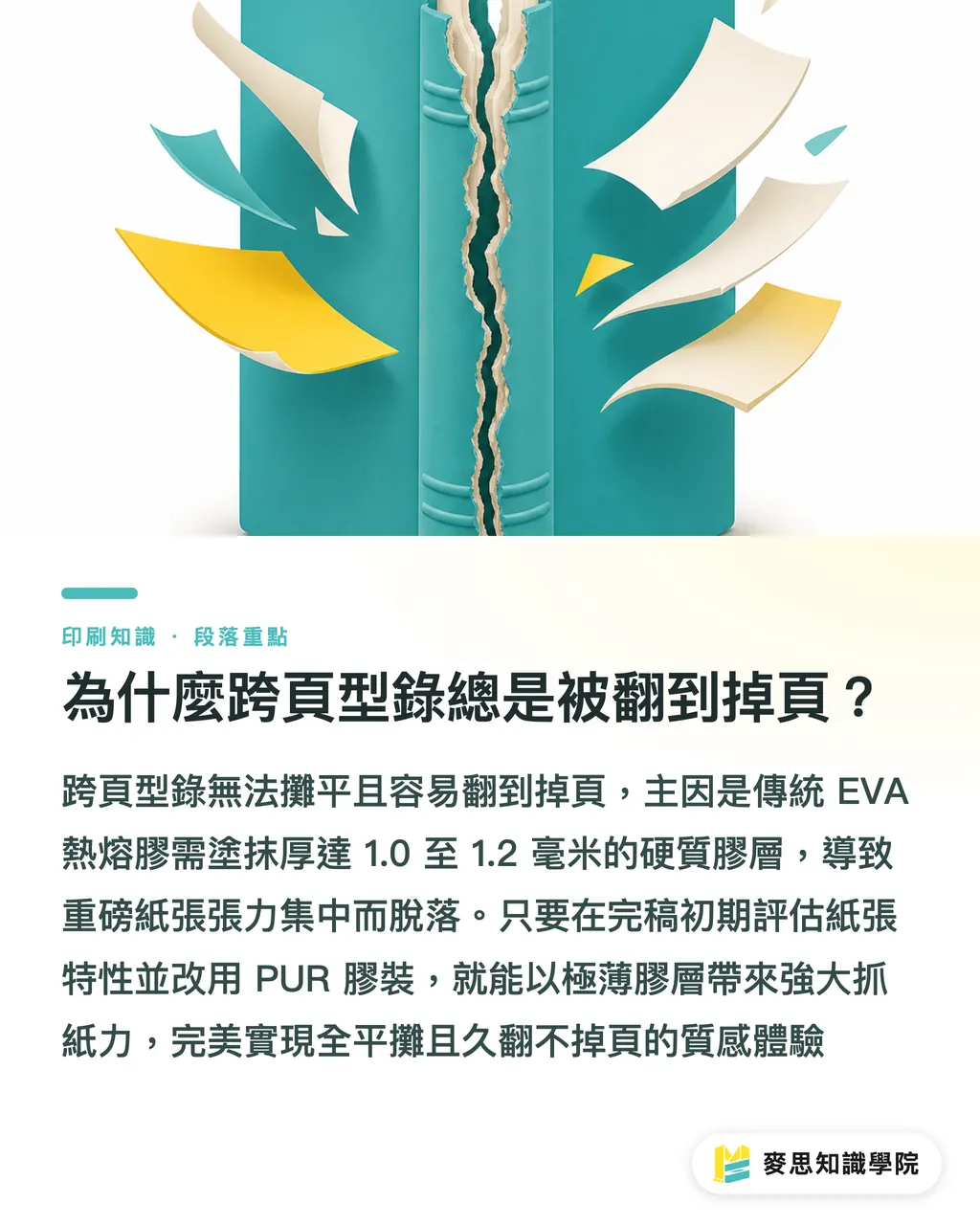
What Are the Physical Differences Between PUR and EVA Hot Melt?
The biggest difference between PUR glue and traditional EVA glue lies in the chemical reaction mechanism of their molecular structures
EVA glue relies on a purely physical process of melting with heat and solidifying when cooled. The process is completely reversible. In hot delivery trucks during summer, it softens back up, and in freezing weather, it turns brittle
PUR glue, on the other hand, is applied warm and then cross-links with moisture in the air, curing into an irreversible network
Here are the key differences on the production line and in real-world use:
・Glue thickness: PUR requires only 0.3-0.5 mm in an ultra-thin layer. EVA needs 0.9-1.2 mm, where the thick glue layer easily causes spine bulging and stiffness
・Page pull strength: PUR delivers 15-20 N/cm of tensile pull strength with strong penetration into heavy coated papers. EVA achieves only around 6-9 N/cm, making heavy stocks prone to tearing loose
・Temperature tolerance: Once cured, PUR withstands environments from -40℃ to 100℃. EVA starts softening above 40℃ and turns brittle and cracks below 0℃
・Lay-flat reading experience: Thanks to its thin layer and resilient cross-linked structure, PUR allows books to open up to 170 degrees. EVA restricts opening and creates heavy spring-back
How Should You Set Spine Milling and Glue Layers for Heavy Coated Paper?
Paper coatings and fiber grain direction are the hidden keys that make or break perfect binding
Many buyers assume switching to PUR glue solves everything, overlooking the essential step of spine milling
Before binding, the print shop uses milling cutters to notch jagged grooves into the spine fold, letting the glue reach deep into the paper
It comes down to this
When binding 150gsm or heavier matte or gloss art paper, if the milling depth is too shallow or fails to cut through the coating, PUR glue still cannot reach the raw wood fibers
In practice, we recommend setting exact milling parameters for different paper stocks:
・Milling depth control: Keep the depth at 1.5mm to 2.0mm to ensure cuts pierce clean through the surface coating of calcium carbonate and binders
・Notch spacing and frequency: Maintain a 3mm to 5mm gap between spine notches on each signature to expand the mechanical bonding area for PUR adhesive
・Grain direction alignment: Paper grain direction must run parallel to the spine. Perpendicular grain causes paper to warp from moisture and tear the glue layer
How to Make Sourcing Decisions with the MINDS (MS) 3-Step Lay-Flat Binding Framework
To help design and sourcing teams strike the right balance between budget and reading quality, we mapped out an actionable evaluation process:
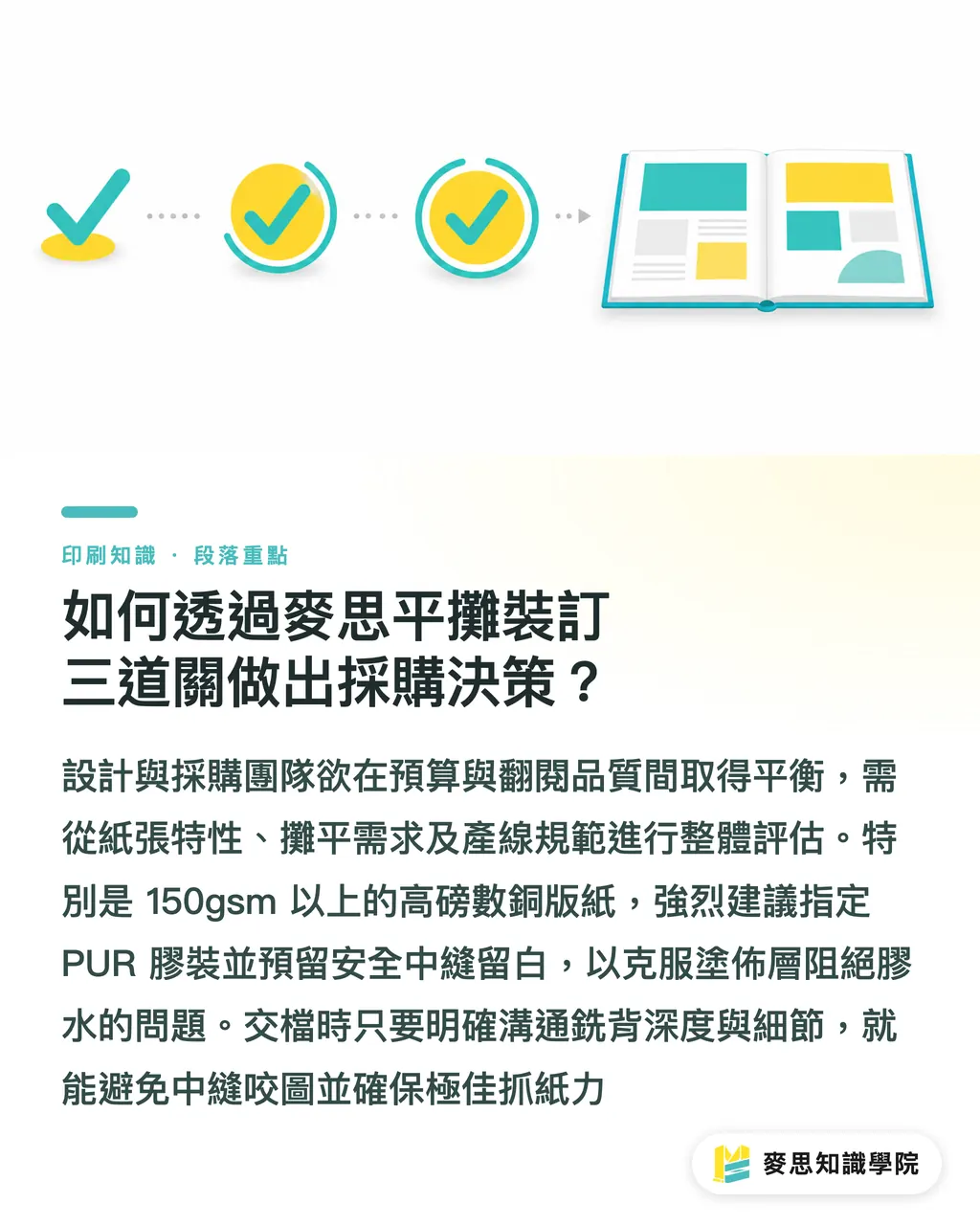
① Check paper weight and coating properties: For heavy coated papers or fully coated stocks at 150gsm and above, surface fillers block standard glue penetration, so we strongly recommend specifying PUR binding directly
② Evaluate spread artwork and lay-flat needs: If the layout features full-bleed photo spreads, art catalogs, or daily planners that get opened repeatedly, choose PUR glue or exposed spine sewn binding to prevent gutter cutoff and blind spots
③ Lock in production specs and milling standards: When sending files, confirm a 1.5-2.0mm milling depth and keep a 3-5mm safe gutter margin with the Mai Strategy Knowledge Academy consulting team to ensure maximum page-gripping strength
Key Takeaways
・The root cause of spread catalogs refusing to lie flat and dropping pages is the stiffening of thick EVA glue and poor penetration into coated paper
・PUR glue relies on moisture-cured chemical bonding, delivering more than twice the pull strength with an ultra-thin 0.3mm glue layer
・Binding coated paper at 150gsm and up requires precise 1.5-2.0mm spine milling to achieve peak holding power
・PUR handles extreme temperatures from -40℃ to 100℃, eliminating delamination risks caused by harsh shipping and storage conditions
・Early in prepress, decide on binding methods based on paper grain and spread requirements using the MINDS (MS, mid-to-high-end fully customized commercial printing) 3-step lay-flat framework
Further Thoughts
When visual presentation matters, binding is never just an afterthought in post-press processing. It is the core engineering decision that dictates brand feel and product lifespan. As demand grows for digital print and short-run variety, procurement teams need to look beyond the unit cost of basic perfect binding. Evaluating paper coatings, spine milling methods, and lay-flat requirements together, and moving binding decisions up into the design and prepress stage, is the only reliable way to avoid costly reprints and elevate the final print piece
Further Reading
FAQ
- Is PUR binding significantly more expensive than traditional EVA perfect binding?
- PUR binding involves higher machinery and material costs, raising unit binding costs by roughly 15% to 30%. However, factoring in how it protects high-value catalogs from losing pages and requiring full reprints, the overall return on investment is actually higher
- Is PUR binding suitable for all types of paper?
- PUR glue works on almost any stock, especially heavy coated papers, metallic cardstocks, and textured papers that standard EVA struggles to grip. On extremely lightweight papers below 60gsm, glue volume must be carefully controlled
- When designing full-bleed spreads, do you still need a gutter safety margin with PUR binding?
- Even though PUR glue lets books open to nearly 170 degrees, milling and side gluing can still slightly obscure the inner fold. We still recommend keeping critical text, graphics, and portraits offset by a 2mm to 3mm safety margin on both sides
Related articles
The Print × AI weekly
The print and AI know-how designers, brands and enterprises can use before they commit — one email, every week
MINDS Free Tools
Spine width and imposition calculators — skip the manual math, free in your browser.
MINDS Group
Need actual printing or gifting services?
From premium printing to online ordering and festive gifts — the MINDS Group sister brands take it from here.