
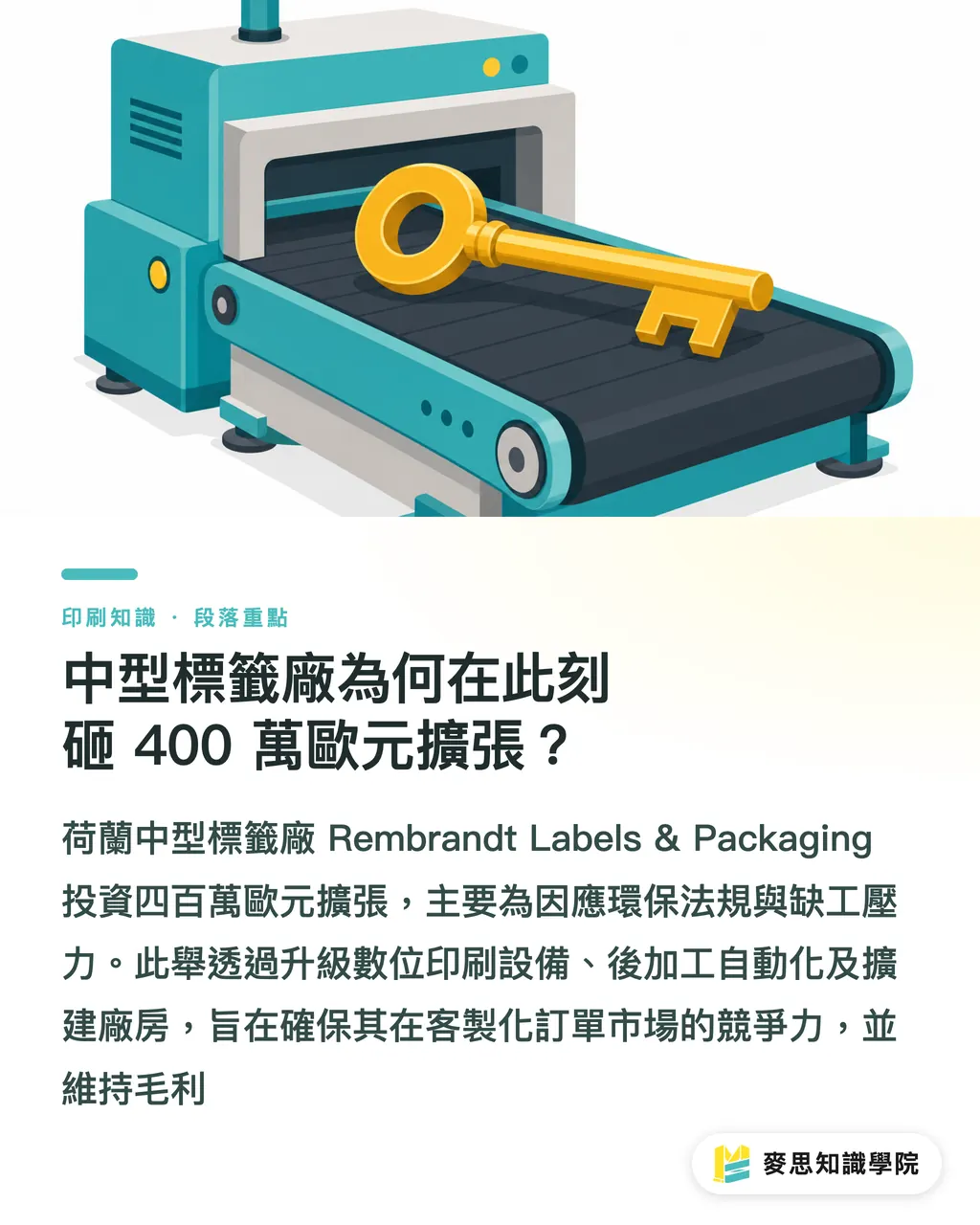
Why would a midsized label printer spend €4 million on expansion right now?
From what I have seen on the production side over the past few years, small and midsized print shops usually make major upgrades because two things force their hand: environmental rules, and labor shortages plus capacity bottlenecks
Dutch midsized label printer Rembrandt Labels & Packaging recently announced a €4 million capital investment plan
They are not throwing money around. The spending is aimed squarely at digital printing equipment, post-press automation, and factory expansion
Compared with multinational paper groups that regularly move hundreds of millions of euros in capital-heavy projects, Rembrandt's scale and situation are much closer to the reality faced by midsized print shops in Taiwan
When you focus on food, beverage, health, and beauty categories that need frequent customization and fast changeovers, a €4 million investment is really a ticket into the market for the next five years
It means they understand that profit margins in standardized mass production are being squeezed, and automation is now needed to protect the gross margin on customized orders
How is Europe's PPWR changing packaging production line planning?
The topic getting noticeably more attention in the industry right now is definitely the chain reaction triggered by Europe's PPWR, the Packaging and Packaging Waste Regulation
Rembrandt's investment plan states clearly that they see the market moving fast from plastic packaging toward paperboard materials
That is why they are not only upgrading their wet-glue labels line, but also putting more money into solid board production equipment
This confirms my earlier judgment: once sustainability becomes a hard requirement, changes in packaging structure directly affect whether a production line lives or dies
・Moving from plastic to paperboard means bringing in different post-press and die-cutting equipment
・Customer procurement strategies will also change. Brand owners will be more inclined to look for integrated contract manufacturers that can handle both labels and carton packaging
For Taiwanese print shops that want European orders or are already under green supply chain pressure from brand clients, this is a production-line restructuring signal that cannot be ignored
What if there is not enough space in the plant? The hidden logistics cost behind a new site layout
Many people read overseas investment news and only look at what top-tier equipment was purchased, while missing the value of "space" itself
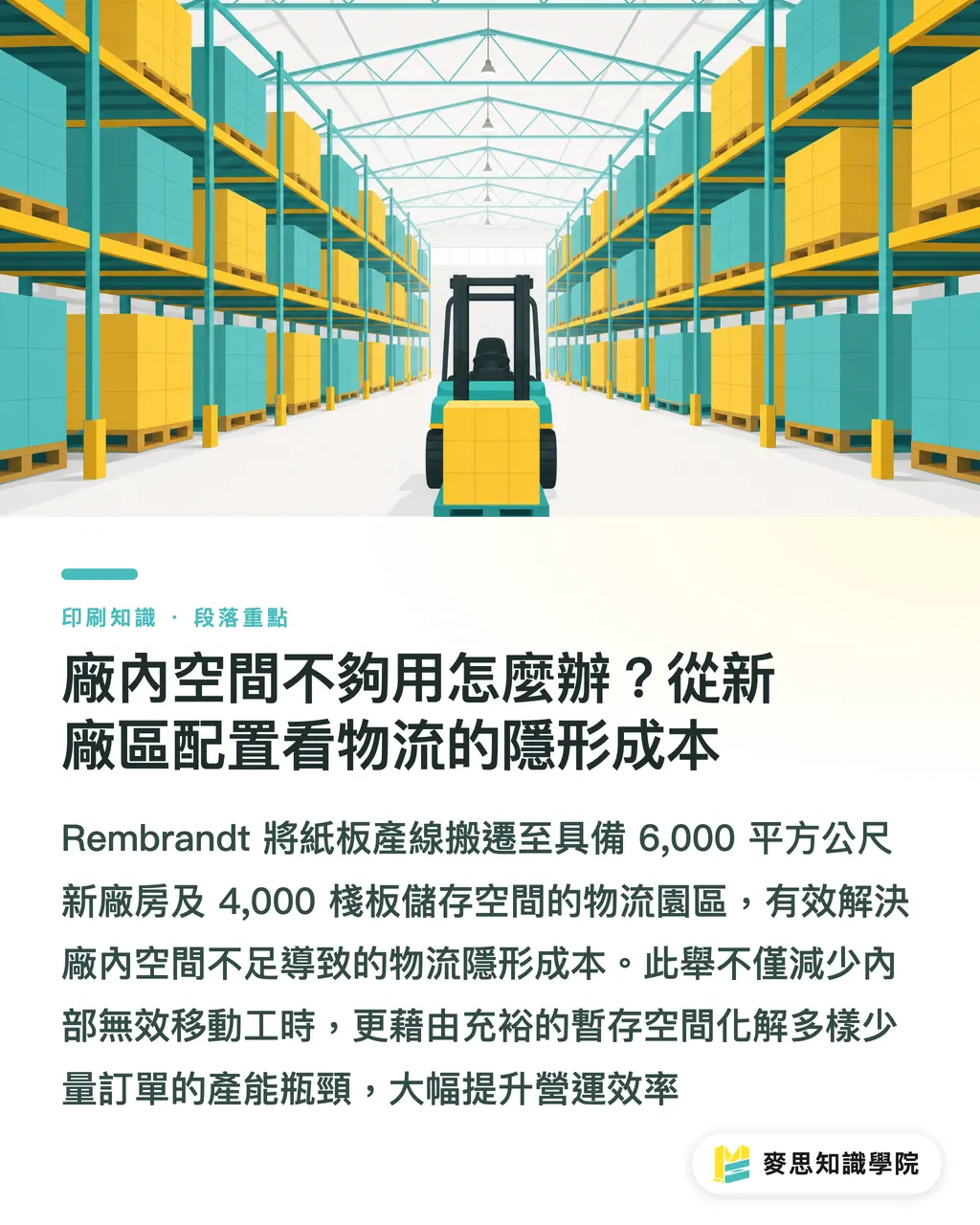
This time, Rembrandt is not only buying equipment. It has also decided to move its paperboard production line from the original Aarschot site to a logistics park on Nieuwlandlaan, a few kilometers away
The new facility covers about 6,000 square meters, which gives a midsized plant quite a generous amount of room for scheduling and movement
More importantly, the new site comes with storage capacity for 4,000 pallets
On a print manufacturing floor, moving and temporarily storing semi-finished goods between machines is often the hidden black hole that eats away at profit
・Keeping production lines, warehousing, and logistics together can cut a meaningful amount of wasted internal movement time
・Enough temporary storage space can ease capacity choke points when many small-batch, varied orders are running in parallel
This kind of thinking, linking production scheduling with logistics layout, is the real core of raising operating efficiency
Key Takeaways
・Investment by midsized print shops should focus on solving changeover efficiency and post-press automation, not merely adding basic capacity
・Europe's PPWR is forcing packaging materials to move from plastic toward paperboard, making related equipment and technical upgrades unavoidable
・Improving internal logistics and warehouse space is a key step in lifting overall operating efficiency and reducing hidden costs
・In a highly competitive market, integrated capability across both labels and paperboard packaging will become an advantage in winning orders
Further Thoughts
For small and midsized print shops and packaging design teams in Taiwan, Rembrandt's decision is a very realistic benchmark
Do not keep thinking about competing with large manufacturers on capital scale or unit prices for standard products. Instead, examine whether your own production line has the flexibility to handle diverse materials, especially sustainable paperboard
When planning the next stage of factory or equipment investment, do not reserve the budget only for printing presses. You must also review internal logistics flow and automated post-press capability at the same time. That is the real foundation for protecting gross margin in the customization market and connecting with the MINDS one-stop service system
Further Reading
FAQ
- Why are midsized European print shops investing heavily in hardware equipment right now?
- The main driver is environmental regulation such as Europe's PPWR, which has sharply increased market demand for plastic alternatives like solid board. At the same time, these shops also need automation to solve post-press production efficiency problems
- Do Taiwanese print shops need to worry about the shift in packaging materials?
- If you handle export orders or local supply for international brands, this is absolutely already happening. As brand clients respond to compliance requirements, they will place more weight on a supplier's ability to process non-plastic materials
- What do small and midsized shops most often overlook when planning expansion or upgrades?
- They often calculate only the floor space taken up by machines, while underestimating the temporary storage needs created by varied small-batch orders, along with the efficiency losses and hidden operating costs caused by internal logistics movement
References
- €4 million in investments for Rembrandt Labels & Packaging · printindustry.news
Related articles




The Print × AI weekly
The print and AI know-how designers, brands and enterprises can use before they commit — one email, every week
MINDS Free Tools
AI background removal, a LINE sticker maker, spine & imposition calculators — all free, right in your browser, no upload.
MINDS Group
Need actual printing or gifting services?
From premium printing to online ordering and festive gifts — the MINDS Group sister brands take it from here.