

Overview
Have you ever had a client ask: "Can this packaging tell consumers if the food inside has gone bad?" In the past, our standard answer was no. Packaging was only there to provide a barrier and communicate information; testing for freshness belonged in a lab. But if the diagnostic tool itself is a printed sheet of paper, does that answer still hold?
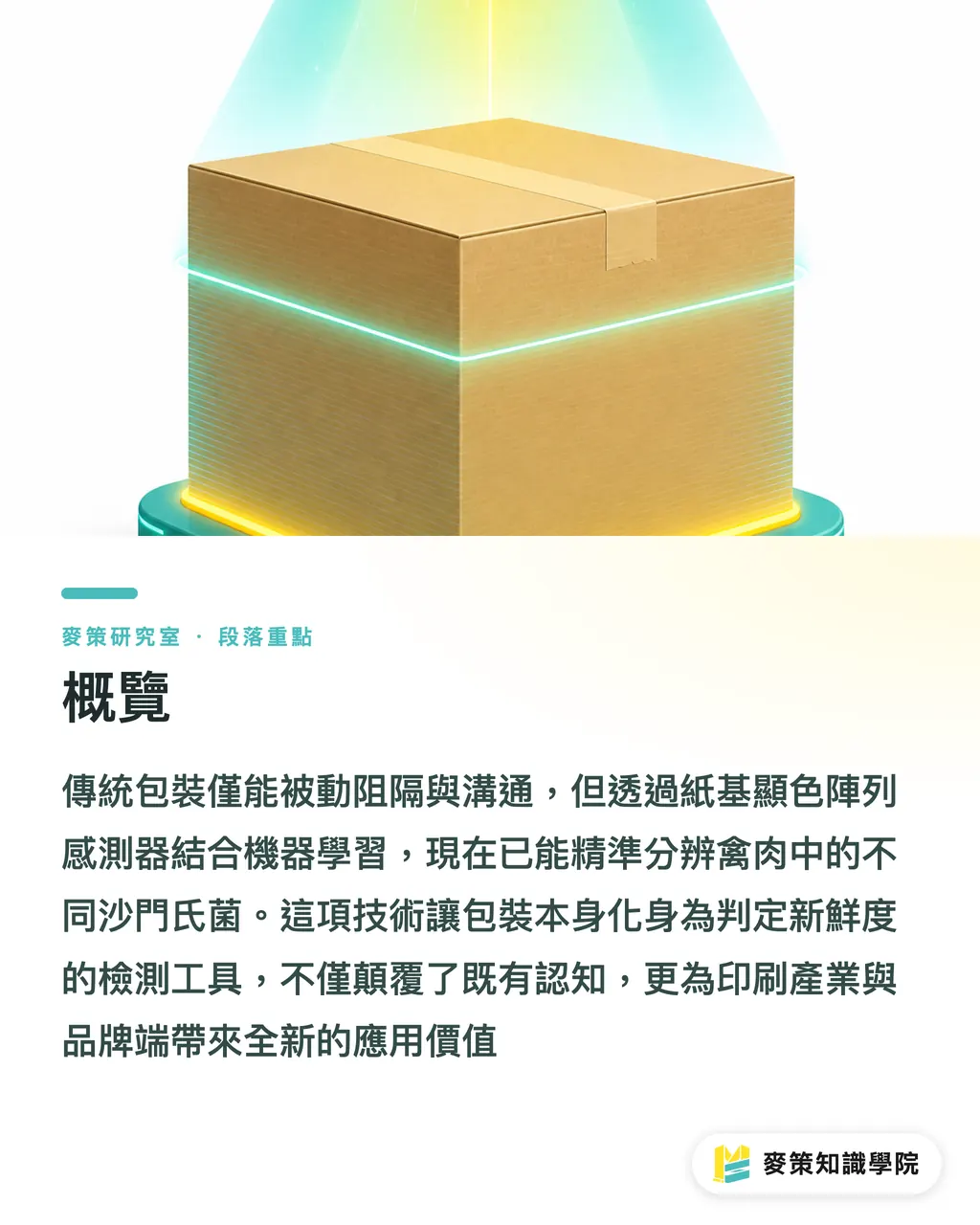
Recent research in food science takes this premise even further. Using a paper chromogenic array sensor paired with machine learning, researchers detected and distinguished between two Salmonella serotypes, Salmonella Typhimurium and Salmonella Enteritidis, in poultry samples [1]. This goes beyond simply detecting whether bacteria are present; it identifies specific strains. It also opens up new directions for the print industry, touching on technical mechanisms, capacity assessment, and how brands measure value
How Paper Sensors Actually Detect Bacteria
The core logic is straightforward: let chemical color spots on paper read metabolic signals in the air
When microorganisms grow in food matrices, they release volatile organic compounds (VOCs). Printing a set of chromogenic reagents sensitive to different chemical functional groups onto paper creates an "array." Each spot changes color to varying degrees depending on the combination of VOCs present. A single spot's color change carries little diagnostic value on its own. However, the collective colorimetric fingerprint of the entire array forms an identifiable feature vector. This is where machine learning comes in: converting images into numerical data and training a classifier to map those patterns to specific pathogens [1]
The human eye can barely distinguish these subtle shifts, which is why algorithms are necessary. The metabolic profiles of the two serotypes overlap heavily; to the naked eye, a few dots might just look slightly more yellow. Traditional freshness indicators relying on pH shifts offer single-point, binary readings. Paper arrays, by contrast, generate multidimensional, continuous signals. The sensor material and the interpretation model must be designed together; neither works without the other
One boundary worth noting: this study was validated in controlled poultry samples [1]. That does not mean it works across any food type or any retail temperature tier. This distinction is critical for brands looking to apply this directly to retail shelves
Is This New Business or a New Barrier for Printers?
The short answer is both. But the real barrier lies in formulation and quality assurance, not the printing press
Printing a colorimetric array on paper is fundamentally high-precision multi-color registration with functional inks. For print shops experienced with barcodes, thermochromic inks, or microprinting, the equipment side is familiar territory. Still, several key challenges must be solved:
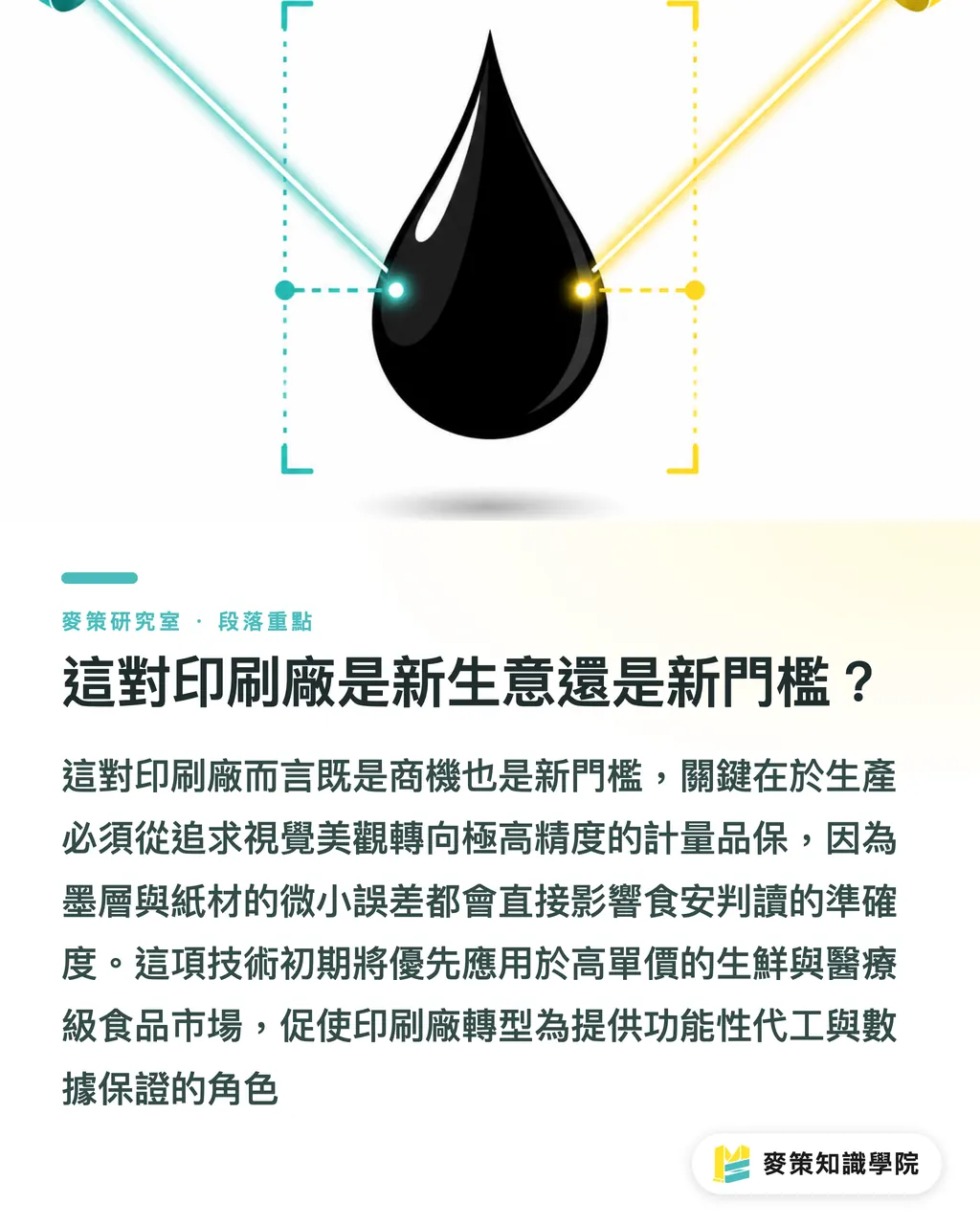
・Print consistency equals measurement accuracy. Ink film thickness variations acceptable in general commercial printing become direct signal noise here. The model is trained on a specific batch of reference standards. If initial color variance between print runs exceeds the training distribution, classification fails. This marks the transition for the printing industry from "visually acceptable" to "metrologically traceable."
・Paper is no longer just a substrate. Coating, sizing, and porosity dictate reagent fixation and VOC diffusion paths. Paper specifications shift from aesthetic choices to functional parameters
・Regulations and liability. Once consumers treat color changes on packaging as definitive food safety signals, where does liability land if there is a misclassification? This is not just a technical issue, but one of industry consensus and standards. The European printing sector already offers mature association-level standards and policy participation mechanisms that serve as useful reference points [3] (this reflects the author's observation on institutional frameworks, not a claim made by the registry itself)
My view: in the short term, this will not enter mass commercial packaging. It will first land on high-ticket, high-risk items like premium raw poultry gift boxes, cold-chain herbal remedies, and medical-grade foods. The entry point for printers is "contract functional printing plus quality assurance data," not racing to print for less
Will Consumers Actually Pay for Bacteria-Detecting Packaging?
Yes, but it fits squarely into what the Kano model calls an "attractive quality," not a "must-be quality." That distinction defines its pricing logic
The impact of packaging attributes on consumer satisfaction is non-linear, a framework empirically supported by Kano model research on packaging materials [2]. In Kano terminology: barrier properties and seal integrity are must-be qualities (doing them right earns no extra points, failing them brings severe penalties). Meanwhile, packaging that actively tells you whether food is safe currently sits in the attractive quality zone. If it is missing, consumers do not complain; if it is there, perceived value and willingness to pay jump significantly. This implies two things: it works well for premium pricing rather than baseline standard features, and attractive qualities drift into must-be expectations over time, giving early movers a limited window
Visual presentation on the readout interface is another practical consideration. If color results need accompanying text, such as bilingual Chinese-English interpretation guides or warning labels, typeface choices directly affect reading speed and comprehension accuracy. Empirical studies in bilingual contexts confirm the impact of font selection on information processing [4]. If consumers cannot intuitively interpret the color readout, the sensing feature loses its practical purpose
What Should Brands and Printers Do Right Now?
The most practical near-term step is not investing in new lines, but running a closed validation loop on a single SKU and a single cold chain
Specific recommendations:
・For brands: Pick a high-ticket SKU with high return costs and relatively controllable cold-chain conditions for a pilot. Measure your own product's VOC shifts under real-world retail temperatures before discussing sensor implementation. Without this baseline data, no vendor model can align with your product
・For printers: Focus on digitizing process data rather than rushing to buy hardware. Start logging color variance, ink film thickness, and batch environmental conditions from existing specialty print lines. That data is your only convincing asset when bidding on future functional printing contracts
・For AI integrators: Model value is tightly coupled to product-specific training data. Cross-product generalization remains a weak spot. Price costs based on project-based custom training for each SKU, rather than treating it like a plug-and-play general API
The boundary of application must be clear: these recommendations hold only for high-value, high-risk items under controlled distribution. For shelf-stable, low-cost processed foods with long shelf lives, the marginal return of paper sensors is likely lower than simply reinforcing seals and traceability. In those cases, putting resources into existing traceability labels makes much more economic sense. This technology has a specific operating scope

Key Takeaways
Paper-based chromogenic arrays paired with machine learning can already distinguish between two Salmonella serotypes in poultry samples, going beyond binary presence detection [1]
Sensor materials and interpretation models must be co-designed; neither standalone color spots nor standalone algorithms can work independently
For printers, the real obstacle is not printing equipment, but batch-to-batch consistency, functional substrate specifications, and digitized quality data
Active food safety sensing is an attractive quality in the Kano model, suited for premium positioning rather than standard configurations, with a window that narrows as adoption grows [2]
The first step toward implementation is closed validation on a single SKU to establish baseline VOC profiles for your product in real cold-chain environments
Further Thoughts
What makes this technological path stand out is how it shifts packaging from a carrier of information to a producer of information. For print manufacturing, the definition of quality may pivot from visual appeal to metrology. Shops that win these orders will compete on process CPK and batch traceability rather than color rendition, offering a structural exit from prolonged price wars. For designers, the challenge lies in translating multidimensional color readouts into visual language that consumers understand within three seconds, while preserving comprehension accuracy across bilingual or multilingual packaging [4]. For AI integration, the core hurdle is data scarcity and poor generalization: every product and matrix likely requires its own training set, pushing the business model closer to custom consulting than off-the-shelf software. For SaaS providers, a clear opportunity emerges. Building a standardized service layer for image uploads, model inference, result delivery, and traceability logs spares printers and brands from building in-house algorithm teams. Many questions remain open. Liability for false readings, in-transit sensor failure detection, and recalibration mechanisms for cross-batch model drift still lack industry-wide solutions
References
[1] Jia, White, Zhang (2027). Detection and differentiation of Salmonella Typhimurium and Salmonella Enteritidis in poultry meat using a machine learning-enabled paper chromogenic array sensor approach. Food Control. DOI: 10.1016/j.foodcont.2026.112583
[2] Acta Graphica/Hrčak: Kano Model Study on Packaging Materials and Consumer Satisfaction. Acta Graphica/Hrčak
[3] German Bundestag Lobbyregister: Official bvdm Lobbying Register Entry. German Bundestag Lobbyregister
[4] Information Design Journal (John Benjamins): Empirical Study on Typeface Selection in Bilingual Contexts. Information Design Journal (John Benjamins)
FAQ
- How does paper sensor packaging detect bacteria?
- An array of chromogenic reagents printed on paper changes color in varying degrees when exposed to volatile organic compounds released by food. A machine learning model then interprets the complete color shift pattern to identify specific pathogens. Research has already differentiated between Salmonella Typhimurium and Salmonella Enteritidis in poultry samples [1]
- Can typical print shops manufacture smart sensing packaging?
- On the equipment side, generally yes. Multi-color registration and functional inks are familiar territory for shops with specialty printing experience. The real hurdle is batch consistency. Print color variance turns directly into measurement error, demanding digitized process controls and traceable quality assurance
- Will consumers pay more for packaging that detects food safety issues?
- This functionality represents an attractive quality in the Kano model. Having it significantly boosts satisfaction and willingness to pay, while lacking it does not cause dissatisfaction [2]. As a result, it works best as a premium differentiator for high-value products rather than a standard feature across all items
- Which products are best suited for paper sensor packaging?
- High-ticket products with high food safety risks and controllable cold-chain conditions are the best candidates, such as fresh poultry gift boxes and chilled prepared meals. For low-cost, shelf-stable processed foods with long shelf lives, investing in stronger seals and traceability tags typically yields a better return
- Is this technology ready for immediate commercialization?
- Validation so far has been completed in controlled sample settings [1], without covering every food matrix or retail temperature profile. The practical approach is to begin with closed validation on a single SKU to establish baseline data for your specific product before considering scale
Related articles


The Print × AI weekly
The print and AI know-how designers, brands and enterprises can use before they commit — one email, every week
MINDS Free Tools
AI background removal, a LINE sticker maker, spine & imposition calculators — all free, right in your browser, no upload.
MINDS Group
Need actual printing or gifting services?
From premium printing to online ordering and festive gifts — the MINDS Group sister brands take it from here.