
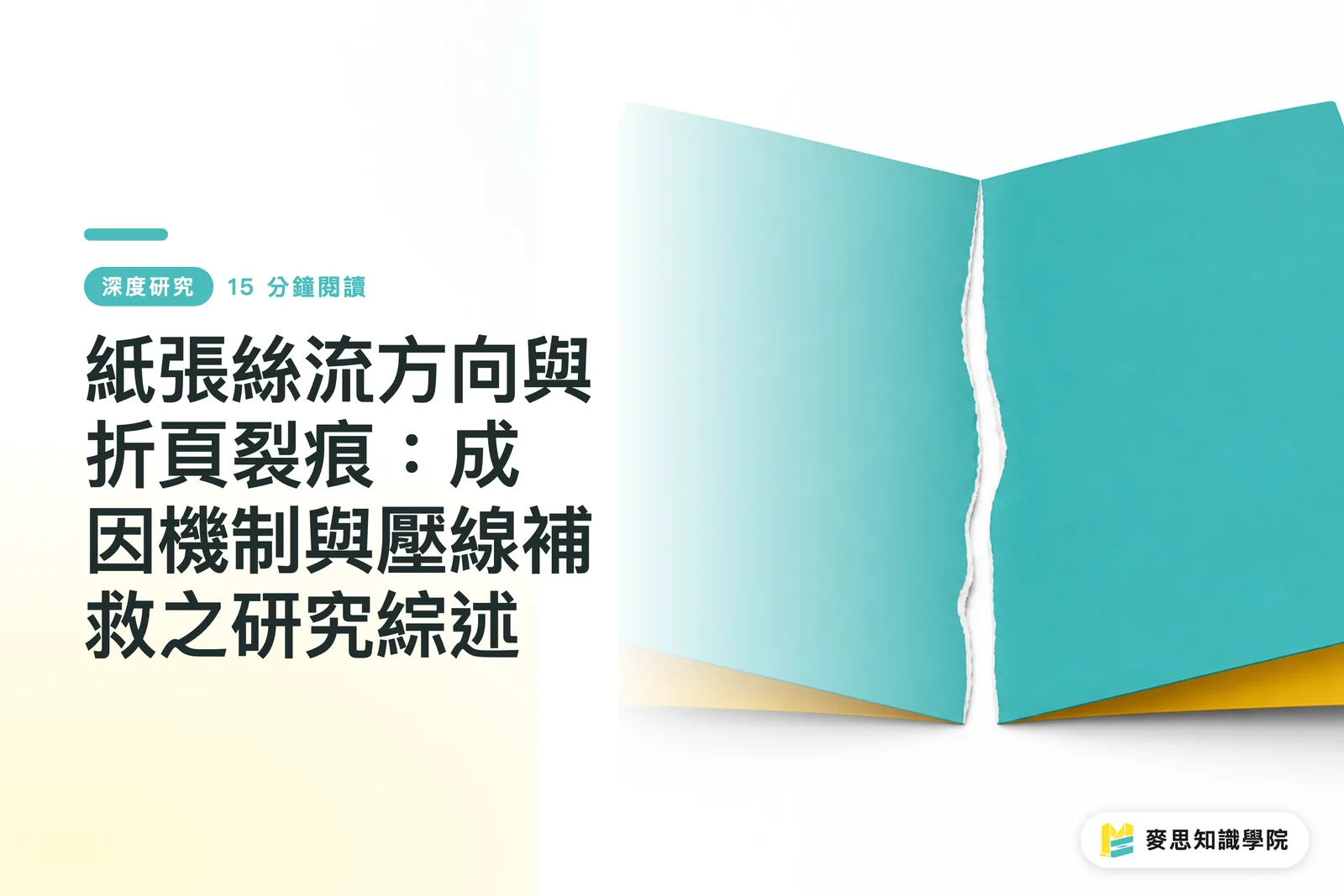
Fold Cracking as an Underestimated Research Problem
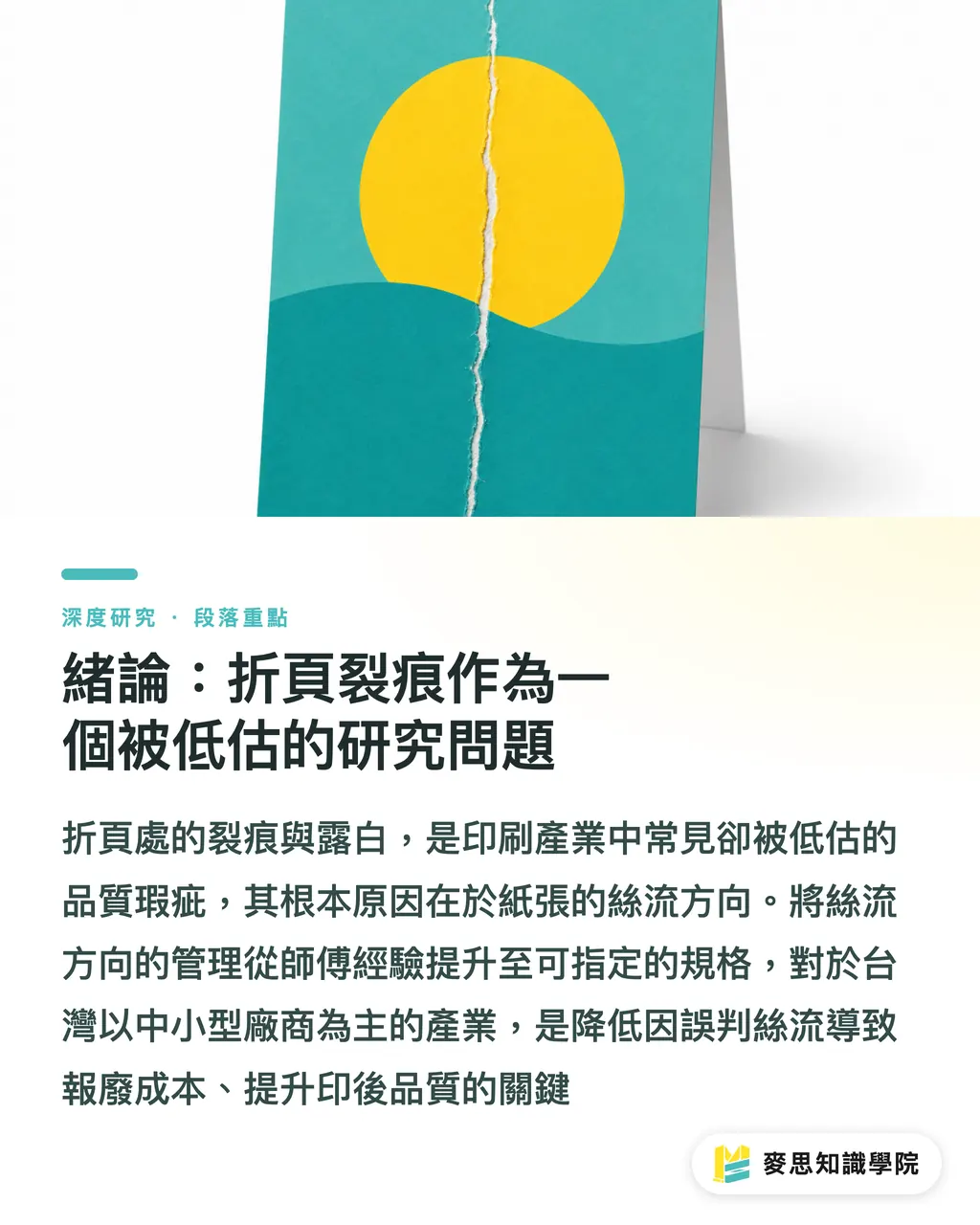
Cracking and white edges along the fold line are among the most common yet least systematically discussed quality defects in the design and print industry. When thick cardstock or coated art card folds along a crease line, microscopic fractures appear on the surface layer and the white core substrate shows through, commonly known in the trade as color flaking or cracking. On the surface, this looks like an ink or paper quality defect. In reality, it stems from a more fundamental material variable: paper grain direction, which is the primary alignment of fibers during the papermaking process
This paper addresses three core questions:
・First, why grain direction determines whether a fold will crack
・Second, what physical mechanism causes surface fracturing during cross-grain folding
・Third, what the effectiveness and boundaries of creasing are as a post-press remedy. The contribution of this paper lies in synthesizing scattered literature across material science, wood measurement, and paperboard converting into an explanatory framework tailored to print production, drawing actionable implications for Taiwan's industry
This issue matters to Taiwan's design and print industry because the local market consists primarily of small and medium print shops and freelance designers. As a result, grain management has long remained tacit knowledge held by senior craftsmen rather than a verifiable specification parameter. As orders shift toward fold-heavy products like hardcover notebooks, branded packaging boxes, and heavy business cards, the cost of scrapping entire batches due to misjudged grain direction far exceeds the upfront cost of specifying paper grain. We argue that treating grain direction as a manageable subject of study rather than a matter of luck is the key entry point for raising local post-press quality
Mapping Knowledge Clusters: From Fiber Alignment to Crease Mechanics
Existing discussions fall into three clusters based on their focus. They complement one another in defining and measuring fiber orientation and modeling creasing and folding, but leave a gap in the practical causal chain connecting grain direction to folding damage
The first literature cluster focuses on the measurement and definition of fiber orientation. Wood science explored through-bark grain measurement decades ago, attempting to deduce internal fiber orientation without damaging the bark [2]. This work shows that fiber orientation as a physical quantity has long been treated as a measurable and predictable material property. The value of this perspective lies in transforming grain from a vague visual impression into a directional, repeatable engineering parameter. Although paper grain comes from sheet forming rather than tree growth, it shares the same premise that fibers have a dominant alignment direction
The second cluster treats creasing as a standardizable and testable engineering process. Standardized frameworks have incorporated paperboard creasing properties [1], demonstrating that crease strength, springback, and failure are not random. Experimental and computational studies on laminated paperboard creasing and folding use testing and simulations to map strain distribution across the inner and outer sides of the fold line [3]. Continuum damage models treat creasing directly as controlled material damage rather than simple geometric bending [4]. We analyze this line of work as elevating creasing from a craft technique into a mechanical design that deliberately guides the fracture path
The third cluster addresses coating layer failure during folding. Research on fold cracking in coated paper points out that pulp fiber composition and beating conditions alter the degree of coating cracks along the fold line [5]. Studies on coated paperboard foldability examine how creasing and folding conditions determine final foldability [6]. This cluster directly addresses the real-world visual defect of color flaking and exposed white substrate
Looking across these three clusters reveals a structural gap. Measurement studies prove that fiber orientation can be defined. Mechanics and coating studies prove that creasing and cracking can be modeled. Yet few studies connect the causal chain between grain direction and fold cracking within the context of print production. The entry point of this paper is to bridge this explanatory gap between material properties and pressroom defects
The Physical Nature and Classification of Grain Direction
This section defines the physical nature of grain direction as the foundation for the folding analysis that follows
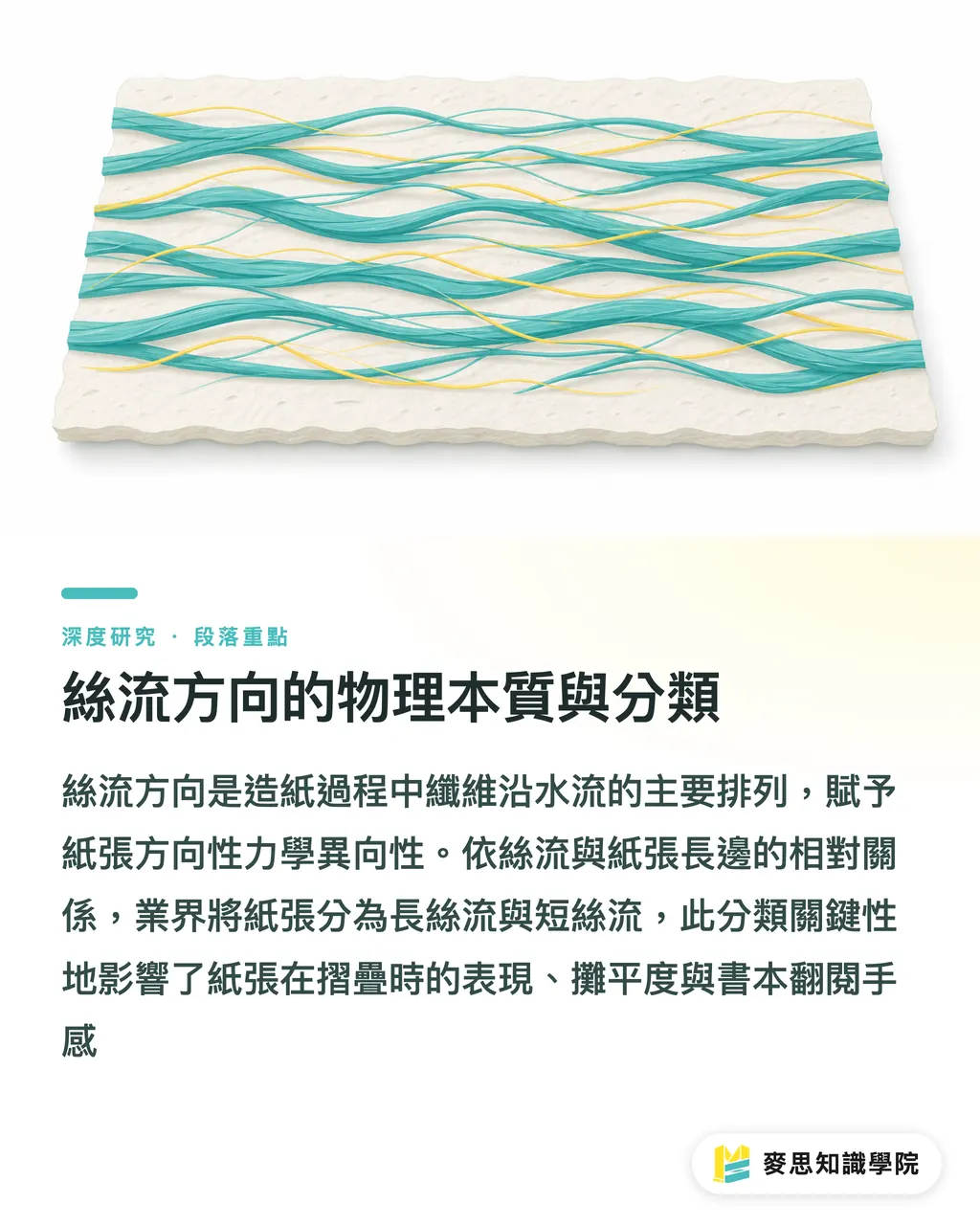
Grain direction refers to the primary alignment of fibers on the forming wire along the flow of water during papermaking. Because pulp slurry stretches in the direction of web travel, fibers tend to align with the machine direction, creating an identifiable dominant orientation. Following the premise that fiber orientation is a measurable physical quantity [2], paper exhibits direction-dependent mechanical anisotropy. Tensile strength is higher and elongation is lower parallel to the grain, while the opposite holds perpendicular to the grain
Based on how grain aligns with the long edge of the sheet, the industry classifies paper into long grain and short grain. Long grain means fibers run parallel to the long edge, while short grain means fibers run parallel to the short edge. The practical significance of this classification is that it dictates whether the fold line will fall parallel or perpendicular to the grain under a given cut size. Our analysis suggests that neither long nor short grain is inherently superior. What matters is whether the final fold line aligns with the grain direction
Grain anisotropy affects several performance factors beyond folding. Paper flattens out more easily along the grain. Across the grain, fibers are forced to bend crosswise, causing springback and waviness. This characteristic directly impacts book lay-flat quality and page turning. When page grain runs parallel to the spine, turning resistance is low and books open flat. When grain runs perpendicular, pages tend to buckle and feel stiff to turn. Grain direction is therefore not just the cause of fold cracks, but also an underlying factor in binding quality
Damage Mechanisms in Cross-Grain Folding: Surface Fracture and Color Flaking
This section examines the core mechanism behind fold cracking, detailing why cross-grain folding causes surface fiber breakage and exposed white core
Folding is essentially bending deformation where material on the outside of the fold experiences tension and material on the inside experiences compression. When the fold line runs parallel to the grain (folding with the grain), the crease separates along the natural weak planes between fibers. Fibers separate smoothly rather than tearing across, allowing the surface layer to remain intact. In contrast, when the fold line runs perpendicular to the grain (folding against the grain), folding forces numerous fibers on the outside of the crease to snap crosswise at the same time. The surface coating and ink layers lose substrate support and shatter along the crease, producing visible white cracks and color flaking. Following the view of creasing as a standardizable damage process [1], we view this as a question of whether the failure path aligns with the material weak planes
This mechanism becomes more pronounced as paper thickness and basis weight increase. When heavy cardstock and paperboard fold, the distance between the outer surface and the neutral axis is greater. Under the same folding angle, the outer surface endures higher tensile strain. When this strain exceeds the elongation limit of the coating and surface fibers, fracture occurs. This explains why thin paper folded against the grain usually shows only minor wrinkling, whereas heavy cardstock folded against the grain cracks and exposes the white core directly. Experimental and simulation studies on laminated paperboard map out inner and outer strain distributions [3], echoing this description of surface failure caused by strain concentration
Coated paper carries higher risk than uncoated paper. The coating layer is a mineral formulation applied over fiber surfaces with limited elasticity, and its fracture strain is lower than that of the fibers themselves. Under identical folding conditions, coated surfaces develop cracks much earlier. This is why heavy coated art papers and coated cardstocks are most prone to white lines along the fold, while softer uncoated art papers are more forgiving. Our analysis indicates that the severity of fold cracking is the combined product of grain direction, paper thickness, and surface coating, rather than any single factor alone
Creasing as a Remedy: Mechanism, Effectiveness, and Boundaries
This section evaluates the mechanism and boundaries of creasing as a remedy for cross-grain folding
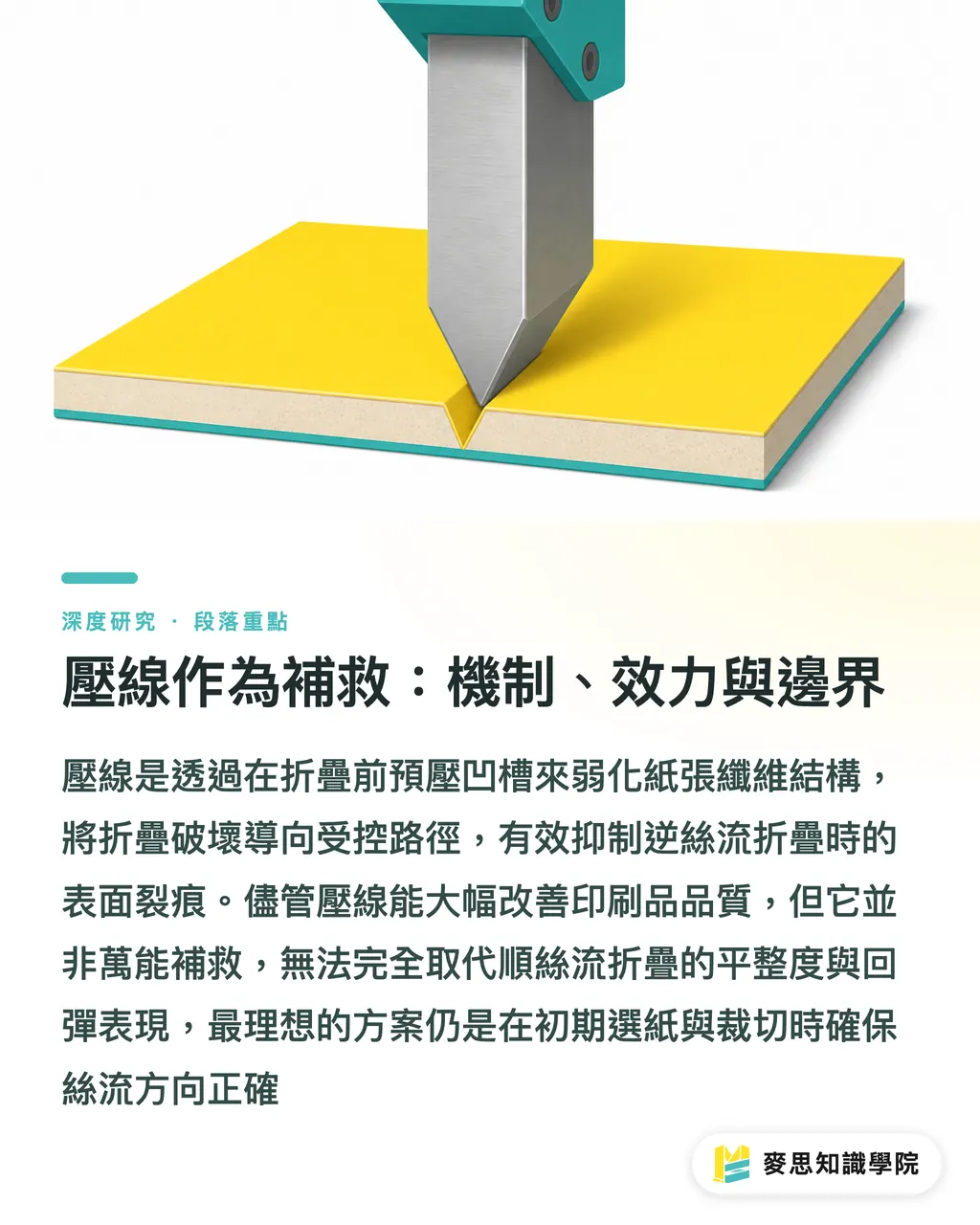
Creasing is a pre-folding step that presses a groove into the fold line using a steel rule or creasing matrix. Continuum damage models treat creasing as controlled material damage rather than simple geometric bending [4]. Mechanically, creasing crushes the fiber structure and redistributes thickness along the fold line beforehand. Subsequent folding concentrates bending within this pre-weakened groove instead of forcing unprepared surface fibers to tear crosswise. Creasing does not eliminate damage, but redirects it along an internal, controlled path
The effectiveness of creasing is part of standardized engineering frameworks. Standardizing paperboard creasing properties demonstrates that crease strength and failure behavior can be tested and set [1]. We deduce that matching crease depth, rule width, and channel width requires adjustment based on paper thickness and grain direction. Cross-grain folds typically require deeper and wider crease settings to compensate for crosswise fibers that resist natural separation. When parameters are properly matched, surface cracking on cross-grain folds drops significantly, bringing previously unacceptable edges back to deliverable quality
Creasing is not an absolute fix, and its limits must be clearly stated:
・First, creasing cannot fully match the flatness and low springback of folding with the grain. Even after creasing, cross-grain folds retain higher springback and may gape open slightly
・Second, an excessively deep crease can fracture the surface layer on its own, turning post-fold cracking into immediate cracking during creasing
・Third, creasing adds platemaking and finishing steps, which may not make financial sense for short runs and low-budget jobs. Our analysis suggests that creasing should be viewed as post-press compensation for grain mismatch rather than a replacement for upfront grain specification. The most cost-effective approach remains aligning the fold line with the grain during paper selection and cutting
Identifying grain direction is the prerequisite for these decisions. In practice, shops rely on three non-destructive or semi-destructive tests: the tear test (tearing with the grain yields a straight line, while tearing against the grain produces a jagged edge), the bend test (bending with the grain shows less resistance and a smoother curve), and the moisture test (wetting one side curls the paper perpendicular to the grain as crosswise fibers expand more from water absorption). Following the tradition of measuring and inferring fiber orientation [2], these tests deduce internal fiber alignment through direction-dependent mechanical or moisture responses
Implications for Taiwan's Design and Print Industry
This section translates these mechanisms into practical takeaways for three industry roles in Taiwan, examining impacts on workflow, cost, and scheduling
For small and medium print shops, managing grain direction means turning tacit knowledge into verifiable workflows. Specific steps include marking grain direction on every paper ream upon receipt and prioritizing with-grain alignment for primary fold lines during imposition and cutting. For layouts that must fold against the grain, shops should build creasing into the default routing and establish reference tables linking paper weight to crease settings. The cost mainly involves added upfront communication and prepress planning time, but the return is clear when compared against paper loss and reprints from entire batches of cracked folds. Documenting grain and crease parameters also reduces reliance on the instincts of individual senior press operators
For designers, the takeaway is integrating grain into early file preparation rather than passively accepting results after delivery. When designing folded brochures, hardcover cases, and packaging dielines, designers should clearly indicate fold locations and directions, confirming with the printer whether folds run with the grain. If fold lines are fixed, designers must request the matching long grain or short grain specification when selecting paper sizes. Following empirical evidence linking coating cracking to fiber composition [5], designers must exercise caution with heavy coated papers, requesting creasing when needed or choosing more forgiving uncoated stocks
For brand owners, the cost of misjudging grain direction appears in production timelines and consistency. Fold cracking degrades the tactile feel of individual pieces, while causing yield fluctuations and delivery delays across large production runs. When establishing packaging or publishing specifications, brand owners should write grain direction and creasing requirements into procurement documents as verifiable acceptance criteria rather than relying on verbal agreements. Treating grain direction as part of the procurement specification rather than an internal print shop detail gives brand owners an effective tool for ensuring consistency across batches
The shared takeaway across all three roles is simple: grain direction is a variable that must be decided before fold lines are locked in. Once finished dimensions and fold orientations are set, grain direction becomes fixed, leaving creasing as the only partial fix. Moving the decision point upstream to paper selection and cutting represents the lowest-cost quality intervention
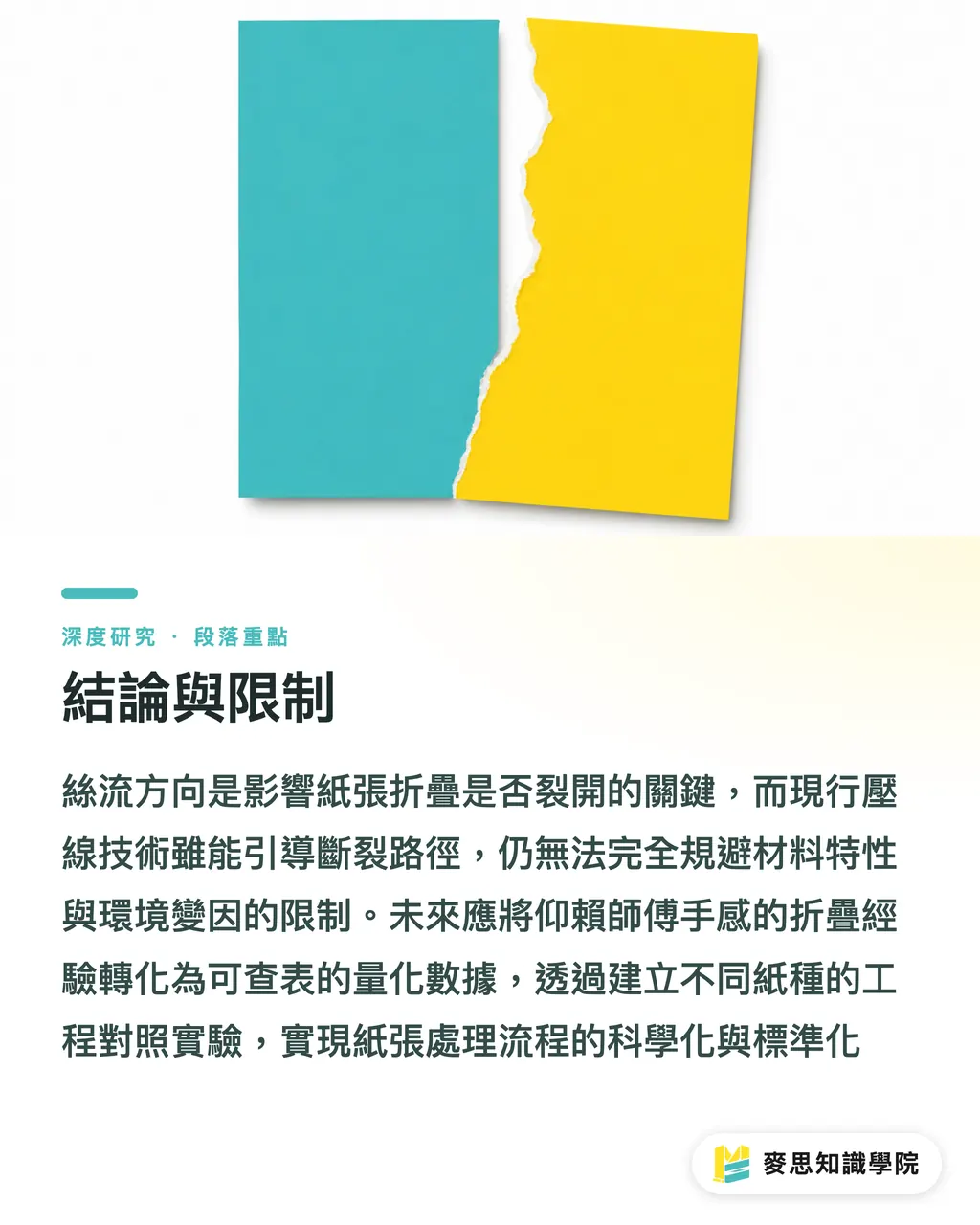
Conclusion
This paper answers the three research questions raised in the introduction as follows:
・First, grain direction determines fold cracking because paper anisotropy dictates whether the fold line and fiber alignment cause the failure path to follow the material weak planes [2][5]
・Second, cross-grain folding fractures the surface because outer fibers are torn across simultaneously while the coating layer loses support and shatters, an effect amplified by paper thickness and coating weight [1]
・Third, creasing serves as a remedy by redirecting fracture into a pre-pressed, controlled groove. While effective, it cannot fully restore with-grain performance and carries clear limits regarding surface rupture and added production cost [1][4][6]
This study has several limitations. First, the cited literature primarily addresses definitions, measurement, and standardization frameworks, lacking quantitative experimental data on cracking thresholds for specific paper grades under specific fold angles. The conclusions regarding thickness and coating remain mechanistic deductions rather than empirical test findings. Second, tear, bend, and moisture tests are experiential methods that depend on operator judgment, and quantitative standards await future research. Third, this paper does not cover how ambient humidity, fiber types, and recycled content interact during folding, variables that may be more complex in recycled and specialty substrates
For future research, we suggest building experimental datasets covering basis weight, grain direction, crease parameters, and post-fold crack grading for coated art cards, fine art papers, and recycled stocks commonly used in Taiwan. This would translate our mechanistic framework into direct lookup tables for production lines, advancing grain management from artisanal intuition into searchable, verifiable engineering specifications
Key Takeaways
・The root cause of fold cracking is not ink or paper quality, but a mismatch between fold line orientation and grain direction
・Folding against the grain forces fibers on the outside of the fold to snap crosswise at once, causing coatings to lose support and expose white core, worsening with thicker sheets and heavier coatings
・Creasing redirects fracture into a controlled groove to suppress cracks, but cannot fully restore with-grain flatness and has clear limits regarding surface rupture and added cost
・Tear, bend, and moisture tests provide semi-quantitative methods to determine grain direction during paper selection and imposition
・The most cost-effective method is aligning fold lines with the grain during paper selection and cutting, rather than relying on creasing after the fact
Further Considerations
For print manufacturing, the next step in grain management is converting craftsman intuition into lookup tables for creasing parameters, pairing paper weight and grain direction with crease depth and width to reduce single-person dependency. For designers, fold lines should be indicated during file preparation to determine long or short grain paper specifications, making grain a design decision rather than a post-press gamble. For AI and SaaS tools, the most promising application is building structured datasets across paper grade, basis weight, grain direction, fold angle, and crack severity, allowing imposition software to flag cross-grain folds automatically and suggest crease settings before layout lock. The remaining challenge is that grain identification and crack thresholds lack public quantitative standards, representing both a research gap and a prerequisite for industry tooling
References
[1] Creasing Properties of Carton Board. BSI British Standards. DOI: 10.3403/bs6965
[2] Through-Bark Measurement of Grain Direction: Preliminary Results. Forest Science. DOI: 10.1093/forestscience/15.1.92
[3] An Experimental and Computational Study of Laminated Paperboard Creasing and Folding. International Journal of Solids and Structures. DOI: 10.1016/j.ijsolstr.2009.08.012
[4] A Continuum Damage Model for Creasing and Folding of Paperboard. Packaging Technology and Science. DOI: 10.1002/pts.2774
[5] Fold Cracking of Coated Paper: The Effect of Pulp Fiber Composition and Beating. Nordic Pulp & Paper Research Journal. DOI: 10.3183/npprj-2012-27-02-p445-450
[6] Studies on the Fold-ability of Coated Paperboard (I). Journal of Industrial and Engineering Chemistry. DOI: 10.1016/j.jiec.2010.05.001
FAQ
- Why do heavy cardstocks crack and show white edges when folded?
- Because the fold line runs perpendicular to the paper grain direction. When folded, fibers on the outside of the crease tear crosswise all at once, causing the surface coating to lose support, shatter, and expose the white paper substrate. This problem is more pronounced with thicker paper and heavier surface coatings
- What is the difference between long grain and short grain?
- Long grain means paper fibers run parallel to the long edge of the sheet, while short grain means fibers run parallel to the short edge. Neither is inherently better. The key is whether the main fold line of the finished product aligns with the grain direction
- Can creasing completely eliminate fold cracking?
- Not completely, but it suppresses cracking significantly. Creasing presses a controlled groove along the fold line to guide bending along a weakened path. However, cross-grain folds may still exhibit springback after creasing, and an overly deep crease can break the surface layer
- How can you test paper grain direction on your own?
- You can use three simple tests: tearing with the grain gives a straighter tear while tearing against it is jagged, bending with the grain shows less resistance and a smoother curve, and wetting one side causes paper to curl perpendicular to the grain direction
- Is it necessary to specify grain direction when placing a print order?
- Yes. If your product has fixed fold lines, specify the matching long grain or short grain sheet when selecting paper sizes, and include grain and creasing requirements in the purchase specification. This is the lowest-cost way to prevent cracking
References
- 紙板壓線性質(Creasing Properties of Carton Board) · BSI British Standards壓線強度與破壞行為的標準化框架
- 穿樹皮量測紋理方向:初步結果(Through-Bark Measurement of Grain Direction: Preliminary Results) · Forest Science纖維方向作為可量測物理量的早期實證
- 疊層紙板壓線與折疊的實驗與計算研究(An Experimental and Computational Study of Laminated Paperboard Creasing and Folding) · International Journal of Solids and Structures壓線與折疊的應變分布實測與模擬
- 紙板壓線與折疊的連續體損傷模型(A Continuum Damage Model for Creasing and Folding of Paperboard) · Packaging Technology and Science把壓線視為受控損傷的力學模型
- 塗布紙的折裂:紙漿纖維組成與打漿的影響(Fold Cracking of Coated Paper: The Effect of Pulp Fiber Composition and Beating) · Nordic Pulp & Paper Research Journal塗布層折裂與纖維組成的關係
- 塗布紙板可折性研究(一)(Studies on the Fold-ability of Coated Paperboard (I)) · Journal of Industrial and Engineering Chemistry壓線與折疊條件對可折性的影響
Related articles


The Print × AI weekly
The print and AI know-how designers, brands and enterprises can use before they commit — one email, every week
MINDS Free Tools
Spine width and imposition calculators — skip the manual math, free in your browser.
MINDS Group
Need actual printing or gifting services?
From premium printing to online ordering and festive gifts — the MINDS Group sister brands take it from here.