

Introduction: Why Binding Deserves to Be Treated as a Decision Problem
Binding is the last structural step in producing a book, yet it is often settled in a rush at the end of a project. This article argues that binding is not an afterthought of post-press. It is a multi-objective decision that moves cost, user experience, and brand tone all at once
The problem is this. When a designer faces four advanced options (exposed-spine binding in the otabind family, section-sewn binding, ring or spiral binding, and hardcover case binding), there is no repeatable, explainable logic for choosing. So the decision leans heavily on a vendor's verbal advice or the designer's personal taste
The core question we want to answer: in which usage scenarios should each specialty binding method come first? We offer three contributions:
・First, we organize scattered craft knowledge into a five-dimension framework: lay-flat, durability, handling frequency, budget, and tone
・Second, we break down the physical mechanism of each method and explain why its strengths and limits arise
・Third, we tie the decision to page count and gutter margin planning on the file-prep side, and propose a workflow Taiwan's industry can actually use
This matters for Taiwan's design and print industry. Our analysis suggests that as demand grows for high-quality short runs such as notebooks, portfolios, brand books, and limited editions, specialty binding is moving from niche to normal. But quotes and advice from small and midsize printers still rest on rules of thumb, with no structured way to communicate. The result is back-and-forth between design and production, rejected files, and misjudged costs
Literature and Current Practice: Grouping the Issues from Basic to Advanced Binding
Existing discussion of binding falls into three layers, and there are gaps between them. This section defines the three layers, then places our entry point
The first layer compares basic methods, that is, saddle stitch versus standard perfect binding. This discussion is mature and widespread, usually built around page count, cost, and production speed. It is the standard answer for mass-produced publications, so we don't repeat it here and treat it as established background
The second layer is how materials and surface finishing work together with binding. Industry practice suggests that a paper's ink absorption and thickness affect both the feel of flipping through and binding compatibility. Surface steps such as lamination affect texture, cost, and environmental impact at once (our analysis, drawing on the author's earlier practical views on paper and lamination). This layer shows that binding is never an isolated decision, since it is tied to paper and finishing. But it rarely treats advanced binding itself as an independent choice worth digging into
The third layer is the structural limits on the file-prep side. In practice, the most common causes of rejected files are wrong spread output, text lost at the binding edge, and too little reserved spine allowance (our analysis, drawing on the author's earlier practical views on file prep). This layer exposes a key fact that gets overlooked: the binding method has to be decided at layout stage, because each method makes different demands on gutter margin and lay-flat behavior
Taken together, the three layers reveal a gap. Basic methods are well compared, material synergy has been discussed, and file-prep pitfalls have been flagged. What's missing is a decision framework that maps advanced binding methods directly onto usage scenarios. In other words, existing discussion answers "how do I avoid mistakes," but rarely answers "which one should I pick in which situation." That gap is our entry point
Core Analysis 1: Mechanics and Trade-offs of the Four Advanced Methods
Our position here is that the strengths and limits of each advanced binding can be derived from one physical question: how the spine is built. Once you understand the mechanism, it's clear why one method lies flat and another lasts longer
The defining feature of exposed-spine perfect binding is that the glue layer on the spine is left visible, with no cover paper wrapped around it. That lets the pages open to nearly 180 degrees and gives an industrial or indie look with the structure on show. Our analysis is that exposed-spine binding is the sweet spot between two goals, lay-flat and design tone. It opens flatter than standard perfect binding and costs less than thread-sewn. But an exposed glue spine also means lower durability and protection than methods with a wrapped cover, and the result is more sensitive to adhesive quality
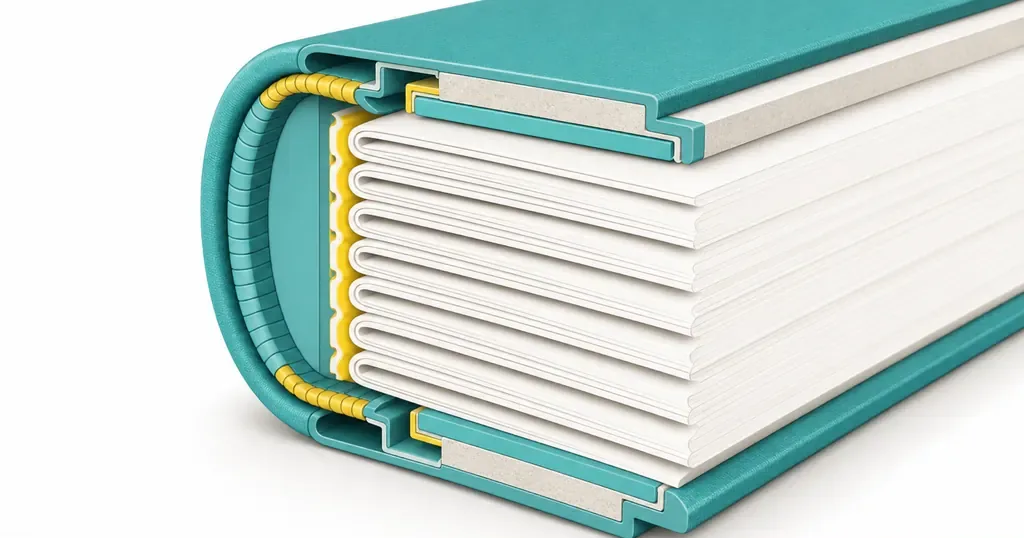
Thread-sewn binding sews the pages together in sections, then adds glue on top. Its mechanism balances structural strength and lay-flat, so among the four methods it is generally seen as the most durable one that can still open flat. Our analysis is that thread-sewn suits books meant for repeated use and long-term keeping, such as archival portfolios or premium notebooks. The price is more process steps, with higher unit cost and longer lead time than exposed-spine
Loose-leaf and ring binding pass metal or plastic rings through punched pages, so the pages pivot around the ring. The biggest advantage is that the book can fold fully flat, even back 360 degrees, and pages can be swapped in and out. This add-and-replace format even has its own recommended editorial specification [1]. Our analysis is that this makes it irreplaceable for recipes, operating manuals, and updatable workbooks, anything that needs to lie flat for writing or gets revised often. The limits: exposed rings read as functional, so it's hard to project a premium feel, and the rings eat into gutter space
Hardcover builds a rigid board case, with the text block usually sewn or glued first and then cased in. This gives the strongest protection and the highest visual spec, which is why it's the usual pick for gift books, brand books, and commemorative editions. Our analysis is that hardcover tops out on two dimensions at once, tone and durability. But it also has the highest cost and longest lead time, and the rigid case usually gives up full lay-flat (unless the text block is sewn and designed to open flat)
One more: Japanese stab binding (thread-tied binding) is a traditional East Asian format where thread is stitched through the side of the book. It gives an elegant, handmade cultural tone. Our analysis is that it has a distinct place on the tone dimension and fits projects built around humanistic and craft sensibility. Lay-flat and durability are secondary there
Core Analysis 2: A Five-Dimension Framework Driven by Usage Scenario
This section presents the article's core tool. Instead of asking which binding is best, define the usage scenario first, then rank priorities across five dimensions. Our analysis is that choosing a binding is a multi-objective trade-off. There is no single best answer, only the best fit under a given set of weights
The five dimensions are defined as follows:
・Lay-flat (do you need to write on it flat, or show full spreads?): where the need is high, the order is loose-leaf/ring > thread-sewn ≈ exposed-spine > hardcover
・Durability (repeated use, long-term keeping?): where the need is high, the order is thread-sewn ≈ hardcover > exposed-spine > loose-leaf/ring
・Handling frequency (daily heavy use versus occasional flipping): heavy use favors the structural stability of thread-sewn or loose-leaf
・Budget (unit cost and run size): roughly low to high, exposed-spine < loose-leaf/ring < thread-sewn < hardcover (our analysis, actual order varies by quantity, size, and vendor)
・Tone (functional versus premium or archival): functional leans loose-leaf, indie leans exposed-spine, archival leans hardcover, and humanistic craft leans Japanese stab binding
Running scenarios through the framework shows its explanatory power. Our analysis: for recipe books and manuals, the top weight is lay-flat plus updatability, so loose-leaf/ring wins. For an archival portfolio, the top weight is durability plus quality feel, so thread-sewn or hardcover wins. For design-minded indie publishing on a limited budget, exposed-spine is often the sweet spot between lay-flat and cost. And gift and brand books that chase spec and protection can reasonably go hardcover
The value of this framework is that it turns personal preference into a weight ranking people can discuss. When design and production talk in the same set of dimensions, quotes and advice share a baseline, and the back-and-forth drops noticeably (our analysis)
Core Analysis 3: Tying Binding to File Preparation
This section makes an argument that's often underrated: the binding method has to be decided early in file preparation, because it directly constrains page structure and gutter margin. Leave binding to the end and you often get lost text, failed lay-flat, or a job that can't be produced at all
On page structure, different methods ask different things of the signature. Thread-sewn and hardcover are built on sewn sections, so page count usually has to follow the signature size (multiples of 8 or 16 pages, for example). Saddle stitch needs multiples of 4. Loose-leaf is relatively free. Our analysis is that if the method isn't locked during design, page count changes late in the job can set off a chain of extra costs
On gutter margin, the differences matter even more. Glue-based methods (including exposed-spine and thread-sewn) lose some visible area near the spine to the adhesive, so text and key elements near the gutter must be pulled inward. Loose-leaf and ring binding need a safe distance for punch holes and rings, or the content gets wrecked by the holes. Hardcover has a hinge groove near the spine that also cuts into the visible area. Our analysis is that this is exactly the root cause of the "text lost at the binding edge" rejections on the file-prep side, and the fix is to set the right gutter safe zone for the chosen method before layout begins
On lay-flat design, even with a method that opens flat, an image that crosses the spine can still shift if the book doesn't open fully. Our analysis is that exposed-spine opens nearly 180 degrees but is still not perfectly flat. For images that truly need to run seamlessly across a spread, loose-leaf or a specialized lay-flat binding is the safer choice
Implications for Taiwan's Design and Print Industry
This section puts the framework to work, looking at what it means in practice for small and midsize printers, designers, and brands. Our position is that the framework's biggest payoff is a shared language among the three parties, which shortens project cycles
For small and midsize printers, the five-dimension framework can become a requirements checklist before quoting. First ask the client how they rank lay-flat, durability, frequency, budget, and tone, then recommend a method with compatible page counts and gutter specs. Our analysis is that this turns verbal experience into a standard consultation flow, cuts mis-estimates and rework, and helps a shop stand out on high-value methods like exposed-spine and thread-sewn
For designers, the takeaway is to decide binding first, then open the layout file. Set the gutter safe zone and page-count multiples from the very start of layout, and assess lay-flat risk for any image across a spread. Our analysis is that this sharply reduces rejected files, and lets designers use binding as an active element of narrative and reading rhythm instead of a constraint they put up with
For brands, binding is a lever on budget and tone. Our analysis is that a brand book doesn't always need hardcover. When the goal is flat display plus design appeal, exposed-spine or thread-sewn may fit the use better and keep costs easier to control. Matching the binding to brand positioning and real use pays off more than simply chasing the highest spec
On process and schedule, we suggest adding an early decision point: lock the method, page-count multiples, and gutter spec at the project kickoff meeting, and ask the vendor for the production lead time of each method (hardcover and thread-sewn usually run well longer than exposed-spine and standard perfect binding), so the binding step doesn't hold up the launch date
Conclusion and Limitations
This article answers the question posed in the introduction. Advanced binding can be chosen with the five-dimension framework of lay-flat, durability, handling frequency, budget, and tone, ranked by the weights of the usage scenario, instead of searching for one best method. Exposed-spine is the cost-effective compromise for lay-flat and design appeal. Thread-sewn gives a high-quality balance of durability and lay-flat. Loose-leaf/ring serves functional needs for lay-flat and updatability. Hardcover tops out on protection and tone. Japanese stab binding fills the humanistic, craft-driven tone niche. The framework also requires that the binding decision be tied to page count and gutter margin from the start of file preparation
We should be upfront about the limits:
・First, the cost, lead time, and durability rankings here are general inferences with no quantified empirical data behind them. Real numbers depend heavily on quantity, size, paper, and the individual vendor, so actual quotes should be the final word
・Second, the article is built around usage scenarios and does not go deep into engineering matters like adhesive chemistry (weather resistance of glues, thread strength) or differences between machines
・Third, the weight rankings still involve subjective judgment and lack user-experience measurements behind them
Directions for further research include: measuring durability and lay-flat angle for each method under standard conditions, running user tests to verify the relationship between flipping frequency and binding lifespan, and turning the five-dimension framework into a quoting and selection tool that print SaaS platforms can adopt, so that dialogue between design and production becomes even more standardized

Key Takeaways
Binding is not an afterthought. It is a multi-objective decision that moves cost, experience, and tone, and it has no single best answer
Ranking the five dimensions of lay-flat, durability, handling frequency, budget, and tone, then picking a method by usage scenario, is the most reliable approach
Exposed-spine balances lay-flat and design appeal, thread-sewn is the most durable and still opens flat, loose-leaf is built for flat use and updating, and hardcover tops out on spec and protection
The method must be decided early in file preparation, because it constrains page-count multiples and the gutter safe zone, and it is the root cause of text-loss rejections
A brand book doesn't always need hardcover. Matching the binding to the use scenario is often more cost-effective than chasing the top spec
Further Thoughts
For print manufacturing, the five-dimension framework can serve as a standard consultation script before quoting. It turns a veteran's verbal know-how into a repeatable selection process and builds a point of difference on high-value methods like exposed-spine and thread-sewn. For design, the lesson is to decide binding before opening the layout file, moving gutter and page-count multiples to the very start of layout. For AI and SaaS adoption, the most valuable open problem is a structured mapping from usage-scenario weights to method, page count, gutter, lead time, and quote, built into a selection and estimating engine so all three parties share one baseline. The key gap for the next step is the lack of quantified durability and lay-flat angle measurements. That is both a research opportunity and a precondition for making any decision tool more credible
References
[1] Recommendations for Loose-leaf Publications. BSI British Standards. DOI: 10.3403/00090951
FAQ
- What's the difference between exposed-spine and thread-sewn binding, and how do I choose?
- Exposed-spine leaves the glued spine visible, opens close to 180 degrees, has an indie design look, and costs less, but its durability is average. Thread-sewn stitches the pages in sections and then glues them. It is the most durable and also opens flat, but it takes more process steps and costs more. Pick thread-sewn if the book will be used heavily over the long term. Pick exposed-spine if design appeal and a tight budget matter more
- Which binding lets a book lie completely flat for writing?
- Loose-leaf and ring binding fold fully flat, even back on themselves, which suits recipe books and manuals. Exposed-spine and thread-sewn get close to flat but not perfectly flat. Hardcover is usually the hardest to get fully flat
- Does a brand book have to be hardcover?
- No. Hardcover has the highest spec and protection, but also the highest cost and longest lead time. If the goal is flat display plus design appeal, exposed-spine or thread-sewn often fits the use better and saves money. Decide based on brand positioning and how the book will actually be used
- Why does the binding method have to be decided before layout?
- Because each method has different requirements for page-count multiples and gutter margin. Perfect binding eats into the visible area near the spine, and loose-leaf needs room for punch holes. Change the method after layout and you risk lost text, failed lay-flat, or a job that can't be produced
- Which binding suits a book with a lot of pages?
- Thick books lean toward glue-based binding or thread-sewn, since both can handle more signatures and keep the spine structure intact. Loose-leaf is limited by ring capacity, and saddle stitch only works for thin books. The real upper limit depends on paper thickness and the vendor's machines, so confirm with them
Sources
- 活頁出版品的編製建議(Recommendations for Loose-leaf Publications) · BSI British Standards活頁形式的內頁抽換與編製規範
Related articles
The Print × AI weekly
The print and AI know-how designers, brands and enterprises can use before they commit — one email, every week
MINDS Free Tools
Spine width and imposition calculators — skip the manual math, free in your browser.
MINDS Group
Need actual printing or gifting services?
From premium printing to online ordering and festive gifts — the MINDS Group sister brands take it from here.