
Overview
When inner text in a multi-page booklet gets trimmed off or stuck in the gutter, it usually comes down to ignoring physical paper thickness, specifically saddle-stitch creep and perfect-binding gutter loss
In pre-press practice at MINDS Printing, we budget file specs through the 'MINDS Printing Three-Stage Binding Gate': 1. Estimate inner-page creep for saddle stitching and reserve compensation, 2. Calculate perfect-binding spine width using paper caliper formulas, 3. Keep spread images and text clear of the gutter setback area
Once you understand binding physics, you can make sure your screen layout translates cleanly to print
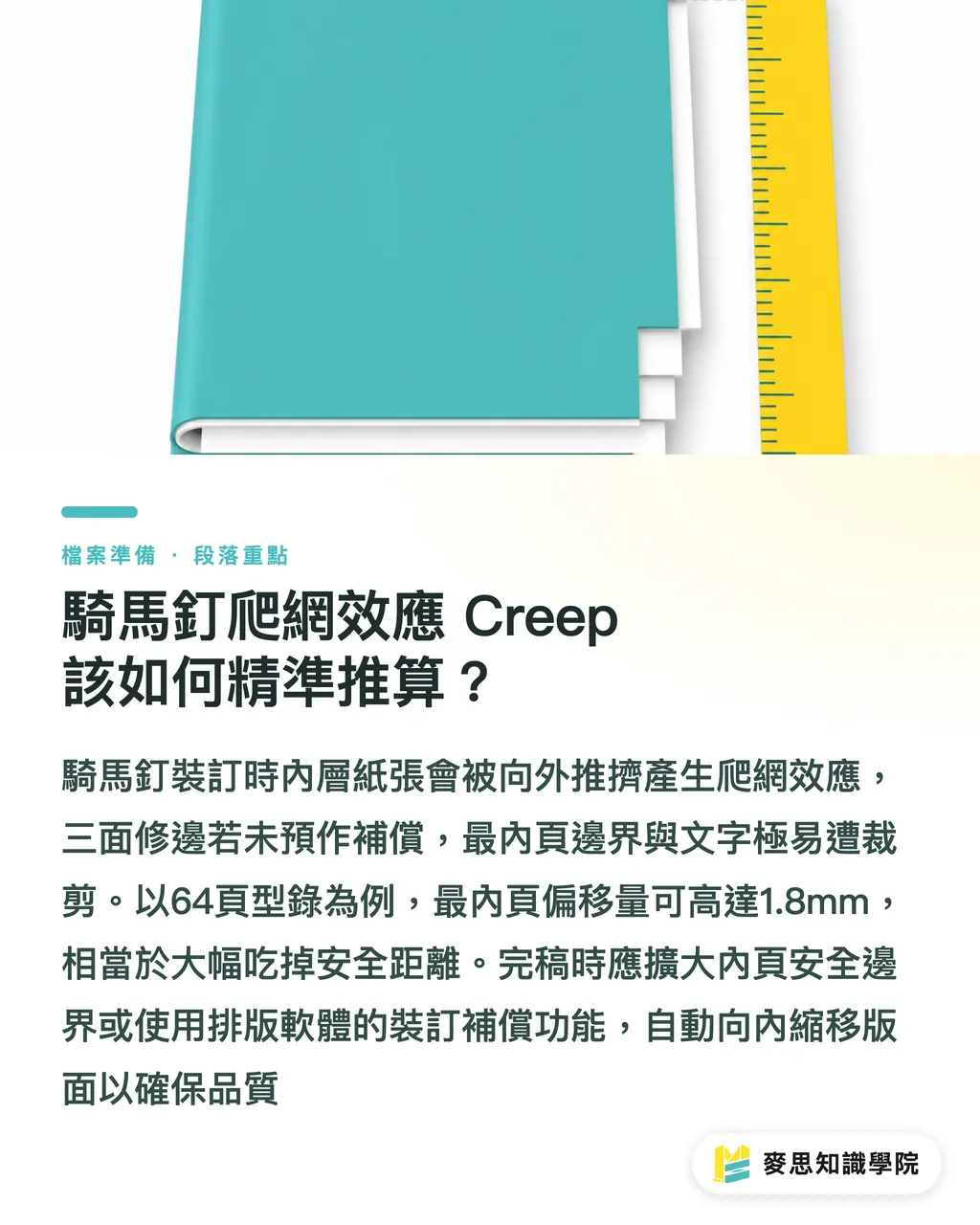
Creep refers to the physical shift in saddle-stitched booklets where paper thickness causes inner pages to push outward past outer pages after folding. When trimmed on three sides, this reduces the outer safety margin on interior pages
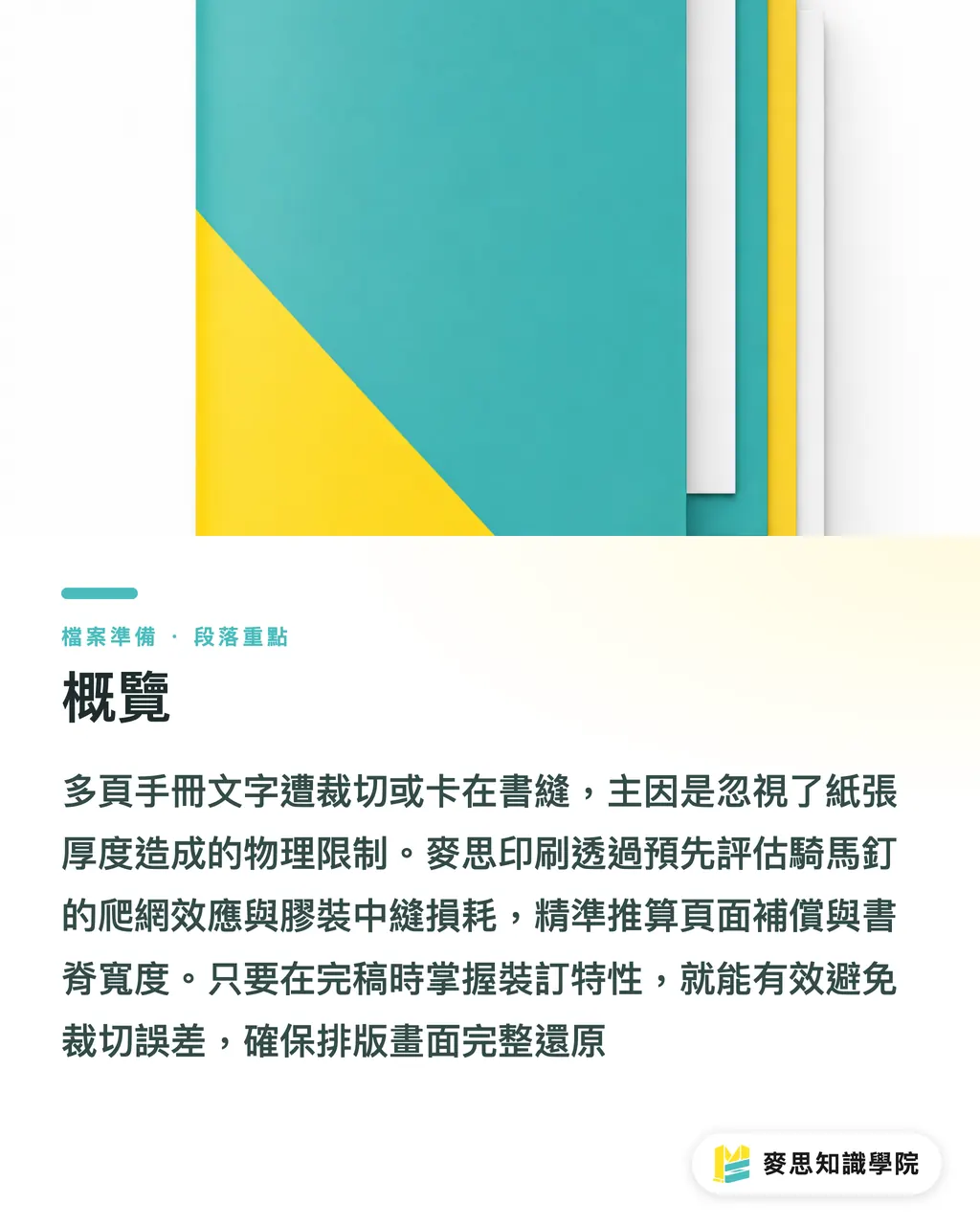
Why Do Perfect Layouts Get Trimmed in Print?
When reviewing artwork on a display, every page looks like an isolated, flat surface
Once the file hits the print shop for folding and binding, actual paper thickness starts distorting those initial dimensions
The most common file rejections and print defects are trimmed text on the innermost pages of saddle-stitched books, or headers swallowed up inside the spine gutter of perfect-bound books
This isn't a software bug. It's the physical push, stack, and wrap loss of real paper during binding
During early pre-press planning, using the estimation methods from the Mai Strategy Knowledge Academy Advisory Team lets you build binding compensation right into layout settings
It's pretty simple
Once you get how paper weight, page count, and binding structure work together, you can catch every binding trap before printing
How to Calculate Saddle-Stitch Creep Accurately
Saddle stitching nests folded sheets inside one another from outside in, staples them along the spine, and trims three edges to finish the book
As folded sheets stack together, outer sheets wrap around inner ones, pushing the innermost pages outward along the fold
That outward push is what we call creep
If you don't compensate in pre-press, three-knife trimmers cut according to cover dimensions, slicing off the largest chunk of margin from the innermost pages
The creep calculation formula is: Creep Offset = ( Total Pages ÷ 4 - 1 ) × Single Sheet Caliper (Thickness)
For example, in a 64-page saddle-stitched catalog on 150gsm coated paper (sheet caliper roughly 0.12mm), the innermost page pushes outward by ( 64 ÷ 4 - 1 ) × 0.12 = 1.8mm
If your original outer safety margin was only 3mm, the innermost page is left with just 1.2mm, putting text dangerously close to the edge or getting cut off entirely
Get the math wrong and the job is ruined
In practice, there are two solutions:
・Expand the inner margin safety distance from the standard 5mm to at least 7mm during layout to allow a comfortable safety buffer
・Use built-in layout software features, like InDesign Creep binding compensation, to shift inner page content inward automatically
How to Calculate Perfect-Binding Spine Width and Gutter Loss
Unlike saddle stitching, perfect binding trims the spine of folded signatures, applies glue along the back, and wraps the cover around it
That means perfect binding avoids saddle-stitch creep, but introduces two new factors: spine width and gutter loss
The basic formula for perfect-binding spine thickness is: Spine Width = ( Total Pages ÷ 2 ) × Sheet Caliper + Cover Paper Caliper
For a 160-page book printed on 100gsm uncoated paper (sheet caliper roughly 0.1mm), the spine width equals ( 160 ÷ 2 ) × 0.1 = 8mm. This is the exact spine dimension you must reserve when setting up cover artwork
Also, perfect-bound books don't lay completely flat at 180 degrees like saddle-stitched books
Hot-melt glue and spine binding take away about 5mm to 8mm of visible space near the center fold
If spread graphics or text sit flush against the spine, wording near the center gets buried deep in the gutter and becomes unreadable
When setting up files for perfect binding, follow these guidelines:
・Pull text and key graphics back by 5mm to 6mm on each side of the center gutter so spreads look continuous when opened
・Create cover artwork as a single continuous spread containing the front cover, spine, and back cover, adding a 1mm to 2mm crease zone on both sides of the spine
・When previewing orders through the MINDS Printing online system, double-check that spine text is centered precisely
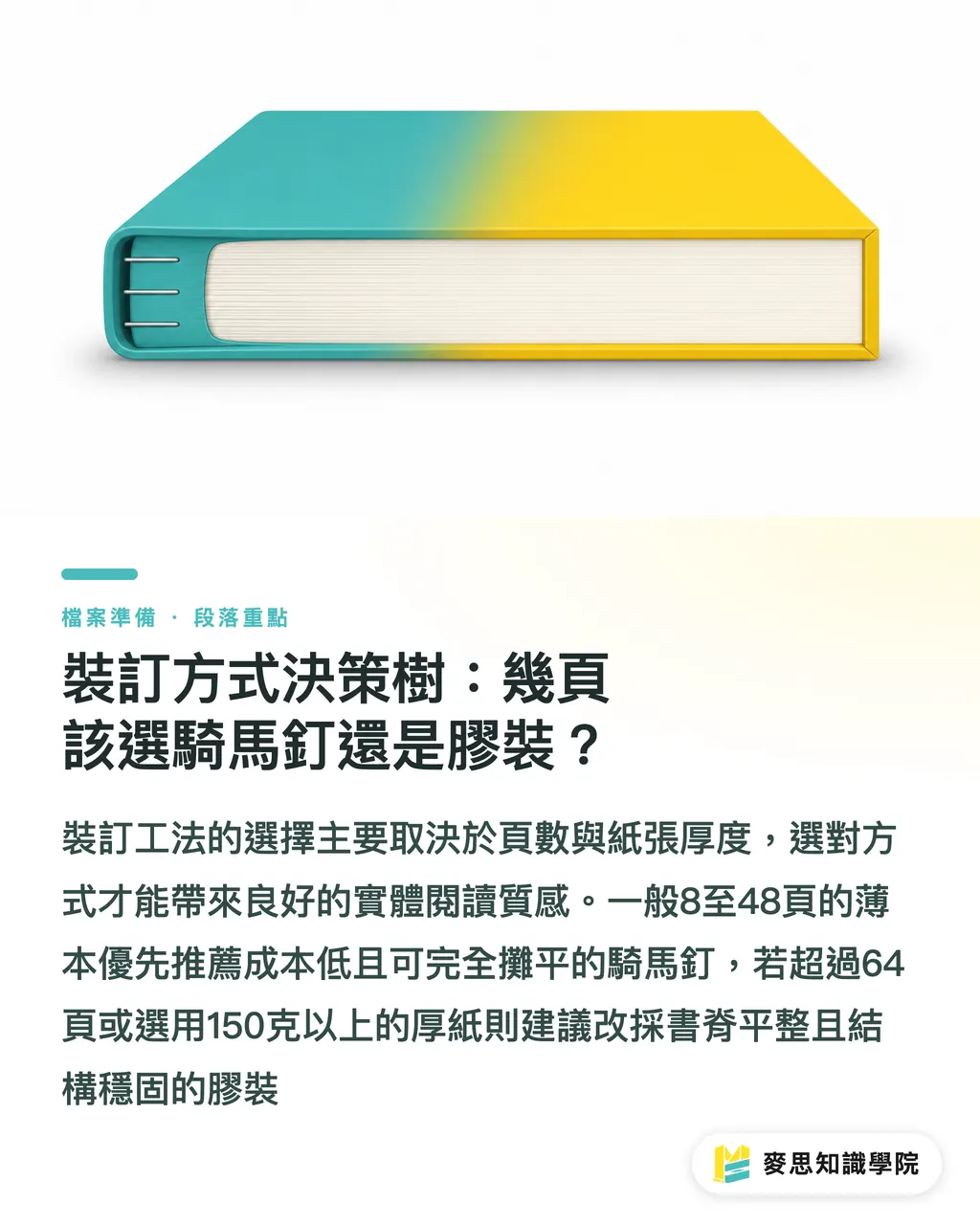
Binding Decision Tree: Saddle Stitch vs. Perfect Binding by Page Count
Page count and paper thickness are the two biggest factors when choosing a binding method
Pick the wrong method and even great visual design can't save a bad physical reading experience
Here is a decision guide designers and print buyers can use right away:
・8 to 48 pages: Saddle stitching is ideal. The finished piece lays completely flat, costs less, and turns around fast
・48 to 64 pages: The crossover zone. If using paper heavier than 150gsm, switch to perfect binding to prevent the spine from bulging or cracking
・64+ pages: Perfect binding (burst or section-sewn) is strongly recommended for a flat spine and solid structure
・128+ page hardcover publications: Factor in rigid board thickness (usually 2mm to 3mm). Get exact spine width and hinge groove specs directly from the print shop
Key Takeaways
・Paper thickness pushes inner pages outward in saddle-stitched books, creating creep. Always expand your outer safety margin from 5mm to at least 7mm when preparing files
・The perfect-binding spine formula is (Pages ÷ 2) × Sheet Caliper + Cover Thickness. Cover files should be set up as a single continuous spread for front cover, spine, and back cover
・Perfect-bound books cannot lie 180 degrees flat. Keep spread graphics and text 5mm to 6mm away from the central gutter on both sides to clear the glue zone
・48 to 64 pages is the main tipping point for binding choices. Switch from saddle stitching to perfect binding if paper weight exceeds 150gsm
Final Thoughts
Binding isn't just the final step in production; it's a physical variable you need to calculate during pre-press file setup
With modern digital presses and automated trimmers, setting up automated pre-press scripts or rules to handle creep compensation cuts manual file rejections and reprint costs
For designers and print buyers, working out paper caliper and binding mechanics on day one is the best way to guarantee your layout translates perfectly into print
Further Reading
・Inner Text Trimmed Off? Pre-Press Spine and Saddle-Stitch Creep Calculations
・How Much Image Does Binding Swallow? A Guide to Perfect Binding and Saddle-Stitch Calculations for Designers
FAQ
- What is saddle-stitch creep?
- Creep is the physical outward push of inner pages in a saddle-stitched booklet caused by paper thickness when folded and nested. This results in the innermost pages losing the most margin when trimmed on three sides
- Why does text across spreads get trapped in the center gutter of perfect-bound books?
- Perfect binding uses hot-melt glue along the trimmed spine, which locks down 5mm to 8mm of space near the gutter and keeps the book from laying 180 degrees flat. Text without proper gutter setback gets pulled into the spine glue
- Should I choose saddle stitching or perfect binding for a 48-page document?
- It depends on paper thickness. Thin paper under 100gsm works fine with saddle stitching. For coated or matte paper over 150gsm, perfect binding is better so the spine closes cleanly without bulging
- How do you calculate spine width for a perfect-bound cover?
- Use the formula (Total Pages ÷ 2) × Single Sheet Caliper + Cover Thickness. Reserve that exact width in the middle of your cover file and mark score lines on both sides
Related articles


The Print × AI weekly
The print and AI know-how designers, brands and enterprises can use before they commit — one email, every week
MINDS Free Tools
Spine width and imposition calculators — skip the manual math, free in your browser.
MINDS Group
Need actual printing or gifting services?
From premium printing to online ordering and festive gifts — the MINDS Group sister brands take it from here.