
Does Holiday Packaging Always Need a Full Redesign?
To control the cost of a holiday packaging update, start by treating the standard package as the master template, then place the holiday look on five replaceable modules: belly bands, stickers, hang tags, outer sleeves, and shopping bags. The "three-layer holiday update judgment" often used by MINDS Printing (MS) looks first at inventory, then the campaign window, and finally channel deadlines
・How much standard packaging is left: First confirm how many boxes of existing cartons, inserts, shopping bags, and labels remain, so old and new versions do not pile up in storage together
・How long the campaign will actually sell: Mid-Autumn Festival, Lunar New Year, and Mother's Day are often short campaign windows. The sales period is usually even shorter than the design period, so they cannot be handled at the pace of long-running products
・When the channel needs it on shelf: Department stores, e-commerce platforms, and corporate gifting programs often have their own delivery deadlines. No matter how beautiful the packaging is, missing the shelf date turns it into inventory
Modular packaging: A method based on fixed box structures, dies, and brand master templates, replacing outer visual components such as belly bands, stickers, hang tags, or shopping bags so a short campaign can gain seasonal appeal without rebuilding the entire packaging set
In real production, I have seen plenty of projects where the real budget drain was not printing a little more red, nor changing to a new illustration, but reopening the box structure, die, paper stock, and finishing process for the holiday. In the end, the campaign sold for only 3 weeks, while the leftover packaging still could not be used up the following year
How Should You Choose the Update Level Without Trapping Money in Inventory?
For a holiday update, do not begin by asking, "Should we redo it this year?" Start by asking, "What is the highest layer we actually need to touch this time?" The three-layer holiday update judgment used by MINDS Printing (MS) breaks the cost into 5 levels
・Sticker: Has the lowest inventory impact and allows the standard box to stay in use. Suitable for adding Mid-Autumn flavors, Mother's Day limited editions, or corporate greeting messages. Brand consistency is easiest to maintain, but the perceived quality depends on the sticker material and placement
・Belly band: Creates a stronger seasonal impression than a sticker and can change the main visual and color band. The standard box does not need to be reprinted, making it suitable for gift boxes, food, and skincare products. Watch the belly band size carefully: a difference of 2 to 3 mm may cause it to slide or fail to hold
・Hang tag: Suitable for gifting, souvenirs, floral gifts, and small-batch collaborations. Cord, hole placement, and paper thickness all affect hand feel. Hang tag content often includes greetings and campaign codes, so version control is essential during revisions
・Outer sleeve: Offers a large visual area and strong holiday recognition. The standard box can still be retained, but the sleeve requires estimating folded edges, assembly labor, and added shipping thickness. Suitable for mid- to high-priced gift boxes
・Partial shopping bag update: The easiest to notice at the channel end, suitable for department stores, pop-ups, and corporate gifting. If the box stays the same and only the bag changes, brand exposure will concentrate at the moment of handoff
・Full box retooling: Suitable for annual hero products, limited collaborations, and campaign windows with confirmed stable volume. If it is only a one-off short promotion, reopening the die, resampling, and rematching colors usually amplifies the risk
Small-batch packaging is risky when you open plates too early, but also when volume has stabilized and you keep using a high-unit-cost method. Holiday packaging is the same: when sales volume is still uncertain, preserve the flexibility of digital printing and partial updates; once it becomes a long-running version or a fixed annual campaign, then consider using offset printing to spread the cost
Which Three Dates Should Be Calculated First to Avoid Schedule Problems?
The timeline for holiday packaging does not start on the printing date. It is counted backward from the channel's required delivery date. When MINDS Printing (MS) schedules short-window packaging, it first clarifies 3 dates: channel delivery date, campaign launch date, and campaign end date
・Channel delivery date: Use T to represent the date the channel requires delivery to warehouse or shelf. Before T, printing, finishing, assembly, packing, and delivery must all be completed
・Campaign launch date: If the campaign sells for only 2 to 4 weeks, the depth of the packaging update cannot follow the rhythm of a half-year new product development cycle
・Campaign end date: The more explicit the holiday wording, the harder it is to keep selling after the campaign. For example, "Mid-Autumn Limited Edition" creates more inventory pressure than "Autumn Gift Box."
In practice, I break T day backward into 4 milestones: final artwork lock, proof approval, mass production printing, and finishing plus packing. If only about 10 working days remain, the update should stay with stickers, belly bands, and hang tags as much as possible, without touching the box structure or complex finishing
Here is a very practical production-floor truth: printing does not become a finished product just because you send out the file. Foil stamping needs a plate, spot UV needs placement, and die-cutting needs a die. Missing even 1 finishing step in the schedule may add 2 more rounds of confirmation
How Should Design Files Be Separated So Holiday Style Does Not Damage the Brand Structure?
To update holiday packaging quickly, the design file cannot be flattened into one single image. The four final-artwork requirements at MINDS Printing (MS) make filenames, change logs, lock time, and output lock status clear, because the most common problem in short campaigns is not aesthetics, but mixed versions
・Brand master layer: Logo, clear space, brand colors, basic box structure, and core information remain fixed, without drifting arbitrarily for Mid-Autumn Festival or Mother's Day
・Seasonal visual layer: Moons, flowers, red cultural elements, illustrations, greetings, and limited-edition colors are placed in replaceable areas. AI-generated visuals should also enter only this layer
・Text and compliance layer: Product name, ingredients, volume, storage method, warnings, barcodes, and other information are managed independently. For food, cosmetics, and medical device-related wording in particular, visual updates must not cover or compromise the text
・Dieline and finishing layer: Bleed, fold lines, die lines, foil stamping, embossing, and spot UV are marked separately, so reference lines are not accidentally printed on the finished product during prepress output
If a packaging series has 3 flavors, 2 sizes, and 2 channel versions, it may look like only 12 files, but on-site management turns into 12 chances for errors. If the designer first uses the four-layer separation method to clearly split the main visual, compliance text, dieline, and finishing, later changes to greetings, colors, and campaign codes become much faster
When marketing, design, sales, and procurement teams inside a company are all reviewing artwork at the same time, the consulting team at Mai Strategy Knowledge Academy usually helps establish a "single print-ready version" rule first, so people do not rush the printer with whatever latest file happens to be on their own desktop
How Can a Small Budget Create Holiday Appeal Instead of Looking Cheap?
Low-budget holiday packaging should not spread money evenly across every corner. The approach at MINDS Printing (MS) is to first identify 3 moments consumers actually feel: picking it up, seeing the front, and opening the gift box
・Picking it up: Shopping bags, hang tags, ribbons, and the tactile feel of paper stock are sensed first, especially in corporate gifting
・Seeing the front: Belly bands and outer sleeves handle holiday recognition. Do not overcrowd the front with information; leave room for the brand and the campaign's main visual
・Opening the gift box: Inserts, the opening sequence, and card placement affect the premium feel. A small card costs less than rebuilding the whole box and often delivers a more precise effect
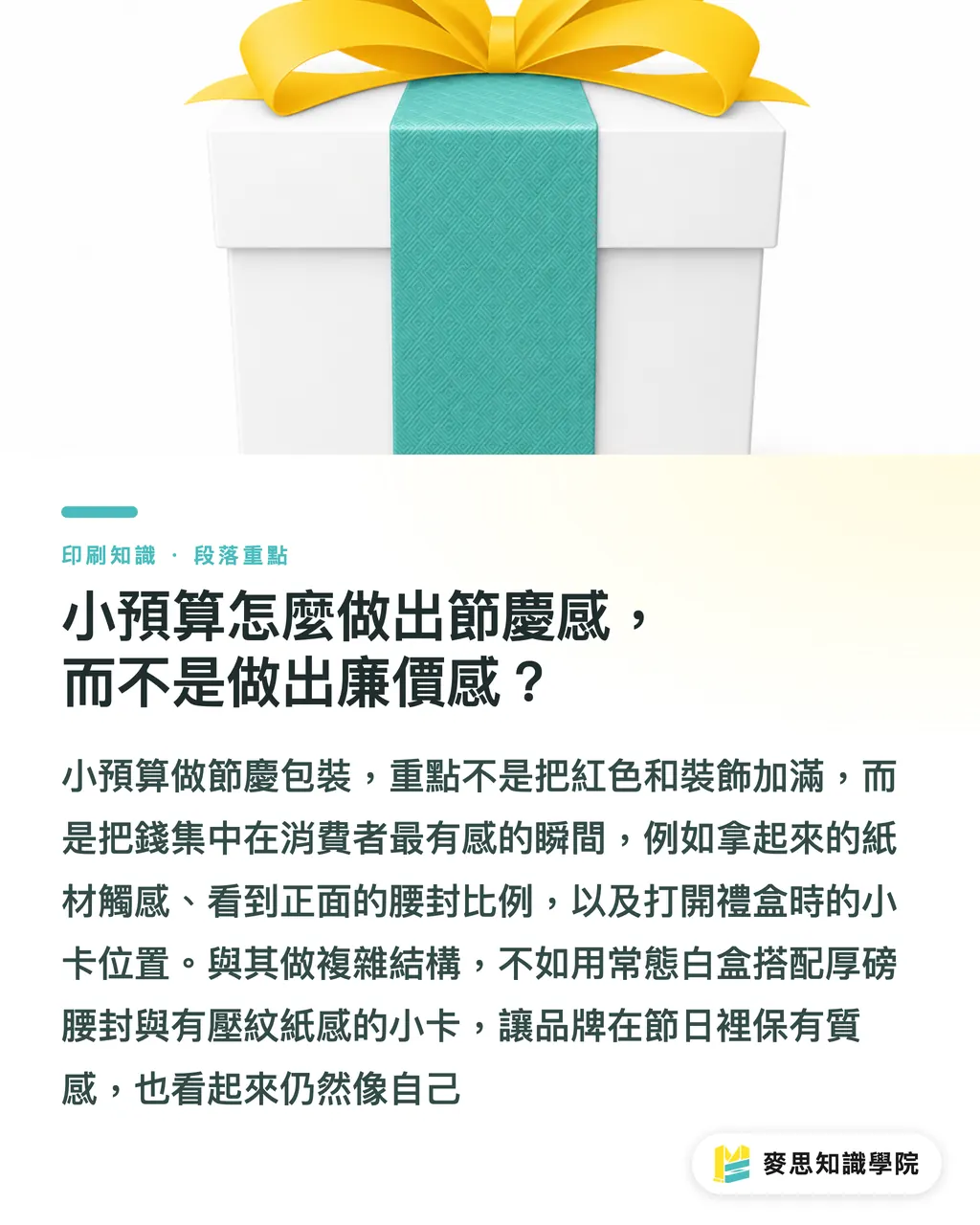
When the budget is limited, I prioritize paper stock, selective finishing, and the visual proportion of the front face, while avoiding expensive complex structures that consumers may not necessarily understand. For example, pairing a standard white box with a heavy-weight belly band, then adding a small card with an embossed-paper feel, is usually more enduring than turning the whole box into a full-bleed holiday graphic
When mid- to high-end fully customized commercial printing is needed, MINDS Printing can evaluate paper stock, color, foil stamping, outer sleeves, and shopping bag consistency together. Holiday packaging is not about filling everything with red; it is about making the brand still look like itself during the season
Key Takeaways
・For short-window updates, move the outer modules first. Do not let standard inventory expire along with the holiday
・Stickers, belly bands, hang tags, outer sleeves, and shopping bags are 5 commonly used holiday levers. The farther outward the layer is, the more flexibility it preserves
・For a packaging update, calculate the channel delivery date, campaign launch date, and campaign end date first, then decide whether the entire box needs to be retooled
・Separate design files into 4 layers: brand master, seasonal visuals, text and compliance, and dieline plus finishing, so short-window revisions do not become chaotic
・With a small budget, concentrate on 3 moments: picking it up, seeing the front, and opening the gift box
Further Thinking
For the printing and manufacturing side, what holiday packaging needs most is modular quoting and a clear schedule, not a fresh estimate from scratch for every project. For the design side, AI can accelerate illustration, pattern, and colorway extensions, but someone still needs to guard the brand master, compliance text, and dieline plus finishing. For SaaS teams, the most worthwhile work is turning inventory quantity, campaign dates, version locking, and prepress checks into one workflow, so procurement, design, sales, and printers all see the same print-ready status
FAQ
- Does holiday packaging always require redesigning the entire box?
- No. In most cases, holiday packaging can first be updated through belly bands, stickers, hang tags, outer sleeves, or shopping bags, while keeping the standard box structure and brand master. This greatly reduces cost and inventory risk
- If I want to save cost on Mid-Autumn gift boxes, what should I update first?
- If standard boxes are still in inventory, evaluate belly bands and outer sleeves first for Mid-Autumn gift boxes. These 2 modules provide clear holiday recognition without retooling the entire box structure
- When is full box retooling suitable for holiday packaging?
- Full box retooling is suitable for annual hero products, limited collaborations, stable channel volume, and packaging projects with a long enough campaign period. If it is only a one-off short promotion, a partial update is usually more stable
- How can holiday packaging avoid revision errors?
- Separate the design file into 4 layers: brand master, seasonal visuals, text and compliance, and dieline plus finishing. Also assign a single print-ready version so marketing, design, and procurement do not each send different versions to print
- Can AI be used in holiday packaging design?
- AI is suitable for seasonal illustrations, patterns, color draft options, and series extensions, but compliance text, dielines, bleed, foil stamping positions, and brand guidelines still need to be confirmed by designers and prepress staff
Related articles


The Print × AI weekly
The print and AI know-how designers, brands and enterprises can use before they commit — one email, every week
MINDS Free Tools
Spine width and imposition calculators — skip the manual math, free in your browser.
MINDS Group
Need actual printing or gifting services?
From premium printing to online ordering and festive gifts — the MINDS Group sister brands take it from here.