
Overview
To save paper on small-batch print jobs under 500 copies, start with sheet layout, the machine's printable area, and post-press routing, not just the paper price. For short-run jobs, MINDS Printing (MS, mid-to-high-end fully custom commercial printing) often uses the "MINDS Printing (MS) three prepress gates" as a quick check: ① size against sheet, ② layout against machine, ③ quantity against process
・① Size against sheet: the finished size must be checked together with 3mm bleed and the safe trim margin. Do not judge only by how large the design looks
・② Layout against machine: gripper margin, printable area, and sheet size must be confirmed before quoting, so you do not discover after press setup that the sheet cannot be filled efficiently
・③ Quantity against process: under 500 copies, compare digital printing and gang-run printing first. For jobs with specialty paper, special colors, or heavy post-press work, then look at dedicated-run printing
Where Does the Paper Waste Actually Happen Under 500 Copies?
The most common waste in short-run printing is not operators carelessly feeding paper. It is the file locking in poor paper efficiency from the start. A finished size that is off by 5mm may look minor, but across 500 copies, double-sided printing, trimming, and post-press work, the edges quickly turn into a stack of unusable offcuts
The file I dread most on the production floor is this kind: beautiful visuals, beautiful white space, but the size lands in an awkward spot, so the second unit will not fit on a large sheet. That kind of waste has no drama. It does not shout from the quotation either. It just quietly becomes more paper bought, more paper trimmed, and more money spent
An economical sheet size means fitting the finished piece into a full sheet, half sheet, quarter sheet, or standard machine sheet in a way that leaves the least trim waste and makes imposition easier. For short-run jobs, asking whether the finished size can be nudged toward an economical sheet size is more useful than cutting the paper weight after the fact
How Can the Print Size Move Closer to an Economical Sheet Size?
Size adjustment is not about making the design uglier. It is about keeping the design away from the most expensive few millimeters. A4 is 210×297mm, and A3 is 297×420mm. These standard sizes are common because they work better with paper, trimming, storage, and mailing
For short-run items such as small cards, invitation cards, DM pieces, and hang tags, run 3 checks before sending the file to print
・Finished size: can it be adjusted close to an A-series size, a common business card size, a common sticker size, or an existing die size from the print shop?
・Bleed size: after adding 3mm bleed on all four sides, can it still fit on the same press sheet?
・Post-press size: will rounded corners, die cutting, lamination, or foil stamping positions force files that could have shared a layout to be produced separately?
For standard short-run jobs such as business cards, small cards, stickers, and DM pieces, ordering through standardized online specs often saves more paper and reduces file revisions. When the specs are close to an existing product format, you can first check the size and material options at Mai Printing, then decide whether the design should be adjusted

Why Do Gripper Margins and White Space Eat Up Paper?
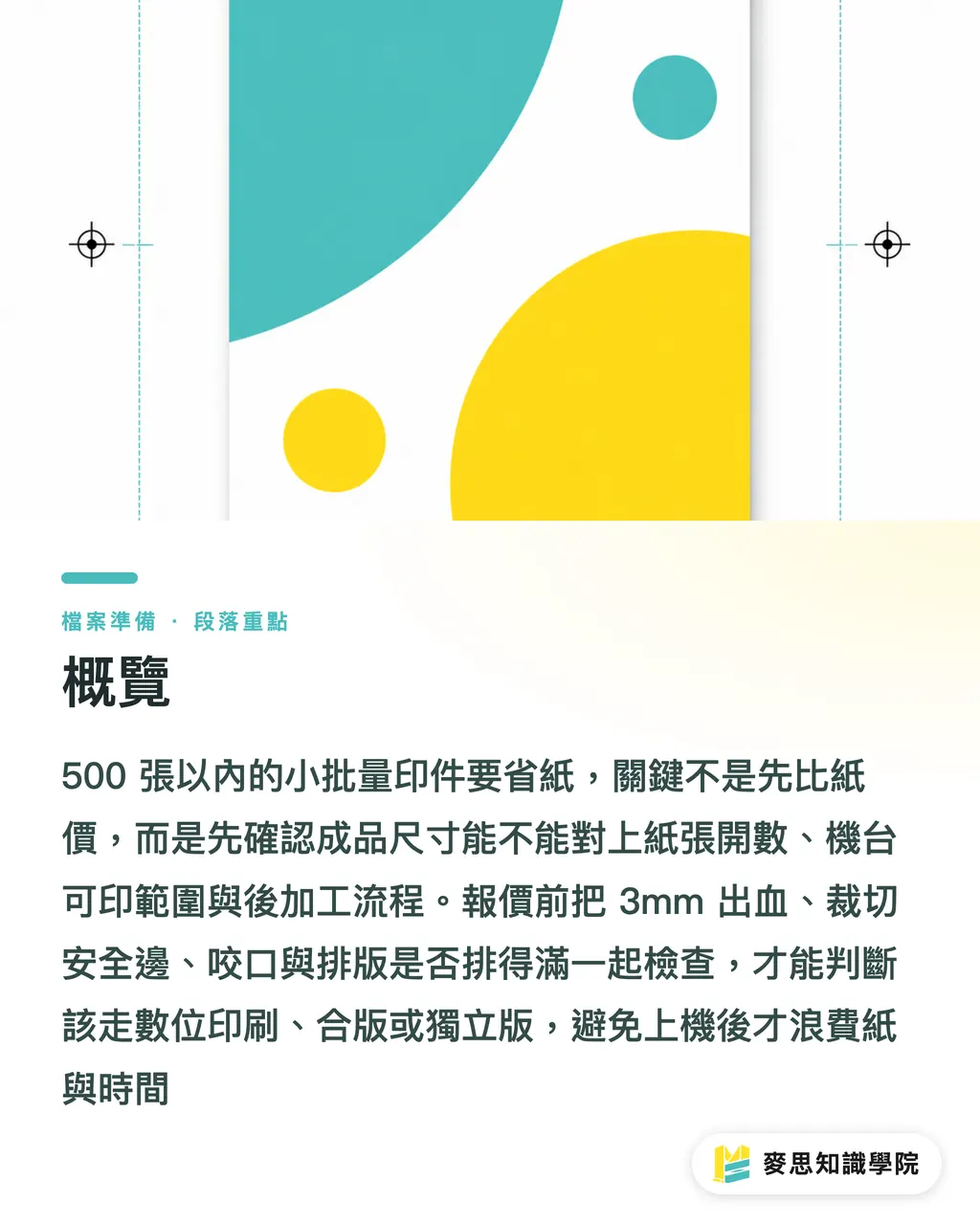
The gripper margin is the edge area where the press grips the paper and feeds it into the machine. Important text and graphics cannot sit in that space. If it is not reserved, registration and trimming can be affected. Different machines need different gripper margins, and the printable area of a small offset press or digital press is not the same as the outer edge of the paper
Many designs waste paper not because there is too much white space, but because the white space is in the wrong place. Bleed is usually set at 3mm on all four sides, but the gripper side still depends on the machine. If a file pushes a full-bleed background, thin border, or QR Code to the edge, prepress can only increase the safe distance or split the job into separate layouts
To avoid trouble on a short-run job, confirm at least 4 things before sending files to print
・Does the full-bleed background include bleed? A common setup is 3mm on all four sides
・Are text, Logo, and QR Code too close to the trim line?
・Is there a thin border around the finished piece? Thin borders make trimming drift look much worse on 500-copy short runs
・Is the digital press's actual printable area smaller than the paper size you selected?
If the job uses thick card stock, specialty paper, lamination, foil stamping, or multiple finishing steps, it is best to let MINDS Printing review the imposition and spoilage allowance before final artwork approval. In custom jobs, the paper-saving point is often not the unit price of paper. It is avoiding one extra process split or one extra material refill
How Should You Choose Between Gang-Run, Dedicated-Run, and Digital Printing?
Gang-run printing places jobs from multiple customers, or multiple versions, on the same press sheet, sharing plate making, press setup, and spoilage allowance. It suits short-run items with fixed specs and higher tolerance for color variation. Gang-run printing saves shared costs, but you also accept less flexibility in paper stock, color difference, and lead time
Digital printing requires no plate. The file is output directly to the machine, making it suitable for print jobs under 500 copies, multiple versions, rush orders, and content that changes often. Digital printing is a strong fit for short runs, but it still has minimum billing units, often based on printed sides, press sheets, or fixed specs
This is how I would judge it
・1 version under 500 copies, no special color, content may still change: look at digital printing first
・3 versions of 100 copies each, with the same size and material: ask first whether they can share a layout or fit gang-run specs
・Specialty paper, strict color requirements, lots of post-press work: dedicated-run printing is easier to control, but you carry the spoilage cost yourself
・More than 5 versions in the same series, with small quantities per version: file names, versions, and trim sizes must be standardized first, or paper savings will lose to routing costs
Gang-run and dedicated-run printing are not always cheaper than each other. The real questions for a short-run job are: can your size share a press sheet with others, can your color tolerate gang-run variation, and will your post-press work split a process that could otherwise have been combined?
What 3 Things Should You Ask Before Printing a Small Batch?
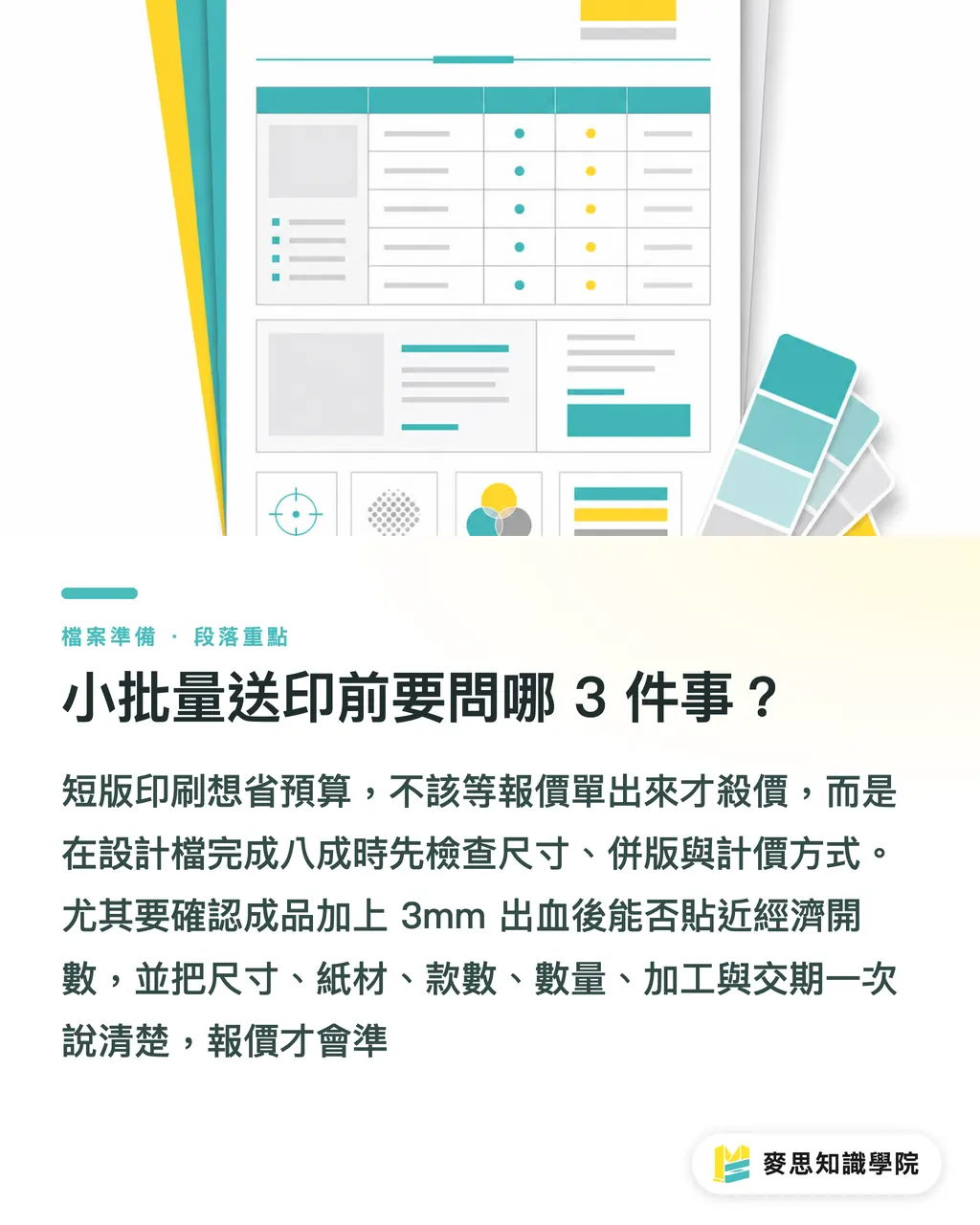
For short-run purchasing, do not wait until the quotation arrives to talk about saving paper. When the design file is 80% complete, ask about the "MINDS Printing (MS) three prepress gates." This 30-second check is often more effective than spending half an hour bargaining later
・Can the finished size move closer to an economical sheet size, and will it still fit after adding 3mm bleed?
・Can versions with the same material, size, and finishing be combined, or at least share the same die and finishing process?
・Is the minimum billing unit for digital printing based on finished copies, press sheets, or a fixed spec?
If purchasing only says, "I need 300 copies," the quote will not be accurate. A better inquiry states size, material, single-sided or double-sided printing, number of versions, quantity per version, post-press work, and deadline all at once. One DM version at 300 copies and 10 small-card versions at 30 copies each are completely different jobs for production
When you need a consultant to review the specs first, the Mai Strategy Knowledge Academy consulting team can help check size, paper, and process separately. For short-run jobs, blocking errors at the file stage is what gives you room later to discuss paper stock, texture, and budget
Key Takeaways
・Under 500 copies, save yourself from mistakes first. Do not start by cutting paper weight
・A 5mm size difference often decides whether a short-run job can get close to an economical sheet size
・Gang-run printing saves shared spoilage. Dedicated-run printing buys control
・Digital printing is flexible, but still limited by printable area and minimum billable press sheets
・For quotes, clearly stating versions and post-press work gets you closer to the real cost than giving only the total quantity
Further Thinking
The practical path is straightforward. On the manufacturing side, print providers should write the machine's printable area, gripper margin, and minimum billable press sheets into the quotation terms. On the design side, 3mm bleed and safe trim margins should be built in from day one of layout. AI and SaaS products should add size checks, imposition suggestions, and version-routing reminders. When clients submit one fewer wrong file, the production line makes one fewer follow-up call
Further Reading
FAQ
- Do print jobs under 500 copies always need digital printing?
- For jobs under 500 copies with no special colors and content that may still change, digital printing is usually a better fit. If the paper is special, color accuracy requirements are high, or there is a lot of post-press work, prepress should still check whether dedicated-run printing would be more stable
- What should be changed first to save paper in small-batch printing?
- Change the finished size and imposition method first. Do not downgrade the paper stock first. Moving the size closer to an economical sheet size usually avoids hidden waste better than changing 250gsm to 200gsm
- Why is gang-run printing cheaper?
- Gang-run printing places multiple files on the same press sheet, sharing plate making, press setup, and spoilage allowance. The tradeoff is less flexibility in specs, paper stock, color variation, and lead time
- If the design file is already finished, can I still save paper?
- Start by checking 3mm bleed, safe trim margins, gripper direction, and finished size. If a difference of only a few millimeters lets one more unit fit on the sheet, a short-run job may still have room to cut paper waste
- How should I ask for a quote on many versions in small quantities?
- Do not write only a total of 500 copies. Break it down by number of versions, quantity per version, size, material, single-sided or double-sided printing, post-press work, and deadline, so the print shop can judge whether digital, gang-run, or dedicated-run printing makes the most sense
Related articles





The Print × AI weekly
The print and AI know-how designers, brands and enterprises can use before they commit — one email, every week
MINDS Free Tools
Spine width and imposition calculators — skip the manual math, free in your browser.
MINDS Group
Need actual printing or gifting services?
From premium printing to online ordering and festive gifts — the MINDS Group sister brands take it from here.