

Overview
Before sending specialty substrates to print, confirm three things first: base color, ink, and thickness. MINDS Printing (MS, mid-to-high-end fully custom commercial printing) uses a three-gate prepress check to clarify the process before any design file moves into proofing
・Kraft paper: specify a white ink underbase or white foil stamping if you need white
・Metallic paper: aluminum foil paper and metallic PET require confirmation of UV ink and curing equipment
・Magnetic sheets: thickness, cutting accuracy, and equipment compatibility must be checked first
Specialty substrates are paper and adhesive materials whose ink absorption, base color, thickness, or adhesion conditions differ from standard coated paper. Before printing, ink, white ink, drying, and finishing all need to be reviewed again

What three things should you ask before printing on specialty substrates?
When I look at a specialty substrate job, the first thing I check is not whether the layout looks good. I look at the three places where production usually gets stuck: base color, adhesion, and finishing
・Base color: kraft paper is brown by nature. White in a design file is usually 0% ink, so without white ink or white foil stamping, the paper color will show through
・Adhesion: metallic paper and metallic PET do not absorb ink. The ink sits on the surface, so drying and scratch resistance depend on UV ink and curing conditions
・Finishing: magnetic sheets are thicker than regular paper. Some lamination, die-cutting, or cutting machines cannot feed the material, and die accuracy needs to be recalculated
Do not rush it
Before quoting, MINDS Printing (MS) writes the material, process, and finishing steps into a confirmation sheet as part of its three-gate prepress check. It is a very manual approach, but it prevents a lot of trouble: extra charges, revised plates, and added processes after proofing has already started
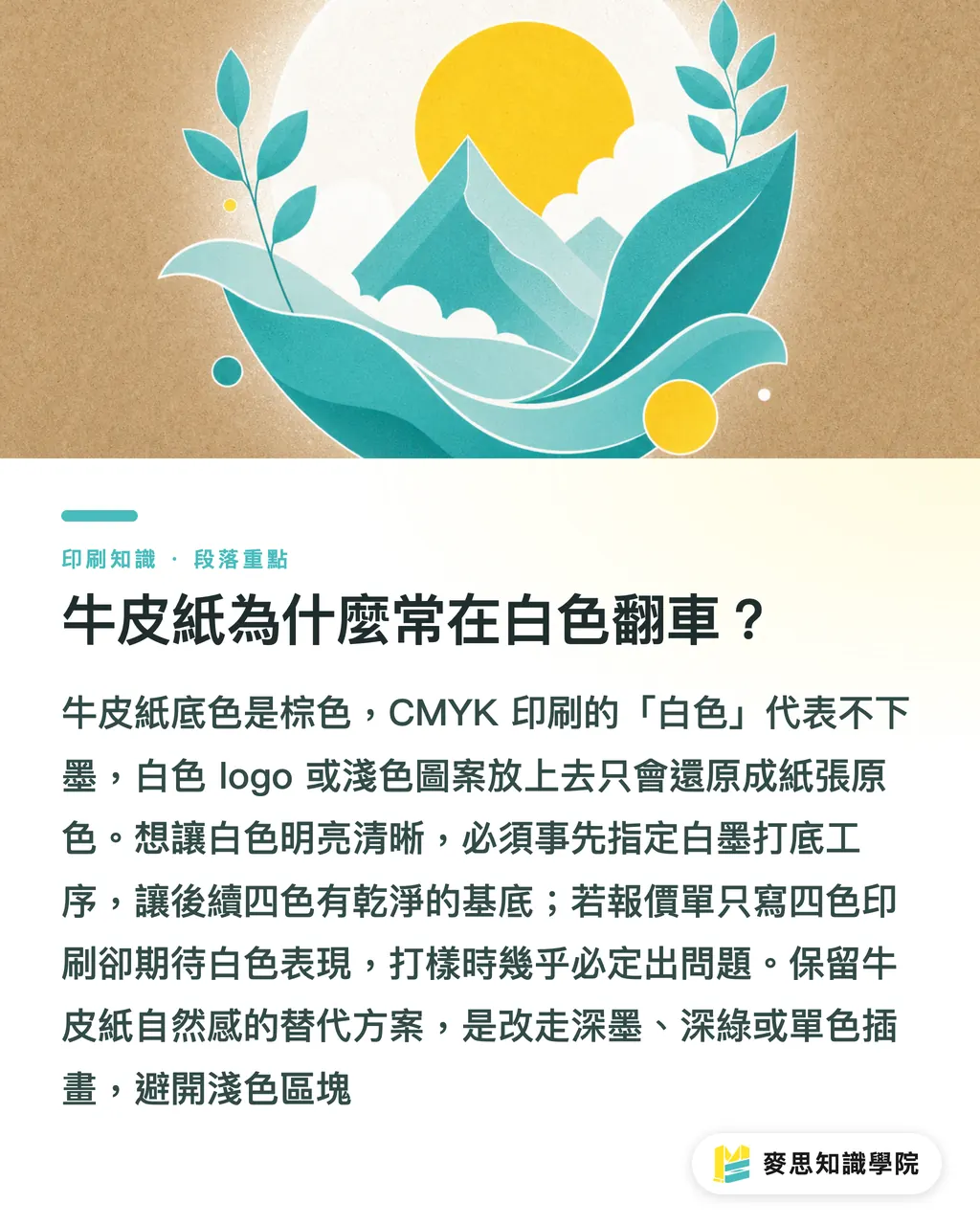
Why does kraft paper often fail on white areas?
Kraft paper has a brown base color. In CMYK printing, "white" usually means no ink is printed. So a white logo, white text, or pale illustration placed on kraft paper can easily shift from clean white on screen to the natural color of the paper
A white ink underbase means printing a layer of white ink first on a dark or transparent substrate, giving the later CMYK layers a clean base so the paper color does not swallow the color
・If the white logo needs to look bright: specify a white ink underbase first, then print process color
・If the white graphic needs a metallic or special finish: white foil stamping can be considered, but ask about production limits first if the lines are very fine
・If you want to keep the natural feel of kraft paper: reduce pale color blocks and shift the color direction toward dark ink, black, deep green, deep red, or single-color illustration
I have seen too many cases where the color swatch was not the problem. What was missing was usually one process that never made it into the quote. If a kraft paper quote only says four-color printing, but the client expects bright white, proofing will almost certainly turn into an argument
Why can't metallic paper be quoted like regular paper?
Metallic paper usually falls into two types: aluminum foil paper and metallic PET. They share the same problem: low surface absorption. Ink does not sink into the paper fibers the way it does on coated paper
UV ink cures under ultraviolet light. It works well on low-absorption surfaces such as metallic paper and PET. The key issues are adhesion, exposure energy, and drying speed
・Ask about ink in the quote: standard oil-based ink cannot simply be treated as the default answer for metallic paper
・Ask about equipment in the quote: UV ink requires matching curing equipment. This is not solved by swapping in a different can of ink
・Ask about post-processing in the quote: lamination, varnishing, die-cutting, and foil stamping all affect ink adhesion and scratch risk
Metallic paper is too often mistaken for just "switching to a shiny sheet." On the actual production line, adhesion comes before color. If the artwork has a large dark solid area, scratch marks, fingerprints, and post-drying abrasion resistance also need to be checked
How should finishing be checked before printing magnetic sheets?
A magnetic sheet is a thick adhesive material with a magnetic back. It is often used for fridge magnets and short-term vehicle notices. Before printing, confirm the machine's feedable material thickness and the cutting method
The main problem with magnetic sheets is usually not print color. It is material thickness and finished-product accuracy. Lamination, die-cutting, and cutting processes that work for standard stickers may fail when the material is changed to magnetic sheet. If one machine cannot feed it, the whole workflow has to change
・Thickness: ask the print shop for its acceptable magnetic sheet thickness range before the final product spec is locked
・Cutting: if the outline has rounded corners, sharp corners, or small notches, confirm the die and cutting tolerance first
・Application: fridges, metal cabinets, and short-term vehicle notices have different use cases, so magnetic strength and surface protection needs also differ
・Proofing: check at least three things: the print sample, cutting sample, and adhesion sample. Do not look only at a flat color proof
That is enough
If a magnetic sheet job includes small text, thin borders, or a complex outline, I would suggest sending the dieline to the vendor one version earlier. If the print shop sees the dieline one day sooner, the buyer spends one less day being chased by the deadline
Which processes drive cost apart?
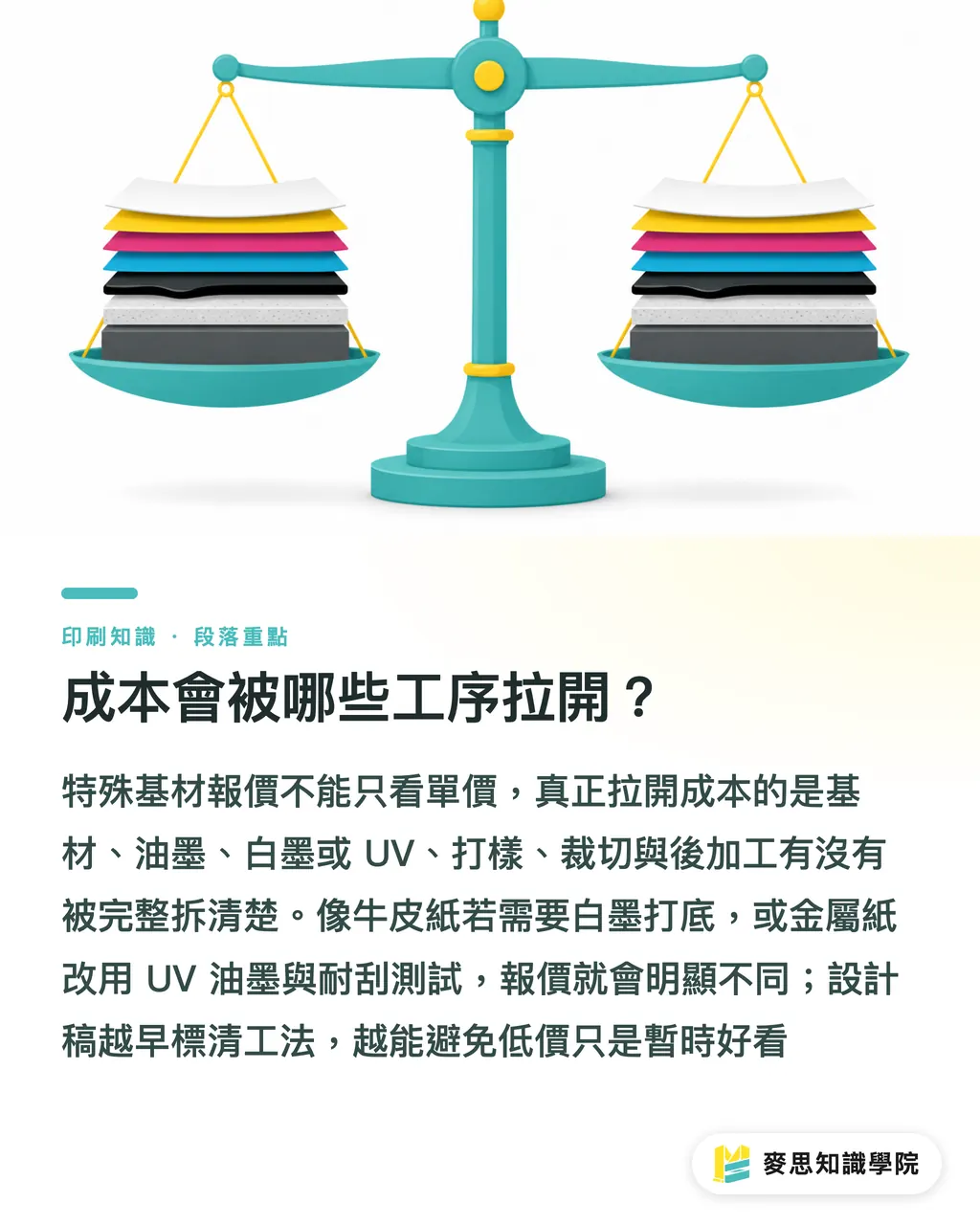
Do not compare specialty substrate quotes by unit price alone. Break them into at least five columns: substrate, ink, white ink or UV, proofing, and cutting plus post-processing. If any one column is missing, the low price only looks good for the moment
・Kraft paper cost differences: white ink underbase, white foil stamping, and dark full-bleed solids will widen the quote gap
・Metallic paper cost differences: UV ink, curing equipment, scratch-resistance testing, and lamination sequence will widen the quote gap
・Magnetic sheet cost differences: material thickness, die complexity, cutting accuracy, and adhesion testing will widen the quote gap
For small batches of shop stickers or basic labels, when the specs are simple, you can first use MINDS Print to get a rough cost feel through its online logic. If the job involves white ink, UV, metallic paper, or magnetic sheet cutting, it is better to ask MINDS Printing to review the process first. The quote should spell out every method that affects the finished result
Designers often make two mistakes: expecting a white effect in the artwork without marking white ink, and choosing metallic paper while quoting with standard oil-based ink. These two mistakes are not hard to fix. The hard part is that they are usually fixed too late
Key Takeaways
・White on kraft paper must be specified as white ink or white foil stamping first. Without that, it will probably turn into the paper color
・For metallic paper, ask about UV ink and curing equipment first. Ink adhesion comes before color discussion
・For magnetic sheets, test thickness and cutting first. If the machine cannot feed the material, even the best design file is useless
・Quotes need to be reviewed by process. If a low price leaves out white ink, UV, or cutting, the cost will come back during proofing
Further Thinking
For print manufacturing, design teams, AI applications, and SaaS products, specialty substrates are best turned into structured checklist fields early: substrate base color, whether a white plate is needed, ink type, drying method, material thickness, and cutting method. Ask these six questions before quoting or automated file checking. The MINDS Printing (MS) three-gate prepress check can become a design handoff form, or a required spec flow inside SaaS. Customer service has fewer follow-up questions, production has less guesswork, and clients are less likely to hear "this needs one more process" only after proofing
FAQ
- Can white be printed on kraft paper?
- White can be achieved on kraft paper, but the design file must specify a white ink underbase or white foil stamping. In a standard CMYK file, white usually means no ink, so the printed result will show the brown base color of the kraft paper
- Does metallic paper always require UV ink?
- Metallic paper and metallic PET have low surface absorption, so standard oil-based ink can run into adhesion and drying problems. Before sending the job to print, confirm the UV ink, curing equipment, and post-processing sequence
- Why can't magnetic sheets be handled like regular stickers?
- Magnetic sheets are thicker than regular paper. Some finishing machines cannot feed them, and cutting accuracy is more sensitive. Before quoting, confirm the thickness, die, cutting method, and final use of the product
- What should be checked in a quote for specialty substrate printing?
- A specialty substrate quote should cover at least five items: substrate, white ink or UV ink, proofing, cutting, and post-processing. If a low quote leaves out process steps, the cost is very likely to come back during proofing
Related articles




The Print × AI weekly
The print and AI know-how designers, brands and enterprises can use before they commit — one email, every week
MINDS Free Tools
Imposition calculator and preflight file check — free prepress tools, right in your browser.
MINDS Group
Need actual printing or gifting services?
From premium printing to online ordering and festive gifts — the MINDS Group sister brands take it from here.