
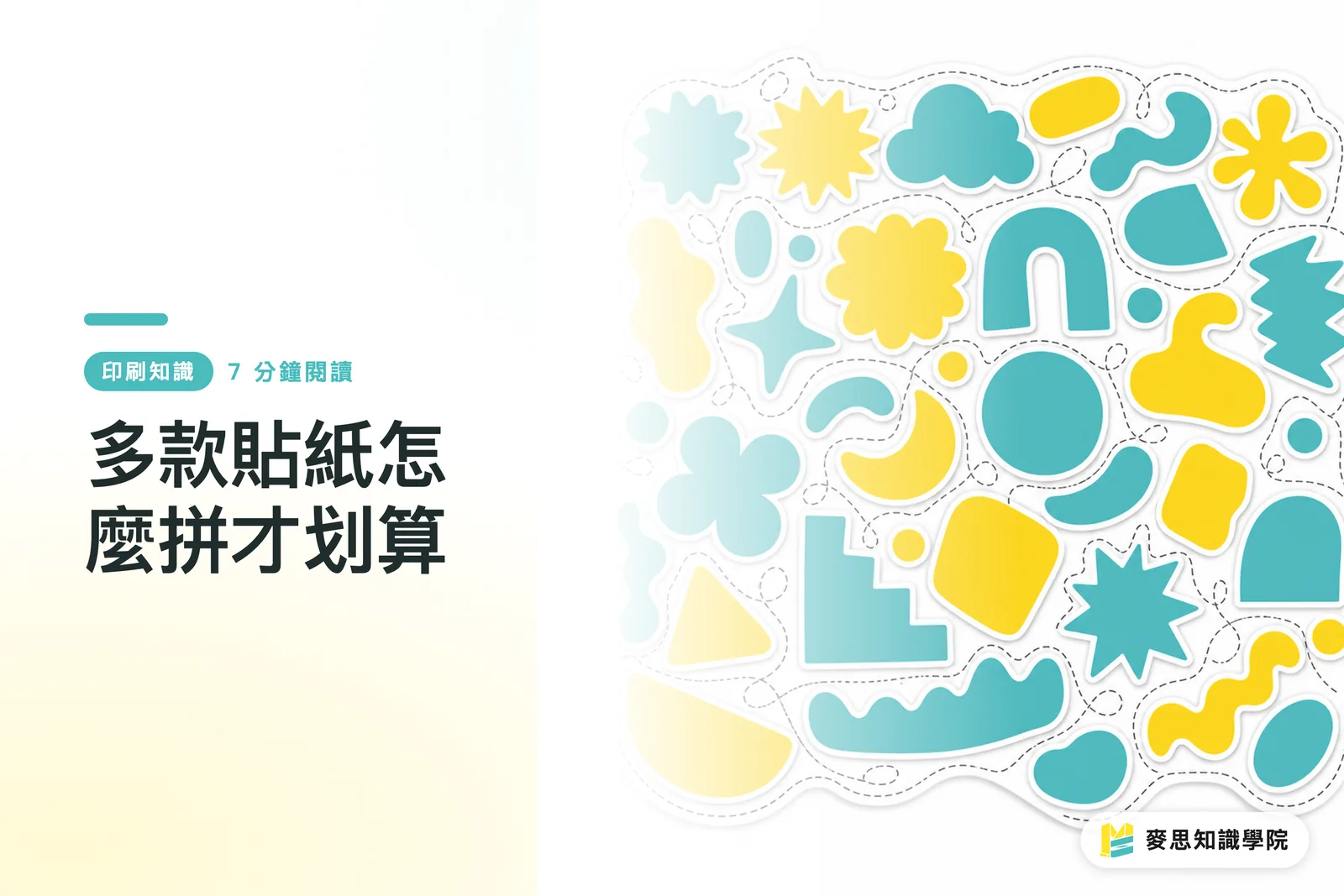
Overview
To gang-print multiple sticker SKUs efficiently, start by narrowing down size, shape, material, lamination, and labeling method into one shared production spec. The rule MINDS Print (MS, mid-to-high-end fully custom commercial printing) uses: share the design first, share the die line second, share the restock logic last
Gang printing: gang printing means arranging multiple artworks on the same print plate or digital output sheet under the same press conditions, so paper, color calibration, cutting, and finishing can all be handled together. Sticker gang printing has to account for size, die line, bleed, and labeling flow at the same time
I use the 'MINDS Print (MS) Three Gates Before Submission' to evaluate multi-SKU sticker gang printing
・① Size Gate: within a series, first narrow down to 1 or 2 width-height combinations, don't let every SKU grow its own dimensions
・② Die Line Gate: keep shapes as shared as possible; don't mix circles, squares, and rounded rectangles in the same small-run batch
・③ Restock Gate: don't force fast-selling and slow-selling SKUs to print in equal quantities, restock timing beats printing everything at once
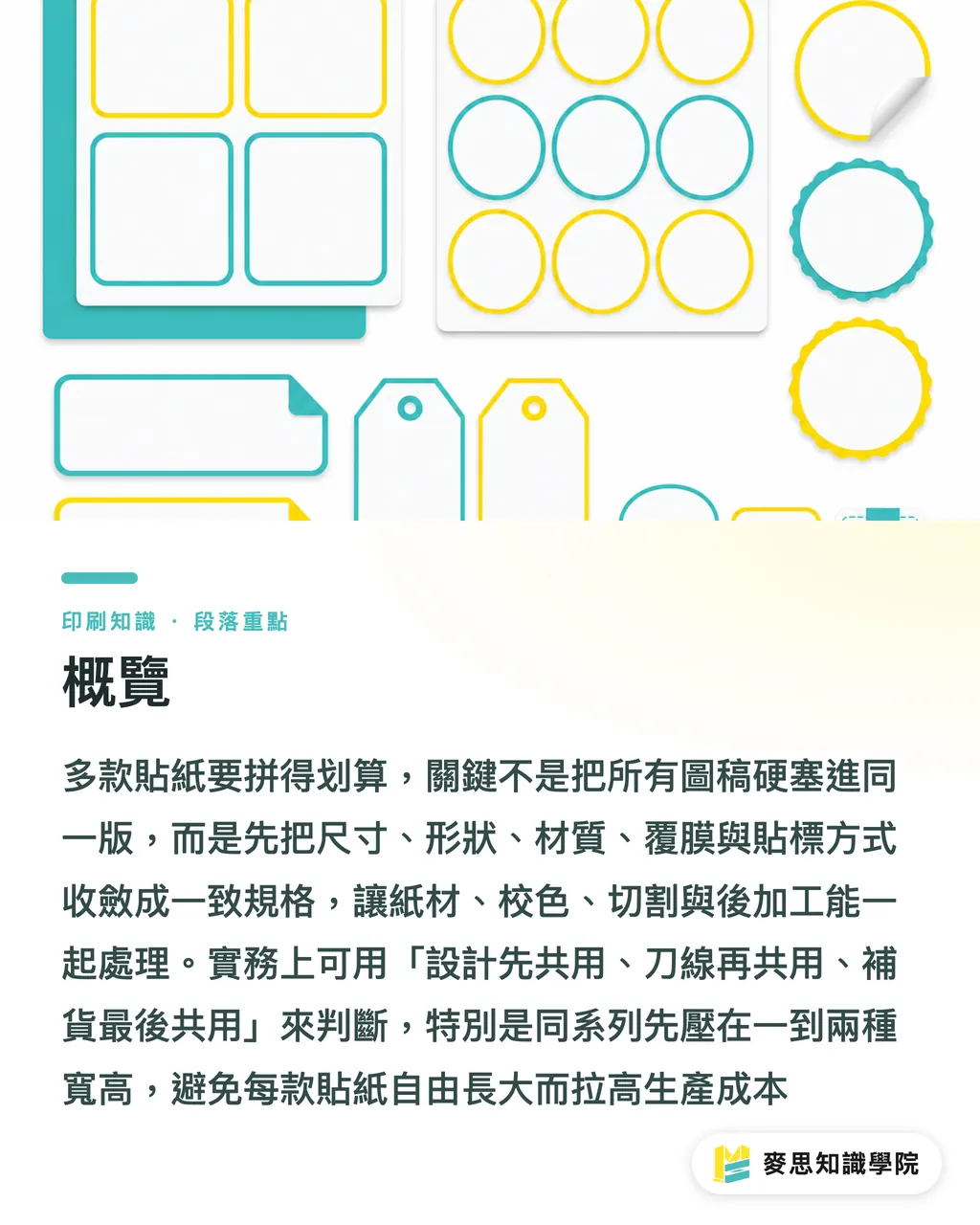
How Do You Gang-Print Multiple Stickers and Actually Save in the Right Places?
The common pain point in food, skincare, and creative goods is that 6, 8, or 12 sticker designs look like a decent total volume, but the actual quantity per SKU is tiny. Judging cost by 'total sheets' is easy to get wrong here, because switching designs, color calibration, die lines, slitting, and labeling routing all eat time
What I dread most on the floor is a certain type of file: 10 sticker designs in a series where every one differs by 2 mm in size, every corner radius is different, every die line is drawn separately. The artwork has a lot of personality; the production line has to treat it as 10 separate mini-jobs
Don't rush
Asking 4 questions before gang-printing multi-SKU stickers gets you further than just asking 'how many fit on one sheet.'
・How many SKUs are in this series — 6 jam flavors, 8 essential oils, 12 creative hang-tag stickers?
・Can every sticker in the series share the same size, all fitting within 40 × 60 mm or 50 × 70 mm?
・Is the labeling method hand-application, semi-automatic, or machine labeling on a bottle line?
・Will restocking split by speed, top sellers restocked monthly, slow movers quarterly?
If a brand is still planning its first batch of SKUs, the Mai Strategy Knowledge Academy consulting team typically looks at the product series, container dimensions, and restock frequency first before recommending sticker specs. Doing this early saves a lot more than reworking die lines after the artwork is finalized
How Do You Share Sizes and Shapes?
The biggest money-saver with multi-SKU stickers isn't packing the sheet as tight as possible, it's keeping sizes and shapes within a small number of specs. For 8 skincare stickers, having all front labels at 45 × 65 mm and all back labels at 40 × 55 mm is usually better than letting each SKU tweak its dimensions slightly
Same with shapes. Mixing circles, ovals, and rounded rectangles in a single small-run batch complicates die line management. If a creative brand has 12 character stickers, I'd suggest picking one outline rule first, say, all fitting within a 50 mm circle, and letting the differences live in the illustration and color, not in every character sprouting its own shape
Sharing sizes has 3 practical benefits
・On the design side, a shared template means brand name, flavor, volume, and barcode fields don't need to be re-laid-out per SKU
・On the print side, a shared gang-printing logic means color calibration and slitting stay consistent across the batch
・On the restock side, you can run individual top-up prints, fast sellers don't get held back by slow ones
It's that simple
For multi-SKU stickers not yet at final artwork, I separate 'what can change' from 'what can't.' Brand name, flavor, and illustration can change. Sticker width and height, outline shape, bleed, and die line naming need to stay fixed
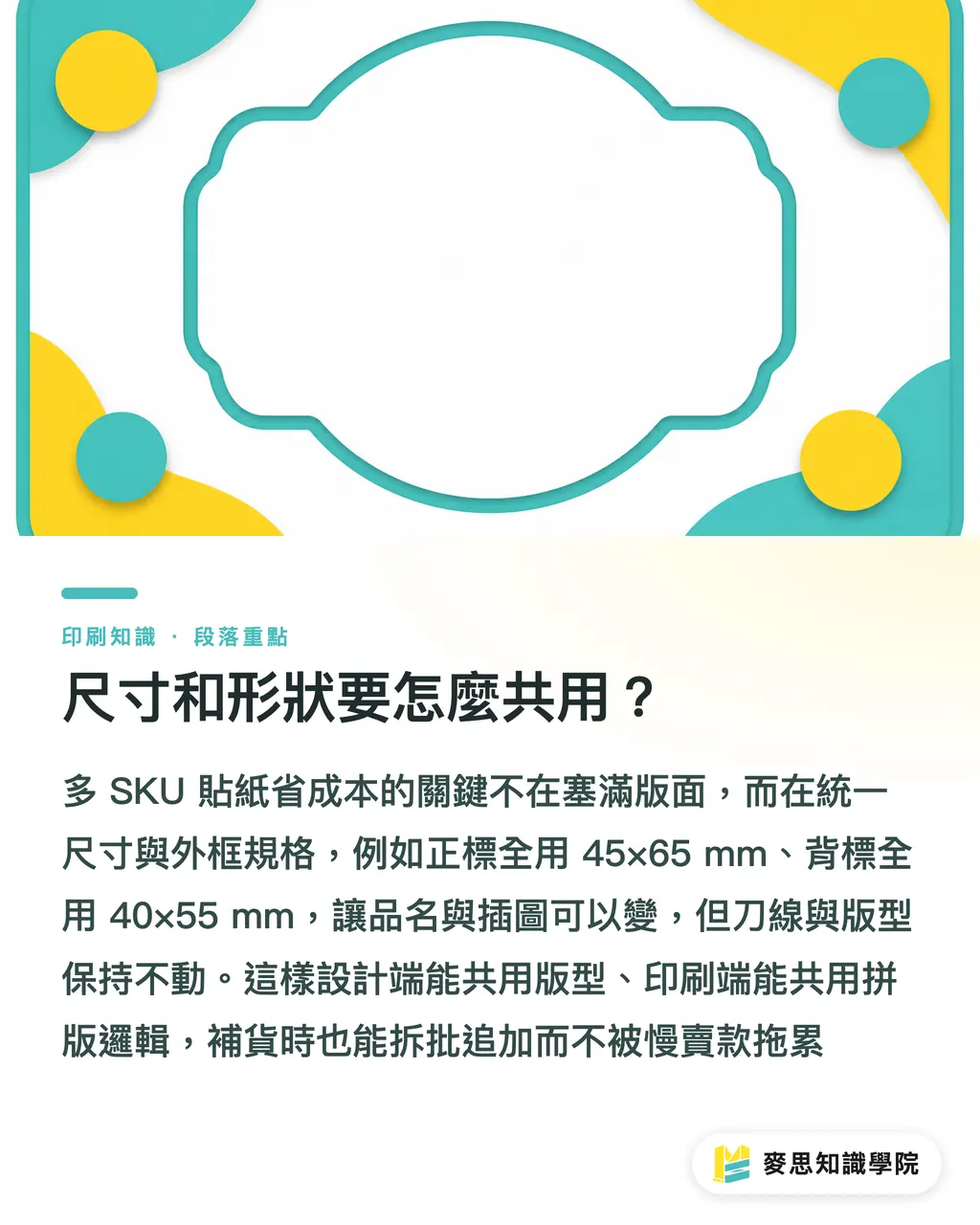
How Should You Set Up Bleeds and Die Lines Without Slowing Down Production?
A sticker file needs to communicate 3 things to the print shop: finished size, bleed area, and die line position. For standard stickers, I require at least 2 mm of bleed from the design side, with text and barcodes pulled further in from the die line, to avoid cutting into text or leaving exposed white edges
The die line should be on its own layer. The standard approach is to use a spot color to mark the die line and set it to non-printing. If 6 food bottle labels share the same outline shape, the die line position across all 6 files needs to be identical, don't redraw the outline manually in each one
File problems I'll ask to be fixed right away
・Die lines and print artwork mixed on the same layer, leaving prepress staff to guess which line to cut
・Bleed applied only to the background image, with color blocks, photos, or full-bleed textures not extended into the bleed area
・Rounded rectangle corner radius varying per SKU — 3 mm, 4 mm, 5 mm mixed in the same batch
・Barcodes placed too close to the edge, making it hard for scanners to read the full quiet zone after cutting
Food and skincare stickers have one more detail: back labels often carry ingredient lists, volumes, storage instructions, and lot number fields. Those small characters can't be shrunk just to fit the layout. If a 30 mm-wide back label can't fit the required information, the size needs to change, don't hand the readability problem to the print shop to solve
Should You Decide on Material, Lamination, and Labeling Method Together?
When gang-printing multi-SKU stickers, you have to decide on material, lamination, and labeling method together, because the ideal is one batch, one paper stock, one finishing process. If half the series needs water resistance and half needs a paper texture, half gloss lamination and half matte, what looks like one sticker batch often gets split into 2 to 4 separate runs
Food stickers regularly face refrigeration, condensation, sweat, and oil. Skincare stickers deal with curved bottle surfaces, wet hands, friction, and alcohol wipes. Creative stickers face packaging bag friction, storage scratches, and long-term display. Different use cases mean you can't pick material based on how it looks in photos
Here's how I think through 3 scenarios
・Refrigerated food bottle labels: synthetic paper or more moisture-resistant materials first; check lamination against whether the bottle gets condensation
・Skincare bottle labels: test the bottle curve and labeling method first; materials that are too thick or too rigid may lift at the edges
・Creative outer packaging stickers: paper texture is fine to keep, but if the sticker gets handled and rubbed often, matte lamination or scuff-resistant finishing holds up better
If the job involves mid-to-high-end commercial printing, specialty materials, or multiple finishing processes, MINDS Print can assess material and gang-printing conditions early in the design stage. I'd recommend bringing at least one actual container, one rough label dimension sketch, and 3 representative design drafts, the conversation goes a lot faster
How Do You Plan Inventory and Restocking Without Getting Stuck?
The biggest trap with multi-SKU sticker gang printing is printing equal quantities of every SKU, because 8 products almost never sell at the same rate. Running out of labels on a fast seller holds up shipping; overprinting a slow seller risks running into ingredient, barcode, regulatory text, or packaging artwork updates
I sort SKUs into 3 groups for restock planning
・Group A, fast sellers: lock in the sticker spec and keep the flexibility to reprint separately, don't let the whole gang plate hold it hostage
・Group B, steady sellers: good candidates to batch with same-spec SKUs, keeping printing and slitting efficient
・Group C, market-test SKUs: start with small digital print runs or conservative quantities to test demand, don't stock up from the beginning
Restock planning also feeds back into design. If a brand expects to add 2 new flavors every quarter, the first sticker batch should already reserve a series template so new flavors can reuse the same size, die line, and information fields
That's all it takes
When multi-SKU sticker gang printing is done well, design, printing, labeling, and restocking all run off the same spec. When it's done badly, every follow-up print feels like opening a brand new job
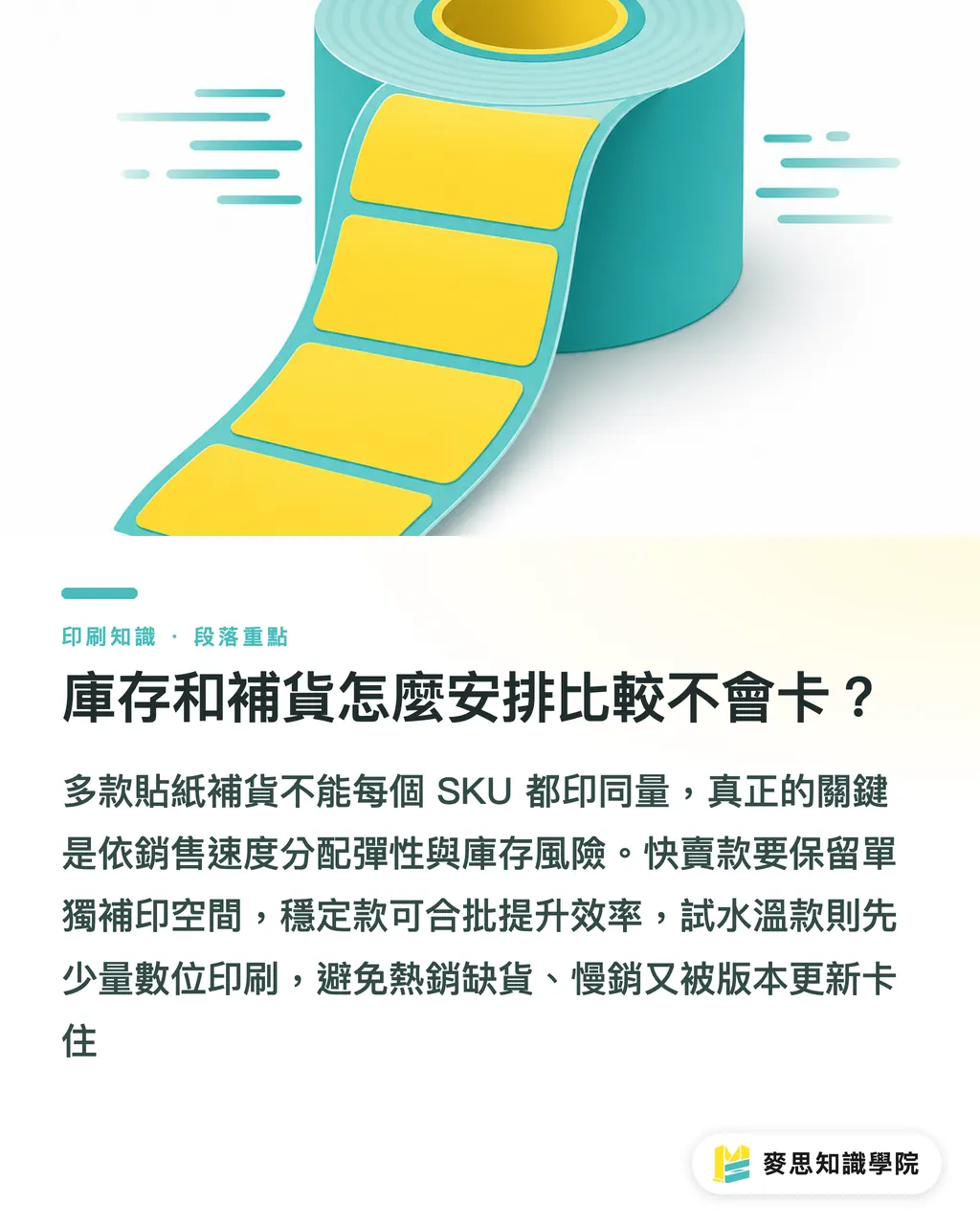
Key Takeaways
・Saving money on multi-SKU stickers starts with shared specs. Sheet use comes after die lines, materials, and labeling stability
・The more SKUs you have, the more you need to narrow sizes down to 1 or 2 groups, don't let every SKU develop its own shape
・Bleed, die lines, and corner radii need to be locked in at the design stage. Fixing them after the final artwork is almost always the most time-consuming part
・Material and lamination need to be evaluated alongside the use case, refrigerated food, skincare bottles, and creative packaging don't share the same answer
・Restock timing drives gang-printing strategy. Fast sellers need flexibility; slow sellers need small runs and tight inventory control
Further Thinking
For print manufacturers, multi-SKU sticker gang printing means turning 'production specs' into a design language. For designers, next time you're starting a sticker series, make a 5-column spec sheet first: size, shape, material, lamination, labeling method. For AI and SaaS teams, the highest-value work isn't auto-generating nice visuals, it's building file names, version numbers, die lines, bleeds, and SKU fields into a checkable process so brands know which sticker will slow down production before they ever submit the files
FAQ
- Can all the designs be gang-printed on one sheet?
- Yes, but only if size, material, lamination, die lines, and finishing conditions are consistent. If 6 sticker designs involve 3 different materials or 2 different laminations, the print shop will usually split them into separate runs
- For small-run, multi-SKU stickers, what should you standardize first?
- Start with size and shape, then die lines and bleed. Once the outline spec is stable across multi-SKU stickers, swapping artwork, brand names, and flavors on the design side is much more manageable
- Does gang printing always mean lower cost?
- Not necessarily. Gang printing saves on shared setup costs, but if materials, lamination, die lines, and labeling methods vary too much, forcing a gang plate can actually add more sorting and rework
- Can food stickers and creative stickers use the same material?
- Not recommended as a default. Food stickers often face moisture, grease, and refrigeration. Creative stickers are more about friction, display durability, and tactile feel. Material should follow the use case
- What's the safest approach for a brand starting its first multi-SKU sticker batch?
- Narrow the first batch down to 1 or 2 sizes, use one die line for the shape, go with small print runs for test SKUs, and keep the option to reprint fast sellers separately
Related articles

The Print × AI weekly
The print and AI know-how designers, brands and enterprises can use before they commit — one email, every week
MINDS Free Tools
AI background removal, a LINE sticker maker, spine & imposition calculators — all free, right in your browser, no upload.
MINDS Group
Need actual printing or gifting services?
From premium printing to online ordering and festive gifts — the MINDS Group sister brands take it from here.