
Overview
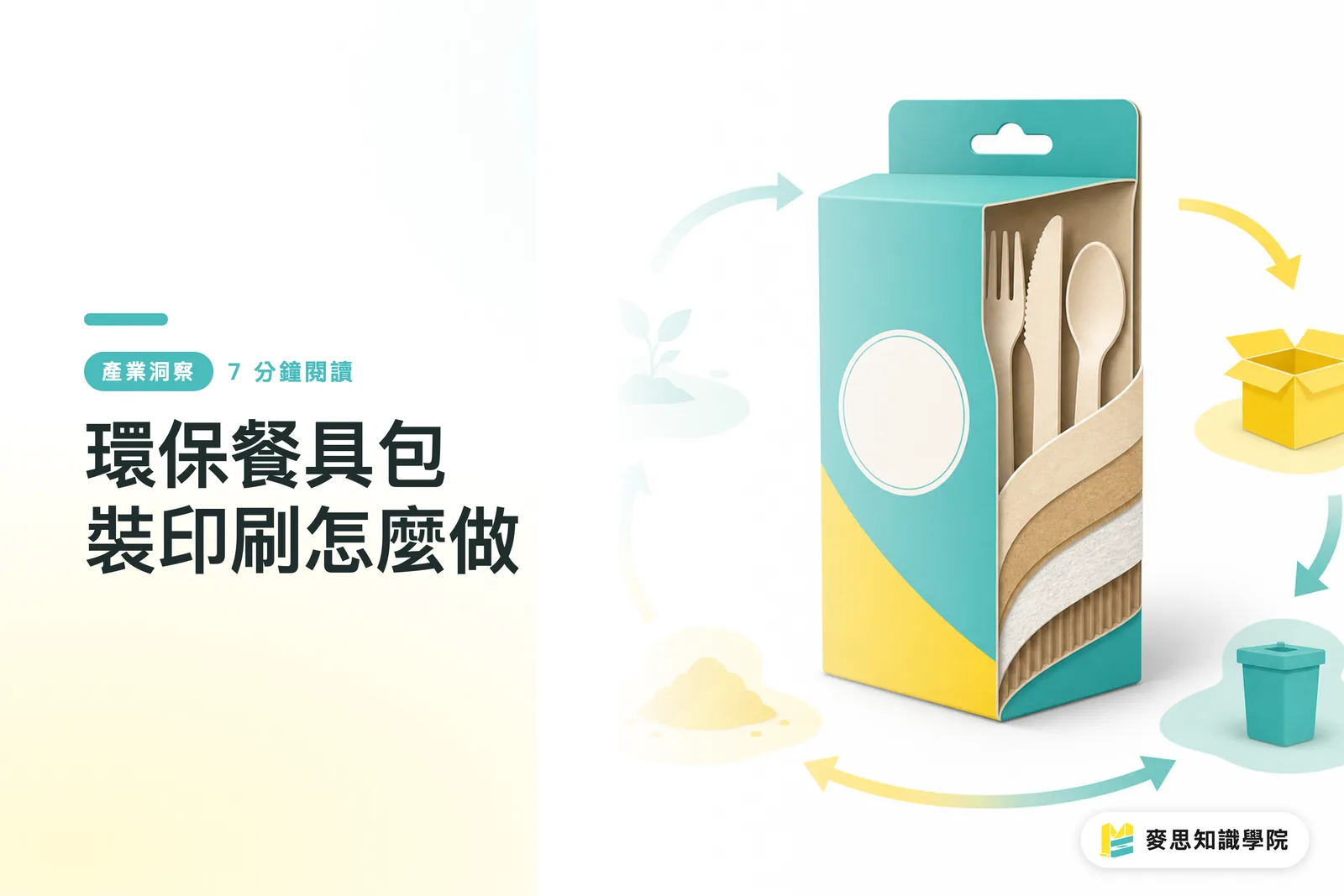
When an eco-friendly tableware brand prepares packaging for print, do not rush into choosing a nice-looking paper. Start with the "MINDS Printing (MS, mid- to high-end fully custom commercial printing) three print-readiness checks" and review 3 things first
・1. Product contact scenario: know whether the tableware is for dry use, wet use, hot food, or takeaway sets
・2. Material and certification evidence: be able to explain where the paper, fabric, coating, or recycled material comes from
・3. Compatibility between printing and recycling: make sure ink, varnish, lamination, and finishing do not weaken the eco claim
Once these 3 checks are passed, the packaging can feel like the brand, feel eco-conscious, and still feel truly ready for production
What should you check first when printing eco-friendly tableware packaging?
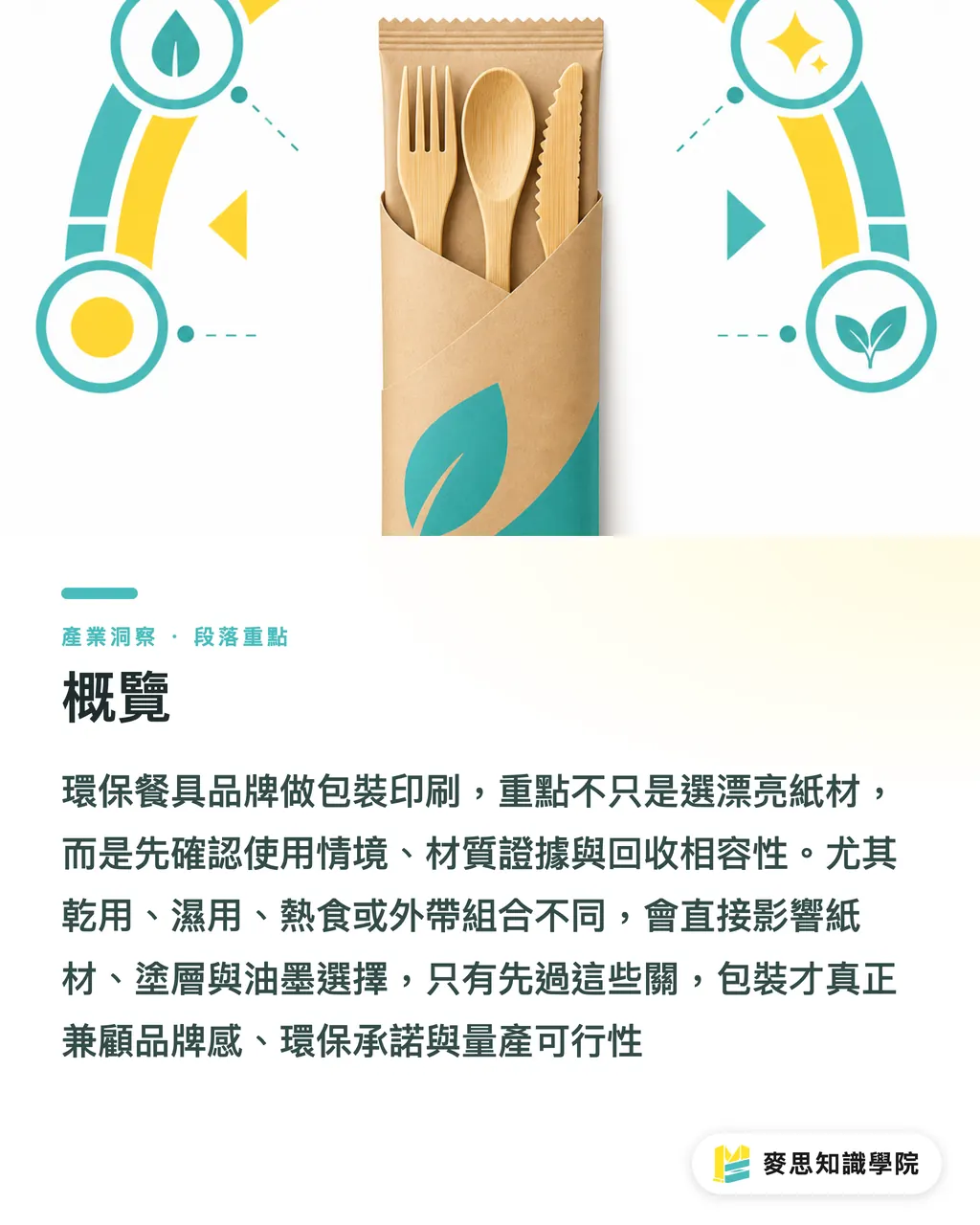
When I review an eco-friendly tableware packaging project, the first thing I look at usually is not the logo. I look at how the product is picked up, how it is packed, and how it will be discarded in the end
A pair of 23 cm chopsticks, a 5-piece knife, fork, spoon, and straw set, or a gift box with a cutlery pouch all need completely different dielines, box depths, hang-hole load capacity, and shipping protection
Start by clarifying 4 questions
・Is the tableware a single item, a set, or a set with a cutlery pouch?
・Will the packaging touch food, or only the outer surface of the tableware?
・Will it be sold on hanging displays, shipped through e-commerce, given away at trade shows, or placed on shelves overseas?
・Does the brand need to print environmental certification marks, or only material details and after-use instructions?
Do not rush
Many packaging failures are not caused by bad design. They happen because "eco-friendly image" was treated as an art style at the start, while product size, contact scenario, and certification authorization were left out of the specification sheet
Which materials work well for eco-friendly tableware packaging?
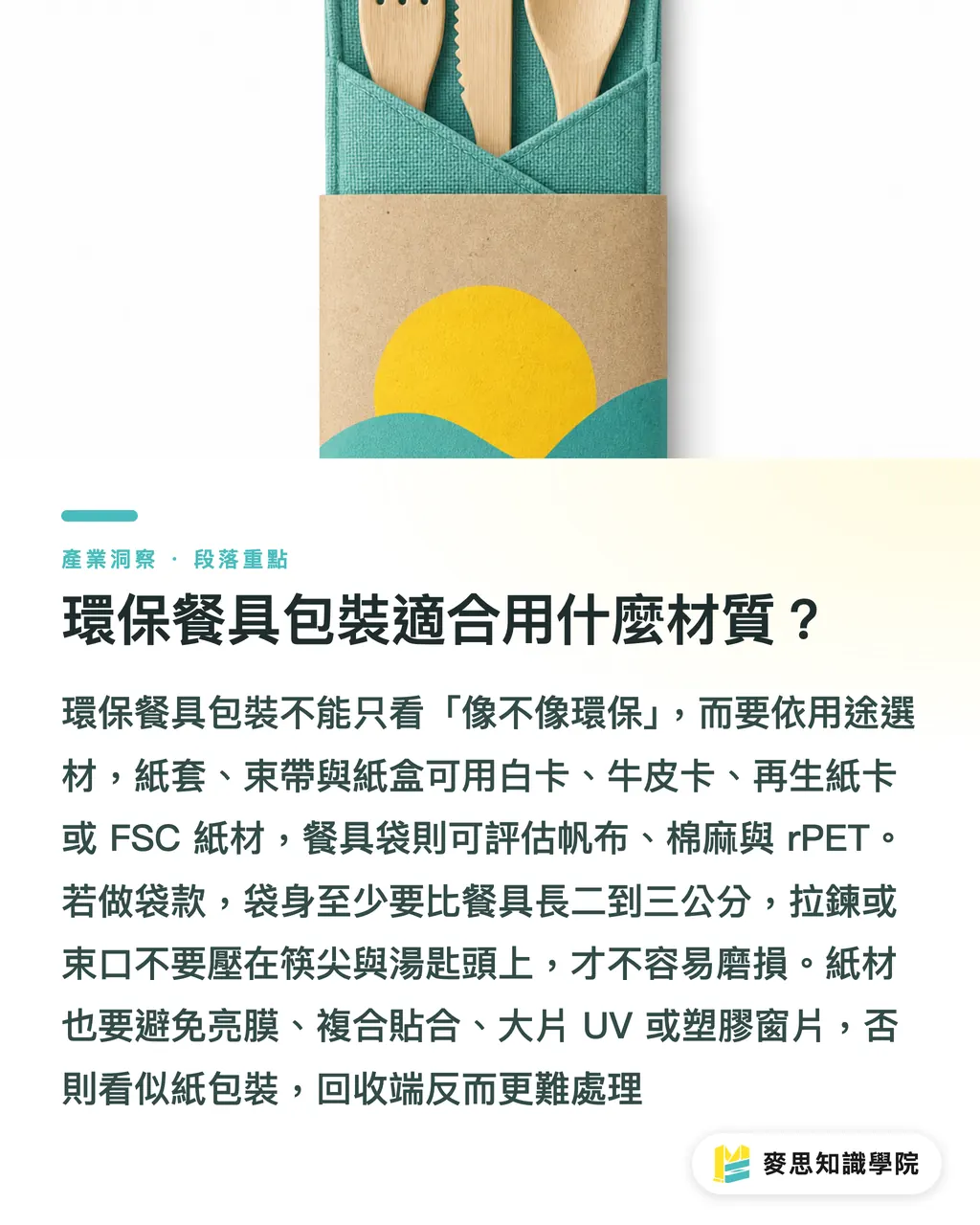
Paper boxes, paper sleeves, and belly bands commonly use white card, kraft card, recycled paperboard, or FSC paper in the 250 gsm to 400 gsm range. If the look needs to be clean and the product needs to stand well on shelf, white card is usually more stable. If you want to keep a plain fiber texture, kraft card or uncoated paper speaks more like an eco-friendly brand
For cutlery pouches, you cannot think only in paper terms. Cotton canvas, cotton-linen blends, and rPET recycled polyester each have their place. For a pouch used in daily commuting, washed, and air-dried, wash durability needs to be judged before printing. Screen printing, heat transfer, and embroidery feel very different in the hand
I use a simple rule: the pouch body should be at least 2 to 3 cm longer than the tableware. The zipper, drawstring, or Velcro should not press directly against chopstick tips or spoon heads, or marks will appear after a few uses
Common materials can be chosen like this
・Paper sleeve or belly band: suitable for chopsticks, spoons, and small sets. Cost is easy to control, and it works well for material notes and QR code printing
・Drawer box or lid-and-base box: suitable for gift boxes and corporate gifts. Box depth should be based on the highest point of the tableware plus buffer space
・Kraft paperboard box: visually natural, but dark paper absorbs ink. Light-colored text and fine lines should be proofed first
・White card box: stable color, suitable for tableware brands with strict brand-color requirements
・Canvas or cotton-linen cutlery pouch: feels durable and suits reusable tableware, but pay attention to shrinkage, color loss after washing, and cracking in the print
・rPET pouch material: suitable for brands emphasizing recycled content, but the copy must clearly state that the pouch uses recycled polyester. Do not let people misunderstand that the tableware itself is made from recycled material
Paper may look eco-friendly, but that does not mean recycling facilities will like it. Gloss film, composite lamination, large-area UV, and plastic window patches can all turn "paper packaging" into a composite material that is hard to separate
Can environmental certification marks be printed directly on the packaging?
Yes, but only if the brand truly has the certificate, authorization, and applicable scope. A printer cannot guarantee legal use of a certification mark on the brand's behalf
Environmental certification marks are issued by governments or third parties that review the environmental performance of products, materials, or processes under public rules. Whether the mark can be printed on packaging depends on the certificate scope, authorized wording, and validity period
Tableware brands most often encounter 5 types of labeling
・FSC: mainly concerns paper sourcing. Common labels include FSC 100%, FSC Recycled, and FSC Mix
・PEFC: also a forest certification system, focused on paper sources and supply chain management
・GRS: often used for recycled content and supply chain claims, and commonly asked about for rPET pouch materials
・OK compost, BPI, EN 13432: common in compostable material or export communication, but a certified tableware item does not mean the outer box is certified too
・Taiwan Green Mark: depends on product category and published specifications. Not every product that says eco-friendly can carry it
I ask clients to provide 3 documents before final artwork: the certificate file, the authorized wording, and the certification mark usage guidelines
That is enough
Without these 3 documents, do not place the mark in the final print file. At most, place it in an internal proposal or mockup, and clearly mark it as "authorization pending"
How should the layout be designed to avoid greenwashing?
Greenwashing means placing vague, exaggerated, or unsupported environmental claims on packaging, making consumers think the product has a lower environmental burden than it actually does. It often appears in taglines with no material details, certification evidence, or disposal guidance
A phrase like "friendly to the planet" is not enough, because it does not tell consumers which part is friendly, how friendly it is, or what to do with it after use
I suggest reserving at least 3 fixed areas on eco-friendly tableware packaging
・Material area: clearly state what materials are used for the tableware itself, the outer box, and the cutlery pouch
・Certification area: place authorized certification marks, certificate-related wording, or compliance statements. Do not redraw the logo yourself
・After-use guidance area: tell consumers to clean and store it, sort it for recycling, or dispose of it according to local rules
A more stable wording style looks like this
・Reusable stainless steel tableware, with outer box made from FSC paper
・Cutlery pouch made from rPET recycled polyester fabric. Hand wash in cold water and dry in the shade
・This packaging contains no plastic window patch. Remove accessories from the paper box before recycling according to local rules
If the brand is making a mid- to high-end gift box, corporate gift, or export package, I recommend having MINDS Printing review the dieline, paper, ink, and certification mark placement before final artwork. A design file may look beautiful, but if the certification mark lands right on a fold after the box is formed, that gets awkward
How should specs be set before printing so things do not go off track?
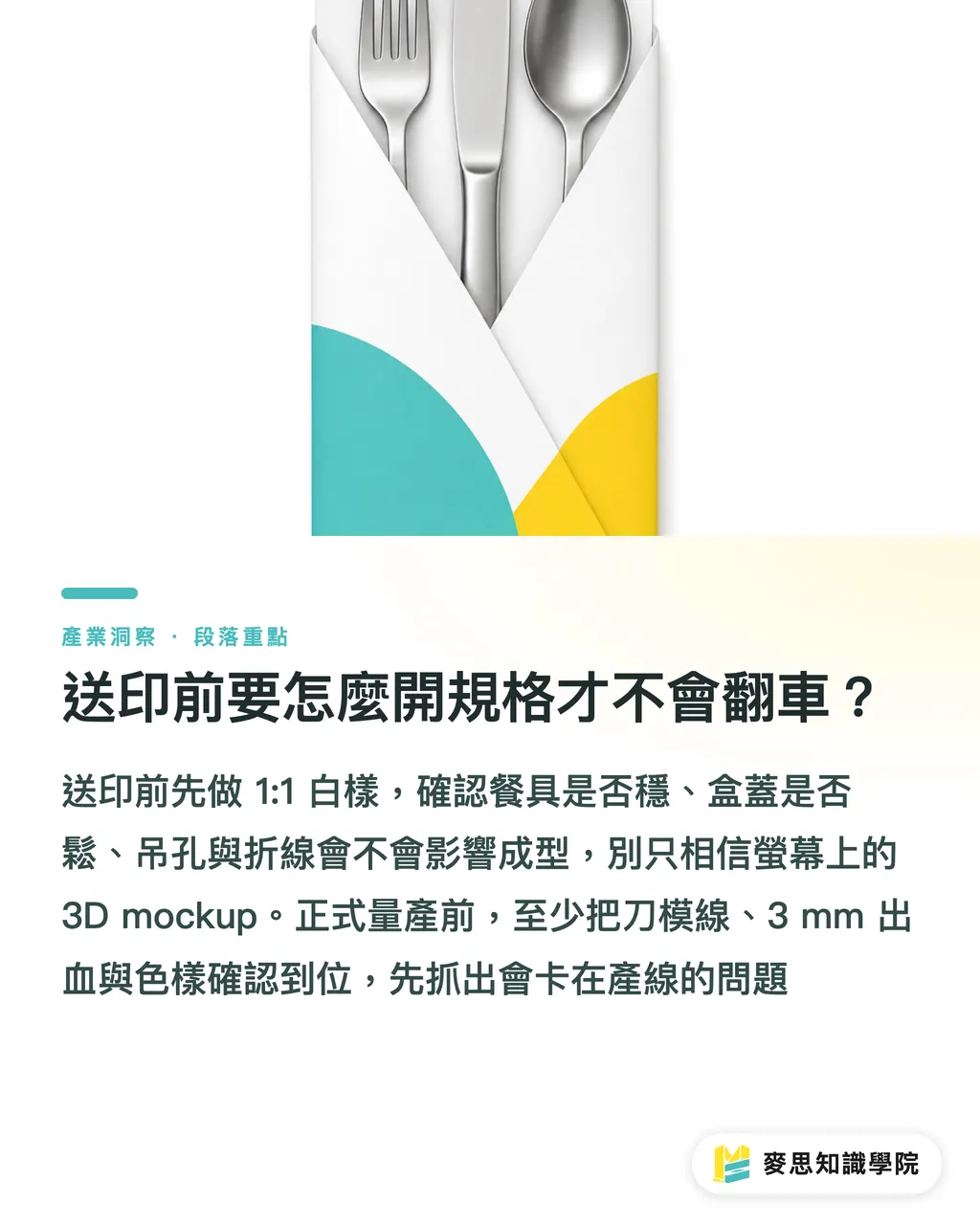
Before sending eco-friendly tableware packaging to print, make a 1:1 white mockup first. Do not rely only on a 3D mockup on screen
A white mockup checks 5 things: whether the tableware shifts around, whether the lid is loose, whether the hang hole tears, whether the cutlery pouch protrudes, and whether certification marks or material notes get swallowed by fold lines
For print files, I require these items to be in place first
・Dielines on separate layers, with cutting, creasing, glue tabs, and hang holes clearly marked
・Bleed of at least 3 mm to avoid white edges on box sides
・Images at 300 dpi, with brand colors checked for color shift after conversion to CMYK
・Fonts converted to outlines, with fine type kept away from dark backgrounds on kraft paper
・Spot gloss, embossing, foil stamping, white ink, and other finishing marked separately, not mixed into the four-color layer
・Certification marks, QR code, and material declarations kept away from fold lines, punched holes, and sealing sticker positions
For a small test run, digital printing or short-run proofing can be used first. But the ink absorption, whiteness, and fiber texture of eco-friendly paper will make colors slightly grayer than they look on screen. Before a large official shelf launch, make at least one color proof and formed sample that are close to mass-production conditions
If the team already has a first packaging version, organize product photos, dimensions, material proof, and AI or PDF files into 4 items and send them to the Mai Strategy Knowledge Academy consulting team for a pre-print diagnosis. Find the production-line issues before they slow things down
Key Takeaways
・Verify before designing eco-friendly packaging. If a certification mark is not authorized, enlarging it in print only enlarges the risk
・Eco-friendly tableware does not mean the outer box, stickers, inks, and varnish can all make the same claim
・Paper that feels plain is not automatically recyclable. Composite lamination is what often causes problems for recycling facilities
・A 1:1 white mockup is more honest than an on-screen preview. Dielines, hang holes, and box depth all reveal problems in your hands
・Good eco-friendly copy states the material, evidence, and after-use destination. It does not rely only on pretty adjectives
Further Thinking
On the print manufacturing side, "materials, certification marks, ink, finishing, and recycling handling" can become fixed review fields. On the design side, authorized certification wording should be treated as a layout element, not patched in after final artwork. AI and SaaS teams can place these fields into quotation, proofing, and copy-check workflows, so every packaging project starts by asking the right questions before talking about style
FAQ
- Does eco-friendly tableware packaging have to use kraft paper?
- Not necessarily. Kraft paper has a natural feel, but brand colors can easily turn darker. If the packaging needs to show brand colors accurately, white card or FSC white card is usually more stable
- Does an FSC paper box mean the whole product is very eco-friendly?
- No. FSC mainly addresses paper sourcing. The tableware material, stickers, ink, varnish, and after-use handling still need to be explained separately
- Can compostable tableware packaging also print compostable certification marks?
- Only when the packaging material, ink, and authorized scope of the certification mark also meet the requirements is it suitable to print compostable-related labels on the packaging. Certification for the tableware itself does not automatically extend to the outer box
- Can environmental certification marks be placed in the design file first and left for the printer to handle?
- Not recommended. The brand should confirm the certificate, authorized wording, and certification mark usage guidelines first. The printer can help check placement and output, but cannot obtain authorization for the brand
- What is the first thing to do before sending eco-friendly tableware packaging to print?
- Make a 1:1 white mockup first. Confirm that the tableware fits, the box structure stands properly, and certification marks do not sit on fold lines before moving into proofing and final printing
Related articles



The Print × AI weekly
The print and AI know-how designers, brands and enterprises can use before they commit — one email, every week
MINDS Free Tools
AI background removal, a LINE sticker maker, spine & imposition calculators — all free, right in your browser, no upload.
MINDS Group
Need actual printing or gifting services?
From premium printing to online ordering and festive gifts — the MINDS Group sister brands take it from here.