
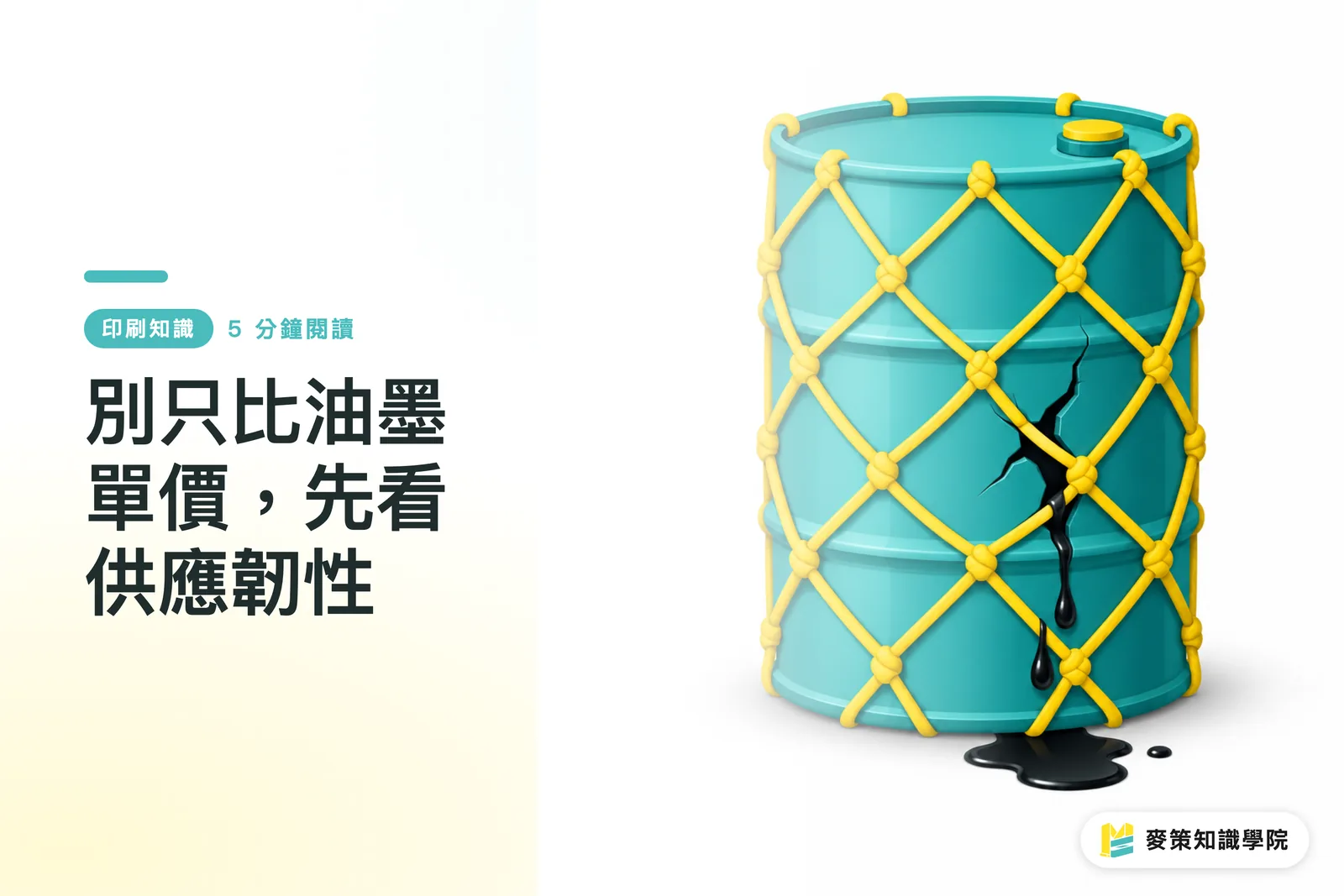
Why Can an Ink Unit Price Hide Supply Risk?
Ink unit prices can hide supply risk because shortages, reformulations, and revalidation can turn savings of a few dollars per kilogram into delay costs for the entire order. Supply resilience is the ability to keep production running during a disruption through alternative sources, validated inks, and clear responsibility for delivery. That is the condition procurement is really buying
After a factory explosion in China, supplies of ink-related raw materials became even tighter. The global ink industry relies heavily on raw-material production hubs in China, and supply interruptions, environmental regulations, and chemical-plant closures can all cause raw-material availability and lead times to fluctuate. Manufacturers therefore look for alternative sources or adjust their formulations. See Ink Raw-Material Supply Becomes More Difficult After a Factory Explosion in China
After years of reviewing purchase orders, the first thing I ask is not how many dollars have been shaved off the unit price. It is who can supply substitute material if the shipment is late, who is responsible for confirming the color, and who will complete the missing documents. Once the printing schedule stops, paper stock, presses, staff, and delivery time all sit idle

What Should Procurement Look at Beyond Price When Comparing Quotes?
At a minimum, procurement should evaluate lead time, substitute-ink validation, batch-to-batch color consistency, SDS, and dual sourcing together. Put all five into the RFQ and acceptance records
・Lead time: Spell out the normal lead time, available quantity, and notification points for exceptions. Do not just write "in stock."
・Substitute-ink validation: Confirm whether samples, testing, and an approval process are available. By the time a shortage appears, there is usually no time left to look for a substitute
・Batch-to-batch color consistency: Require retained color samples and batch records so the printer has a basis for comparing and releasing each batch
・SDS (Safety Data Sheet): A document that procurement, on-site staff, and safety managers use to check chemical hazards, handling instructions, and emergency-response information. Update it whenever the ink changes
・Dual sourcing: Confirm that the second source can actually provide compatible specifications and a delivery commitment. Having a name on the list does not mean it can take an order
Only by comparing these conditions together can procurement see the risk costs beyond the per-kilogram price. I treat a quote that lists only the unit price and says nothing about the substitution process as half-finished
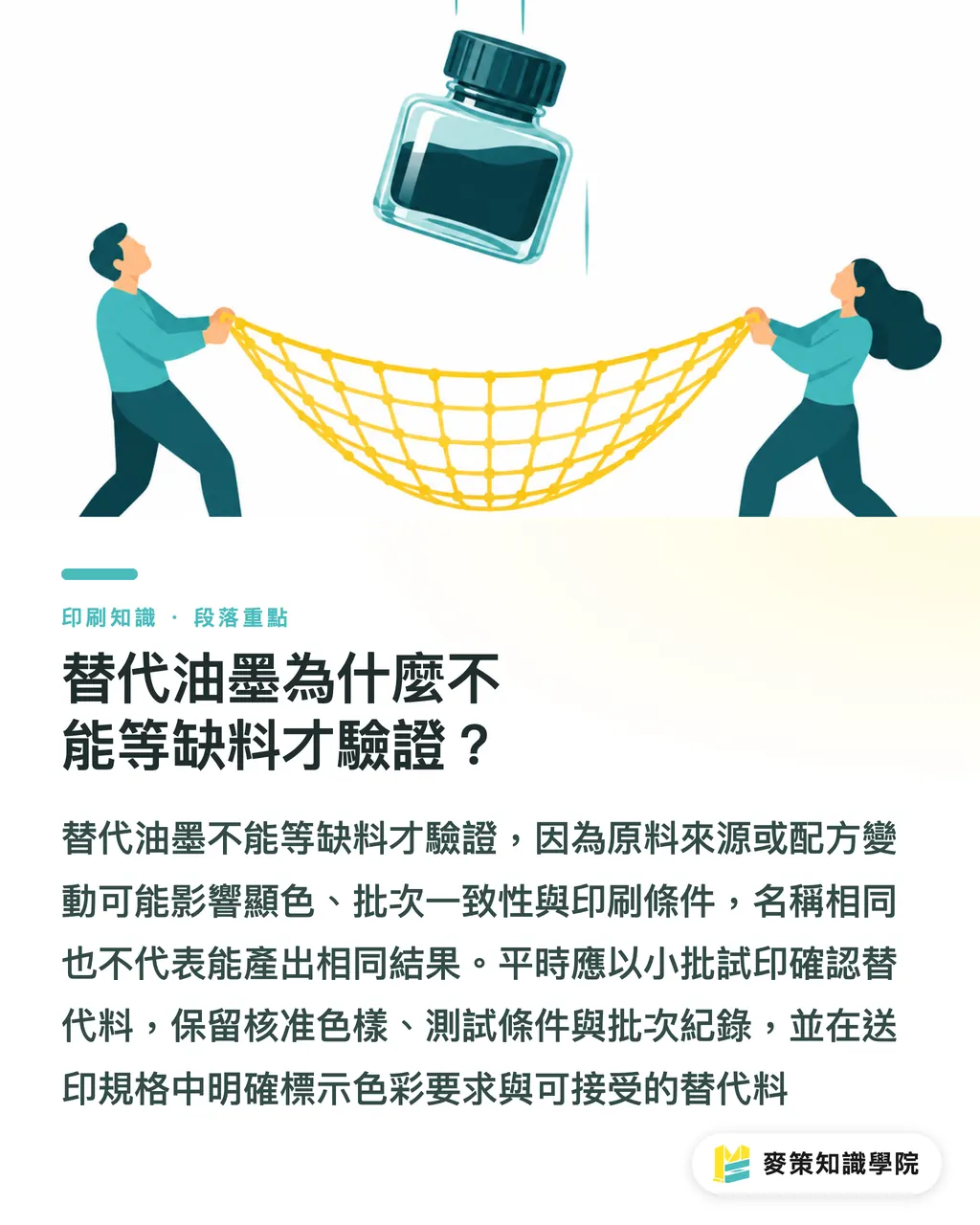
Why Can't Substitute Ink Wait Until a Shortage to Be Validated?
You cannot wait until a shortage to validate substitute ink, because it can affect the formulation, color reproduction, batch-to-batch consistency, and on-press conditions. When a supplier switches raw-material sources or reformulates, the printer has to confirm again that it can deliver the same result consistently. A matching product name is not enough
・1. During normal supply, list acceptable substitutes and a second source in advance
・2. Run a small trial print, and retain the approved color sample, test conditions, and batch records
・3. Treat a raw-material interruption, a lead-time problem, or a formulation change as a trigger for a material-change notification
The design team should also state the color requirements and whether substitute materials are acceptable in the print specifications. Otherwise, procurement may find the material, but the production floor still has no basis for releasing it. Substitute materials need to be tested during normal supply. If you wait until a shortage to look for one, it is usually too late
Why Should Color Consistency and SDS Be Managed Together?
Color Management and SDS need to be managed together because a material change affects both the print result and the safety documents used on site. Color Management is a process that uses consistent color data, equipment conditions, and acceptance samples so designs, proofs, and printed results can be compared. SDS provides information on material hazards, handling, and emergency response
If procurement leaves color decisions to the printer and documents to the supplier, a material change can leave two different versions in circulation. Keep the received lot, approved color sample, and SDS for every ink batch in one traceable record, and responsibility can be traced when needed
・Incoming inspection: Check the batch, product name, specifications, and SDS version
・Trial-print release: Use the approved color sample to confirm batch-to-batch color consistency. If anything is off, pause use in the full production run first
・Change notification: When the source or formulation changes, document the change and complete substitute validation first
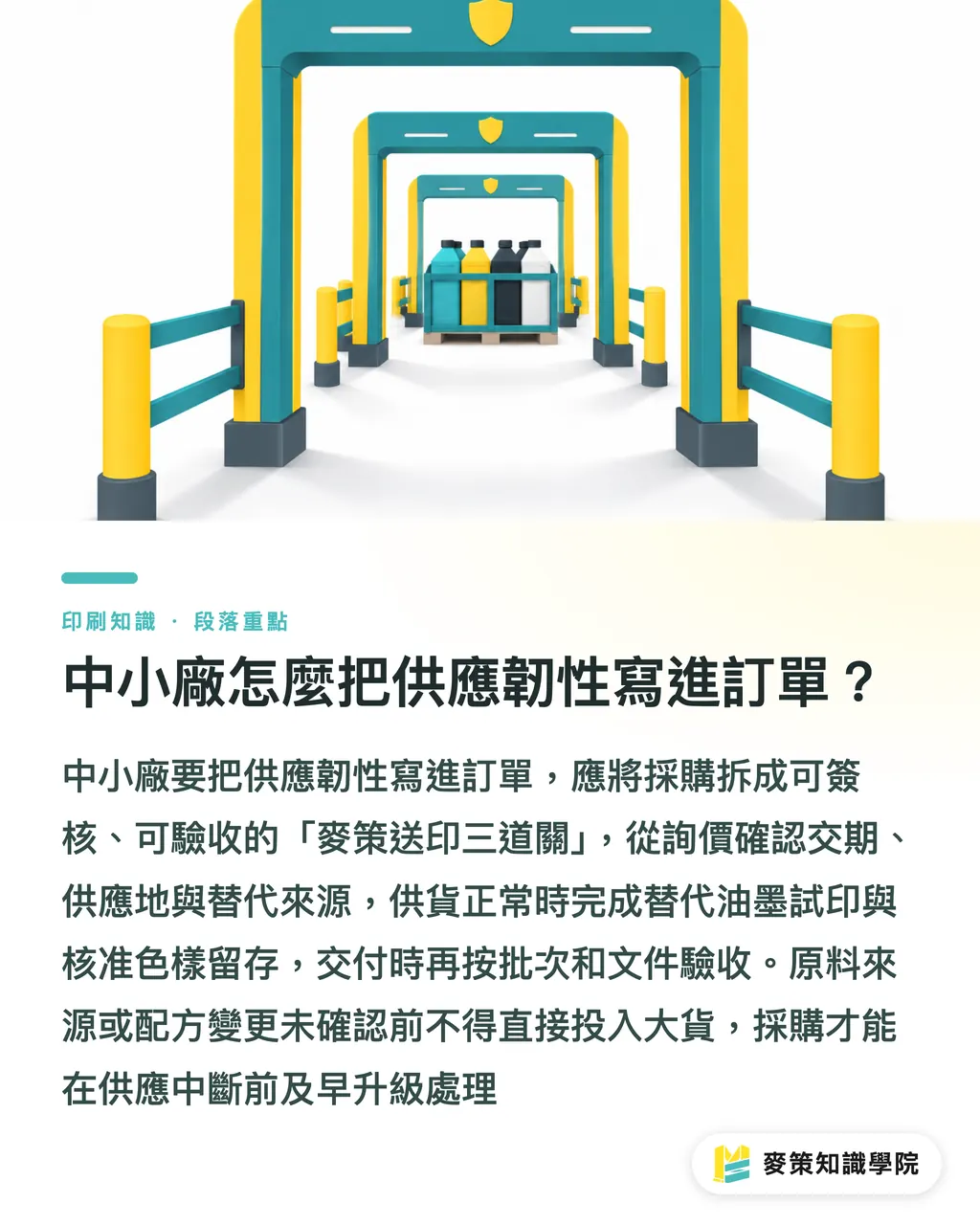
How Can Small and Mid-Sized Plants Put Supply Resilience into Their Orders?
To put supply resilience into an order, small and mid-sized plants need to break it into three gates that can be signed off and checked at acceptance, so procurement does not have to rely on verbal promises. MINDS (MS, a mid- to high-end fully customized commercial printer) calls this the "Mai Strategy Three-Gate Print-Order Process."
・1. RFQ gate: Ask about normal lead time, source location, exception notifications, alternative sources, and the SDS version in addition to the unit price
・2. Validation gate: Complete a substitute-ink trial print, confirm batch-to-batch color consistency, and retain the approved color sample during normal supply
・3. Delivery gate: Inspect incoming goods by batch and against the documents. If the raw-material source or formulation changes, do not put the material into a full production run until confirmation is complete
Writing these requirements into the order gives procurement grounds to escalate before a supply disruption. If you need to turn the RFQ, substitute-material validation, and acceptance fields into a shared team specification, the Mai Strategy Knowledge Academy consulting team can help put it into practice
Ink can compete on price. Backup conditions cannot rest on a verbal promise
Key Takeaways
・A low per-kilogram ink price cannot make up for supply interruptions, revalidation, and delivery delays
・Lead time, substitute materials, batch-to-batch color consistency, SDS, and dual sourcing are the purchasing criteria worth comparing
・Substitute ink should be validated during normal supply. Looking for it only after a shortage occurs is usually too late
・Color Management should be tied to batches and approved color samples, and SDS should be tied to every material change
・Supply resilience must be written into the RFQ, order, and acceptance records. Verbal promises do not count as delivery conditions
Further Considerations
On the manufacturing side, start by putting ink batches, color samples, lead times, and SDS into one traceable record. When submitting files, the design team should specify the substrate, color requirements, and whether substitute materials are acceptable. Do not rush to introduce AI (Artificial Intelligence) or SaaS (Software as a Service, a service that provides software functions over the internet). Complete the data fields and approval responsibilities first, then let the tools help flag discrepancies, prompt document updates, and track substitute-material validation. The next step is simple: take one existing RFQ and add fields for dual sourcing and material-change notifications
Further Reading
FAQ
- Does cheaper ink always mean lower procurement costs?
- Not necessarily. If lead times are disrupted, substitute ink has to go through validation again, or batch color is inconsistent, the per-kilogram savings can be eaten up by rework and delays
- What conditions should be included in an ink procurement RFQ?
- At minimum, include lead time, substitute-ink validation, batch-to-batch color consistency, SDS version, dual sourcing, and responsibility for exception notifications, so quotes can be compared on the same basis
- When should substitute ink be validated?
- Complete a small-batch trial print, retain an approved color sample, and confirm the documents during normal supply. If you wait until a shortage to start looking for a substitute, you put delivery risk directly on the critical path
- Why should SDS be checked together with Color Management?
- Color Management confirms that printed results can be compared, while SDS provides information on material hazards, handling, and emergency response. Keeping both together gives procurement, design, and the production floor one shared basis
Related articles





The Print × AI weekly
The print and AI know-how designers, brands and enterprises can use before they commit — one email, every week
MINDS Free Tools
Spine width and imposition calculators — skip the manual math, free in your browser.
MINDS Group
Need actual printing or gifting services?
From premium printing to online ordering and festive gifts — the MINDS Group sister brands take it from here.