
Why Do Material Properties of Acrylic and Metal Directly Dictate the Process?
Acrylic and metal share several common properties in the printing workshop: non-absorbent surfaces, high hardness, and partial transparency. These three traits directly block the path of offset printing and standard digital inkjet printing, as ink fails to adhere or simply cannot cure on non-porous surfaces
Therefore, process options for this type of merchandise are currently concentrated on two main paths: screen printing and digital UV flatbed printing (UV flatbed / UV direct printing). Both paths can print, but clarifying the conditions under which each is advantageous is what procurement professionals and designers need to understand most
Common brand applications for acrylic include transparent standees, display bases, trophies, and keychains; metal items commonly include nameplates, ID badges, commemorative coin bases, and equipment tags. The transparency of the material is particularly important because light transmission directly affects whether you can use white ink as a base and whether you need it, a topic we will discuss later
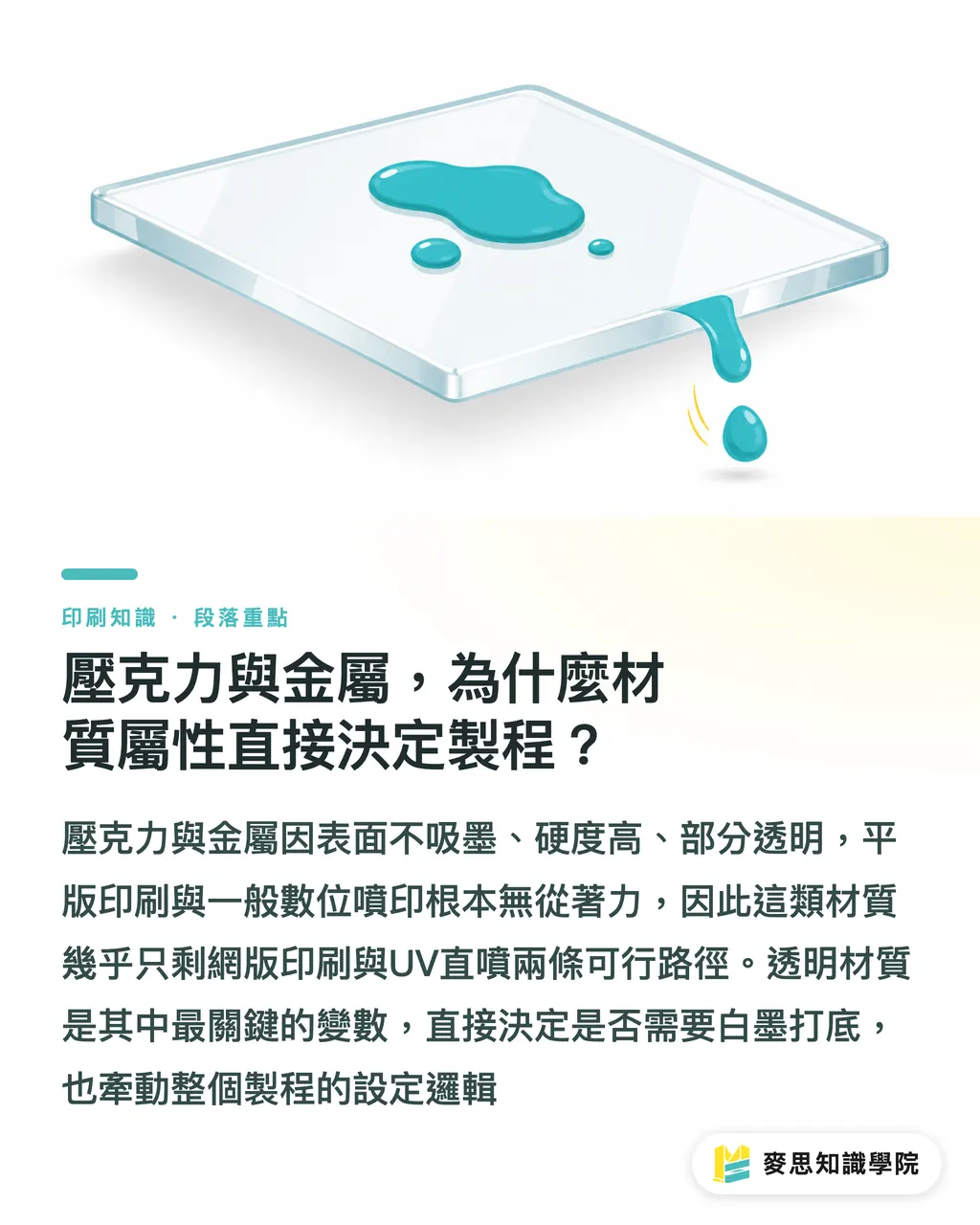
What Can and Cannot Screen Printing Do on Special Materials?
The physical logic of screen printing is using a squeegee to push ink through the openings of a stencil on a mesh screen onto the material surface. The ink layer thickness is typically between 20 to 100 microns, offering opacity that far exceeds any digital process. This characteristic gives it a significant advantage on dark or transparent materials
On transparent acrylic, screen printing can use opaque white ink as a base to completely block out transparency, preventing the top color layers from being affected by the material. On metal materials, you can choose specialized adhesion inks or print directly after surface treatment (such as plasma treatment or primer)
Strengths of screen printing:
・Precise spot colors (Pantone color matching) without relying on CMYK process layering; colors are achieved in a single step
・Thick ink layers with a distinct tactile feel, often specified by clients who want that "tactile 3D" texture
・Unit cost becomes extremely low at high volumes, with a significant cost advantage for orders over 500 pieces
・Stable scratch and abrasion resistance, making it the preferred choice for long-term use nameplates or equipment tags
Limitations of screen printing:
・Cannot print gradients; each color requires a separate screen setup, three colors mean three screens
・Screen setup fees are a fixed cost, typically ranging from 500 to 2,000 NTD per color, making it impossible to amortize at low quantities
・Proofing cost is almost as high as production printing, making it impossible to "just print one to see."
・Almost never cost-effective for small runs (under 30 pieces)
・Resolution limits exist for fine details; lines thinner than 50 microns require careful risk assessment
In practice, I often encounter clients who have a gradient logo in their design draft and want to make an acrylic standee but also demand Pantone spot colors. These two requirements are inherently contradictory for screen printing. Gradients rely on decreasing halftone dot sizes, and the quality of halftone dots on special materials is hard to keep stable, usually requiring a trade-off between the two
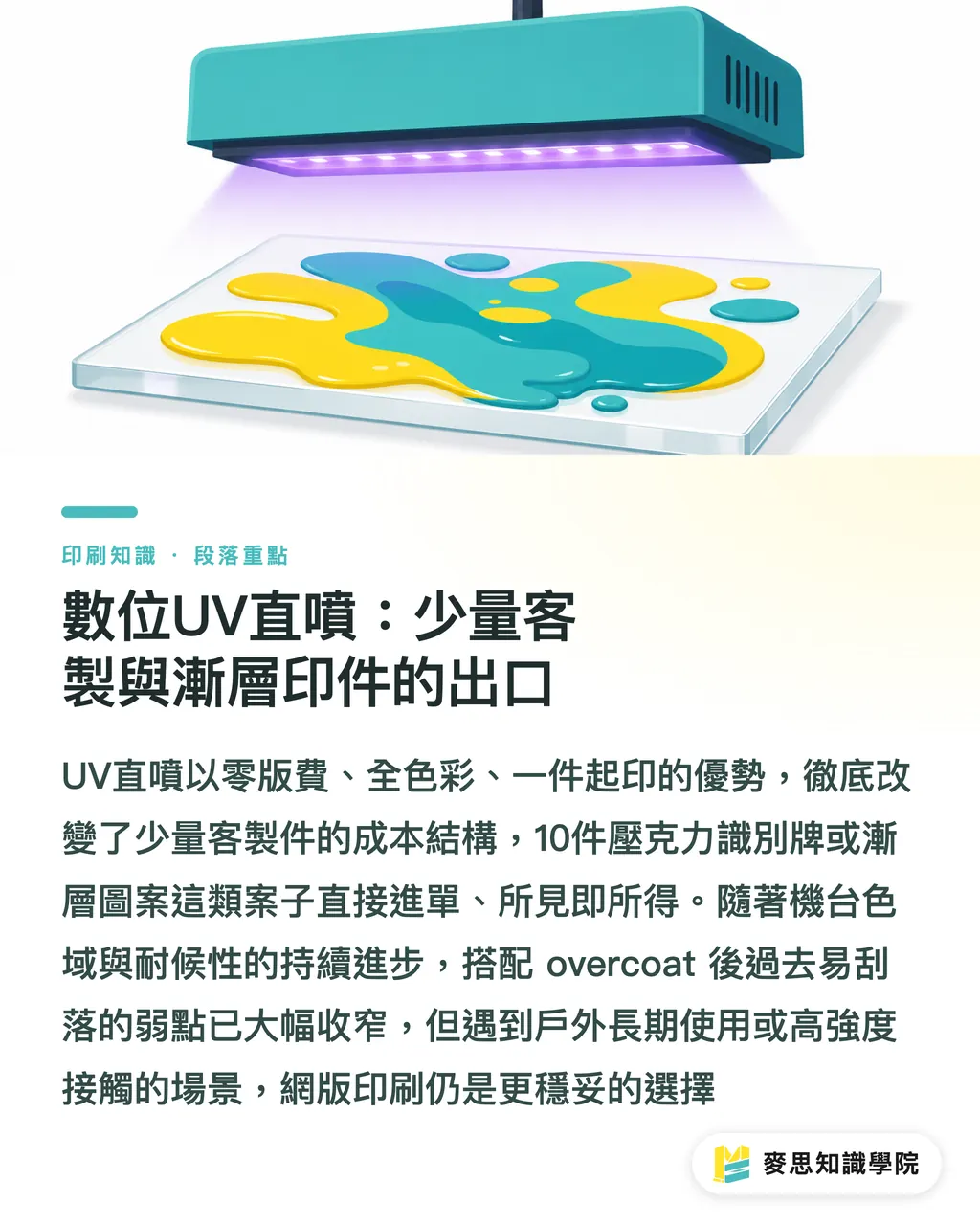
Digital UV Flatbed Printing: The Solution for Small-Batch Customization and Gradient Prints
UV flatbed printing is a process where UV ink is jetted directly onto the material and cured instantly with ultraviolet lights. The equipment consists of large flatbed machines where materials are laid directly for printing, and objects with thicknesses from 3 to 50 mm can typically be processed
This process changes the economic structure of low-volume custom items: with no setup fees, each print run incurs only material costs and machine time, so the unit cost difference between 1 piece and 100 pieces is far smaller than in screen printing. For example, to make 10 acrylic ID badges, UV flatbed printing can proceed directly, whereas screen setup fees would disrupt the entire budget
Strengths of UV flatbed printing:
・Zero setup fees, minimum order of 1 piece; proofing is virtually identical to the final product, offering what-you-see-is-what-you-get accuracy
・Full-color printing; gradients, photos, and complex illustrations pose no issues at all
・Supports printing layered white ink as a base (the key for transparent materials) and can also create a double-sided effect that is transparent on the front and opaque on the back
・Some models support raised ink modes to create localized tactile 3D effects
・Zero cost for version changes; a batch of 10 pieces can all be printed with different designs
Limitations of UV flatbed printing:
・High unit cost, remaining more expensive than screen printing at large volumes
・Pantone spot colors can only be approximated using CMYK, making 100% precise color matching impossible
・Scratch resistance varies by machine model and topcoat treatment; although the gap narrows for high-end models with an overcoat, it remains a weakness
・Requires verification that the material allows UV ink adhesion; some metal or PE materials with specific surface treatments may have adhesion issues
・Extremely dark materials require multiple layers of white ink for complete opacity, driving up process costs
In my observation, the color gamut and weather resistance of UV flatbed printers have improved rapidly in recent years. The past impression that "UV prints scratch off immediately after printing" has been greatly improved when paired with an overcoat. However, for nameplates in long-term outdoor use or high-intensity contact scenarios, screen printing remains the more reliable choice
How to Compare the Four Dimensions? Practical Decision-Making from MOQ to Scratch Resistance
To choose the right process, clearly evaluate the following four dimensions, and the answer will naturally emerge
Minimum Order Quantity (MOQ)
・Under 50 pieces: UV flatbed printing is practically the only choice, as setup fees costing more than the printing itself defies logic
・50 to 200 pieces: The costs of both are close; choice depends on the number of colors and design complexity
・Over 200 pieces with a stable design and no version changes: Screen printing begins to show a cost advantage, especially for single- or double-color designs
Color Performance
・Specified Pantone or precise brand colors: Choose screen printing, as CMYK process layering is always just an approximation
・Gradients, photo-grade designs, or complex illustrations: Choose UV flatbed printing; screen printing cannot achieve this
・Solid colors with few colors (within 3 colors): Both are viable; decision depends on volume
Scratch Resistance and Use Scenarios
・Long-term outdoor exposure or frequent mechanical contact (equipment tags, industrial nameplates): Screen printing
・Indoor displays, gifts, or collectibles: UV flatbed printing with an overcoat is usually sufficient
・Requirements for fingernail scratch tests or abrasion resistance: Bring this up before ordering. Screen printing usually passes consistently, while UV flatbed printing requires confirming topcoat specifications
Proofing Cost
・Multiple rounds of color or design confirmation needed: UV flatbed printing; a proof is printed directly as a single item, with the cost equaling the single-item material and labor fee
・Design finalized for high volume: Screen setup fees are amortized all at once, resulting in low marginal costs for subsequent add-on orders
A quick practical judgment: If a client requests a single Pantone color on transparent acrylic for 300 pieces, the answer is almost certainly screen printing. If it is "20 ID badges with a brand gradient background in the design," then it is UV flatbed printing. Only the projects caught in the middle require calculating the total cost carefully
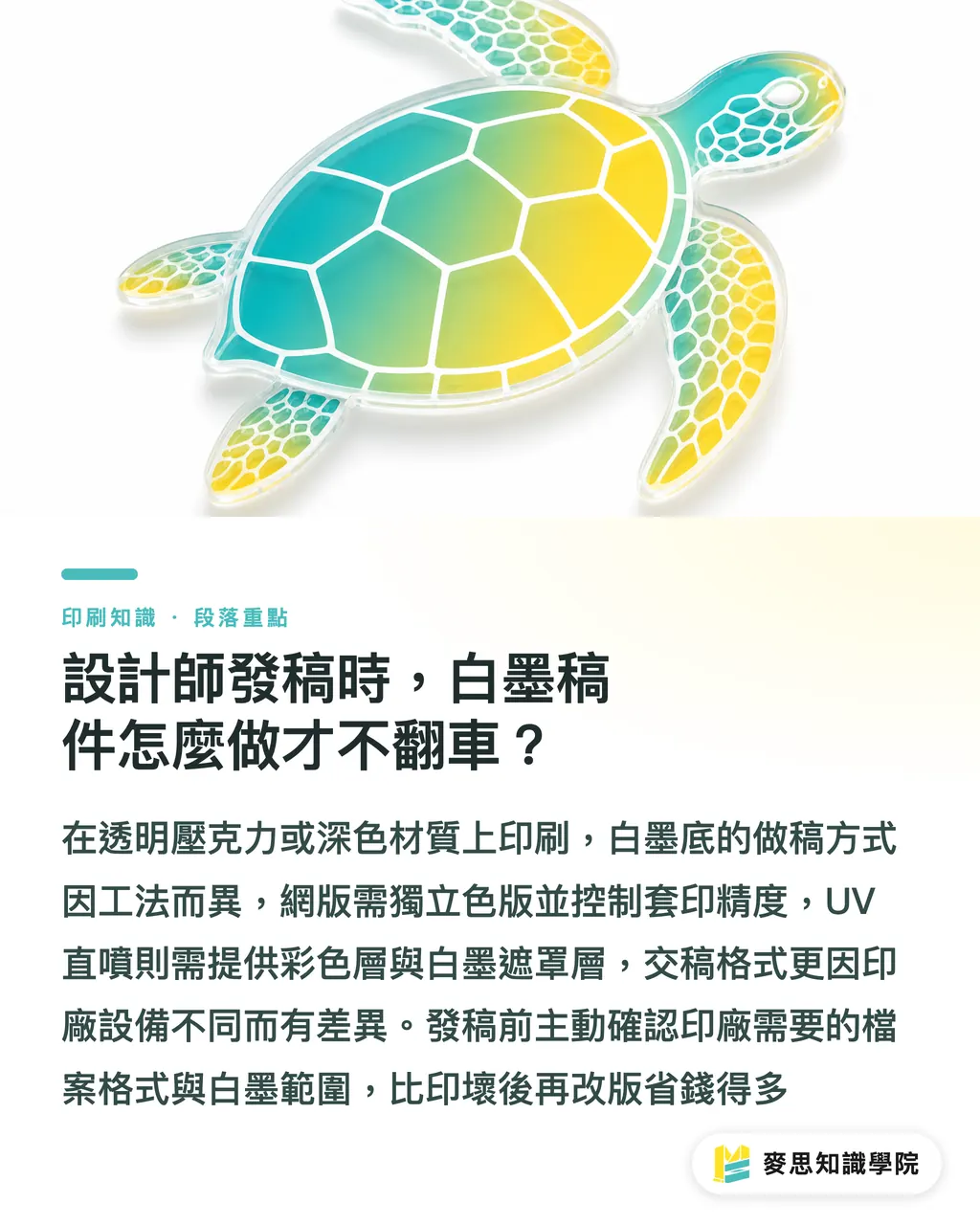
How Can Designers Prepare White Ink Artwork Without Running into Issues?
This is the step that designers most easily overlook and where prints are most likely to go wrong
When printing on transparent acrylic or dark materials, whether using screen printing or UV flatbed printing, a white ink base is almost always required. However, the artwork preparation methods differ between the two processes
Screen Printing White Ink Method
・White is separated into an independent color plate; the printing sequence is usually white base first, followed by color overlay
・The artwork must isolate the white ink area into a separate spot channel, typically designated as PANTONE White or otherwise clearly marked
・The registration accuracy between the white plate and the color plates must be within ±0.5 mm; misalignment will cause the white base to peek out at the edges
・The designer needs to confirm whether the white plate is a full-surface solid white base or limited only to the design area, as the two visual effects are completely different
UV Flatbed Printing White Ink Method
・The RIP software of most machines (such as Onyx or Wasatch) directly supports an independent white channel
・Designers typically need to provide two layers: the color layer plus a white ink mask layer, using black, white, and gray to represent opacity
・White ink can be made into a gradient white base, creating a transition effect from transparent to opaque, which screen printing cannot achieve
・Submission formats (layered PDF, separate TIFF channel, or RIP-direct layered reading) vary by printing factory equipment; clarify this before sending files
After confirming the design files, MINDS will provide a white plate preview, allowing clients to verify if the white ink coverage meets expectations before screens are made. This verification step is particularly crucial for screen printing projects, where plate modification costs are high; an extra check saves unnecessary expenses
Key Takeaways
・For acrylic or metal merchandise under 50 pieces, UV flatbed printing is the default answer; only seriously consider screen printing for volumes exceeding 200 pieces with a stable design
・If there are specified Pantone colors, choose screen printing; if there are gradients or photo-grade designs, choose UV flatbed printing; if both are required, compromise on one beforehand
・White ink artwork preparation is the easiest place for acrylic printing to go wrong. Screen printing requires a separate plate, while UV flatbed printing requires a white ink mask layer; clarify the format requirements before placing the order
・Scratch resistance test requirements must be requested before ordering; although UV flatbed printing with an overcoat has greatly improved, screen printing remains more stable for high-intensity use scenarios
・Proofing cost is the hidden variable in process decisions: UV flatbed proofs are virtually identical to production items, while screen printing proofing requires paying setup fees, making multiple rounds of confirmation very expensive
Further Thoughts
In the acrylic and metal merchandise market, the greatest structural change in recent years has been the popularization of UV flatbed printing equipment, which has eliminated the barrier to low-volume customization. In the past, a brand wanting to make 50 acrylic ID badges would be almost deterred by screen setup fees; now, UV flatbed printing has lowered the entry barrier to a single piece for testing, shifting the decision-making logic of corporate procurement from "feasible only in large quantities" to "confirm with small batches first, then place follow-up volume orders."
For designers, when taking on projects with acrylic or metal materials, the most worthwhile investment of time is clarifying the printing process before placing the order, rather than modifying files only after proofs come back. Confirming white ink coverage, Pantone color matching needs, and quantity scale simultaneously minimizes the probability of choosing the wrong process
On the procurement side, when managing annual merchandise budgets, walking a dual-track path where "high-volume standard models" go through screen printing batches and "low-volume event or personalized items" go through UV flatbed printing is more cost-effective than forcing everything into a single process. If you need to calculate which path is more cost-efficient before placing an order, you can consult MINDS's process advisory service, bringing your design drafts and expected quantities directly for discussion
FAQ
- Should I choose screen printing or UV flatbed printing for acrylic standees?
- For quantities under 50 pieces or designs containing gradients or photo elements, choose UV flatbed printing. For quantities over 200 pieces, specified Pantone spot colors, or designs with solid-color geometric patterns, choose screen printing. For projects in between, calculate the total cost by amortizing the setup fees over the number of pieces before making a decision
- Is UV flatbed printing on acrylic scratch-resistant?
- Scratch resistance depends on whether an overcoat (protective topcoat) is added. UV flatbed printing with an overcoat is durable enough for indoor displays and general use environments. For scenarios involving long-term outdoor exposure, industrial environments, or frequent mechanical contact, screen printing remains more reliable. Bring up scratch testing requirements before placing the order, and the printing factory will provide the corresponding topcoat specifications
- How do I prepare white ink artwork for acrylic printing?
- Screen printing requires separating the white into an independent plate, labeled as PANTONE White or a designated color, with a registration accuracy within ±0.5 mm. UV flatbed printing requires a white ink mask layer using black, white, and gray to represent opacity; the specific format varies based on the printer's equipment and RIP software, so confirm the submission format requirements before sending files
- How do I choose the printing process for metal materials?
- Adhesion on the metal surface is the key. Whether using screen printing or UV flatbed printing, you must check the surface treatment of the metal (such as anodized, painted, or sandblasted). Screen printing offers stable adhesion on treated metal surfaces, while UV flatbed printing requires verifying ink adhesion test results on that specific metal surface. We recommend providing material samples for the printing factory to test before placing a formal order
- Which process is cheaper for 30 acrylic ID badges?
- For 30 pieces, UV flatbed printing is almost certainly cheaper. The setup fees for screen printing (roughly 500 to 2,000 NTD per color) far exceed the single-item material and labor cost of UV flatbed printing for low-volume projects. Additionally, UV flatbed proofing directly produces the final product without incurring extra proofing fees
Related articles
The Print × AI weekly
The print and AI know-how designers, brands and enterprises can use before they commit — one email, every week
MINDS Free Tools
Spine width and imposition calculators — skip the manual math, free in your browser.
MINDS Group
Need actual printing or gifting services?
From premium printing to online ordering and festive gifts — the MINDS Group sister brands take it from here.