

Overview
To get campaign business cards printed fast without legal violations, lock in standard dimensions and attribution details first, then organize your delivery batches. The MINDS (MS) prepress process splits design jobs into checkable, printable, and trackable workflows to avoid getting stuck in reprints or re-submissions
・① Dimensions and bleed: Confirm finished size, bleed, safety margin, and QR Code scanning distance first
・② Legal text: Check attribution, signatures, address details, poll data, and false statement risks first
・③ Delivery batches: Label and separate boxes by electoral district, borough, canvassing route, and volunteer pickup point

What Information Must Go on Campaign Business Cards to Avoid Reprints?
Definition of a campaign business card: A compact printed material handed out by candidates or campaign teams during street canvassing, home visits, and office visits to convey their name, candidate number, key policies, contact details, and required legal attribution
The most common cause of rework I see on the prepress floor is not bad photos. It is cramming too much text onto the back, treating a 90 × 54 mm card like a mini flyer. Voters only scan a card for about 2 seconds. The candidate name, number, district, and contact info must be clear instantly
・Front side: Candidate name, photo, district, ballot number or registration status, party or team identity
・Back side: Policy highlights in 3 lines or less, campaign office phone, LINE or website QR Code, and legally required attribution
・Version tagging: Include candidate name, district, usage, and version in the filename, such as wang-daan-card-v03.pdf
・Items to avoid on cards: Lengthy policy papers, unverified attack copy, poll figures, and undersized sponsor lists
As of July 14, 2026, Article 52 of the Civil Servants Election and Recall Act in the Laws & Regulations Database of The Republic of China states that campaign or recall printed matter using text or graphics must carry a personal signature. Non-candidates publishing materials must also include a residential or business address. Even though business cards are small, they are legally campaign materials. Have your campaign legal adviser or campaign manager confirm attribution details before sending files to print
How Should You Set Card Dimensions for Fast Bulk Printing?
For fast bulk printing of campaign business cards, I recommend Taiwan standard business card dimensions of 90 × 54 mm. Add 3 mm of bleed to each edge and keep a safety margin of at least 3 mm. For a finished size of 90 × 54 mm, your design canvas with bleed should be 96 × 60 mm
When checking dimensions during the MINDS (MS) prepress process, the goal is to eliminate manual guessing of trim lines at the factory. Candidate photos, names, numbers, and QR Codes must stay clear of trim lines. Small text should never sit close to edges. Otherwise, a trim shift of just 1 mm during high-speed cutting makes the entire batch look cheap
・Paper stock: For mass distribution, 250g to 300g coated art paper or standard cardstock works best. It reorders quickly, keeps costs stable, and minimizes finishing variables
・Color setup: Build candidate main colors in CMYK rather than submitting RGB image files alone. Include a physical sample for party or brand colors
・Special finishes: Avoid foil stamping, embossing, spot UV, or custom die-cuts on rush jobs. These steps add extra scheduling and inspection time
・Lamination: Lamination improves wear resistance, but it adds an extra processing step. For street giveaways, focus on lead times and readability first
・QR Code: Keep the final printed QR Code at least 12 × 12 mm with a 2 mm white margin. Scan it on a real phone before sending to print
The quality of a campaign card does not depend on extra-thick cardstock. It comes from clean layout, stable colors, and clear information hierarchy. I would rather skip a fancy finish so volunteers handing cards out at market entrances can be sure voters catch the candidate name and number in a single glance

How Do You Check Legal Text and Political Risks?
When checking legal compliance during the MINDS (MS) prepress process, I group campaign card risks into 4 categories: attribution info, campaign periods, content authenticity, and expense records. All 4 tie directly to your print files. Do not treat them as an afterthought for legal teams
・Attribution info: Under Article 52 of the Civil Servants Election and Recall Act, printed campaign materials with text or graphics must display valid signatures, names, addresses, or corporate representative information
・Time limits: Article 40 of the Civil Servants Election and Recall Act sets campaign and recall periods at 15 days for special municipality mayor elections, 10 days for legislators and councilors, and 5 days for borough chiefs. Daily activity hours run from 7:00 AM to 10:00 PM
・Content authenticity: Article 104 of the Civil Servants Election and Recall Act imposes criminal liability for spreading rumors or false statements. Keep unverified allegations off the back of your card
・Poll data: Article 53 of the Civil Servants Election and Recall Act restricts publishing poll data within 10 days before polling day and requires specific disclosures. Printed cards stay in circulation for a long time, so handle poll figures carefully
・Expense records: Article 20 of the Political Donations Act requires political parties, political groups, and prospective candidates to maintain accounting books and record daily donations and expenditures. Keep print quotes, invoices, and delivery receipts organized
AI retouching and generated visual assets are common today, but convenience does not offer legal immunity. Basic color adjustments on candidate photos are fine. Avoid synthesized images, audio, or statements resembling real people. Article 51-3 of the Civil Servants Election and Recall Act regulates deepfake audio and video content
If your campaign team lacks an in-house prepress specialist, ask the consultant team at Mai Strategy Knowledge Academy to review layout and print risks as soon as the first draft copy is ready. Catching a missing address or attribution detail after 5,000 cards come off the press leaves you with no choice but to reprint
How Should You Schedule High-Volume Printing to Avoid Last-Minute Bottlenecks?
Schedule campaign card production backward from delivery dates, not forward from design completion. If your active campaign window is only 5 or 10 days, proofing, printing, sorting, and location deliveries must finish before campaign activities start. That gives staff buffer time for emergency reorders
When organizing delivery batches during the MINDS (MS) prepress process, I ask campaign teams for a detailed distribution matrix instead of a single total volume. Printing 20,000 cards delivered to one headquarters requires a completely different workload for packaging, labeling, trucking, and receipt tracking than dividing them across 12 borough pickup points
・Zoning: Group batches by electoral district, administrative borough, canvassing route, or volunteer team rather than dumping everything at headquarters
・Box packing: Pack a consistent 1,000 or 2,000 cards per box. Affix outer labels showing candidate, version, quantity, destination, and contact person
・Version separation: When joint campaign materials for mayor, councilor, and borough chief share a color palette, separate their filenames and box labels clearly
・Reorder buffer: Avoid spending your entire print budget on the first run. Keep financial flexibility for updated versions or additional quantities
・Sign-off tracking: Log date, box count, total quantity, recipient name, and phone number on delivery slips for audit trails and shipment tracking later
If your team also needs constituent cards, invitation cards, thank-you cards, or bespoke commercial printing, supply your card die-lines, primary colors, and photo samples to MINDS (MS) to build a unified color baseline. High-end custom commercial printing suffers when items are built in isolation, making a campaign kit look like it came from different teams
What Final Pre-flight Checks Should Designers Complete Before Submission?
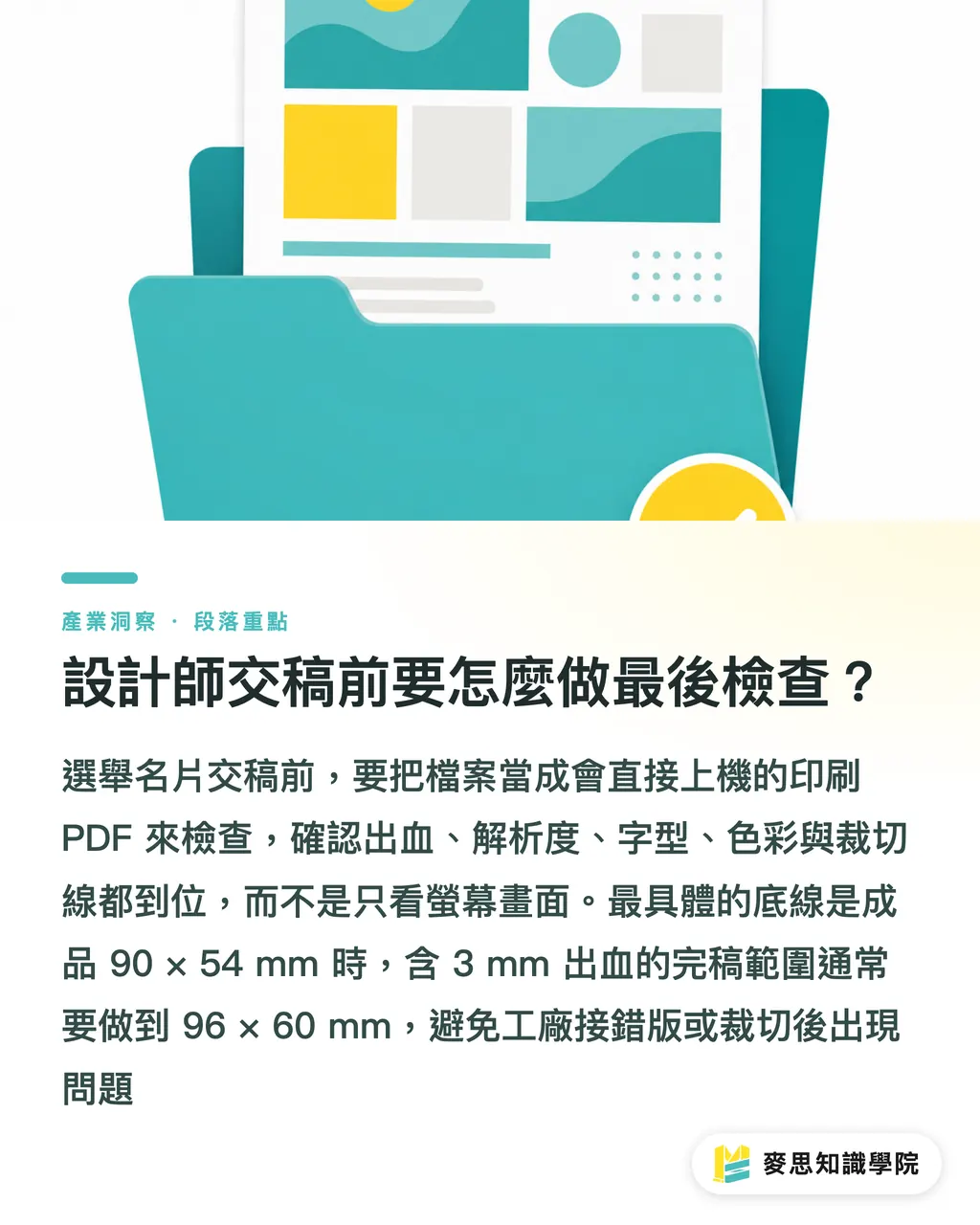
Before submitting campaign card files, designers must check them as press-ready PDFs, not screen screenshots. The print shop processes bleed, resolution, fonts, colors, and crop marks, not the conceptual layout in a designer's mind
・Dimensions: For a finished size of 90 × 54 mm, final layout bounds including 3 mm bleed should measure 96 × 60 mm
・Resolution: Candidate photos and raster images should be 300 dpi. Do not force low-resolution screenshots onto the canvas
・Colors: Convert the entire document to CMYK. Set small black text to K100 to prevent registration ghosting from 4-color black
・Fonts: Embed fonts or convert text to outlines before exporting PDF files. Keep candidate names and numbers large enough for clear reading outdoors
・Stroke weights: Keep fine lines and borders above 0.25 mm. Keep critical icons away from trim zones
・QR Code: Scan codes on both iPhone and Android devices before printing, and confirm short URLs resolve correctly
・Legal checks: Ensure attribution, signatures, addresses, poll claims, and attack copy receive sign-off from legal counsel or authorized managers
・Filenames: Maintain strict versioning like candidate-card-v03-print.pdf instead of final-final-new.pdf
I ask designers to save final confirmation screenshots, print PDFs, and distribution tables in a single folder. Late-night file updates claiming to be the latest version cause chaos in political campaigns. If the plant picks up the wrong file version, volunteers get stuck with incorrect cards the next morning
Key Takeaways
・Fast turnaround depends on locking in dimensions, legal compliance, and distribution before sending files to print
・The smaller the card canvas, the more ruthlessly you must prioritize information
・Treating the back of a 90 × 54 mm card like a flyer creates small text, tight margins, and unscannable QR Codes that slow down field teams
・Run legal checks during initial layout drafts. Trying to fix legal issues after printing usually means starting over
・Clear distribution sheets and outer box labels eliminate half of a campaign team's shipment tracking calls
Further Considerations
For print manufacturers, campaign business cards represent high-pressure, short-turnaround jobs. A SaaS system can consolidate quotes, file versions, distribution matrices, and delivery logs into a unified work ticket. For designers, AI tools can help condense policy copy, organize versions, and check QR Code sizing, but candidate portraits, competitor assets, and legal copy still require human sign-off. For campaign teams, the immediate priority is not chasing the lowest unit price, but preparing a press-ready PDF, a legal checklist, and a distribution matrix
Further Reading
FAQ
- Can campaign business cards be printed in advance and handed out when the official campaign period begins?
- Article 52 of the Civil Servants Election and Recall Act notes that campaign materials printed prior to the campaign period for distribution during the campaign are treated as printed during the campaign period. Print production can be scheduled early, but distribution timing and attribution details should be approved by your campaign legal counsel
- What is the safest standard size for campaign business cards?
- The standard business card size in Taiwan is 90 × 54 mm. Add 3 mm bleed to each edge and keep critical text at least 3 mm from trim lines. Using standard dimensions is the safest choice for high-volume rush orders
- Can poll figures or attack copy be printed on the back of campaign business cards?
- Including unverified poll results or attack copy is not recommended. Article 53 of the Civil Servants Election and Recall Act mandates required disclosures and timeframe limits on poll releases, while Article 104 establishes criminal liability for spreading rumors or false claims
- Should campaign business cards feature lamination, foil stamping, or custom die-cuts?
- For cards distributed in large volumes on canvassing runs, clarity, punctual delivery, and easy reordering take top priority. Lamination, foil stamping, and custom die-cuts add extra manufacturing steps and should generally be avoided on rush orders
- Can print shops determine election law compliance for candidates?
- Print shops can flag standard artwork requirements and common attribution items, but candidate status, promotional content, and distribution schedules must be verified by campaign legal counsel or authorized representatives. Print providers should not make legal decisions on behalf of campaign teams
Related articles





The Print × AI weekly
The print and AI know-how designers, brands and enterprises can use before they commit — one email, every week
MINDS Free Tools
Imposition calculator and preflight file check — free prepress tools, right in your browser.
MINDS Group
Need actual printing or gifting services?
From premium printing to online ordering and festive gifts — the MINDS Group sister brands take it from here.