

What Exactly Is Edge Painting on Premium Business Cards?
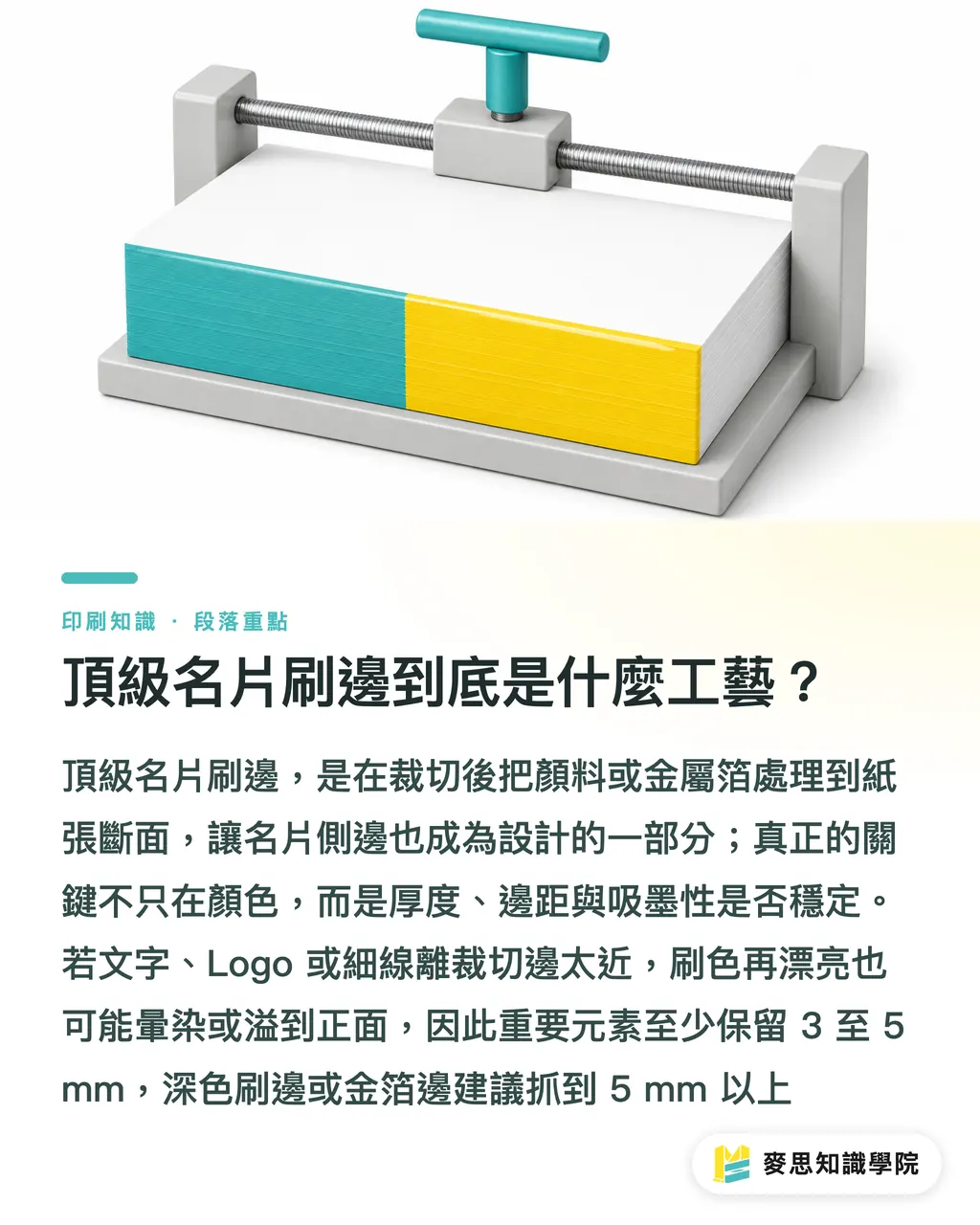
Edge painting for premium business cards means clamping a finished stack of cards after trimming, then brushing, spraying, or rolling pigment onto the cut edges. This turns all four edges of a 90×54 mm card into part of the design. The MINDS (MS, high-end custom commercial printing) Three-Pass Edge Check inspects thickness, margins, and ink absorption first. If these three factors fail, even the best color will bleed onto the card face
Edge painting colors the trimmed paper edges to create colored lines or solid blocks along the sides. It is commonly used on heavy-stock business cards, invitations, membership cards, and luxury hangtags
Edge foiling applies metallic foil to cut paper edges using heat, pressure, and precision fixtures. This gives the card sides a metallic shine in gold, silver, or rose gold, and it demands even higher paper edge flatness and thickness than standard edge painting
I have seen many high-end business cards fail not on the main visual, but on the edges. The card face looks clean with great white space, but the sides are fuzzy, smudged, or bleeding. As soon as a client picks it up, they know the card was not finished properly
Here is how to remember the MINDS (MS) Three-Pass Edge Check:
・① Thickness comes first: Standard 250-300gsm cards can feel nice, but their edges are too thin. Painted lines will not stand out enough, and edge foiling becomes unpredictable
・② Margin safety net: Keep essential text, logos, thin lines, and borders at least 3-5 mm away from trim edges. For dark edge paint or foil edges, set margins to 5 mm or more
・③ Restraint with pigments and foils: Neon tones, deep black, rich red, and metallic foils grab attention, but bold choices magnify bleed, rough edges, and trimming errors
Why Are Edge-Painted Cards So Picky About Paper Thickness?
Edge-painted cards demand thickness for a simple reason: edge finishing acts on the cut profile of the paper, not the printed face. When evaluating edge finishing projects, MINDS considers a finished thickness of around 0.8 mm a safe starting point. Below this thickness, colors look thin, and fixtures struggle to clamp straight lines
Paper weight in gsm does not translate directly to thickness. A 350gsm coated card can be thinner than 350gsm cotton paper. A 600gsm duplex card can show totally different edge profiles depending on glue layers, core stock, and pressing methods. When requesting quotes, asking for 400gsm is not enough. You should confirm finished thickness, paper type, and duplexing method together
Here are practical guidelines to keep in mind:
・250-300gsm: Good for standard business cards and spot finishing. Edge painting looks faint, and edge foiling is not recommended
・350-450gsm: Suitable for light or low-saturation edge paint, provided cut edges are clean and safe margins are sufficient
・Around 600gsm: A common threshold for premium cards. Edge lines carry weight, but duplex structure must be solid, or paper layers and glue lines may show on the edge
・800-1000gsm: Ideal for bold edge paint, heavy-stock cards, luxury invitations, and select edge foiling. Trimming, pressing, and drying times require extra care
Thicker is not always better. Cards above 1 mm make a strong statement, but if paper is too rigid, the cutter blade can cause frayed edges. If paper is too soft, clamped stacks absorb ink unevenly. As press operators say, paper needs both body and backbone
If brand business cards require 600gsm duplex stock with dark edge paint, MINDS recommends approving paper and color proofs first. This is critical for black stock, cotton paper, and heavily textured paper with variable ink absorption. Paying for one proof before production is far cheaper than reprinting 500 cards
Why Does Edge Paint Bleed onto the Card Face?
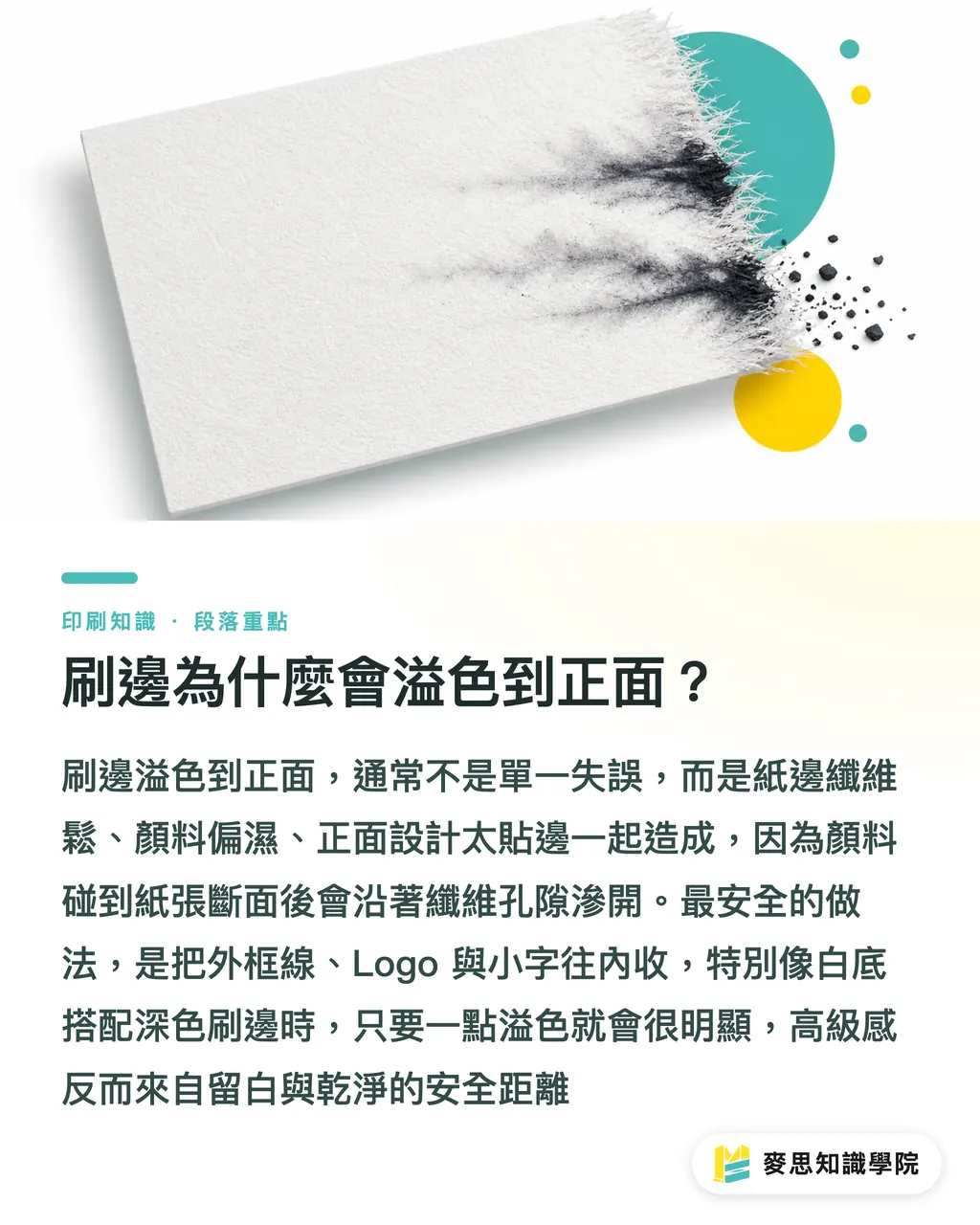
Edge paint bleeds onto the front face usually when three issues combine: loose paper fibers, overly wet pigment, and design elements placed too close to the edge. The MINDS (MS) Three-Pass Edge Check enforces front safe margins because finishing is not about aligning pixels on a screen. It is about controlling ink absorption on a stack of real paper
When pigment hits cut paper edges, it seeps along fiber pores toward the front or back. This is more pronounced on cotton paper, uncoated stock, and rough textured paper. A dark blue edge paint might look crisp on dense cardstock, yet leave smudged halos on softer paper
Here are the most common file setup pitfalls I see on the shop floor:
・Front borders placed only 1 mm from the edge: A minor trim drift of 0.5 mm makes the edge paint look like it overlaps the frame
・White background cards paired with black or dark red edge paint: Tiny bleeds show up instantly, especially around the four corners
・Logos or small text placed near edges: Slight foil curling along the edge makes front branding look messy
・Cotton paper paired with full dark edge paint: Uneven ink absorption leaves noticeable color shifts along the sides
・Imperfect duplex pressing: Edge painting exposes separate paper layers, making cards look poorly glued up close
A safer approach is pulling key information inward and letting side colors speak for themselves. A 90×54 mm card offers limited space. Sophistication comes from negative space, not crowding every edge with details
Why Is Edge Foiling Harder Than Edge Painting?
Edge foiling is tougher than edge painting because foil does not soak into paper edges. It adheres to the cut profile using heat and pressure. When MINDS reviews edge foiling projects, we first check if cut edges are flat, if paper thickness offers support, and whether all four sides can handle secondary processing
Edge painting allows minor fiber absorption, but edge foiling cannot rely on paper absorption. Foil demands a flat contact surface. If paper is too thin, foil wraps around to the front or back. If paper is too rough, metallic sheen breaks apart and looks flaky
Design choices for edge foiling should be even more conservative than edge painting:
・Start discussions at 600gsm or heavier. For stable metallic shine across all four edges, a finished thickness of 0.8–1.2 mm will offer a much better chance of a crisp effect
・Keep front margins at 5 mm or more. Be extra conservative with white backgrounds, matte paper, and light-colored stock
・Avoid ultra-thin foil lines along the same front edge. Placing side foiling too close to front foiling creates visual clutter
・Discuss rounded corners beforehand. If corner radius is too tight or sharp, foil application around corners becomes uneven
・Dark paper with gold foil creates strong impact, but metallic sheen also highlights paper lint and rough cuts. Verify trimming quality first
My rule of thumb is simple: If a card face already features full black ink, spot UV, and fine line foiling, adding edge foiling compounds your risk. Premium cards are not about maxing out every technique at once. They are about letting one or two techniques shine cleanly
How Can Designers Verify Files Before Sending to Print?
Before sending files to print, run them through the MINDS (MS) Three-Pass Print Check: Can paper thickness handle it? Are margins generous enough? Does the color fit the paper type? These three questions determine success far earlier than asking whether the gold should be shinier
Integrate the MINDS (MS) Three-Pass Print Check directly into your design and procurement workflow:
・① Paper check: Confirm finished thickness, weight in gsm, paper stock, and duplex setup, then check if your printer supports edge painting or edge foiling
・② File check: Standard business card dimensions are 90×54 mm with 3 mm bleed. Aim for 3-5 mm front safe margins, and set 5 mm or more for edge foiling
・③ Sample check: For high-end cards and invitations, review paper samples, color proofs, or partial press proofs. Check edge ink absorption, layer lines, foil adhesion, and corner quality
Be realistic with color pairings. Bright orange, neon pink, or royal blue on white paper command attention, but the slightest bleed will be visible. Gold foil on black paper feels commanding, yet foil breaks, paper dust, and trim burrs become harder to hide
If you are preparing brand rebrand business cards, VIP invitations, or luxury cards, the best time to involve MINDS is before final artwork, while stock and finishing choices remain flexible. At that stage, our consultants can help switch 300gsm stock to 600gsm duplexing, pull edge lines inward by 2 mm, or tweak dark edge paint to safer low-saturation shades
For design SaaS platforms and prepress tools, these techniques translate naturally into validation rules. When a user selects edge painting or edge foiling, the system should prompt for finished thickness, 3 mm bleed, 5 mm safe margins, and ink absorption risks. Having AI flag these errors early serves press room realities far better than generating more visual drafts
Key Takeaways
・Check paper thickness first for edge-painted cards. A finished thickness of 0.8 mm or more provides enough edge surface for color to hold cleanly
・Edge foiling is pickier than edge painting. Uneven edges, thin paper, and sharp corners magnify foil flaws
・Do not skimp on front safe margins. Allow 3-5 mm for edge painting and 5 mm or more for edge foiling to cut reprint risks dramatically
・Premium quality comes from aligning paper stock, negative space, and edge effects, not stacking endless techniques
・Always review paper samples or color proofs for high-end cards. The success of thick cards rests in that 1 mm side profile
Final Thoughts
For print manufacturers, edge painting and edge foiling should be quoted as distinct processes rather than tossed in as an add-on option. For designers, adding 90×54 mm dimensions, 3 mm bleed, 5 mm safe margins, and paper thickness to your prepress checklist eliminates back-and-forth rejections. For AI integrations and SaaS products, the most valuable feature is not rendering shiny layouts, but turning practical print room checks, like insufficient paper thickness, tight logo placement, or high-risk dark edge paints, into real-time design alerts
FAQ
- How thick should business cards be to prevent edge paint bleed?
- We recommend starting at around 600gsm or a finished thickness of about 0.8 mm. Thin paper lacks sufficient side surface, causing uneven color or bleed onto the card face. Exact requirements depend on paper stock and press equipment
- Can edge foiling be applied to standard 300gsm business cards?
- It is not recommended. The edges of 300gsm cards are too thin, causing foil wrapping, flaking, or uneven adhesion. Edge foiling generally requires heavy-weight stock or duplex cards
- How far should front text be placed from the edge on edge-painted business cards?
- We suggest placing front text, logos, and fine lines 3-5 mm away from trim edges. For edge foiling or dark edge paint, setting margins to 5 mm or more is safer
- Is cotton paper suitable for edge-painted business cards?
- Cotton paper offers great tactile appeal and is popular for premium cards, but loose fibers absorb ink quickly and cause feathering. Reviewing color proofs beforehand is recommended, especially for saturated colors like black, red, or royal blue
- Can edge painting and edge foiling be combined on the same card?
- It is technically possible, but it increases risk. Paper thickness, trimming, duplexing, drying time, and foil adhesion must be evaluated together. For high-end cards, focusing on executing one edge technique cleanly is advisable
Related articles





The Print × AI weekly
The print and AI know-how designers, brands and enterprises can use before they commit — one email, every week
MINDS Free Tools
Spine width and imposition calculators — skip the manual math, free in your browser.
MINDS Group
Need actual printing or gifting services?
From premium printing to online ordering and festive gifts — the MINDS Group sister brands take it from here.