
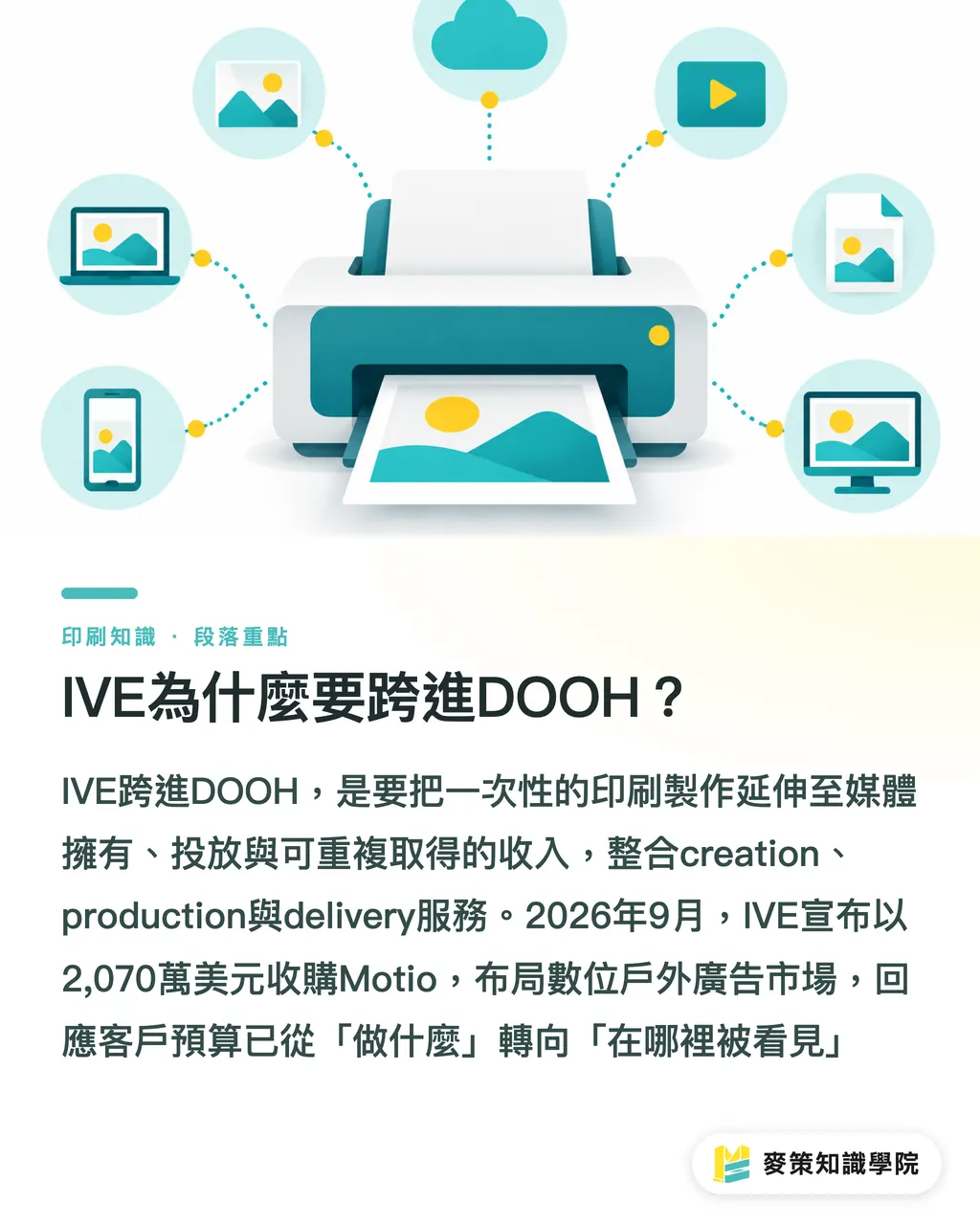
Why Is IVE Moving into DOOH?
IVE is moving into DOOH because print groups want to extend their value into media ownership, delivery, and monetization, while shifting revenue away from one-off production orders and closer to recurring revenue (revenue that can be earned repeatedly). In September 2026, IVE announced its $20.7m acquisition of Motio and placed the deal within the adjacent-market strategy of its 2030 plan. If the deal closes, IVE's creation, production, and delivery capabilities could be brought into a single commercial proposal, opening the service offering to new customer groups
DOOH (Digital Out-of-Home, digital out-of-home advertising) is a medium placed in public or commercial settings, where digital screens play advertising content that can be updated. Its overlap with print is direct: one brand brief may call for printed materials, screen creative, and on-site placement arrangements at the same time. From my years of watching how print clients allocate budgets, the buying question has already shifted toward "Where will people see it?" Print21: "IVE Enters Digital Out-of-Home Advertising"
How Can DOOH Connect with Print Capabilities?
DOOH and print fit together because both start with brand content. The delivery medium is simply different: one lands on paper, the other on screens. Motio has about 1,300 digital screens across roughly 1,000 locations, including medical centers, fitness centers, cafés, and bars, all high-traffic settings where people tend to stay longer. This place-based media (media that delivers exposure based on where people are) gives content a chance to appear while audiences are waiting
IVE already had capabilities in data, creative, production, technology, retail, and one-to-one communications (personalized communications), and recently acquired creative agency Daily Press. MINDS (MS, mid-to-high-end fully customized commercial printing) can turn this case into a proposal: for one brand campaign, print gives people information to take away, while DOOH keeps the content updated on site. Both use the same brief (brand requirements brief). That gives printers a chance to enter media planning instead of simply waiting for the artwork to arrive
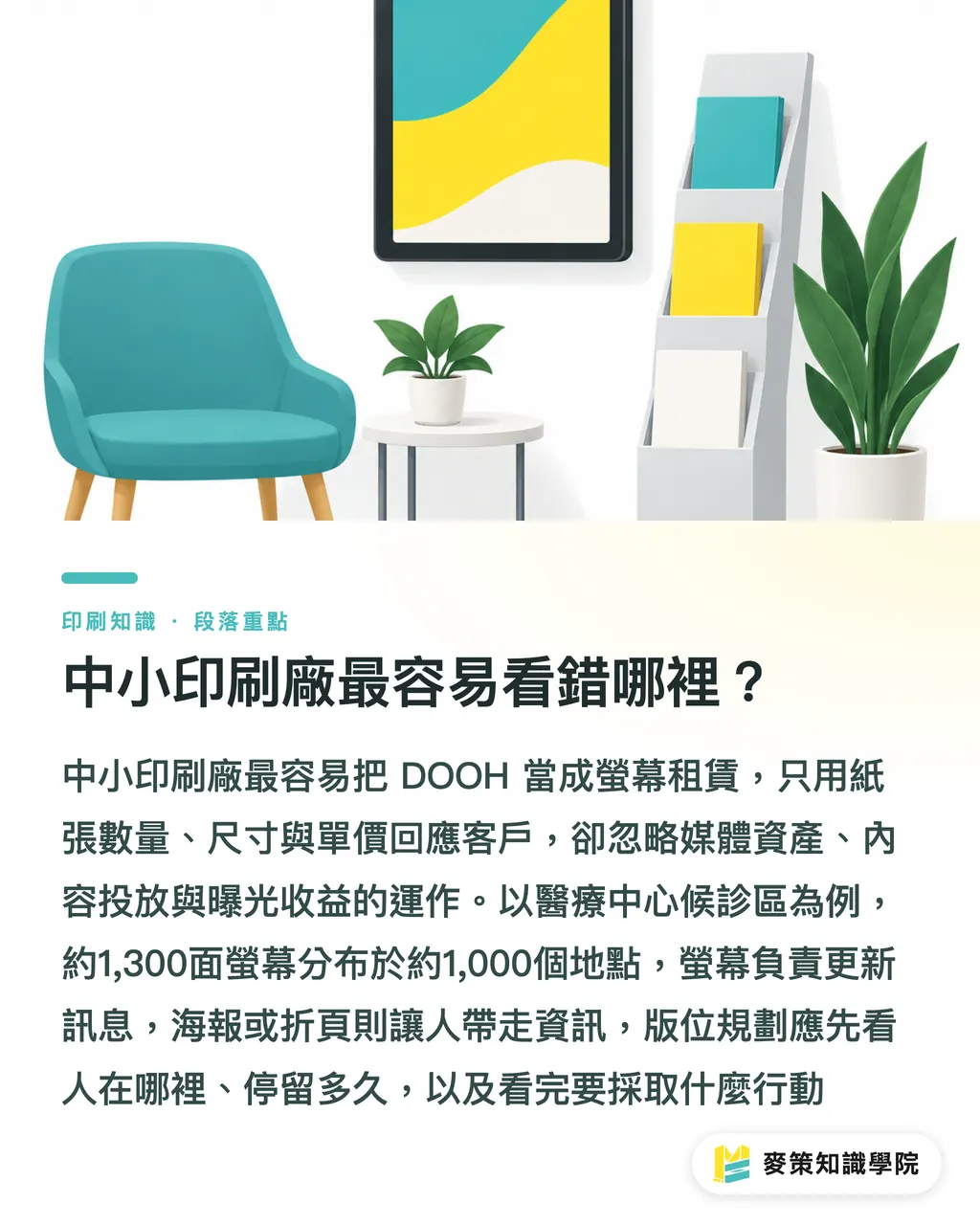
What Are Small and Mid-Sized Printers Most Likely to Get Wrong?
Small and mid-sized printers are most likely to mistake DOOH for screen rental, and still answer clients with print quantities, sizes, and unit prices. IVE's case reframes the issue around three questions: Who owns the media assets? Who delivers the content to the locations? Who earns ongoing revenue from the exposure? Motio's assets are tangible: about 1,300 screens across roughly 1,000 locations. The locations themselves are part of the service
Print is still part of it. Take a medical center waiting area: a poster or folded leaflet gives people information to take away, while the screen handles messages that need updating. Mai Strategy's Three Questions for Media Placement start here
・1. Where are people: moving, standing in line, or seated and waiting?
・2. How long do they stay: is it meant to be read at a glance, or played in segments?
・3. What do they do after seeing it: scan, visit the store, ask a question, or take printed information with them?
These three questions bring print specifications back to the context of use and show designers which medium the content belongs on
How Should Taiwan's Printers Respond?
Taiwanese printers do not need to buy screens first. Start by turning the service from an itemized quote into a proposal built around the setting. That is the most reliable entry point in my view. The value of this acquisition lies in a place-based media network that can be delivered as a service. Small and mid-sized shops can start with an existing print campaign, then add location selection, content organization, and a delivery checklist for partner media
・1. Start with the setting: Does the brand need to reach people in a medical center, fitness center, or café?
・2. Then split the content: Create print and DOOH versions from the same key visual, and spell out the size, viewing distance, and responsibility for updates
・3. Cover delivery: list design, printing, media placement, asset uploading, and reporting in the quote, and find partners for any missing capabilities
For mid-to-high-end fully customized brand materials, start by talking with MINDS. For print products with more fixed specifications that suit online ordering, Mai Printing can help smooth out the production workflow
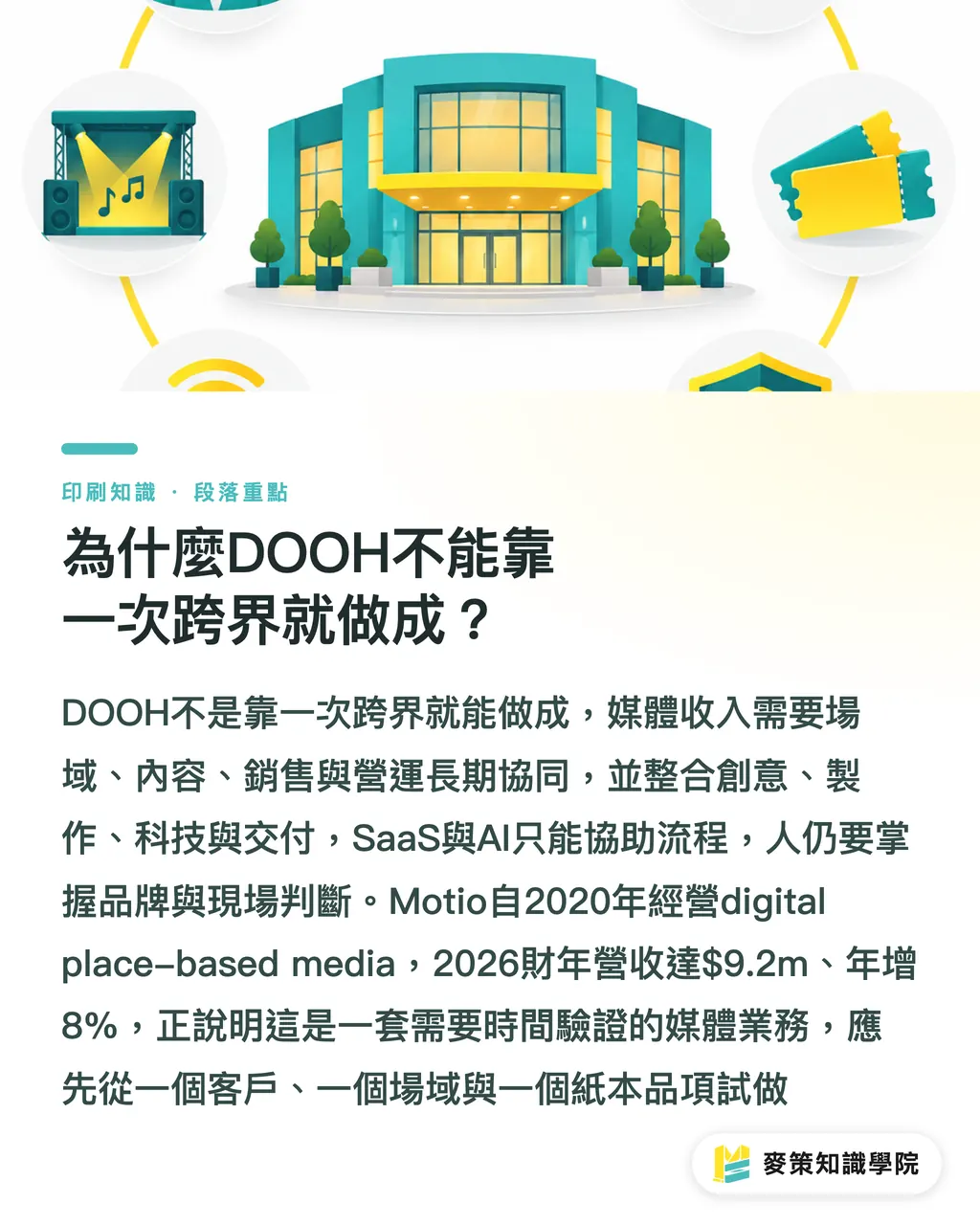
Why One Cross-Industry Move Won't Build a DOOH Business
DOOH cannot be built through a single cross-industry move because media revenue depends on the long-term coordination of venues, content, and operations, while print capabilities cover only one part of that chain. Motio has been building its digital place-based media business since 2020. Revenue was $9.2m in fiscal 2026, up 8% from the previous year. That operating history shows that media businesses have their own sales rhythm
IVE only gets close to an end-to-end proposition (a complete service from creative work through production and delivery) by putting Motio, Daily Press, and its data, creative, production, technology, retail, and one-to-one communications capabilities on the same group capability map. SaaS (cloud software delivered by subscription) can manage the brief, asset versions, proofing, scheduling, and delivery records. AI can help with size variations and format checks. People still make the calls on brand and on-site fit. I would test it with one client, one location, and one print product. The $20.7m deal still needs approval from Motio shareholders. On the print floor, what matters is that the work has an owner, files can be traced, and the client gets a result
Key Takeaways
・IVE's $20.7m acquisition expands a print group's revenue possibilities into media ownership, delivery, and monetization
・DOOH's value goes beyond the screens, extending to the dwell time in roughly 1,000 locations
・Small and mid-sized printers should sell setting-based proposals first, then find media partners, rather than build a screen network from day one
・Print and DOOH share brand content, shifting procurement from unit-price comparisons to the full delivery package
・SaaS and AI can handle versions, proofing, and delivery records first, while people retain on-site judgment
Further Thoughts
I would suggest that print manufacturers start with an existing brand client, split one campaign into three columns for print materials, DOOH creative, and delivery responsibilities, have the designer map two viewing distances for the same key visual, let SaaS track file versions and proofing checkpoints, let AI help with size variations and a first draft of the copy, and then have sales find a suitable place-based media partner. The shift starts with a brief you can actually execute, so you do not need to spend heavily on assets up front
Further Reading
FAQ
- What is the relationship between DOOH and traditional print?
- DOOH is digital screen media, while print is paper production. The two can share the same brand brief, with one handling on-site updates and the other providing information people can take away. IVE's acquisition of Motio points toward putting creation, production, and delivery into one service
- Why did IVE acquire Motio?
- IVE wants to extend from creating and producing marketing content into media ownership, delivery, and monetization, reaching new customer groups and recurring revenue. Motio has about 1,300 screens across roughly 1,000 locations
- How can small and mid-sized printers in Taiwan get started with DOOH?
- First ask where the audience stays, how quickly the content needs to change, and what action people should take after seeing it. Then find a place-based media partner. There is no need to build a screen network first
- How can AI or SaaS be used in print and DOOH?
- SaaS can manage briefs, asset versions, proofing, scheduling, and delivery records. AI can help with size variations, first drafts of copy, and format checks. People still need to decide the brand voice, print color, and whether the content fits the setting
Related articles


The Print × AI weekly
The print and AI know-how designers, brands and enterprises can use before they commit — one email, every week
MINDS Free Tools
AI background removal, a LINE sticker maker, spine & imposition calculators — all free, right in your browser, no upload.
MINDS Group
Need actual printing or gifting services?
From premium printing to online ordering and festive gifts — the MINDS Group sister brands take it from here.