
Why Is Even P&G Making a Move This Time?
The most direct push behind P&G stepping into laser marking trials is pressure from EU EPR (Extended Producer Responsibility) regulations. Legal accountability for packaging waste is shifting from voluntary disclosure to mandatory financial liability. That suddenly turns packaging recyclability, something brands previously kicked down the road, into tangible balance-sheet penalties
Traditional labeled packaging comes with an issue recyclers have dealt with for years: paper labels, adhesives, and inks get mixed together. Once in the recycling stream, they demand extra sorting or chemical treatment, dragging down both the quality of recycled resin and overall recovery rates. The industry has known this for ages, but nobody had the incentive to move first until regulations forced external costs onto internal balance sheets
According to Packaging Dive reporting, P&G partnered with industrial laser system specialist LasX and packaging supplier Mondi, with each taking a clear role. P&G brings demand and volume, LasX supplies equipment and processing know-how, and Mondi validates material compatibility. Mondi already has several commercial cases in laser marking on flexible packaging, two of which won industry packaging awards. Picking Mondi was no accident. Laser marking on film packaging is far tougher than on rigid containers, so Mondi's involvement signals that the tech has cleared a major maturity threshold
What Is the Fundamental Difference Between Laser Marking and Traditional Labels?
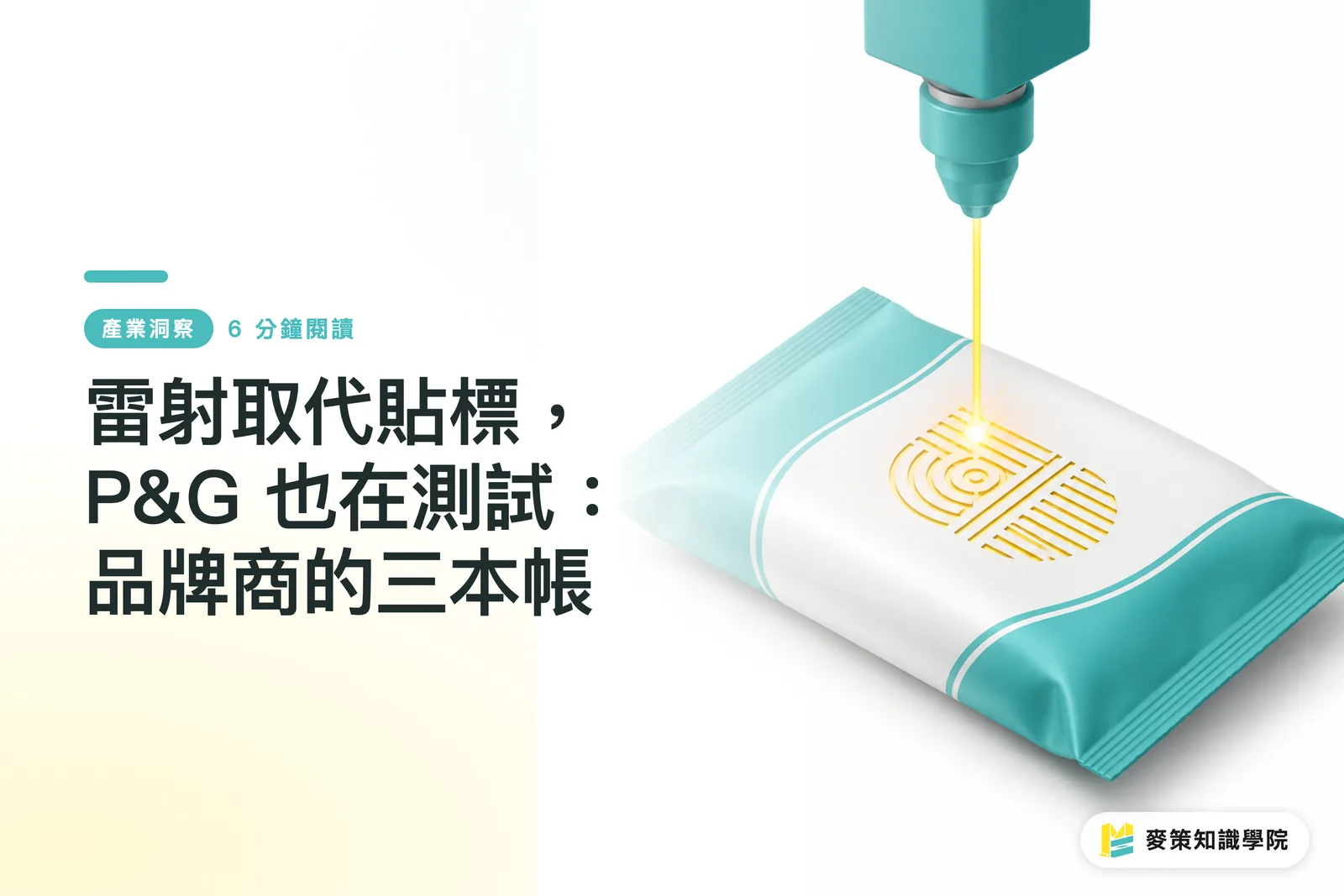
The difference comes down to how information attaches to the packaging. Traditional labeling makes a separate label, applies adhesive, and presses it on, adding another distinct material layer. Direct laser marking uses a concentrated beam of light to alter the color or texture of the substrate surface. The graphics grow directly within the material itself, with nothing extra stuck on top
That distinction triggers several ripple effects:
・Fewer material layers: Recycling facilities do not have to strip labels from the substrate, making sorting cleaner and delivering higher-quality recycled material
・Stronger anti-counterfeiting: Laser markings cannot be peeled off or covered up, making counterfeit swaps noticeably harder
・Shifting design flexibility: Without the masking coverage of a label, color output depends on the base material, usually appearing as tonal contrasts in brown or black. Vibrant colors are almost impossible to achieve with a laser alone
・Significant equipment investment: Laser systems must integrate into existing production lines, creating substantial engineering and maintenance demands
Simply put, laser marking eliminates friction on materials and back-end recycling, but demands upfront sacrifice on equipment and design. This is not a cheap upgrade. It is an entirely different operational logic
Sustainability, Costs, and Brand Perception: Which Ledger Really Matters?
The three ledgers operate on completely different timelines, which is where many brand owners get confused
The sustainability ledger is the most straightforward, but takes the longest to pay off. Stripping out the label and adhesive layers simplifies packaging composition, which creates measurable progress in EPR compliance calculations and ESG reports. If your brand sells in Europe, or major retail clients are starting to demand packaging waste data from your supply chain, this ledger is an immediate reality. Calculate it first
The cost ledger looks simple, but traps lurk at both ends. In the short run, amortizing capital equipment into fixed costs creates real budget pressure. In the long run, you eliminate label materials, labor and consumables from the labeling process, and waste disposal fees. High-volume brands amortize these costs faster than expected. For lower-volume brands, do not rush. Traditional labeling still offers a solid cost-to-performance ratio in the near term
The brand ledger is the one most often underestimated. To consumers, label-free packaging suggests cleanliness, premium quality, and eco-consciousness, creating room for visual standout on the shelf. The catch is whether your target shoppers actually pick up on it. Luxury skincare brands have built packaging narratives for decades, and they do not need lasers because they rarely relied on mass labeling anyway. For mainstream consumer brands to turn this into a clear brand statement, design strategy must carry the weight. It does not happen automatically just by swapping production methods
How Should Taiwanese Brands Assess This Right Now?
Most small and mid-sized brands in Taiwan will not be investing directly in laser equipment right away. A more practical path is having your contract manufacturer or material supplier adopt it first, while you choose to spec the process. That does not mean you can ignore it today, because once mass-production contracts are signed, the switching cost to turn back is steep
Evaluation comes down to three conditions:
・Material compatibility: Rigid PET bottles, HDPE, and aluminum surfaces handle the process relatively well. Ultra-thin composite films or clear flexible pouches require material suppliers to fine-tune formulations, meaning it is far from universal across all substrates
・Annual volume threshold: An annual volume of several hundred thousand units per SKU provides the baseline to seriously consider laser marking. For low-volume, high-mix brands, digital printing remains far more practical right now
・Source of compliance pressure: If your export buyers or core markets are already asking for concrete packaging waste metrics, the layer-reduction advantage of laser marking translates directly into deliverable reporting figures
If you are planning your next packaging upgrade, the Mai Strategy Knowledge Academy consulting team can help run an initial roadmap assessment, checking material compatibility and cost modeling before you decide whether to include laser options in your RFQs
Key Takeaways
・P&G is testing laser marking because EPR regulations have turned external packaging waste costs into balance-sheet liabilities, not out of pure tech preference
・The core strength of laser marking is material layer reduction: removing labels and adhesives simplifies packaging structures and makes recycling sortation cleaner
・The three ledgers run on separate timelines: sustainability shows up quickly, cost pays off over the long haul, and brand value hinges on consumer perception
・Color limits tied to base materials are a real constraint. Vivid colors cannot be achieved by laser alone, so design strategies must adapt alongside production
・A pragmatic starting point for Taiwanese brands: verify substrate compatibility and annual volume thresholds before deciding to add laser marking to your next round of RFQs
Further Considerations
What truly deserves attention from Taiwanese brands in this wave of trials is a supply-chain timing gap. European brands are testing now because regulatory pressure has already hit home. For Taiwanese export brands, compliance mandates typically lag by one or two cycles, but the trajectory is set. Asking your packaging vendors today whether they are tracking laser solutions is zero-cost intelligence gathering. Waiting until clients demand your packaging waste numbers before asking is too late. Service partners like MINDS, who track material science and print technology shifts, offer a concrete starting point for mapping out current production capabilities. Your next move is straightforward: list the substrates of your flagship SKUs and run a quick compatibility check. It will not take you half a morning
Further Reading
FAQ
- What is the biggest difference between laser marking and traditional labeling?
- Traditional labeling applies a separate layer of material onto the package. Laser marking uses a laser beam to etch text and graphics directly onto the substrate surface, eliminating labels, adhesives, and inks. Without those extra material layers, recycling facilities face fewer sorting hurdles, yielding cleaner recycled material
- Why is P&G testing direct laser marking on packaging?
- EU EPR regulations hold brand owners financially accountable for packaging waste, and the adhesives and ink layers on traditional labels act as contaminants during recycling. Direct laser marking removes those layers to simplify packaging materials, directly improving numbers on compliance scorecards
- Does the color appearance of laser marking match traditional printing?
- No. Color rendition in laser marking depends strictly on the underlying substrate, usually appearing as tonal contrasts in brown or black. If your brand identity relies on bold, vibrant colors, a laser cannot achieve that on its own. You would need to pair it with other print processes or adjust your visual branding
- Is it practical for small and mid-sized Taiwanese brands to adopt laser marking right now?
- Brands with compatible substrates and annual volumes topping several hundred thousand units per SKU should look into it seriously. For low-volume, high-mix brands, traditional labeling or digital printing remains far more cost-effective in the short term, but right now is an ideal time to check in on where your suppliers stand
- What role does Mondi play in this trial?
- Mondi is a leading European flexible packaging converter responsible for material compatibility testing and process integration. Laser marking on flexible films is much harder than on rigid containers. Mondi already has commercial applications that have earned packaging awards, demonstrating that this technology is ready for production scaling on film substrates
Related articles
The Print × AI weekly
The print and AI know-how designers, brands and enterprises can use before they commit — one email, every week
MINDS Free Tools
Spine width and imposition calculators — skip the manual math, free in your browser.
MINDS Group
Need actual printing or gifting services?
From premium printing to online ordering and festive gifts — the MINDS Group sister brands take it from here.