

Why Should Low-Carbon Printing Start at the Planning Stage?
Many clients ask me, 'Which printing method is the most environmentally friendly?' This question itself misses the mark
What determines the carbon footprint of a printed piece is not whether you use digital or offset printing, but rather the specifications you decide on during the planning stage. Dimensions, paper size, run length, post-press processing, and shipping, every single step offers an opportunity to either cut carbon emissions or generate them unnecessarily
When MINDS (MS, offering mid-to-high-end fully customized commercial printing) assists clients with prepress planning, we typically evaluate projects using a five-dimensional checklist: materials, processing, transport, waste, and disposal. This framework examines how much material is used, how much energy the process consumes, how far it travels, how much scrap cannot be recycled, and how much of the final product ends up as waste. Mapping these out usually makes it clear at first glance which stage is most ripe for optimization
Carbon emissions and waste are essentially two sides of the same coin. Viewed this way, carbon reduction and budget savings align perfectly

Paper Size and Imposition Efficiency: Where is the Most Overlooked Waste?
When designers determine the final dimensions of a product, there is one step they rarely take: checking those dimensions against a standard paper size chart to see how much paper will be thrown away
Commercial printing in Taiwan commonly uses Kikuban (636×939 mm) or Shirokurban (788×1091 mm) sheets. If your final product is A4, measuring approximately 216×303 mm with bleed, laying it out horizontally on a Kikuban sheet yields 8 pages, achieving a paper use rate of nearly 88%. However, if the size is changed to a custom dimension like 210×280 mm, the same sheet might only fit 6 pages, immediately increasing the scrap ratio by 20%. For a run of 5,000 copies, this difference translates to dozens of kilograms of wasted paper
The first step in choosing dimensions is to confirm how many pages can fit on a sheet and how many centimeters of scrap it produces, rather than locking in the design first and then asking the printer if it is feasible
Another frequently underestimated source of carbon emissions is the number of proofing cycles. Proofing consumes paper, ink, and press time. If color approval is finalized at the digital stage, reducing proofs from three to one for the same project often yields a more significant carbon reduction than switching paper types
Several key questions to align on during the design phase:
・Whether the final size (including bleed) aligns with standard paper divisions, keeping scrap under 20% of the paper area
・Whether bleed settings and full-bleed color areas are accurate to prevent printing mishaps that lead to reprints
・Whether the responsibilities for digital color proofs and physical proofs are clearly defined in the contract to avoid wasting resources on repetitive rounds of validation
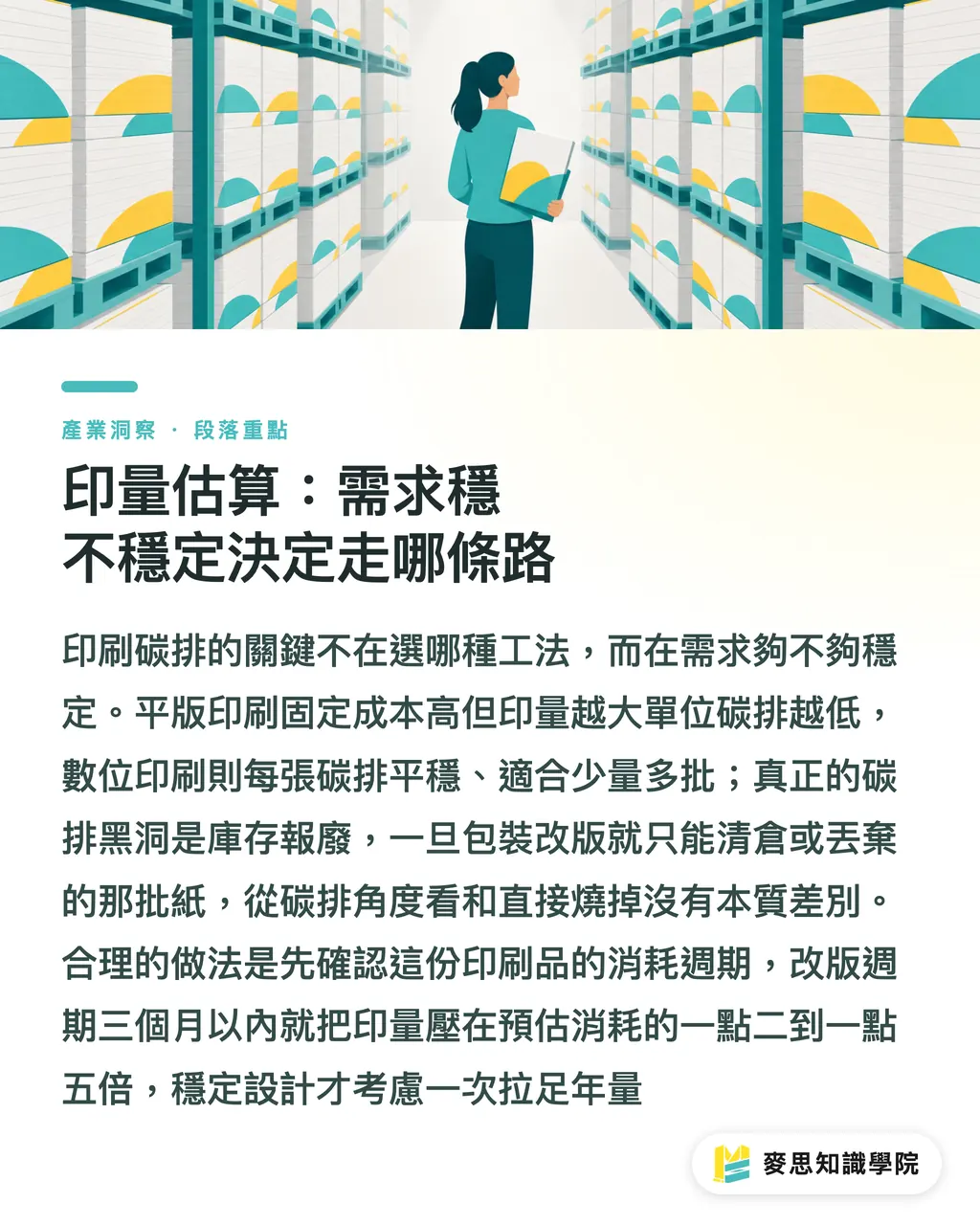
Print Volume Estimation: Demand Stability Dictates the Path
This is the decision that impacts carbon emissions the most, yet is most easily overlooked by both designers and procurement
The carbon emission profile of offset printing involves unavoidable fixed overhead from plate making, setup, and ink calibration, but the emissions per sheet drop rapidly as the print volume increases. Digital printing is the opposite: the emissions per sheet remain stable, but as print volumes scale up, the unit emissions end up higher than those of offset printing
Therefore, the question is not which printing method is greener, but rather how stable your demand is:
・Stable demand, fixed quarterly usage, low revision frequency → print the full amount at once. Offset imposition efficiency is high, resulting in lower total carbon emissions for the batch
・Fluctuating demand, frequent revisions, uncertain consumption → use digital printing for small, multiple batches to avoid inventory waste. Obsolete inventory is the single biggest carbon sink in the entire printing process
・Trial sales or new products → never gamble on large print volumes just to get a cheaper unit price. Moving and recycling unsold inventory generates massive carbon emissions
I have seen many small-to-medium brands order 10,000 units at once to save on unit costs, only to have 4,000 units left for clearance or scrap three months later due to a packaging redesign. From a carbon emissions perspective, this is functionally no different from burning the paper directly
A more sensible estimation logic is to first determine the consumption cycle of the printed material, then decide on the volume per print run. For revision cycles under three months, it is recommended to keep the print volume conservatively at 1.2 to 1.5 times the estimated usage; only consider printing a full year's supply if the design is highly stable and the revision cycle exceeds one year
How to Manage Post-Press Processes, Delivery Batches, and Inventory Risk?
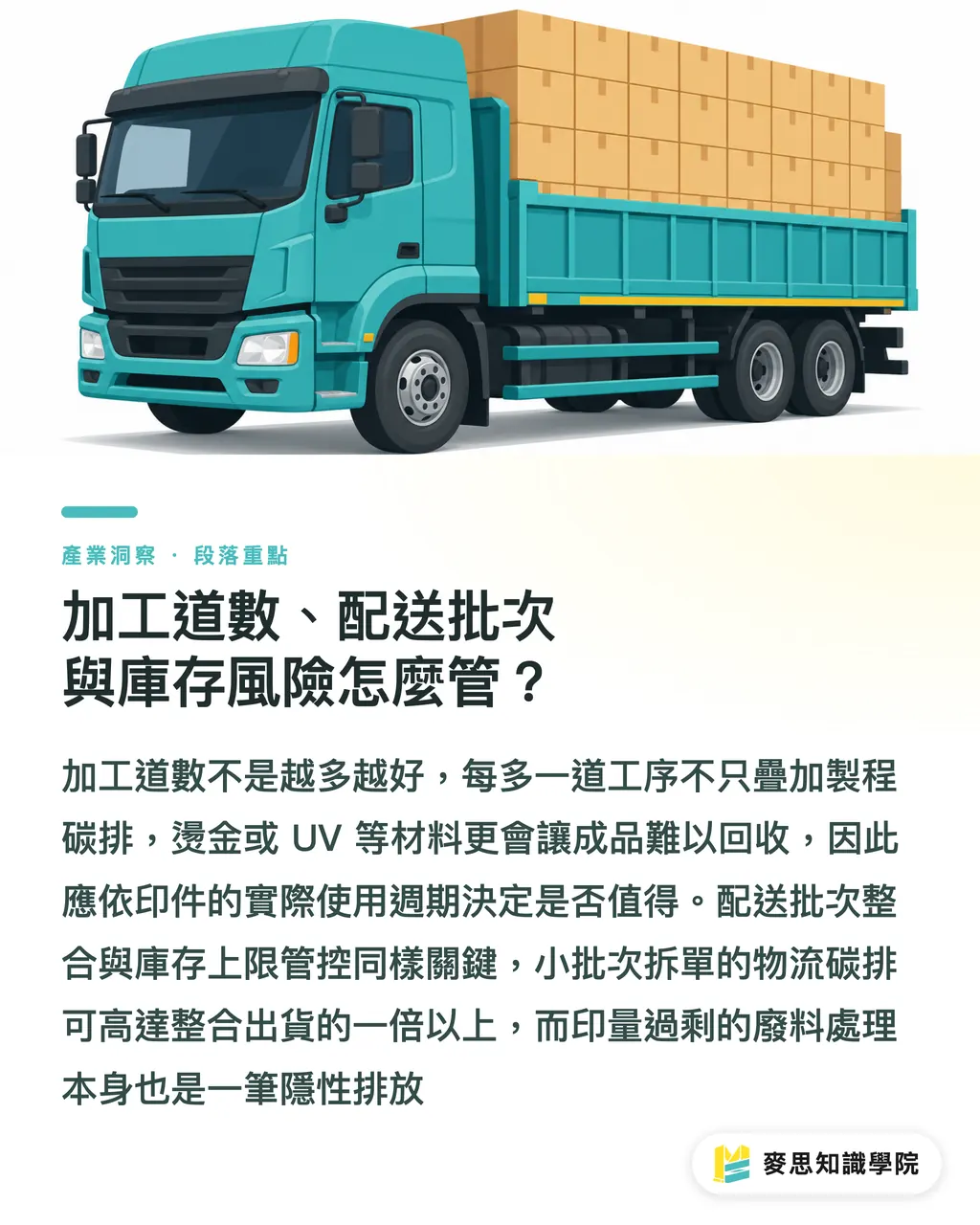
When it comes to post-press processing, many clients instinctively feel 'the more elaborate, the better.' However, every additional process adds another production step and extra transport, driving up carbon emissions. Worse still, finishing materials (such as foil stamping films and UV coatings) often make the final product harder to recycle, increasing emissions at the disposal stage
Trade-offs among common finishing options:
・Saddle stitching: The go-to choice for thin booklets (within 64 pages). It requires no glue, uses a simple process, and generates the least waste
・Perfect binding: Consumes glue but yields a durable product. If inventory management is well-controlled downstream, its overall disposal emissions are not necessarily higher than saddle stitching
・Foil stamping, UV coating, and spot varnish: Each process makes recycling paper more difficult. If water-based varnish or PP film can be used as alternatives, it is recommended to make the trade-off during the planning stage
・Die-cutting custom shapes: High scrap ratio, unsuitable for low-volume runs; only larger volumes can amortize the scrap loss
The number of post-press processes should be evaluated alongside the lifecycle of the printed piece. For an exhibition brochure with a three-month lifespan, adding foil stamping and UV coating is counterproductive, as it increases processing emissions and burdens the disposal stage due to poor recyclability
Shipping emissions are often heavily underestimated. Practical observations show that consolidating a single client's fragmented small shipments into a single delivery can cut logistics emissions by 30 to 40%. This requires no change in materials or printing methods, only coordination four to six weeks in advance of the order
Inventory waste is the final issue that must be addressed. Overprinting is not just a waste of money; processing waste (handling, recycling, incineration) generates carbon emissions. A more sensible approach is to set a maximum inventory limit that triggers promotions or volume reductions, rather than discovering a warehouse full of obsolete packaging when a design is updated
Key Takeaways
・The best time to make carbon-reduction decisions is before finalizing the design, not after printing. Once specifications are locked, the carbon footprint cannot be undone
・Aligning final dimensions with standard paper divisions is the simplest and most direct way to reduce carbon. If scrap exceeds 20%, it is worth rethinking the dimensions
・If demand is unstable, do not chase the low unit price of high-volume offset printing. Inventory disposal is the largest carbon black hole in the entire process
・For every additional finishing process, evaluate its impact on downstream recyclability, not just the financial cost
・Consolidated shipping can reduce logistics emissions by 30% to 40%. Planning orders six weeks in advance is the lowest-cost way to reduce carbon
Further Considerations
Behind every decision point discussed in this article lies the same question: how is the lifecycle of this printed piece designed? The path from the designer's final draft to the last printed piece being used or recycled is where we must look to identify and eliminate unnecessary carbon emissions
For SaaS platforms or e-commerce brands, if dimensions, print volumes, and finishing combinations can be converted into a rough carbon estimate before ordering, clients will have a basis for their decisions in real time rather than regretting them after printing. This is a scenario where digital print management tools can highly add value
For printers, proactively helping clients with prepress specification reviews (paper size compliance, recommendations for fewer finishing steps, consolidated shipping plans) is not only a value-added service but also makes their production scheduling more predictable, saving trouble for both sides
If you have a project and are unsure how to balance quality and carbon footprint, MINDS's prepress consulting process includes this level of specification review. You are welcome to reach out directly with your specifications
FAQ
- Which is more environmentally friendly: digital printing or offset printing?
- There is no set answer; it depends on print volume and revision frequency. For projects with stable demand and large volumes, offset printing offers lower emissions per unit. For projects with frequent updates or fluctuating demand, digital printing in small, multiple batches avoids inventory waste, resulting in lower overall emissions
- How can I determine if the final product dimensions are wasting paper?
- Try laying out the final size (including bleed) on a Kikuban or Shirokurban sheet to see how many pages fit and how much scrap remains. If scrap exceeds 20% of the paper area, it is worth reconsidering the dimensions. Usually, a minor adjustment of 5 to 10 mm can significantly improve paper use
- Is there a safer baseline for estimating print volumes?
- Start with the consumption cycle. For revision cycles under three months, it is recommended to limit the print volume to 1.2 to 1.5 times the estimated usage. For stable designs with revision cycles exceeding one year, a full year's supply can be considered. The most high-risk decision is boosting quantity just to get a cheaper unit price, only to face massive inventory disposal after a revision
- Do foil stamping and UV coating affect carbon emissions?
- Yes, and the impact is twofold. Every additional step consumes more energy during production. Also, materials like foil stamping films and UV coatings typically make the final product harder to recycle, increasing emissions at the disposal stage. It is especially worth considering whether these processes are necessary for short-lived printed items (such as those with a lifespan under three months)
- How much carbon emissions can be saved through consolidated shipping?
- Practical observations show that consolidating a single client's fragmented small shipments into a single delivery can typically reduce logistics emissions by 30% to 40%. This requires no material changes or print modifications, only coordinating batches four to six weeks in advance on the planning side
Related articles




The Print × AI weekly
The print and AI know-how designers, brands and enterprises can use before they commit — one email, every week
MINDS Free Tools
AI background removal, a LINE sticker maker, spine & imposition calculators — all free, right in your browser, no upload.
MINDS Group
Need actual printing or gifting services?
From premium printing to online ordering and festive gifts — the MINDS Group sister brands take it from here.