
Overview
For a restaurant menu to last, start with the three MINDS Printing checkpoints: durability in context, page replacement rate, and surface cleanability. Stir-fry restaurants prioritize cleaning and single-sheet replacement, fine-dining restaurants prioritize hand feel and binding, and cafes prioritize texture and small-batch updates
The three MINDS Printing checkpoints can be broken down like this:
・1. Durability in context: if a menu is flipped more than 50 times a day, surface treatment should first account for wiping and corner wear
・2. Page replacement rate: seasonal dishes, drinks, and set-menu pages should be reprintable one page at a time, so every price change does not force the entire menu to be discarded
・3. Surface cleanability: choose matte lamination, splash-resistant paper, or synthetic paper based on the amount of oil and water exposure, not just how good the proof looks on day one
Why Restaurant Menus Should Not Be Printed Like Ordinary Flyers
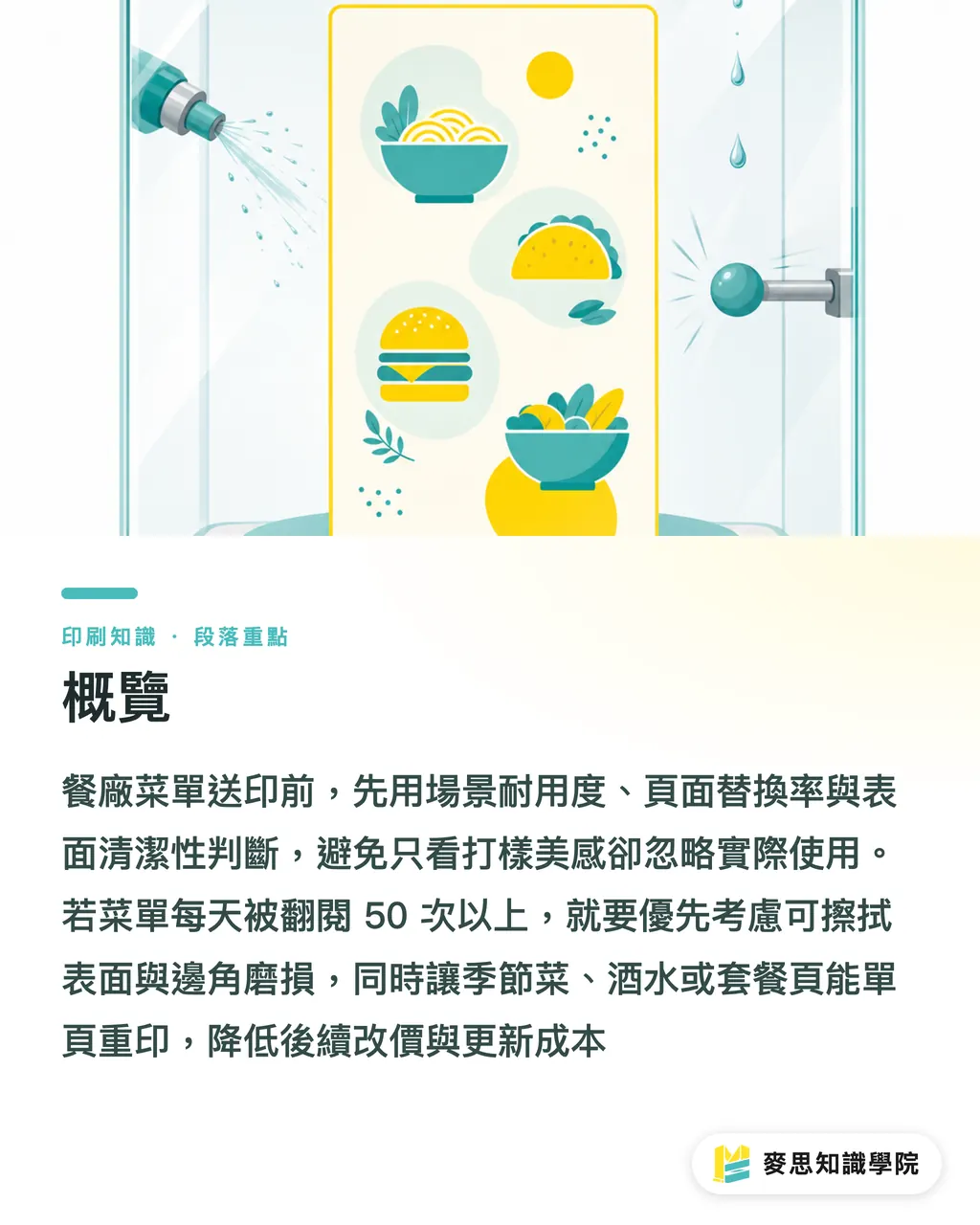
Menus are high-contact items. Ordinary flyers are usually put away after reading, but menus are handled on the table, pressed down, wiped, and exposed to condensation from glasses, soup, grease, and disinfectant
The issue I see most often on site is not that the menu was poorly printed at the beginning. It is that the restaurant treats 157g coated paper with matte lamination as a universal solution, only to find fuzzy corners, white fold lines, and a sticky-feeling cover two weeks later
Matte lamination is a common protective print finish. It reduces glare and provides basic splash resistance, making it suitable for everyday wiping, but water can still seep into trimmed edges, fold lines, and binding holes and cause lifting
Menu printing should start with three practical questions:
・About how many rounds of handling does this menu go through each day, and do multiple guests at the same table share it during peak hours?
・Will the menu be near drinks, hot pot, stir-fry dishes, sauces, or the bar sink?
・How often do item prices change: one page each month, or the whole menu only once every six months?
Choosing Binding for Stir-Fry Restaurants, Fine Dining, and Cafes
Menus for stir-fry restaurants usually have to withstand oil, water, and fast ordering. An A3 or A4 double-sided single sheet with matte lamination, or partial use of synthetic paper, is often more practical than a thick hardcover menu because staff can wipe it quickly and update prices quickly
Fine-dining restaurants are well suited to hardcover screw-post binding, brass fasteners, or loose-leaf structures. Wine lists, set-menu pages, and seasonal pages of 4 to 12 pages can be organized by section, keeping a premium cover while allowing individual inner pages to be replaced when updates are needed
Cafes often use photo paper mounted on thick board for counter menus, tabletop cards, and dessert displays. Thick board feels substantial in the hand, but it is not suitable for frequent price changes because changing even one item may require remaking the entire board
I usually advise restaurant clients like this:
・Stir-fry restaurants: A3 or A4 double-sided single sheets, matte lamination or synthetic paper, with the focus on cleaning and low-cost replacement
・Fine-dining restaurants: hardcover screw-post binding or brass fasteners for the cover, with inner pages separated into drinks, set menus, and seasonal dishes. The focus is on texture and single-page replacement
・Cafes: photo paper mounted on thick board, table cards, and short-run small menus. The focus is photogenic texture and counter display
・Restaurant chains: separate fixed pages from campaign pages, and print campaign pages independently. The focus is avoiding waste when more than 10 locations need simultaneous updates
Should Splash-Resistant Menus Use Matte Lamination or Synthetic Paper?
Matte lamination works for most dine-in menus. It has a refined hand feel, low glare, and basic protection against water droplets and everyday wiping. If the restaurant environment is relatively dry and the menu does not often come into contact with oil, matte lamination is a stable choice for both cost and texture
Synthetic paper is usually made mainly from PP-based materials and has better water resistance than ordinary paper. It is suitable for beverage shops, hot pot restaurants, outdoor seating, and areas near the bar, but print color, writability, and fold-line performance should be confirmed through proofing first
Splash-resistant does not mean oil-proof, scratch-proof, or alcohol-proof. I say this directly to restaurant owners because menus most often fail in four places: corners, binding holes, fold lines, and the trimmed edges of lamination
When planning menu materials, the Mai Strategy Knowledge Academy consulting team usually first divides restaurant formats into two types: table-side browsing and counter ordering. The former depends on hand feel and wipe resistance, while the latter depends on viewing distance and replacement speed
How to Design Menus for Easier Future Replacement
For an easy-to-replace menu, the layout must be divided into pages from the beginning. Do not force the fixed brand story, signature items, seasonal specials, and price-variable items all into the same spread
For a restaurant with 30 menus, reprinting the entire menu just because two seasonal dishes change price increases printing cost, binding labor, and in-store collection and sorting. This kind of waste is very common in food service
A more stable structure divides the menu into four sections:
・Cover and brand pages: replaced only every six months to a year, so the material can be thicker and more refined
・Fixed item pages: signature dishes, regular drinks, and set-menu rules go here, with a layout that keeps more than 5mm of safe margin
・Variable item pages: seasonal dishes, limited desserts, and drinks promotions are made as independent pages for convenient single-sheet reprinting
・Table cards and add-on pages: high-margin new items, holiday set menus, and QR code pages can be produced in short runs
If the menu already involves branches, drinks pages, or quarterly campaigns, having the Mai Strategy Knowledge Academy consulting team restructure the pages once is usually far cheaper than repeated reprints later
What to Check Before Sending Menu Design Files to Print
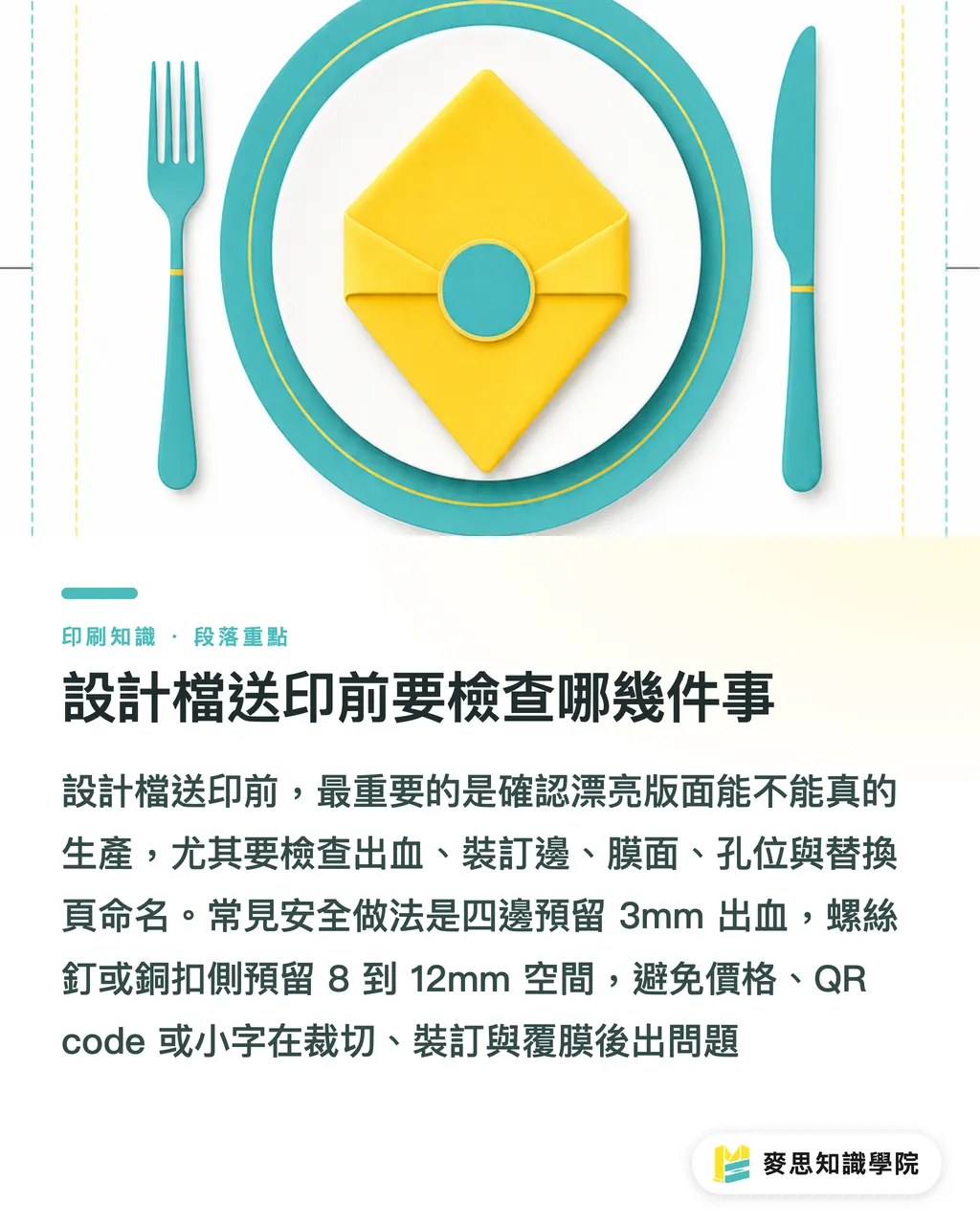
When a designer hands over menu files, bleed, binding edge, surface film, hole positions, and replacement-page naming should all be confirmed at minimum. A common safe setup is 3mm bleed on all four sides, with 8 to 12mm reserved on the screw-post or brass-fastener side
The biggest risk with menu files is that they look beautiful but cannot be produced properly. Prices placed too close to the trim line, QR code on the binding edge, small text on a dark background, and reduced contrast after matte lamination on the cover may not be obvious on screen, but they become very real in print
The three MINDS Printing checkpoints can be reviewed again at the design-file stage:
・1. Durability in context: confirm whether the film, paper stock, and thickness match the oil, water, and wiping frequency
・2. Page replacement rate: confirm whether every variable item can be exported as an independent single-page PDF
・3. Surface cleanability: confirm whether dark areas, reversed white text, and partial synthetic paper sections have already been proofed and checked as physical samples
For mid- to high-end fully custom menus, MINDS Printing can evaluate binding, board mounting, and surface finishing, especially for projects involving post-processing tolerances such as hardcover screw-post binding, brass fasteners, and photo paper mounted on thick board
Key Takeaways
・A menu usually fails at the corners, hole positions, and wiping paths, not on the printed front surface
・Splash resistance is only the first layer of protection. True durability depends on paper stock, surface film, binding, and trimming at the same time
・Restaurants that change prices frequently should divide the menu into pages first, then discuss texture
・Stir-fry restaurants need easy wiping, fine-dining restaurants need easy replacement, and cafes need photogenic presentation. Each restaurant type requires a different printing method
・A good menu is not the thickest one. It is the one that can still stay clean and presentable at low cost after six months
Further Thinking
On the print manufacturing side, menu projects can be converted into a four-column specification sheet covering restaurant type, handling frequency, replacement cycle, and cleaning method. On the design side, fixed pages and campaign pages can be managed separately. If restaurant SaaS is going to connect with print workflows, the most valuable feature is exporting menu data as reprintable single-page PDF files. AI can be introduced for dish-name organization, price version comparison, and initial layout drafts, but the final decision still has to return to paper stock, surface film, hole positions, and on-site wiping methods, because menus are tested on the table every day
FAQ
- Do restaurant menus need lamination pouches to last?
- Not necessarily. Lamination pouches are suitable for low-cost, frequently wiped, single-sheet menus, but they feel stiff and do not support a fine-dining image well. To balance hand feel and splash resistance, consider matte lamination, synthetic paper, or hardcover menus with replaceable inner pages
- Are matte-laminated menus waterproof?
- Matte lamination can handle everyday water droplets and short wiping, but it is not the same as long-term soaking resistance, oil resistance, or alcohol resistance. If the menu is near a drinks bar, hot pot table, or outdoor seating, synthetic paper is more reliable
- If a restaurant changes prices often, what is the most economical way to print menus?
- Divide the menu into cover, fixed items, variable items, and campaign add-on pages, so seasonal dishes or price pages can be reprinted one sheet at a time. For 30 menus, replacing only 2 pages is much easier to control than reprinting the entire menu
- What binding works best for fine-dining menus?
- Fine-dining restaurants are well suited to hardcover screw-post binding, brass fasteners, or loose-leaf structures. The cover can maintain a premium feel, while inner pages can be separated into drinks, set menus, and seasonal pages, allowing only the necessary pages to be replaced in future updates
- What should designers watch for when handing over menu print files?
- Menu files should confirm 3mm bleed, an 8 to 12mm binding edge, scannable QR code, readable small text on dark backgrounds, and separately exported replaceable pages, so later price changes do not force a full-menu reprint
Related articles


The Print × AI weekly
The print and AI know-how designers, brands and enterprises can use before they commit — one email, every week
MINDS Free Tools
Spine width and imposition calculators — skip the manual math, free in your browser.
MINDS Group
Need actual printing or gifting services?
From premium printing to online ordering and festive gifts — the MINDS Group sister brands take it from here.