
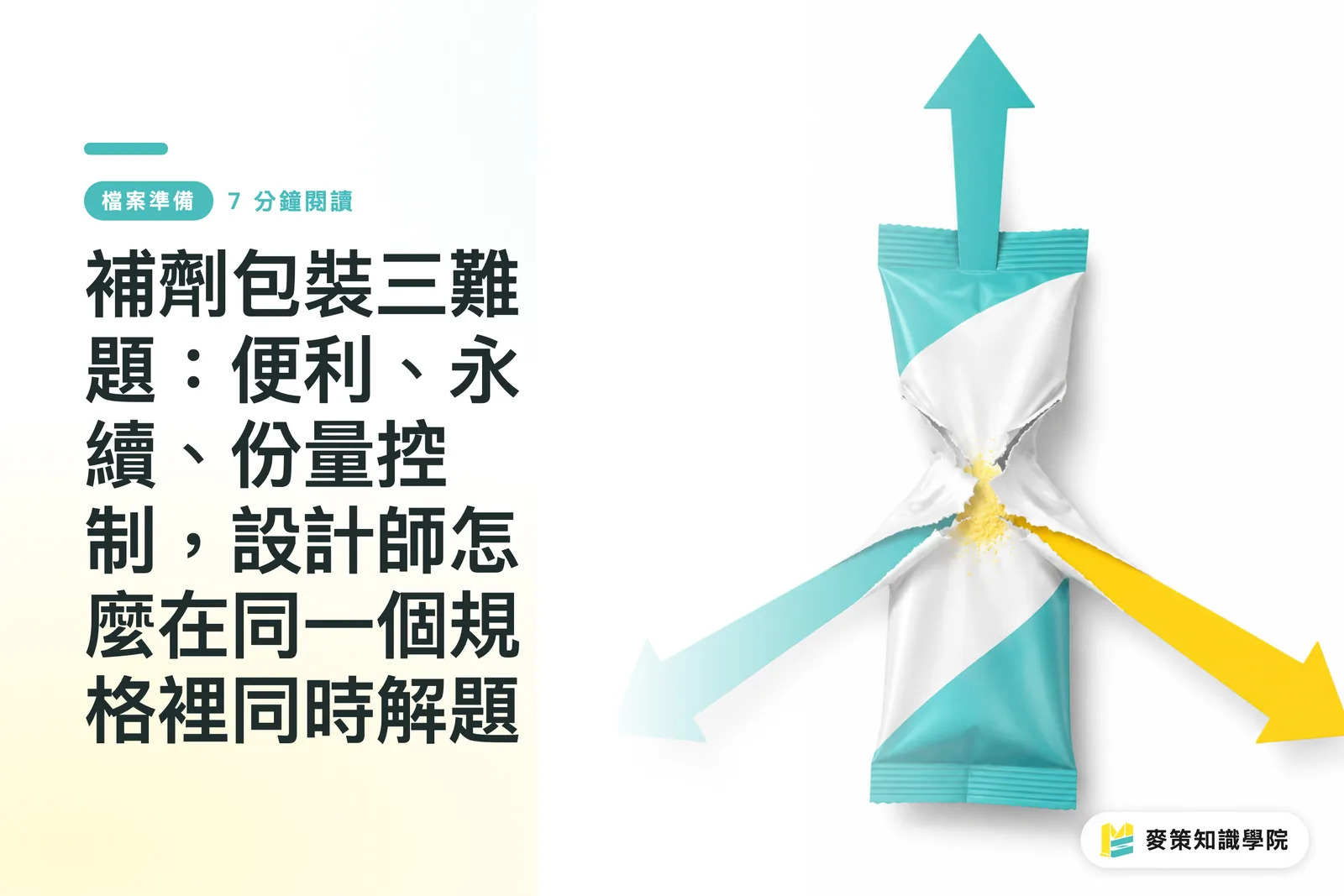
Why Do These Three Demands Clash in the First Place?
Looking at the supplement brand clients I have worked with, the conflict among these three demands is no accident. It comes down to material physics
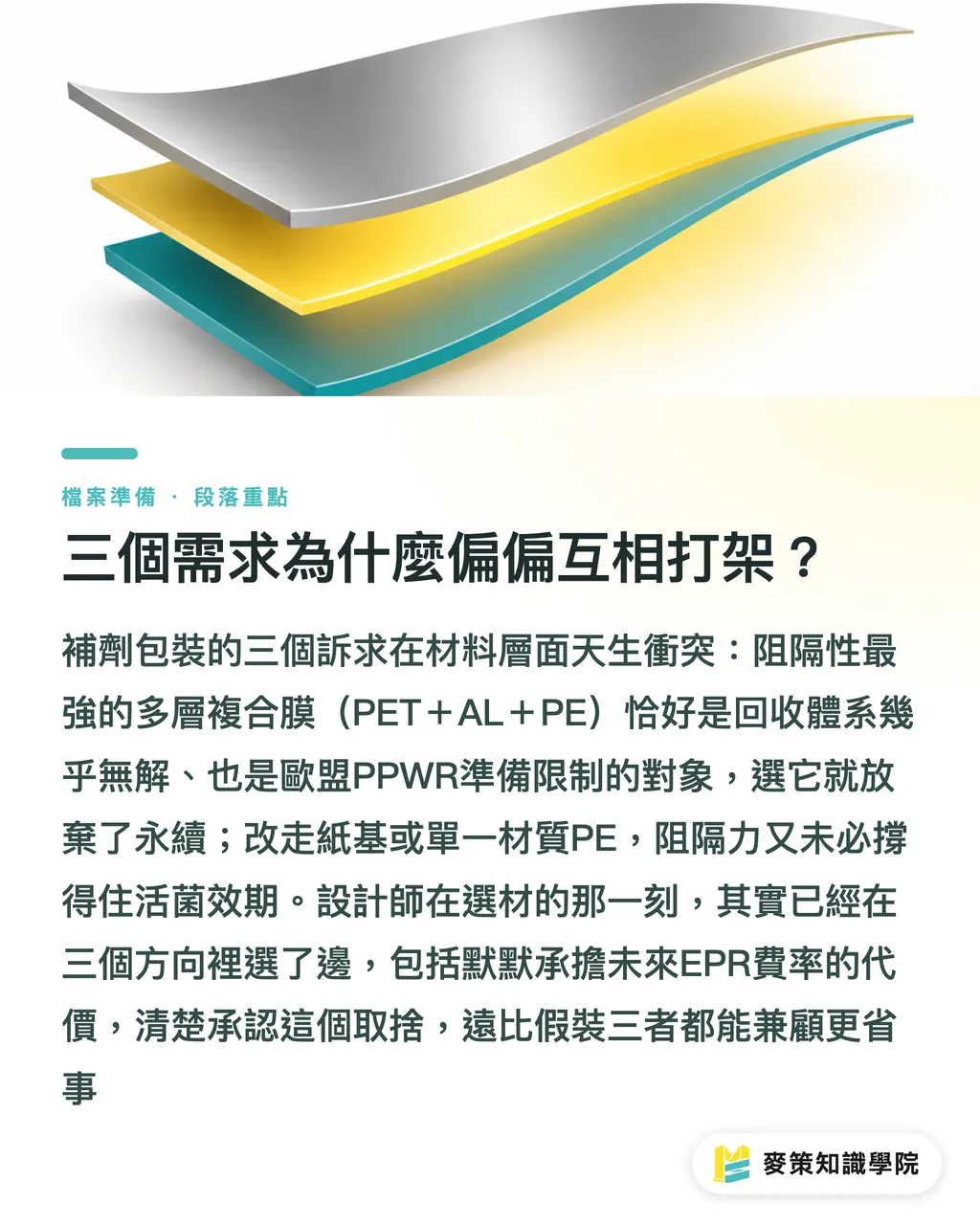
Convenience demands lightweight builds, single servings, and easy tearing. Sustainability demands recyclable or compostable materials, leaning toward paper-based or mono-PE structures. Portion control requires strong oxygen and moisture barriers so vitamins or probiotics stay potent until they reach the consumer. That is where the problem lies. The structure with the best barrier properties is a multilayer laminate film, usually a three-layer PET+AL+PE build. This structure has virtually no path through existing recycling systems, and it is precisely what the EU PPWR (Packaging and Packaging Waste Regulation) will effectively restrict after 2030
EPR (Extended Producer Responsibility) fees will also be tiered by material category. Brands using non-recyclable composite materials will pay significantly higher fees than those using mono-materials. For supplement brands planning to export to Europe, this is not a distant concern. It is a cost you have to factor into package design right now
The moment a designer picks a material in the final artwork, they have already picked a side among these three directions. Knowing clearly that you are making a tradeoff is far more honest and saves much more trouble than pretending you can cover all three
What Does It Actually Take to Solve Convenience in Design?
Convenience is too often mistaken for a visual issue, like switching to a grippier bottle silhouette or adding a tear notch. But what consumers actually care about is simple: can I pull this off with one hand while holding a water bottle with the other?
Take single-dose packaging as an example. Stick packs and blister packs are the two most common answers in the supplement market, and the differences in their design files go way beyond outer dimensions:
・For stick packs, the heat seal width determines opening force. The final file must mark the heat seal zone (5 to 8 mm is standard in the industry), and any material swap requires re-testing the opening force
・For blister packs, push-through force depends on PVC thickness. The feel changes completely from 200 μm to 300 μm. If your target audience includes seniors, bring this number down
・For bottles with measuring cups, if the print alignment error on the graduation lines exceeds 0.5 mm, the visual dosing makes consumers feel like the measurement is off
Check these specifications with structural engineers during prepress. Do not leave the printer to guess after receiving the artwork. Brands with custom structural packaging needs can reach out to MINDS early to verify structures before making plates, saving a round of revisions caused by vague specs
When Switching to Sustainable Materials, What Printability Issues Pop Up?
This is the trap supplement brands fall into most often, and it happens in the exact same spot almost every time: leadership signs off on 'switching to eco-friendly materials,' the designer gets handed a single line of instruction, and nobody tells them that printing behavior changes with it
Printability for paper-based flexible packaging (paper+PE laminate film) is vastly different from traditional PET film. Ink adhesion, dot gain, and dimensional stability after moisture exposure all become issues at once. Mono-PE pouches (all-PE multi-layer co-extruded structures) score higher in certain sustainability rating frameworks, but their surface energy is low. Without proper corona treatment, UV ink will not adhere, while water-based ink is constrained by a very narrow sealing temperature window. One slip, and you end up with a whole batch of scrap
A few questions design teams need to confirm in advance:
・Matching the printing method: Gravure printing has relatively forgiving requirements for PE surface energy, but plate costs are high, making it suitable for high-volume items. Flexo printing has lower plate costs but strict requirements for PE corona levels. Small-to-medium runs in Taiwan usually use flexo, so this detail should be clarified before taking orders
・Reconfirming color profiles: Paper-based materials have higher dot gain than PET film. You cannot reuse the ICC Profile from old artwork, or the printed color will turn out a full shade darker than the proof. Fixing colors means re-proofing and waiting on lead times all over again
・High-barrier alternatives: If a brand insists on sustainability but worries about moisture, the current market option is a recyclable mono-material structure with an EVOH (ethylene vinyl alcohol copolymer, a high-barrier resin) core layer. Suppliers for these materials are still limited in Taiwan, so procurement needs to confirm 3 to 4 months in advance
One more point worth stating plainly: 'bio-based' and 'recyclable' are two different things. Confusing these two concepts is very common in procurement. Bio-based materials might be completely non-recyclable, while fossil-based rPET (recycled polyethylene terephthalate) actually performs much better in current recycling streams. When designers encounter this confusion, explain it clearly to the client right away to spare them a round of redesigns headed in the wrong direction
Portion Control Structures: Which Details Need to Be Marked in the Artwork?
Portion control in supplement packaging has two sides. Designers usually only account for the consumer side, while the factory side gets almost entirely ignored
On the consumer side:
・Bottles with measuring cups or scoops (typical for protein powders): note whether graduation lines are printed or laser-etched. The precision and durability differences between the two are clear. Printed markings wear off easily after repeated washing, so the final artwork must specify the material and surface treatment method clearly
・Individually wrapped gummies or capsules for single servings: the packaging needs to make the 'one per day' message visible without opening the pack. This is a tradeoff between surface area and typography layout, so the design file needs to account for viewing angles both on the retail shelf and in the consumer's hand
・Liquid dropper packaging: printing graduations on PE tubes requires prior adhesion testing. Testing UV ink adhesion on PE tubes is a must-do prep step, not something to figure out after printing
On the factory filling side: bottle mouth roundness tolerance affects filling machine sealing efficiency. Excess tolerance increases defect rates. This is not a minor detail designers can shrug off, but a real issue causing yield loss in every production run. Mark bottle mouth tolerance requirements on the design file (±0.2 mm is a common baseline) so the production team has a spec to match
Balancing All Three Challenges: How Do You Prioritize?
First, ask the brand where this product will mainly be sold and through which channels
・Brands targeting Europe or planning exports: PPWR and EPR are hard constraints. Sustainability compliance comes first. Find the best answers for convenience and portion control within a recyclable material framework. Do not wait for regulations to hit before rushing changes. The cost of redesigning now is much lower than being forced to redesign after 2030
・Brands targeting local Taiwan retail and pharmacy channels: consumers care about the unboxing experience and intuitive dosing. Start sustainability efforts with on-pack material labels (such as 'This packaging is recyclable' badges) instead of replacing the entire barrier structure right away. Pace the two initiatives separately
・Direct-to-consumer e-commerce brands: moisture resistance and shock protection come first. Solve portion control through individual unit packaging. Sustainability can start with the outer shipping box while leaving the inner packaging barrier layer untouched if there are no hard regulatory requirements
Pick one primary demand and treat the other two as secondary so the material and structural design have a clear direction to follow. If the brand demands maxing out all three at once, the best response is to state the conflict plainly: that material does not exist right now. Saying this early is far better than saying it late. Finding out only after proofs are run wastes three months
Key Takeaways
・PET+AL+PE laminate films provide the best barrier, but they face restrictions under the PPWR framework. Designs targeting European exports need an alternative path decided early on
・ICC Profiles need recalibration after switching to sustainable materials. Paper-based substrates have higher dot gain than PET film, so sending old artwork straight to plates will definitely cause color shifts
・'Bio-based' does not mean 'recyclable.' This confusion is widespread in procurement, and designers who point it out proactively can prevent a round of off-target revisions
・Portion control design details are split between the consumer side and the factory side. Bottle neck tolerances must be specified in the design file, not left to the printing plant
・These three challenges have a clear priority order rather than simultaneous fulfillment. Confirm the primary objective first so the other two have a clear path for specification tradeoffs
Looking Ahead
Supplement packaging will only get tougher over the next few years because the PPWR timeline is set in stone and EPR fee structures are increasingly penalizing composite materials. For designers, the next step is pulling material spec decisions to the very start of the design process. Build the material testing checklist right as style concepts get finalized, rather than waiting until proofs arrive to realize barrier needs and recycling rules clash. Designers who pull this off will carry much more weight at the brand decision table. Brands needing custom packaging structure support can work with MINDS during prepress to verify structural compliance, avoiding time lost on downstream fixes
Further Reading
FAQ
- Why is it so hard for supplement packaging to achieve convenience, sustainability, and portion control all at once?
- These three demands conflict at the material level. High-barrier composite films protect dose stability but cannot be recycled, mono-PE is recyclable but offers weak barrier protection, and paper substrates are lightweight but behave completely differently in printing compared to traditional PET film. You must establish which priority comes first before design begins, so the other two can find workaround solutions within that framework
- What specs need updating in design files when switching to paper-based or mono-PE materials?
- You need to verify at least three things: ink type and corona treatment requirements, ICC Profile recalibration (paper has higher dot gain than PET), and whether heat seal widths match the sealing conditions of the new material. If these three items are not verified beforehand, proofing will run into trouble
- What practical impact does PPWR have on supplement packaging design?
- The EU PPWR (Packaging and Packaging Waste Regulation) will impose real restrictions on non-recyclable composite materials after 2030. Supplement brands targeting Europe need to shift their packaging structures toward mono-materials or recyclable composites early. On the design side, the most direct impact is a reshuffled priority list for material selection. At the same time, because EPR fees are tiered by material, using composite materials will drive up costs
- What is the difference between design file specs for stick packs and blister packs?
- Stick packs must specify heat seal widths (5 to 8 mm is a common range), while blister packs must specify PVC thickness (which dictates push-through force, with a noticeable difference between 200 μm and 300 μm). Both require re-testing opening force after any material change, rather than carrying over specs from the old material
- How do you determine the priority order among the three packaging challenges?
- Look at your primary market first. European exports prioritize sustainability compliance, local Taiwan retail prioritizes consumer opening experience, and direct-to-consumer e-commerce prioritizes moisture resistance and accurate portioning. Once market and channel are locked in, you have a concrete direction to compensate for the other two requirements
Related articles


The Print × AI weekly
The print and AI know-how designers, brands and enterprises can use before they commit — one email, every week
MINDS Free Tools
AI background removal, a LINE sticker maker, spine & imposition calculators — all free, right in your browser, no upload.
MINDS Group
Need actual printing or gifting services?
From premium printing to online ordering and festive gifts — the MINDS Group sister brands take it from here.