
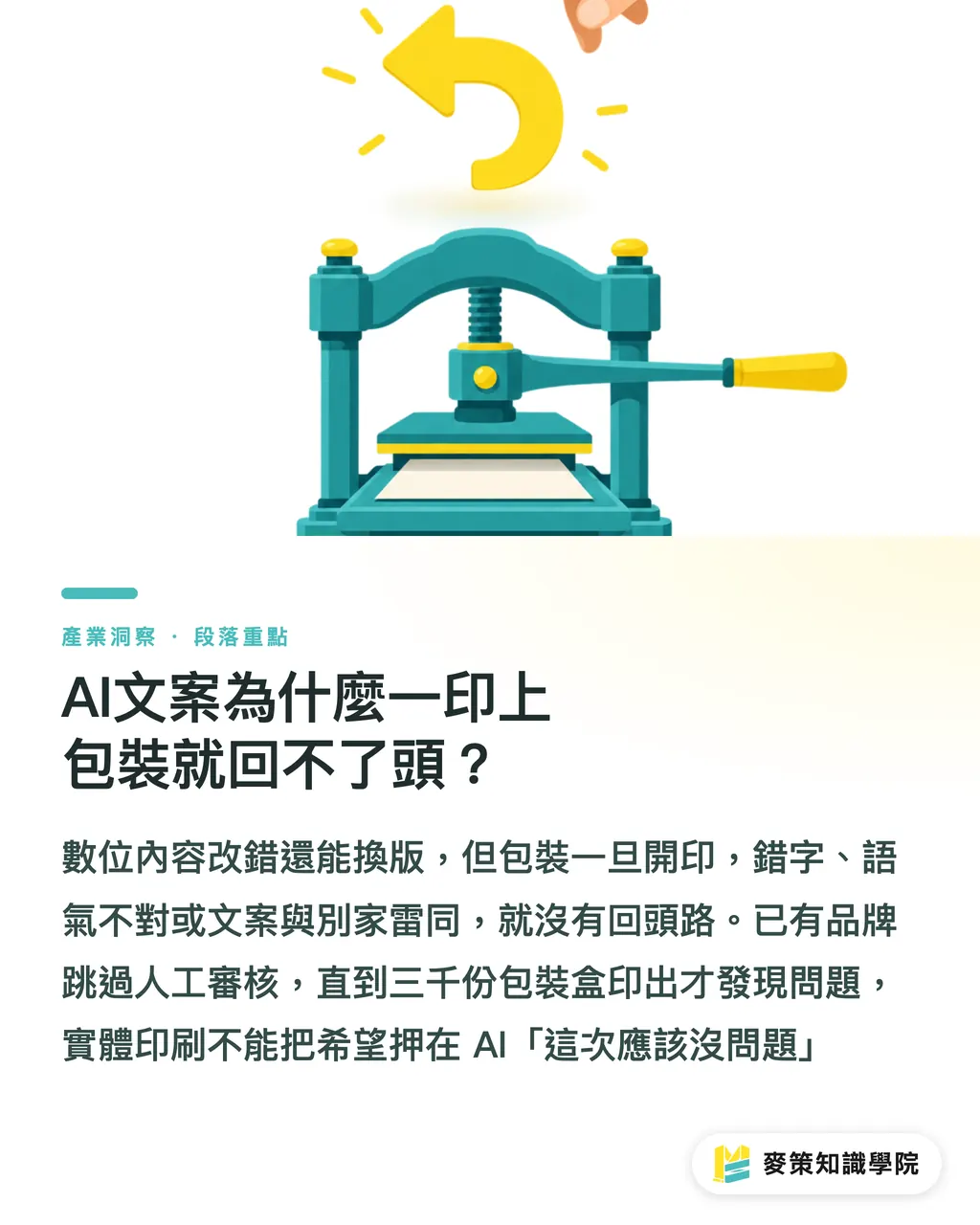
Why is there no going back once AI-generated copy is printed on packaging?
Digital content can be replaced immediately when something goes wrong. Packaging and catalogues are another matter once they have been printed. Once the job is on press, a typo, an off-brand tone, or even a whole passage that sounds suspiciously familiar can only be written off as a loss
Among the projects I've worked on over the past six months, I've seen more than one brand send an AI-generated first draft straight to the printer, with no human copy review in between. The problem is not that AI writes badly. It is that nobody checks whether the wording sounds too much like another brand's. By the time 3,000 boxes have been printed, it is already too late
The physical limits of print are simple: the paper has already been cut, the plates are already on press, and the ink has already dried. There is no undo button. That is a completely different logic from digital advertising A/B tests, where variants can be swapped at any time. If procurement and print buying do not build that difference into the workflow, they are effectively betting that AI got it right this time
Why does AI-generated copy so easily lose brand distinctiveness?
When language models generate copy for large numbers of similar situations, they tend to converge on familiar sentence patterns and combinations of words. The result reads like one template with only the product name swapped out
A study on Reddit about generative AI's impact on writing diversity points out that even using AI simply to polish existing text can pull an overall writing style toward greater uniformity. That effect is especially risky in brand copy because packaging and catalogues are supposed to make consumers recognize you at a glance, not sound polished in a way that could belong to anyone
I compared several client proposals myself and found that copy produced with the same set of prompts had opening lines and transition phrases that were almost interchangeable. You could swap in another brand name and use them as-is. The copy was not badly written. It simply had no brand personality at all. Printed on packaging, that means handing your distinctiveness over to the algorithm's default preferences
How should the procurement contact set guardrails in the job specifications?
Beyond word count and delivery date, the job specification should explicitly define a human review checkpoint for AI-generated copy and a benchmark for comparing brand voice. Those are the two things that determine whether the copy is fit for use
A price comparison is not enough. Compare these dimensions too:
・Tone consistency: Has the copy been checked against the brand's existing catalogues and website language, or is everyone working from their own playbook?
・Layout fit: Was a copy-length limit set in advance based on the layout, or is the team trying to force the finished copy into the design?
・Revision cost: If a sameness problem is found, do you revise the artwork or run a new proof? The cost difference is significant
・Review record: Can the supplier provide a copy-comparison report showing that the wording does not overlap with competitors' copy or the brand's own older drafts?
When requesting a quote, ask the supplier one plain question: Do you have a human review step that compares AI-generated copy with our brand voice, or do you send it straight to print after it is generated? If the answer is vague, you own the risk
What should you check at acceptance to keep generic copy off the press?
Acceptance is not about whether the copy reads smoothly. It is about whether the words feel different on your brand than they would on another brand
The acceptance checklist should include:
・Read it aloud at the proofing stage first: If it still works perfectly after you replace the brand name, the copy has no personality and should go back for revision
・Compare it with competitors' marketing materials from the past three months: Are the sentence patterns and selling-point angles highly repetitive?
・Check that the key selling points have not been diluted by AI's generic wording, such as replacing a specific description of the process with a vague adjective
・Ask the supplier to attach an explanation of where the copy came from. The AI-generated and human-rewritten portions should be distinguishable
These checks take little time, but they can catch most sameness problems before printing. That is far cheaper than reprinting afterward
How can Mai Strategy's three-checkpoint copy review be put into practice?
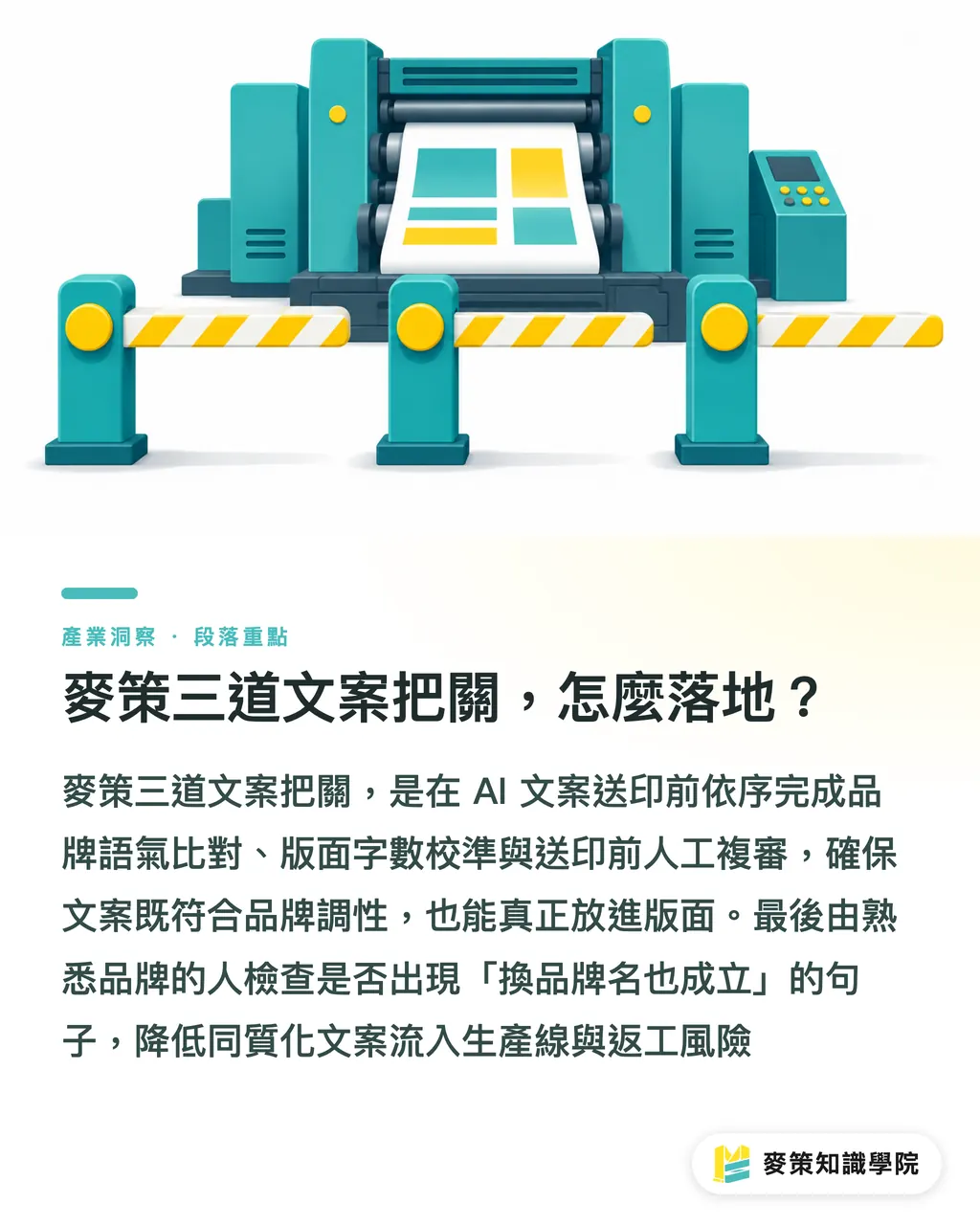
Mai Strategy's three-checkpoint copy review means putting AI-generated copy through three gates in sequence before it goes to print: brand-voice comparison, layout-length calibration, and a final human review before printing. Miss any one of them and generic copy can slip onto the production line
The process is specific:
1. Brand-voice comparison: Run the AI first draft against the brand's accumulated copy library, then have a human check whether the wording and sentence structure match the established voice
2. Layout-length calibration: Adjust the prompts based on the physical limits of the packaging format, rather than trying to cram the copy into the layout after it has been written
3. Final human review before printing: Have someone familiar with the brand make one final pass, looking in particular for sentences that still work if you swap in another brand name
If you want to build this review process into the actual print-buying specifications, talk with the Mai Strategy Knowledge Academy consulting team about how to write it into the procurement contract terms. For mid- to high-end, fully customized commercial print projects, MINDS can also help catch copy and layout mismatches during proofing and imposition, so you do not discover the problem too late and end up reworking the job
Key takeaways
・Physical print has no undo button. Brand review for AI-generated copy must happen before the files go to press, not after the job is finished
・Language models tend to converge on similar sentence patterns. Copy that still works after the brand name is swapped out is a warning sign of generic writing
・The job specification should spell out the human review checkpoint. Beyond price, compare brand-voice consistency and revision cost
・The read-aloud test is the most direct check at acceptance: Would the line still work if it appeared on another brand's packaging?
・Mai Strategy's three-checkpoint copy review breaks the key actions into voice comparison, layout calibration, and a final prepress review. All three are required
Further thoughts
For procurement contacts, the next step is concrete: add a human review checkpoint for AI-generated copy to the next print-job specification, and require suppliers to attach an explanation of their copy-comparison process to the quotation. For designers and printers, rather than waiting for a client to complain that the copy has no character, proactively offer brand-voice comparison as a value-added line item on the quote rather than treating it as an extra cost. For print companies adopting AI tools, this is also a reminder: AI can speed up production, but protecting distinctiveness and brand personality ultimately requires a human checkpoint
Further reading
FAQ
- Can AI-written copy be sent straight to the printer?
- Sending it straight to print is not recommended. Packaging and catalogues cannot be changed once they have been printed. The copy should first go through a brand-voice comparison and human final review to make sure it does not substantially overlap with competitors' copy or the brand's own earlier drafts
- What clauses should a company add to its print-buying specifications to prevent AI-generated copy from becoming generic?
- Specify a human review checkpoint for AI-generated copy and a benchmark for comparing brand voice. Require the supplier to attach an explanation of its copy-comparison process to the quotation, and use it as one of the acceptance criteria
- How can you tell when AI-generated copy has become too generic?
- The simplest test is to replace the brand name with another brand's name and read it aloud. If the passage still works without sounding out of place, it lacks brand personality and should be sent back for rewriting
- Why is the risk of AI-generated copy greater on packaging than on a website?
- Web copy can be edited or replaced whenever a problem is found. Once packaging and catalogues are printed, however, the finished goods are a sunk cost. Generic or off-brand copy then travels with the physical product into the market, making it hard to fix afterward
- What are the three checkpoints in Mai Strategy's copy review?
- They are brand-voice comparison, layout-length calibration, and a final human review before printing. All three are handled by people familiar with the brand's voice, rather than treating the AI first draft as the final copy
Related articles

The Print × AI weekly
The print and AI know-how designers, brands and enterprises can use before they commit — one email, every week
MINDS Free Tools
AI background removal, brand stamping, and a LINE sticker maker — free design tools, right in your browser, no upload.
MINDS Group
Need actual printing or gifting services?
From premium printing to online ordering and festive gifts — the MINDS Group sister brands take it from here.