
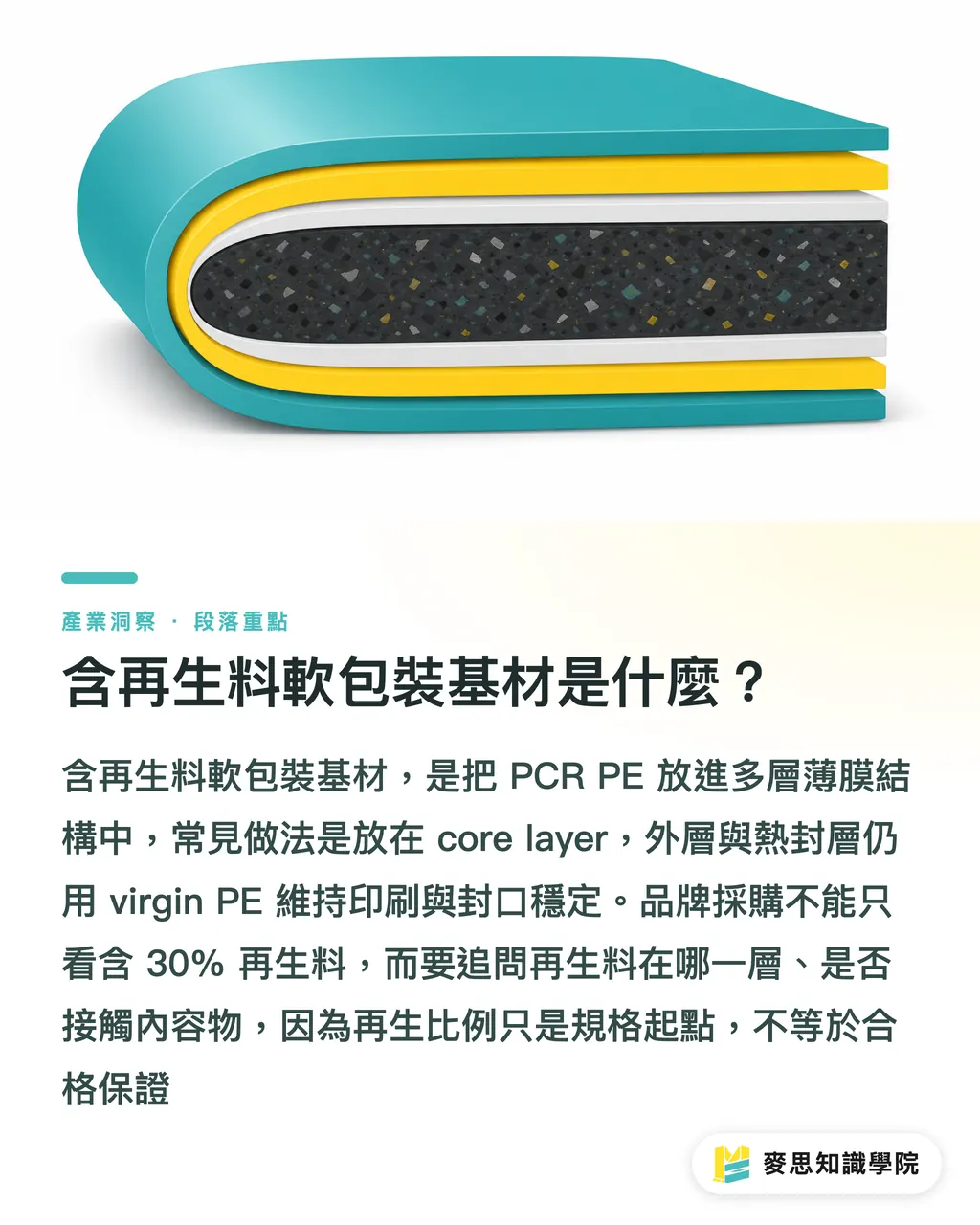
What Are Recycled-Content Flexible Packaging Substrates?
Recycled-content flexible packaging substrates incorporate PCR PE into the film structure. The typical approach puts recycled material in the core layer while keeping virgin PE on the outer and sealant layers to maintain stable printing and sealing surfaces
PCR PE (Post-Consumer Recycled Polyethylene) is PE packaging material that has been used, then cleaned, sorted, and re-pelletized back into film structures. Its quality is driven by source, contamination level, and reprocessing history
Hold on
The most common mistake I see brand buyers make is treating '30% recycled content' as a complete spec, without asking which layer the 30% sits in, whether it contacts the product, or whether the print surface is virgin PE
A 2026 Packaging Technology and Science study on additives and gels in recycled-content PE films divided commercial multilayer PE films into core layers containing 30% and 50% PCR PE - a setup that mirrors actual practice closely. Recycled percentage is a starting point, not a certificate of conformity
Why Do Gel Defects Only Show Up Downstream?
Gel defects tend to hide in clear film and only emerge when you lay down full-coverage printing, white ink, heat seals, or run high-speed filling - showing up as black specks, bumps, tears, or unstable seals
A gel is a small hard point in the film formed by incomplete fusion, crosslinking, oxidation, or a fragment of foreign material. It may look like a dust particle, but it disrupts ink adhesion, film stretch, and seal integrity
The study used FTIR (Fourier-transform infrared spectroscopy) to confirm that some spherical and fibrous contaminants traced back to polyamide or cellulose sources - which is actually useful for buyers: asking a supplier 'does it look OK?' means nothing. Ask them how they identify defect composition
For a concrete number: in 100% monolayer PCR PE experimental film, one MAH compatibilizer reduced gel count from 432 to 375 pcs/9 cm², and gel area ratio from 0.81% down to 0.67%
5 Metrics to Ask Suppliers Before You Buy
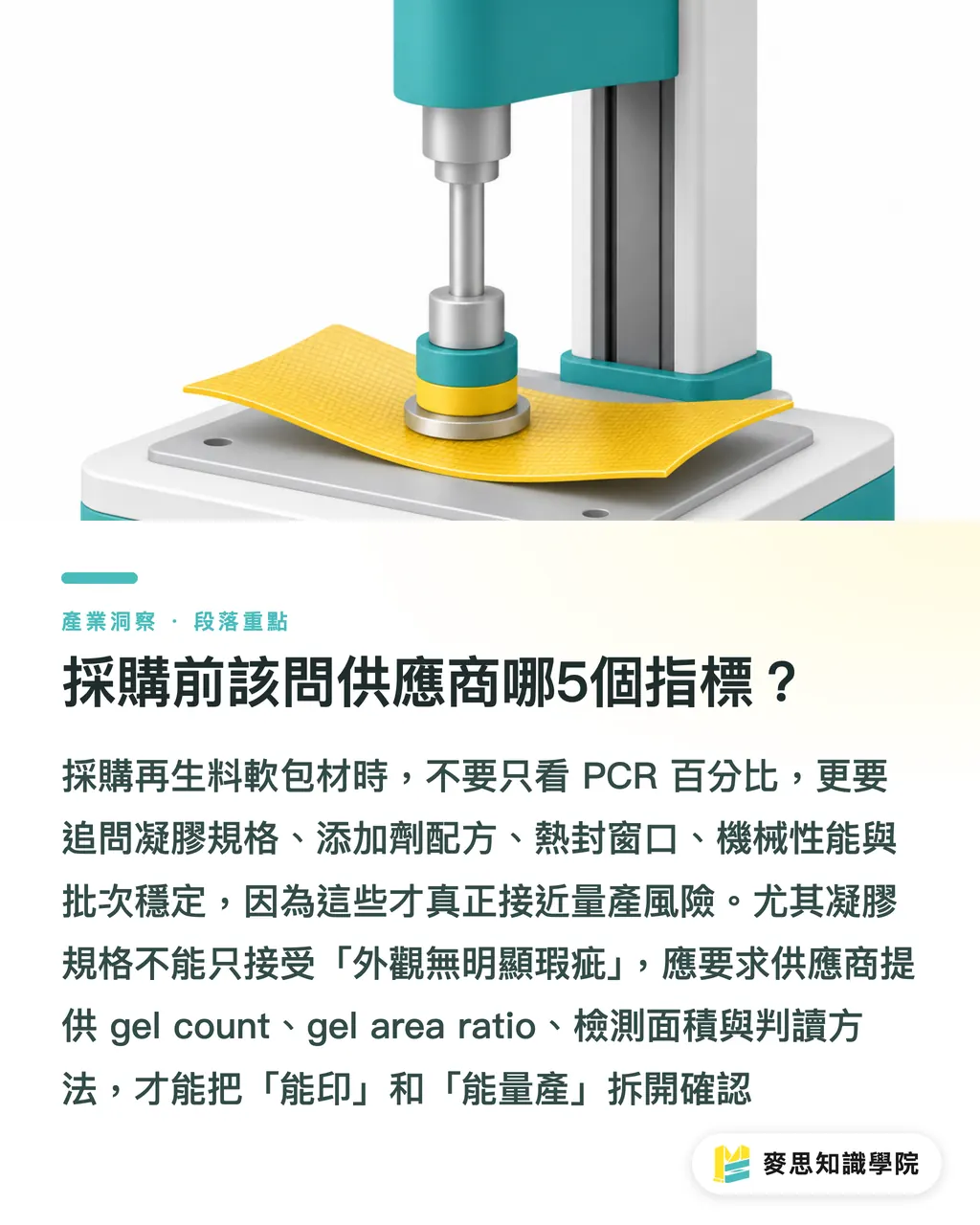
The 5 metrics worth asking about before purchase are: gel specs, additive formulation, heat-seal window, mechanical properties, and batch consistency. These five tell you far more about production risk than PCR percentage alone
・Gel specs: ask the supplier for gel count, gel area ratio, the test area, and how defects are identified. You need numbers that can be compared against a fixed area like 9 cm². 'No visible defects' is not an acceptable answer
・Additive formulation: confirm the logic behind antioxidant and compatibilizer use. In the study, antioxidants showed no clear reduction in gel presence, but additive combinations delayed hot-tack breakage. Don't treat antioxidants as a cure-all
・Compatibilizer type: MAH compatibilizer (maleic anhydride-based compatibilizer) works like an interfacial adhesive, helping PE from different sources - and small amounts of foreign material - stay bonded during melt processing. Ask your supplier for the brand, the intended function, and test results
・Heat-seal window: hot-tack is bond strength while the seal is still hot. Cold-tack is strength after cooling. The study noted that samples with compatibilizer showed stronger cold-tack attachment at a sealing temperature of 100°C
・Batch consistency: request a COA (Certificate of Analysis) for every batch. The commercial nonfood contact films in the study showed significant quality variation between PCR PE batches, with hot seal strength and cold seal strength varying accordingly
If you're putting recycled-content flexible packaging into commercial use for the first time, MINDS Printing can help with proofing and cross-referencing supplier documents - separating 'printable' from 'production-ready'
How Brands Turn ESG Targets into Verifiable Specs
To turn ESG targets into verifiable specs, put recycled percentage, film layer structure, defect acceptance limits, heat-seal conditions, and end-use restrictions into a single procurement document - not just sustainability language in an RFQ
My recommendation is to use MINDS Printing's (MS, mid-to-high-end fully custom commercial printing) three-stage procurement approach. It's straightforward, but it works on the floor
・Document stage: clarify whether the PCR PE is post-consumer or post-industrial, which layer it occupies, and whether the stated 30% or 50% is calculated against the full film or a single layer
・Proof stage: test white ink, fine type, full-coverage color, and post-process friction using the actual design files. Gel spots are barely noticeable on blank film - put a deep-color ink layer over them and they become obvious
・Filling stage: look at hot-tack, cold-tack, seal temperature, line speed, and product weight together. Clean results at 100°C don't mean your filling line's temperature and pressure settings will work
Food packaging also requires a separate food contact compliance check - data from nonfood contact films cannot be used as clearance for food packaging. If your procurement documents need to feed into ESG disclosures and supplier questionnaires, the Mai Strategy Knowledge Academy consulting team can help you frame the questions in language suppliers can actually answer
How Small and Mid-Size Print Shops Handle Recycled-Content Jobs
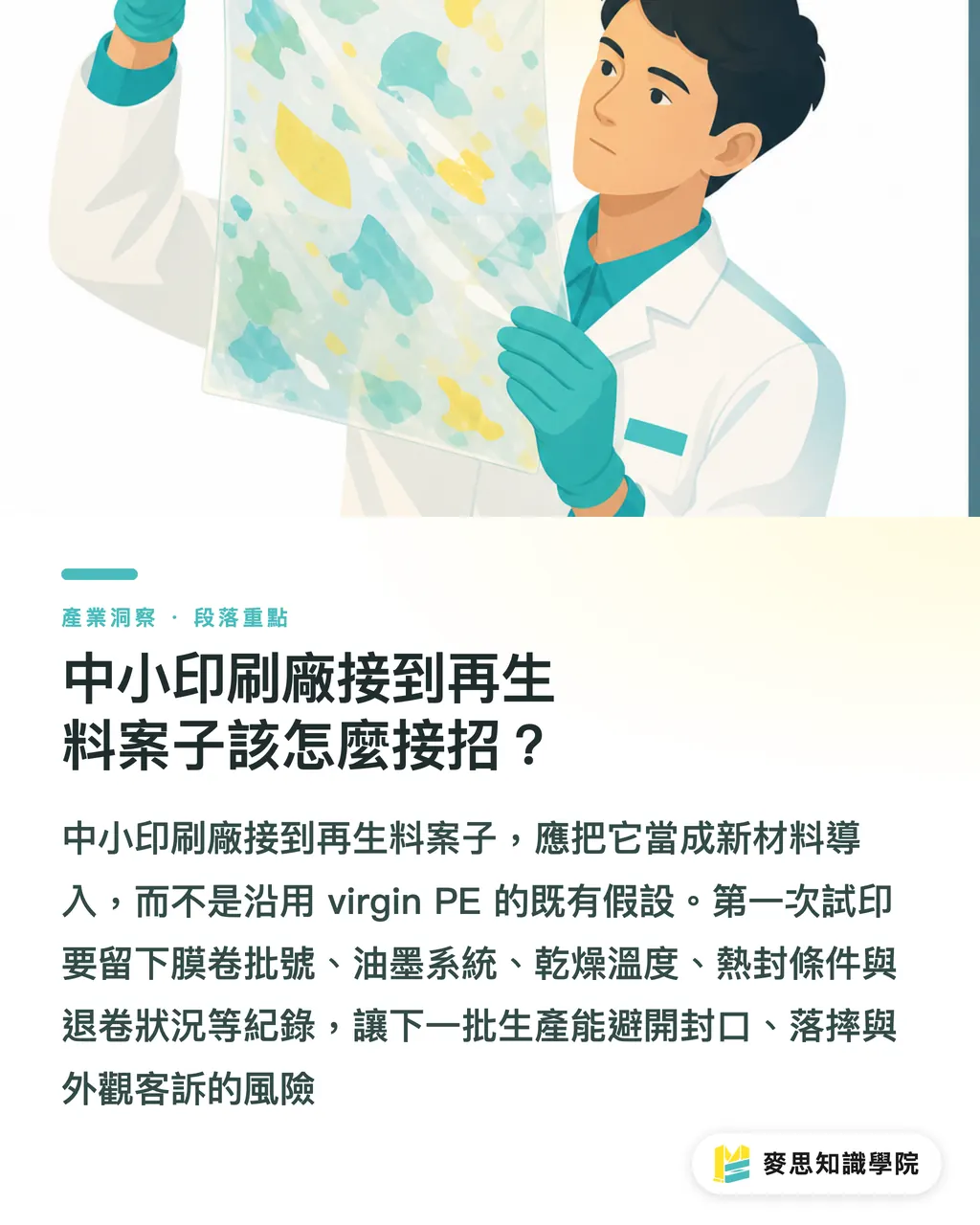
When a recycled-content job lands at a small or mid-size print shop, treat it as a new material qualification - don't carry over the ink, tension, drying, and heat-seal assumptions you use for virgin PE
The phrase I dread most on the floor: 'The client said it's just an eco-friendly film, everything else stays the same.'
It almost never stays the same. Multilayer film with 30% or 50% PCR PE can still have batch variation - surface flatness, seal strength, and roll tension response may all shift
Log the first proof run: roll lot number, ink system, drying temperature, registration offset, white ink coverage, gel spot locations, heat-seal conditions, and unwind behavior
These records don't need to read like a research paper - they just need to make sense to the next operator
That's enough
For designers, recycled-content flexible packaging is not the place to start with ultra-fine rules, large dark gradients, and high-contrast reversed text. For buyers, low-cost samples should never skip small-run trial filling - the real failures almost always show up at the seal, in drop tests, and in appearance complaints after the product hits the shelf
Key Takeaways
・Recycled percentage is not a quality spec. Which layer the PCR PE sits in is what actually affects printing and sealing
・Gel defects are not just a cosmetic issue - they affect appearance, film stretch, and seal stability
・For antioxidants and compatibilizers, look at the test results, not just the supplier's claim that they've been added
・Hot-tack, cold-tack, and batch COA are the documents you should be asking for before sourcing recycled-content flexible packaging
・ESG procurement has to translate into proof conditions and filling conditions, or sustainability becomes a rework problem on the production line
Further Thinking
On the manufacturing side, start incorporating gel count, heat-seal conditions, and batch COA into incoming material records. On the design side, avoid high-risk layouts that amplify gel defects from the first draft. For AI integration, start with structured data from supplier documents, proof records, and customer complaint photos. For SaaS teams serving packaging procurement, the most valuable fields aren't polished ESG scores - they're the ones that trace back to roll lot number, PCR layer, hot-tack window, and actual customer filling conditions
Further Reading
FAQ
- What should I ask first when sourcing recycled-content flexible packaging substrates?
- Start by asking which layer the PCR PE percentage applies to, whether the supplier can provide gel count and gel area ratio data, and whether they offer a COA for every batch. These answers tell you more about production risk than any ESG copy
- Why do PCR PE films develop gels?
- Gels in PCR PE films can come from incomplete fusion, oxidative crosslinking, or polyamide and cellulose-type contaminants. They make print appearance, film stretch, and seal integrity unpredictable
- Can antioxidants solve the gel problem in recycled-content films?
- Antioxidants can slow thermal-oxidative degradation during processing, but they don't necessarily reduce gel count in any meaningful way. Buyers should also look at compatibilizer use and actual gel test results
- Why do hot-tack and cold-tack both matter?
- Hot-tack determines whether the seal can hold product weight while still warm. Cold-tack is the seal strength after cooling. If both vary significantly in recycled-content flexible packaging, you'll get leakers in high-speed filling
- Can small and mid-size print shops just apply virgin PE parameters to PCR PE film?
- Not recommended. PCR PE films can have batch-to-batch variation, so print shops should re-establish their own records for ink, tension, drying, heat sealing, and visual defect acceptance
Related articles
The Print × AI weekly
The print and AI know-how designers, brands and enterprises can use before they commit — one email, every week
MINDS Free Tools
AI background removal, a LINE sticker maker, spine & imposition calculators — all free, right in your browser, no upload.
MINDS Group
Need actual printing or gifting services?
From premium printing to online ordering and festive gifts — the MINDS Group sister brands take it from here.