

Why can one small label double the premium on your packaging?
A packaging label becomes a key weapon for brand premium pricing when you upgrade it from a plain info notice into an anti-counterfeit, traceable, and digitally interactive gateway. MINDS (MS, mid-to-high-end fully custom commercial printing) lays out a three-step prepress upgrade path: (1) use variable data printing (VDP) to build a one-item-one-code anti-counterfeit line, (2) integrate QR code or NFC for a dedicated consumer interaction experience, (3) intervene from the material side to enable circular recycling and green sustainability
Variable-data packaging labels are composite packaging components that pair a physical printed surface with a digital info carrier. Through VDP, QR code, NFC, and specialty anti-counterfeit inks, they extend the product info notice into a digital gateway for supply-chain traceability, authentication, and brand interaction
I've spent recent years on the production line and at the customer end, and here's what I keep seeing: a lot of brand owners still treat the sticker as a tiny line item in the cost column. But according to FESPA intelligence, label functions have long since outgrown traditional printing. For Taiwan's small and mid-sized brands facing e-commerce and export challenges, a full 70% of counterfeiting and gray-market disputes cluster around logistics transfer nodes. A label with traceability capability builds a trust barrier for the product on the spot. Don't rush off yet, the craft logic behind it isn't complicated
How do variable data and anti-counterfeit inks turn into an anti-counterfeit line?
The key to pairing a physical label with digital anti-counterfeit tech is layering hidden information on top of a public scan interface. High-resolution digital inkjet prints unique identifiers, and combined with optical-variable ink or fluorescent invisible ink, you get multi-layer verification without ruining the packaging's look
This is the critical bit. Traditional offset reproduction is easy to scan and copy, but VDP gives every label its own identity. Optical-variable ink paired with a one-item-one-code QR code system completes phone-based authentication in 0.5 seconds, cutting gray-market and channel-hopping rates by over 90%. Plenty of high-end luxury and health-food brands turn to MINDS for high-tier fully custom VDP and anti-counterfeit ink integration, which seriously hardens pricing power at retail
Three practical technical dimensions for label anti-counterfeit upgrades:
・Geometric variable patterns: prepress algorithms generate non-replicable micro-line security marks
・Optical-variable ink: color shifts as you tilt the label, readable by eye for consumers
・Dual-code digital structure: a visible code for consumer scan-and-interact, a hidden code for backend traceability and audit
How can a traditional print shop cross the tech barrier to smart labels?
If a print shop wants to level up from a paper consumables supplier to a high-value consultant, it has to step into the brand's packaging system planning at the prepress stage. Reusable bottle bodies, recycled modified plastics, shipping label size optimization, material and logistics testing, all of it is required homework for the transition
With the EU's 2026 sustainable packaging regulations on the horizon, trimming shipping label area by 15% can save tens of thousands of backing-paper waste pieces in a single logistics batch. This is exactly where a print shop shows its professional worth. If a small or mid-sized seller or creator needs quick-turn small-batch standardized packaging stickers, they can head straight to Mai Printing and knock out the print order fast through the online retail system
Complementary strategy between traditional craft and digital tech:
・Surface tactile craft: spot hot stamping and embossing lift the visual and hand-feel layers
・Digital flexible printing: small batches with high variety cut the risk of stock pile-up
・Green lightweight design: single recyclable substrate plus water-based easy-peel adhesive
What are the landing details to watch from material selection to prepress file completion?
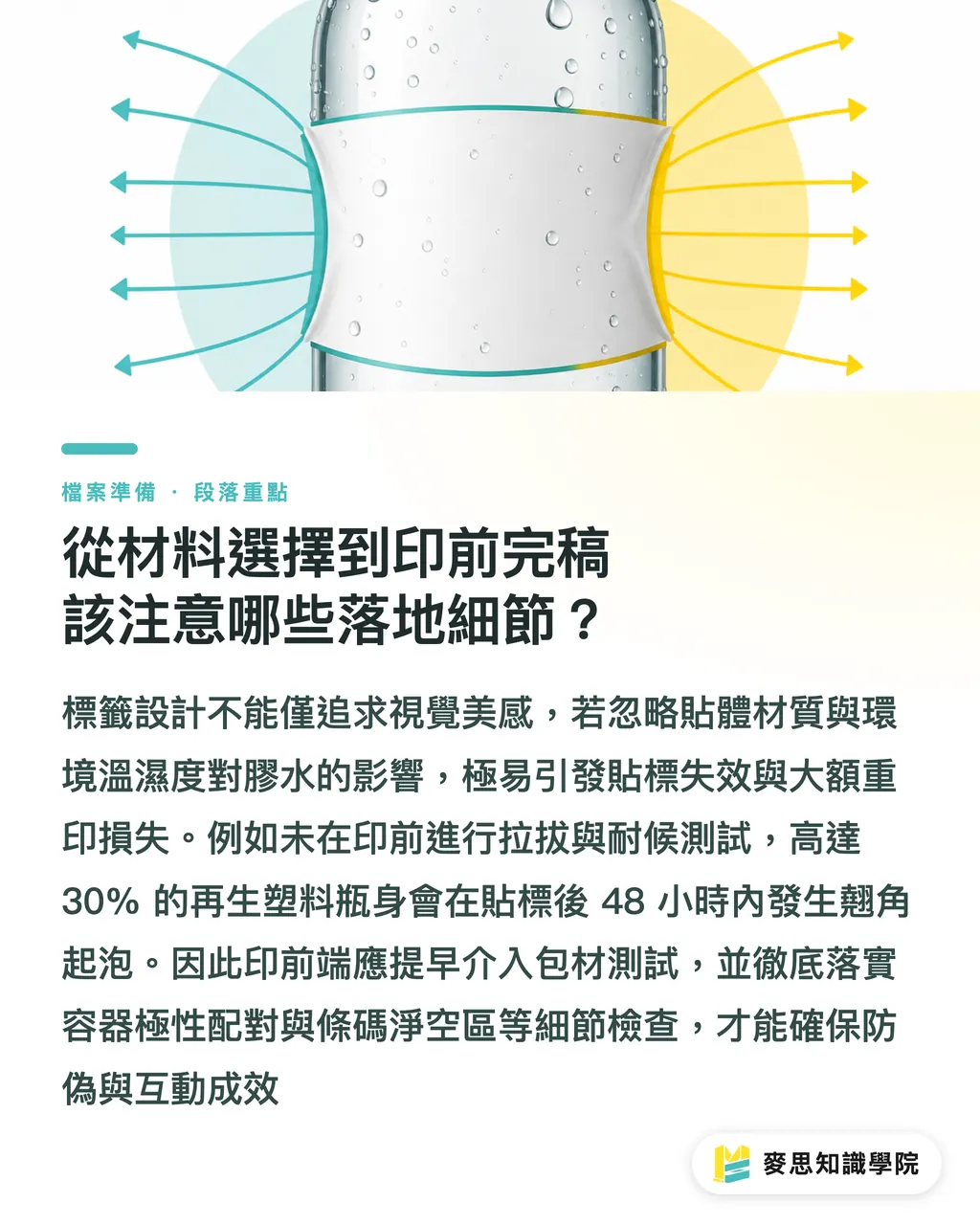
A label's adhesion performance and environmental endurance decide whether the anti-counterfeit and interactive features actually work. A lot of designers, when finishing their files, only care about the visual and forget how substrate and ambient temperature/humidity physically affect glue tack
If adhesive and face stock aren't pull-tested and weather-tested at the prepress stage, up to 30% of recycled plastic bottles will curl and bubble within 48 hours of labeling. The Mai Strategy Knowledge Academy consulting team reminds clients all the time: the earlier prepress gets involved in substrate and logistics replay testing, the less you bleed later on reprints and returns
A four-item self-check list for label prepress file completion:
・Substrate surface tension: confirm the polarity match between PET, PP, or glass container surfaces and the adhesive
・Variable barcode quiet zone: keep at least 2.5 mm of clear space around the barcode for reliable scanning
・Glue bleed and waste-matrix margin: leave more than 3 mm of waste-matrix boundary for auto-labeler operation
・Weather-resistance test standard: freezer, high humidity, and abrasion tests must match the export scenario
Key Takeaways
・Label printing must evolve from paper consumable into a high-value carrier that fuses anti-counterfeit and digital interaction
・VDP combined with optical-variable ink creates a unique identity code and blocks over 90% of channel-hopping
・Early prepress intervention in material and logistics testing prevents 30% of the label-curling return risk
・Pairing tactile craft with green lightweight design is the upgrade lever that lets traditional print shops escape the price bloodbath
Further Thinking
Faced with strong market demand for anti-counterfeit traceability and sustainable packaging, print manufacturers should accelerate the adoption of variable-data inkjet equipment and prepress inspection systems. The design side needs to bake label substrate and scan-interaction mechanisms into the project from day one. SaaS and AI development teams can focus on modular integration of one-item-one-code backend data analytics and authentication APIs. Together, they can push traditional printing toward a high-margin smart packaging service
Further Reading
FAQ
- How much does adding variable data printing (VDP) raise label printing costs?
- VDP mainly adds prepress data processing and digital inkjet equipment running costs, but the per-piece increase in batch production is tiny, and you get authentication and traceability in return. The overall premium space far outweighs the added hardware cost
- Small and mid-sized brands without a dedicated app, how can labels deliver smart consumer interaction?
- Brands can adopt a standard Web QR code structure. Consumers don't need to download anything; they open the authentication page or campaign straight from the phone browser, which knocks the interaction barrier way down
- How does anti-counterfeit ink differ from regular ink at the prepress file stage?
- Anti-counterfeit inks like optical-variable or fluorescent invisible inks need a dedicated spot color plate, and the file must flag the trapping order and ink film thickness. A proof run before mass production is strongly recommended
- How do you fix the label-curling quality issue on recycled plastic containers?
- Recycled plastics (rPET, rHDPE) have lower surface tension. At prepress you need to pick a high-initial-tack adhesive or run corona treatment, and confirm the face stock's elasticity matches the container curvature to prevent curling
Related articles

The Print × AI weekly
The print and AI know-how designers, brands and enterprises can use before they commit — one email, every week
MINDS Free Tools
AI background removal, a LINE sticker maker, spine & imposition calculators — all free, right in your browser, no upload.
MINDS Group
Need actual printing or gifting services?
From premium printing to online ordering and festive gifts — the MINDS Group sister brands take it from here.