
Why Look at Awards and Plant Expansion Together?
Because the industry report from September 21, 2026 placed two kinds of investment side by side in the same week: Mondi's Recyklobox wins an award, while eCorrugated invests in a plant-wide waste system and expands capacity
Paper-based packaging refers to packaging where paper or paperboard forms the primary structure, completed through printing, die-cutting, box-gluing, and similar processes. Whether it can be recycled still depends on coatings, composite materials, and local recycling infrastructure. A circular economy is a model of production and consumption that keeps materials in use after their initial life through recycling, reuse, or remanufacturing, extending material lifespans and reducing waste
Based on my long experience working across production lines and on the client side, I read these two events as the same signal: Mondi built the recycling process into the product design; eCorrugated built waste management into its plant investment. The first touches how consumers return packaging; the second touches how production lines cut waste. Brands need to look at both packaging experience and supply cost together, not just the award
What Recycling Problem Does Recyklobox Solve?
Recyklobox addresses collection efficiency under a bottle deposit system. Mondi developed it with Polish retailer Biedronka to work with Poland's new bottle deposit system, making the collection process simpler and faster. It won the Eco Packaging category at ART OF PACKAGING (a Polish packaging award), and the launch was preceded by extensive testing and close collaboration
This case sends brands a very practical reminder: 'recyclable' means more than the paper material itself, the whole chain of use, collection, and sorting has to work. A package can look spotless on the shelf, but if consumers don't know how to return it, the design is only half done. Mondi and Biedronka ran testing before the official launch; brands developing new packaging should build the recycling scenario into prototyping and communications, not bolt on instructions after mass production starts
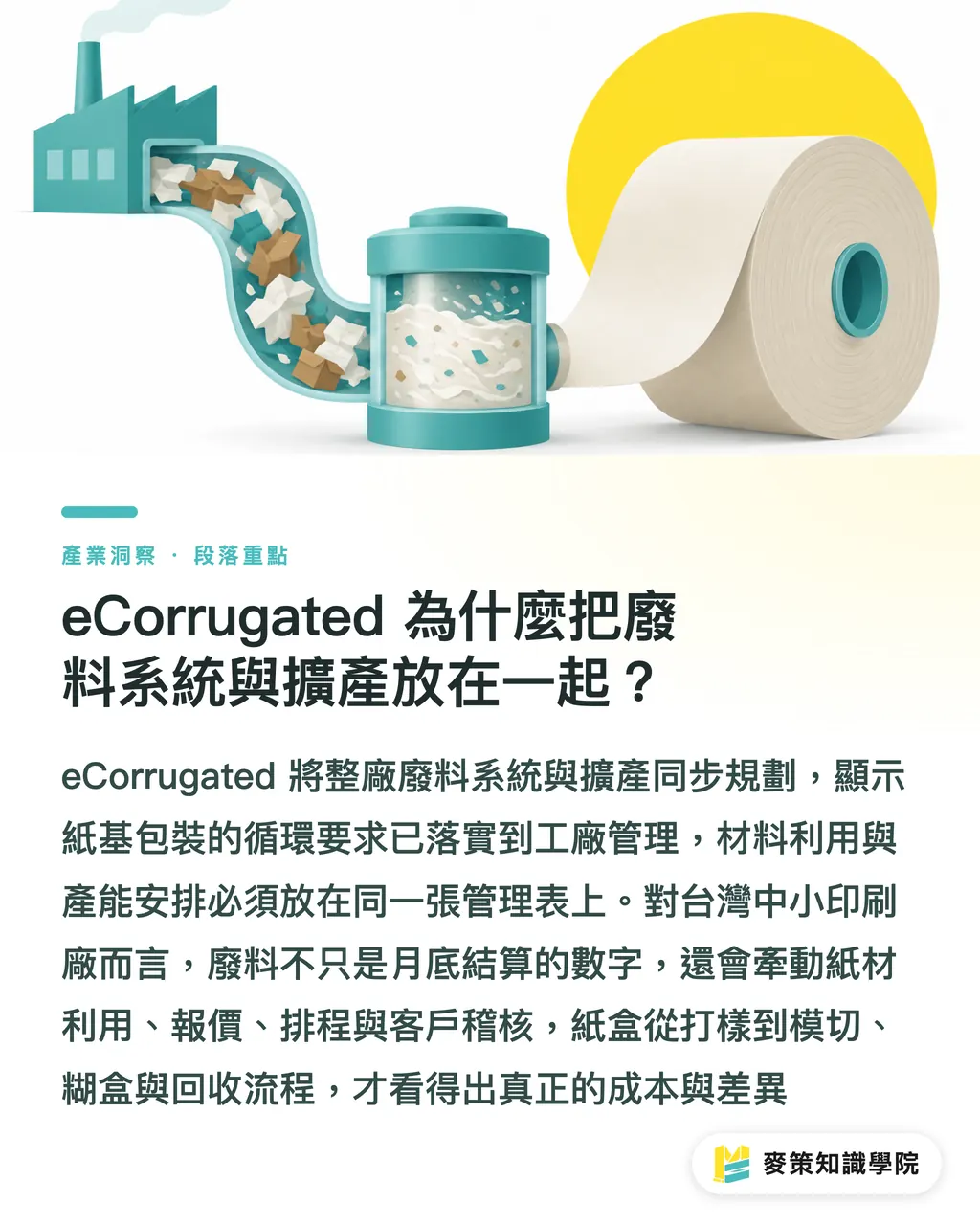
Why Did eCorrugated Combine Waste Systems and Capacity Expansion?
eCorrugated's move shows that circular requirements for paper-based packaging have reached the factory floor: the same week it invested in a plant-wide waste system and expanded capacity. The report doesn't list specific equipment, and there's no need to fill in machine names. Putting a waste system inside an expansion plan is enough to see that material utilization and capacity planning are now on the same management sheet
For small and mid-sized print shops in Taiwan, waste shouldn't only appear at month-end accounting. It flows through material utilization, quoting, scheduling, and the data clients audit. Brand buyers who only ask about paper price tend to miss the difference between the same packaging at the prototyping stage, in mass production, and at the recycling end. A carton looks great on a desk. Die-cutting, box-gluing, and the recycling stream are where it gets real
How Should Brands Evaluate Paper-Based Packaging Over the Next Three Years?
Brands should break the next three years into three gates, recycling path, mass-production validation, and supplier evidence, before deciding whether paper-based packaging belongs in their core lineup. I'd sequence the Mai Strategy three-gate checklist as follows:
・1. Verify the recycling path first: confirm which recycling or deposit system the packaging needs to work with, and write the consumer return action into the design brief. Recyklobox was developed specifically around Poland's new deposit system
・2. Validate mass-production conditions next: prototype with paper materials, printing, die-cutting, box-gluing, and logistics together, and confirm that the sustainability claim holds up under real-world use and process conditions
・3. Complete supplier evidence last: request material composition, test records, waste handling, and implementation timelines so ESG communications have documentation to back them up
Brand teams that lack a shared language for materials and print processes can work with the Mai Strategy Knowledge Academy consulting team on a pre-production audit, translating recycling requirements into specs, then comparing suppliers against those specs. The decisions get a lot cleaner
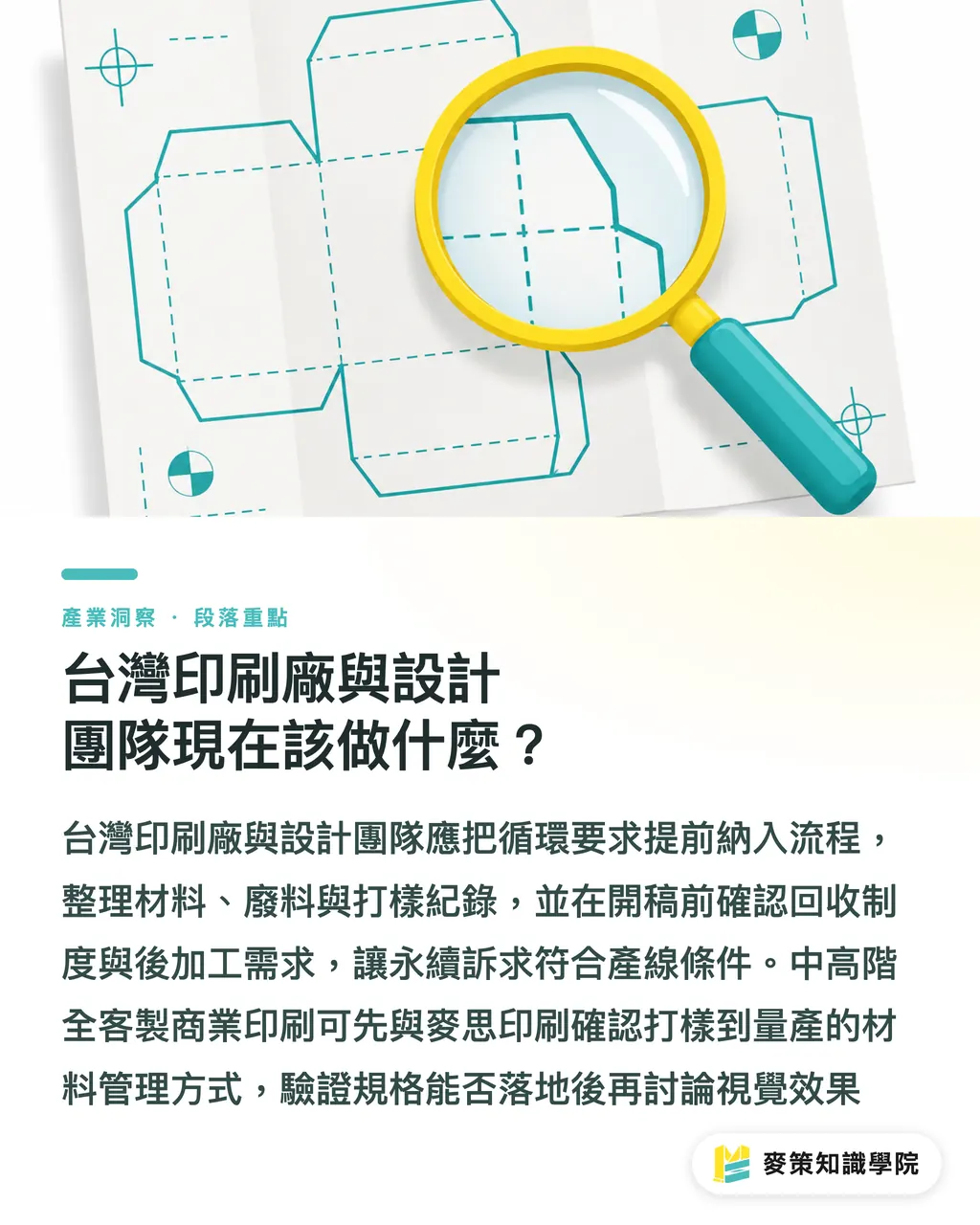
What Should Taiwan Print Shops and Design Teams Do Now?
Small and mid-sized print shops in Taiwan should start by organizing waste, materials, and prototyping records into evidence that clients can actually read. Design teams need to confirm the recycling scenario before opening any file. Mondi and Biedronka ran extensive testing before launch; eCorrugated folded waste systems into its expansion the same week. Both examples show that circular requirements need to enter the workflow early
・Print shops should pull quoting upstream from per-sheet paper price, explaining how materials and waste are managed from prototype to mass production, that gives clients something to compare
・Designers should ask about recycling infrastructure and finishing requirements before committing to coatings, composites, and adhesives, so the sustainability claim on paper matches what the production line can actually do
・SaaS and AI teams should keep specs, tests, and supplier documents in a single traceable workflow. AI handles organization and flags gaps; material judgment stays with people who know the production line
When these requirements need to reach mid-to-high-end, fully custom commercial printing, brands can discuss prototyping and mass-production conditions with MINDS, start with whether the specs can work on the production line, then talk about visual results
Key Takeaways
・Award-winning solutions are about recycling experience; plant investments are about process efficiency. Together they form the full circular signal for paper-based packaging
・Recyklobox built the recycling process into development, a reminder that 'recyclable' shouldn't stop at packaging copy
・Brands planning for three years should validate the recycling path first, then mass-production and supplier evidence
・Taiwan print shops need to turn waste and prototyping records into procurement data that clients can actually use
Further Thinking
I'd suggest brands pick one existing product and audit the paper materials, coatings, recycling path, and waste records to build a spec sheet shared across procurement, design, and the print shop. Print shops connect the specs to prototyping and quoting; SaaS teams keep versions and test results in a single record. AI handles organization and flags what's missing. Material judgment stays with people who know the production line
Further Reading
FAQ
- Why did Mondi's Recyklobox win the award?
- Mondi developed Recyklobox with Polish retailer Biedronka to work with Poland's new bottle deposit system. The goal was to make the collection process simpler and faster, which is why it won the Eco Packaging category at ART OF PACKAGING
- What does eCorrugated's capacity expansion have to do with the circular economy?
- eCorrugated invested in a plant-wide waste system and expanded capacity in the same week, showing that circular requirements for paper-based packaging extend to factory waste management and process efficiency, not just packaging appearance
- What should brands check before adopting paper-based packaging?
- First, verify the recycling or deposit system the packaging needs to align with. Then confirm that the paper materials, printing, and finishing can hold up through stable mass production. Finally, ask suppliers for material composition, test records, and waste handling evidence
- Can AI or SaaS determine whether packaging is recyclable?
- AI and SaaS can organize specs, tests, and supplier documents, flag gaps, and maintain version records. But whether something is actually recyclable still requires professional judgment on materials, processes, and local recycling infrastructure
Related articles
The Print × AI weekly
The print and AI know-how designers, brands and enterprises can use before they commit — one email, every week
MINDS Free Tools
AI background removal, a LINE sticker maker, spine & imposition calculators — all free, right in your browser, no upload.
MINDS Group
Need actual printing or gifting services?
From premium printing to online ordering and festive gifts — the MINDS Group sister brands take it from here.